Introduction
Customs Brokerage Software helps customs brokers, freight forwarders, importers, exporters, logistics companies, and trade compliance teams manage customs declarations, import/export documentation, duty calculations, tariff classification, regulatory filings, broker workflows, and shipment clearance processes. In simple words, it helps companies move goods across borders while reducing manual paperwork, compliance errors, shipment delays, and customs filing risks.
International trade can be complex because every shipment may involve product classification, country of origin, valuation, duties, taxes, licenses, restricted goods checks, denied party screening, government agency requirements, and customs documentation. If customs paperwork is wrong or incomplete, shipments can be delayed, fined, inspected, or rejected.
Customs Brokerage Software is used for import declarations, export filings, customs entry preparation, duty and tax calculation, document management, tariff classification support, trade compliance checks, broker collaboration, shipment status tracking, customs audit trails, and integration with freight forwarding or transportation systems.
Buyers should evaluate:
- Customs entry preparation and filing support
- Import and export documentation workflows
- Tariff classification and duty calculation capability
- Country and region coverage
- Integration with freight forwarding, TMS, ERP, WMS, and accounting systems
- Trade compliance and denied party screening support
- Document management and audit trails
- Broker-client collaboration features
- Exception handling and shipment status visibility
- Automation for repetitive customs tasks
- Security, role-based access, and compliance controls
- Vendor support and regional customs expertise
Best for: Customs brokers, freight forwarders, importers, exporters, logistics companies, 3PLs, manufacturers, retailers, distributors, global trade teams, and companies that handle regular cross-border shipments.
Not ideal for: Very small businesses with rare international shipments, simple courier-based imports, or companies that fully outsource customs work to a broker and do not need internal visibility. In those cases, a broker portal, basic document checklist, or freight forwarder system may be enough.
Key Customs Brokerage Software Trends
- Customs workflows are becoming more digital. Manual forms, email attachments, and spreadsheet-based filing processes are being replaced by structured digital workflows.
- Trade compliance automation is becoming essential. Companies want software that helps reduce errors in classification, valuation, origin rules, restricted party checks, and customs documentation.
- Integration with freight forwarding systems is growing. Customs clearance works better when shipment, carrier, document, and customs entry data are connected.
- Real-time shipment visibility is becoming important. Importers and exporters want to know whether a shipment is pending documents, submitted, cleared, held, inspected, or released.
- Tariff and duty complexity is increasing. Teams need better tools to manage product classification, duty rates, special programs, taxes, and changing trade rules.
- Broker-client collaboration is improving. Modern platforms allow clients to upload documents, review status, approve entries, and communicate with brokers in one place.
- Audit readiness is a major requirement. Customs records must be accurate, searchable, and retained properly for future audits and compliance reviews.
- Global trade platforms are expanding beyond brokerage. Many tools now combine customs, trade compliance, screening, logistics visibility, and document management.
- AI-assisted document extraction is gaining attention. Software can increasingly extract data from invoices, packing lists, bills of lading, and certificates to reduce manual entry.
- Security is becoming more important. Customs systems store supplier data, customer details, shipment values, product information, financial data, and regulatory documents.
How We Selected These Tools
The tools below were selected using practical customs brokerage, global trade, compliance, and logistics technology criteria.
- Recognition in customs brokerage, global trade management, freight forwarding, or trade compliance workflows
- Ability to support customs entry preparation, documentation, filing, and clearance visibility
- Fit for customs brokers, freight forwarders, importers, exporters, and logistics providers
- Support for import/export processes, duty calculations, classification, or compliance workflows
- Integration potential with TMS, ERP, WMS, freight forwarding systems, accounting tools, and document platforms
- Scalability across regions, shipment volumes, clients, customs programs, and business units
- Usability for brokers, trade compliance teams, operations users, and customers
- Reporting, audit trail, document management, and exception handling capability
- Security, permissions, and governance readiness
- Vendor support, product maturity, implementation ecosystem, and trade compliance expertise
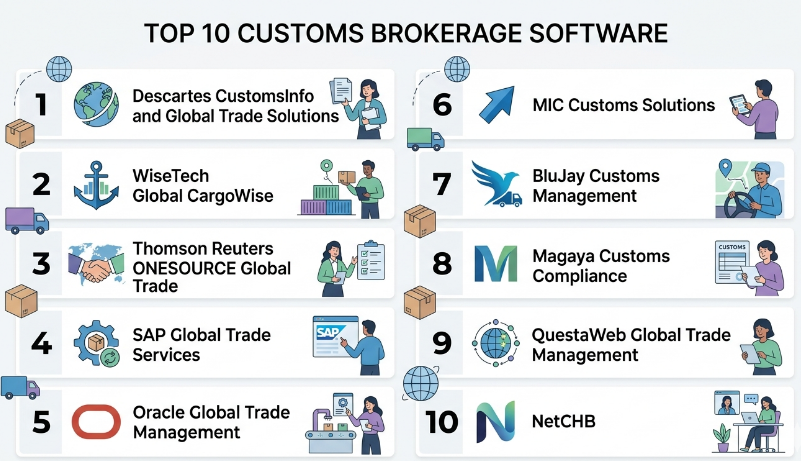
Top 10 Customs Brokerage Software
#1 — Descartes CustomsInfo and Global Trade Solutions
Short description :
Descartes provides customs, trade compliance, logistics, and global trade management solutions used by brokers, importers, exporters, and logistics teams. Its customs-related tools help organizations manage trade data, customs documentation, classification, denied party screening, and compliance workflows. The platform is useful for companies that need customs processes connected with transportation, logistics visibility, and global trade operations. Descartes is especially relevant for businesses handling cross-border shipments across multiple regions. It is a strong choice for companies that want customs brokerage and trade compliance capabilities within a broader logistics technology ecosystem.
Key Features
- Customs and global trade workflow support
- Trade compliance and screening capabilities
- Product classification and trade data support
- Import/export documentation workflows
- Logistics and customs visibility
- Reporting and audit support
- Integration with transportation and supply chain systems
Pros
- Strong global trade and logistics ecosystem
- Useful for importers, exporters, brokers, and logistics providers
- Good fit when customs workflows need to connect with broader supply chain visibility
Cons
- Product scope may vary by module and region
- Implementation can require trade process alignment
- Smaller businesses may not need the full ecosystem
Platforms / Deployment
Web / Enterprise environment.
Cloud deployment is commonly expected.
Hybrid: Varies / N/A.
Security & Compliance
Enterprise controls may be available depending on deployment.
SSO/SAML, MFA, encryption, audit logs, RBAC: Not publicly stated in detail.
SOC 2, ISO 27001, GDPR, HIPAA: Not publicly stated.
Integrations & Ecosystem
Descartes fits into logistics and trade environments where customs data must connect with transportation, compliance, shipment visibility, and enterprise systems.
- TMS and logistics systems
- ERP and finance platforms
- Trade compliance databases
- Carrier and freight forwarding workflows
- Document management systems
- Reporting and analytics tools
Support & Community
Support is vendor-led with documentation, implementation assistance, customer support, and trade compliance expertise. Community strength is strong in logistics, transportation, customs, and global trade operations.
#2 — WiseTech Global CargoWise
Short description :
CargoWise is a logistics execution platform widely used by freight forwarders, customs brokers, 3PLs, and global logistics providers. It supports freight forwarding, customs brokerage, accounting, documentation, shipment tracking, and operational workflows. For customs brokerage teams, CargoWise helps manage declarations, shipment data, client files, documents, and customs-related processes within one logistics platform. It is especially useful for companies that want freight forwarding and customs brokerage operations connected in the same system. CargoWise is a strong choice for logistics providers handling high shipment volumes and multi-country operations.
Key Features
- Customs brokerage workflow support
- Freight forwarding and logistics execution
- Shipment documentation management
- Client and job file management
- Accounting and billing support
- Customs declaration support by region
- Operational reporting and visibility
Pros
- Strong fit for freight forwarders and customs brokers
- Connects customs work with shipment operations
- Suitable for multi-office logistics providers
Cons
- Can be complex for small teams
- Requires training and process discipline
- Customs coverage and workflows vary by country and configuration
Platforms / Deployment
Web / Enterprise logistics environment.
Cloud deployment is commonly expected.
Desktop or local components: Varies / N/A.
Security & Compliance
Enterprise controls may be available depending on configuration.
SSO/SAML, MFA, encryption, audit logs, RBAC: Not publicly stated in detail.
SOC 2, ISO 27001, GDPR, HIPAA: Not publicly stated.
Integrations & Ecosystem
CargoWise fits into logistics environments where customs brokerage, freight forwarding, accounting, and shipment execution must work together.
- Freight forwarding systems
- Carrier and shipment workflows
- Accounting and billing processes
- Document management
- Customer portals and reporting
- Customs filing workflows by region
Support & Community
Support includes vendor documentation, training resources, implementation partners, and customer support. Community strength is strong among freight forwarders, customs brokers, and logistics providers.
#3 — Thomson Reuters ONESOURCE Global Trade
Short description :
Thomson Reuters ONESOURCE Global Trade helps companies manage trade compliance, classification, denied party screening, import/export processes, duty management, and global trade documentation. It is useful for importers, exporters, manufacturers, retailers, and enterprise trade compliance teams. While it is broader than customs brokerage alone, it can support customs-related processes by helping companies manage the data and controls needed for accurate customs filings. ONESOURCE is especially valuable for organizations that need strong compliance governance across countries, products, suppliers, and customers. It is a strong choice for enterprise global trade compliance.
Key Features
- Global trade compliance management
- Product classification support
- Restricted party screening
- Import and export process support
- Duty and tax-related trade data
- Trade documentation and audit support
- Enterprise compliance reporting
Pros
- Strong compliance and governance focus
- Useful for large import/export organizations
- Good fit when trade compliance must connect with tax and enterprise controls
Cons
- May be broader than a customs broker needs
- Implementation may require master data cleanup
- Best value comes in complex global trade environments
Platforms / Deployment
Web / Enterprise environment.
Cloud deployment is commonly expected.
Hybrid: Varies / N/A.
Security & Compliance
Enterprise controls may be available depending on configuration.
SSO/SAML, MFA, encryption, audit logs, RBAC: Not publicly stated in detail here.
SOC 2, ISO 27001, GDPR, HIPAA: Not publicly stated.
Integrations & Ecosystem
ONESOURCE Global Trade fits into enterprise environments where trade compliance must connect with ERP, tax, procurement, sales, and logistics systems.
- ERP systems
- Product master data
- Supplier and customer records
- Screening databases
- Import/export documentation workflows
- Reporting and compliance audit tools
Support & Community
Support is enterprise-focused, with documentation, customer support, implementation services, and compliance expertise. Community strength is strong among tax, trade compliance, and enterprise governance teams.
#4 — SAP Global Trade Services
Short description :
SAP Global Trade Services supports trade compliance, customs management, import/export controls, product classification, denied party screening, and foreign trade processes in SAP-centered environments. It is useful for companies already using SAP ERP or SAP S/4HANA and needing customs and trade workflows connected to enterprise operations. The platform helps businesses manage customs-related data, declarations, compliance checks, and trade documentation. SAP GTS is especially suitable for large manufacturers, retailers, distributors, and exporters with complex SAP-based supply chains. It is a strong choice when customs and trade compliance must align tightly with SAP business processes.
Key Features
- Customs management support
- Import and export compliance workflows
- Product classification support
- Denied party screening
- Trade document and declaration processes
- Integration with SAP ERP and logistics workflows
- Audit and compliance reporting
Pros
- Strong fit for SAP-centered enterprises
- Connects trade compliance with procurement, sales, logistics, and finance
- Useful for global import/export operations
Cons
- Implementation can be complex
- Best value comes with SAP ecosystem maturity
- Smaller companies may find it too heavy
Platforms / Deployment
Web / Enterprise SAP environment.
Cloud / Hybrid / On-premise: Varies / N/A.
Security & Compliance
Enterprise controls may be available depending on SAP environment and deployment.
SSO/SAML, MFA, encryption, audit logs, RBAC: Not publicly stated in detail here.
SOC 2, ISO 27001, GDPR, HIPAA: Not publicly stated.
Integrations & Ecosystem
SAP GTS fits into SAP environments where trade compliance, customs, logistics, sales, procurement, and finance data must work together.
- SAP ERP and S/4HANA
- Procurement and sales workflows
- Logistics and shipping systems
- Product master data
- Compliance screening workflows
- Reporting and audit tools
Support & Community
SAP has a large support ecosystem, implementation partners, training resources, documentation, and customer community. Support experience may vary by region, partner, and deployment scope.
#5 — Oracle Global Trade Management
Short description :
Oracle Global Trade Management helps companies manage global trade compliance, import/export documentation, customs processes, screening, classification, and trade control workflows. It is useful for companies that want customs and trade compliance connected with Oracle ERP, transportation, order management, procurement, and supply chain operations. The platform can help enterprises reduce manual trade compliance work and improve visibility into cross-border movement. Oracle GTM is especially relevant for cloud-first organizations with complex global trade requirements. It is a strong fit when customs brokerage and compliance workflows must connect with broader Oracle business systems.
Key Features
- Global trade compliance management
- Import and export documentation support
- Product classification workflows
- Restricted party screening support
- Customs process visibility
- Integration with Oracle supply chain and ERP tools
- Compliance reporting and audit support
Pros
- Strong fit for Oracle-centered enterprises
- Useful for connecting trade compliance with supply chain operations
- Good for companies with broad import/export workflows
Cons
- Implementation may require configuration and process mapping
- Best value comes within Oracle ecosystem environments
- Dedicated brokerage depth may vary by use case
Platforms / Deployment
Web / Enterprise environment.
Cloud deployment is commonly expected.
Hybrid: Varies / N/A.
Security & Compliance
Enterprise security controls may be available depending on Oracle environment and setup.
SSO/SAML, MFA, encryption, audit logs, RBAC: Not publicly stated in detail here.
SOC 2, ISO 27001, GDPR, HIPAA: Not publicly stated.
Integrations & Ecosystem
Oracle GTM fits into Oracle enterprise environments where trade compliance data must connect with order, procurement, transportation, finance, and logistics systems.
- Oracle ERP and SCM
- Transportation management workflows
- Order management systems
- Procurement and supplier data
- Screening and classification data
- Reporting and analytics platforms
Support & Community
Oracle provides enterprise documentation, cloud support, implementation partners, training resources, and customer support. Support quality may vary by contract and implementation partner.
#6 — MIC Customs Solutions
Short description :
MIC Customs Solutions provides global customs and trade compliance software for companies that manage import, export, customs filing, classification, duty management, and foreign trade processes. It is useful for multinational companies, manufacturers, automotive firms, retailers, and trade compliance teams handling complex customs requirements across multiple countries. The platform supports customs automation, tariff classification, origin management, bonded warehouse processes, and export control workflows depending on selected modules. MIC is especially strong for companies needing customs specialization across international operations. It is a strong choice when customs process automation is a central business requirement.
Key Features
- Customs management workflows
- Import and export process support
- Tariff classification support
- Origin and preference management
- Export control support
- Duty and customs reporting
- Multi-country customs process support
Pros
- Strong customs and global trade specialization
- Useful for multinational import/export operations
- Good fit for complex customs process automation
Cons
- May be too advanced for small businesses
- Implementation requires trade process knowledge
- Module selection and regional coverage should be validated carefully
Platforms / Deployment
Web / Enterprise environment.
Cloud / Hybrid / On-premise: Varies / N/A.
Security & Compliance
SSO/SAML, MFA, encryption, audit logs, RBAC: Not publicly stated in detail.
SOC 2, ISO 27001, GDPR, HIPAA: Not publicly stated.
Integrations & Ecosystem
MIC fits into global trade environments where customs data must connect with ERP, logistics, product master data, and compliance processes.
- ERP systems
- Product classification data
- Import and export documentation
- Customs filing workflows
- Compliance screening and controls
- Reporting and audit systems
Support & Community
Support is vendor-led and trade-focused, with implementation assistance, documentation, and customs process expertise. Community strength is strongest among global trade and customs compliance teams.
#7 — BluJay Customs Management
Short description :
BluJay Customs Management, now associated with E2open’s connected supply chain ecosystem, helps businesses manage customs filings, trade compliance, documentation, and cross-border shipment processes. It is useful for logistics providers, customs brokers, importers, exporters, and companies that want customs workflows connected with transportation and supply chain visibility. The platform supports customs declaration processes and trade documentation depending on region and configuration. BluJay is especially relevant when customs brokerage must connect with freight forwarding, transportation, and supply chain execution. It is a strong option for organizations looking for customs management within a broader logistics network.
Key Features
- Customs filing workflow support
- Trade compliance and documentation management
- Import/export process visibility
- Cross-border shipment support
- Broker and logistics provider workflows
- Integration with transportation systems
- Reporting and audit support
Pros
- Strong logistics and customs workflow alignment
- Useful for freight forwarders and global shippers
- Good fit when customs and transport visibility need to connect
Cons
- Product packaging and capabilities may vary by region
- Implementation may require logistics process alignment
- Public security details should be validated directly
Platforms / Deployment
Web / Enterprise environment.
Cloud / Hybrid: Varies / N/A.
Security & Compliance
Enterprise controls may be available depending on configuration.
SSO/SAML, MFA, encryption, audit logs, RBAC: Not publicly stated in detail.
SOC 2, ISO 27001, GDPR, HIPAA: Not publicly stated.
Integrations & Ecosystem
BluJay Customs Management fits into logistics environments where customs, transportation, shipment data, and trade documentation must work together.
- TMS and freight forwarding systems
- ERP and order platforms
- Customs filing workflows
- Carrier and shipment data
- Trade documentation systems
- Analytics and reporting tools
Support & Community
Support is vendor-led with documentation, implementation support, customer services, and logistics technology expertise. Community strength is connected to transportation, trade, and supply chain users.
#8 — Magaya Customs Compliance
Short description :
Magaya provides logistics, freight forwarding, warehouse, and customs-related software for logistics service providers and businesses managing international shipments. Its customs compliance capabilities help teams organize shipment data, documents, customs information, and operational workflows. The platform is useful for freight forwarders, customs brokers, 3PLs, and logistics companies that want customs-related processes connected with freight, warehouse, and customer operations. Magaya is especially relevant for small-to-mid-sized logistics providers that need an integrated operational system. It is a practical option when brokerage workflows should sit close to shipment management and customer documentation.
Key Features
- Shipment and customs documentation management
- Freight forwarding workflow support
- Customs-related compliance processes
- Customer and operational records
- Warehouse and logistics process connection
- Reporting and visibility
- Document and file management
Pros
- Good fit for logistics providers and freight forwarders
- Connects shipment operations with customs-related workflows
- Practical for small-to-mid-sized logistics businesses
Cons
- May not match the depth of large enterprise trade compliance suites
- Customs filing capability may vary by country and configuration
- Advanced compliance controls should be validated during demo
Platforms / Deployment
Web / Desktop / Mobile: Varies by product setup.
Cloud / On-premise / Hybrid: Varies / N/A.
Security & Compliance
SSO/SAML, MFA, encryption, audit logs, RBAC: Not publicly stated in detail.
SOC 2, ISO 27001, GDPR, HIPAA: Not publicly stated.
Integrations & Ecosystem
Magaya fits into logistics operations where freight, warehouse, customs documents, and customer files must be connected.
- Freight forwarding workflows
- Warehouse operations
- Customer portals
- Accounting and billing systems
- Document management
- Shipment tracking processes
Support & Community
Support is vendor-led with product documentation, onboarding, training, and customer assistance. Community strength is strongest among freight forwarders, 3PLs, and logistics service providers.
#9 — QuestaWeb Global Trade Management
Short description :
QuestaWeb Global Trade Management supports import, export, customs compliance, broker management, duty management, and trade documentation workflows. It is useful for importers, exporters, brokers, and companies that need better control over international trade operations. The platform helps teams manage customs-related data, track shipment compliance, process trade documents, and support audit readiness. QuestaWeb is especially relevant for organizations that need a focused global trade and customs workflow platform. It is a strong option for businesses looking to reduce manual trade compliance work and improve cross-border process visibility.
Key Features
- Import and export management
- Customs compliance workflows
- Broker management support
- Duty and tax-related visibility
- Document management
- Shipment compliance tracking
- Reporting and audit support
Pros
- Focused global trade management capabilities
- Useful for importers, exporters, and brokers
- Supports audit and documentation needs
Cons
- Integration scope should be reviewed carefully
- May require trade compliance process setup
- Public security and certification details may be limited
Platforms / Deployment
Web / Enterprise environment.
Cloud / Hybrid: Varies / N/A.
Security & Compliance
SSO/SAML, MFA, encryption, audit logs, RBAC: Not publicly stated in detail.
SOC 2, ISO 27001, GDPR, HIPAA: Not publicly stated.
Integrations & Ecosystem
QuestaWeb fits into trade compliance environments where import/export data, broker workflows, shipment documents, and enterprise systems need to connect.
- ERP systems
- Customs broker workflows
- Import/export documentation
- Duty and tax records
- Shipment and logistics data
- Reporting and audit workflows
Support & Community
Support is vendor-led with implementation assistance, documentation, and customer support. Community strength is mainly among global trade and customs compliance users.
#10 — NetCHB
Short description :
NetCHB is a customs brokerage software platform focused on helping customs brokers prepare and manage customs entries, documentation, and brokerage workflows. It is especially useful for customs brokers and logistics service providers handling import clearance processes. The platform helps organize entry data, client information, shipment documents, and customs-related tasks. NetCHB is practical for brokerage teams that need focused customs entry tools rather than a broad enterprise global trade suite. It is a good option for brokers seeking software designed around daily customs entry and clearance operations.
Key Features
- Customs entry preparation support
- Brokerage workflow management
- Shipment and client file organization
- Document management
- Customs process tracking
- Reporting and operational visibility
- Broker-focused workflow tools
Pros
- Focused customs brokerage functionality
- Useful for broker teams managing daily entries
- Practical for customs clearance workflows
Cons
- May be less suitable for large enterprise trade compliance programs
- Country and filing scope should be validated
- Integration depth may vary by customer setup
Platforms / Deployment
Web / Broker operations environment.
Cloud deployment is commonly expected.
Hybrid: Varies / N/A.
Security & Compliance
SSO/SAML, MFA, encryption, audit logs, RBAC: Not publicly stated in detail.
SOC 2, ISO 27001, GDPR, HIPAA: Not publicly stated.
Integrations & Ecosystem
NetCHB fits into customs brokerage environments where customs entries, client data, shipment records, and documents need to be organized.
- Customs filing workflows
- Broker client records
- Shipment documentation
- Accounting or billing systems
- Freight forwarding workflows
- Reporting and operational tools
Support & Community
Support is vendor-led and focused on customs brokerage users. Documentation, onboarding, and support may vary depending on brokerage workflow and deployment needs.
Comparison Table
| Tool Name | Best For | Platform(s) Supported | Deployment | Standout Feature | Public Rating |
|---|---|---|---|---|---|
| Descartes CustomsInfo and Global Trade Solutions | Global trade and logistics-connected customs workflows | Web / Enterprise | Cloud / Hybrid: Varies | Customs plus logistics visibility ecosystem | N/A |
| WiseTech Global CargoWise | Freight forwarders and customs brokers | Web / Enterprise logistics | Cloud / Varies | Customs brokerage connected with freight forwarding | N/A |
| Thomson Reuters ONESOURCE Global Trade | Enterprise trade compliance | Web / Enterprise | Cloud / Varies | Strong compliance governance and screening support | N/A |
| SAP Global Trade Services | SAP-centered trade and customs operations | Web / Enterprise SAP | Cloud / Hybrid / On-premise: Varies | Customs workflows connected with SAP ERP | N/A |
| Oracle Global Trade Management | Oracle-centered global trade operations | Web / Enterprise | Cloud / Hybrid: Varies | Trade compliance connected with Oracle SCM | N/A |
| MIC Customs Solutions | Multi-country customs process automation | Web / Enterprise | Cloud / Hybrid / On-premise: Varies | Specialized customs and trade compliance depth | N/A |
| BluJay Customs Management | Logistics and customs visibility workflows | Web / Enterprise | Cloud / Hybrid: Varies | Customs management inside connected supply chain ecosystem | N/A |
| Magaya Customs Compliance | Small-to-mid-sized logistics providers | Web / Desktop / Mobile: Varies | Cloud / On-premise / Hybrid: Varies | Customs-related workflows connected with logistics operations | N/A |
| QuestaWeb Global Trade Management | Import/export and broker management workflows | Web / Enterprise | Cloud / Hybrid: Varies | Focused global trade and customs documentation | N/A |
| NetCHB | Customs brokers managing daily entries | Web / Broker operations | Cloud / Varies | Broker-focused customs entry workflow | N/A |
Evaluation & Customs Brokerage Software
The scoring below is comparative and based on practical customs brokerage and global trade needs. It considers core features, ease of use, integrations, security signals, performance, support, and value. Scores should not be treated as final purchasing advice because the best fit depends on country coverage, filing needs, shipment volume, broker workflow, ERP environment, and compliance complexity.
| Tool Name | Core (25%) | Ease (15%) | Integrations (15%) | Security (10%) | Performance (10%) | Support (10%) | Value (15%) | Weighted Total (0–10) |
|---|---|---|---|---|---|---|---|---|
| Descartes CustomsInfo and Global Trade Solutions | 9 | 8 | 9 | 8 | 8 | 8 | 8 | 8.35 |
| WiseTech Global CargoWise | 9 | 7 | 9 | 8 | 9 | 8 | 8 | 8.35 |
| Thomson Reuters ONESOURCE Global Trade | 9 | 7 | 8 | 8 | 8 | 8 | 7 | 7.95 |
| SAP Global Trade Services | 8 | 7 | 9 | 8 | 8 | 8 | 7 | 7.85 |
| Oracle Global Trade Management | 8 | 8 | 9 | 8 | 8 | 8 | 8 | 8.15 |
| MIC Customs Solutions | 9 | 7 | 8 | 7 | 8 | 8 | 7 | 7.80 |
| BluJay Customs Management | 8 | 8 | 8 | 7 | 8 | 8 | 8 | 7.85 |
| Magaya Customs Compliance | 7 | 8 | 7 | 7 | 8 | 8 | 8 | 7.50 |
| QuestaWeb Global Trade Management | 8 | 8 | 7 | 7 | 8 | 7 | 8 | 7.60 |
| NetCHB | 8 | 8 | 7 | 6 | 8 | 7 | 8 | 7.45 |
A higher score usually means stronger overall fit across broad customs brokerage and trade compliance needs. However, the best tool depends on the operating model. Freight forwarders and brokers may prefer CargoWise, NetCHB, or Magaya. Large importers and exporters may prefer SAP, Oracle, Thomson Reuters, Descartes, or MIC. Companies that need logistics and customs visibility together may consider Descartes or BluJay.
Which Customs Brokerage Software Should You Choose?
Solo / Freelancer
Solo customs consultants, trade compliance advisors, and independent brokerage professionals usually need practical tools for classification review, document checks, compliance assessment, and client advisory work. A full enterprise platform may not be required unless they manage active customs entries or broker operations.
Good approach:
- Use structured customs document checklists
- Maintain product classification records
- Track client shipment documentation
- Review import/export compliance risks
- Recommend software based on country coverage and filing requirements
For client projects, the right software should depend on customs filing needs, shipment volume, broker workflow, and existing logistics systems.
SMB
Small and mid-sized businesses often need customs visibility, document organization, and compliance support without the complexity of a large enterprise trade platform. If they outsource customs brokerage, they may only need a portal or visibility tool.
Good options:
- Magaya Customs Compliance for logistics providers and smaller forwarders
- NetCHB for broker-focused customs entry workflows
- QuestaWeb for import/export documentation and broker management
- Descartes for growing companies needing trade compliance and logistics visibility
- CargoWise for freight forwarders that need customs and forwarding together
SMBs should start by digitizing documents, standardizing product data, and reducing manual email-based customs communication.
Mid-Market
Mid-market importers, exporters, freight forwarders, and distributors usually need better integration, broker coordination, document control, compliance checks, and reporting. They may operate in multiple countries or work with several brokers and logistics partners.
Good options:
- CargoWise for logistics providers and forwarders
- Descartes for customs and trade workflows connected with logistics visibility
- MIC Customs Solutions for customs process automation
- Oracle Global Trade Management for Oracle-centered companies
- BluJay Customs Management for customs connected with transportation workflows
- QuestaWeb for trade compliance and broker management
Mid-market buyers should focus on data quality, customs filing coverage, integration needs, and audit readiness.
Enterprise
Large enterprises need scalable customs and trade compliance systems that can support many countries, business units, products, suppliers, customs programs, and compliance controls. These organizations often need deep ERP integration and strong governance.
Good options:
- SAP Global Trade Services for SAP-centered enterprises
- Oracle Global Trade Management for Oracle-centered enterprises
- Thomson Reuters ONESOURCE Global Trade for enterprise compliance governance
- Descartes CustomsInfo and Global Trade Solutions for global logistics and compliance workflows
- MIC Customs Solutions for customs automation across multiple countries
- CargoWise for large logistics providers and global forwarders
Enterprise buyers should involve trade compliance, logistics, IT, finance, legal, procurement, and customs brokerage teams before final selection.
Budget vs Premium
Budget-focused teams should first identify whether they need customs entry filing, document management, classification support, broker collaboration, or full global trade compliance.
Budget-friendly path:
- Standardize commercial invoice and packing list data
- Maintain product classification records
- Track broker status in one place
- Digitize customs documents
- Use broker portals where available
- Add automation after shipment volume grows
Premium platforms make sense when the business needs:
- Multi-country customs workflows
- Automated import/export controls
- Product classification governance
- Denied party screening
- ERP integration
- Broker management
- Customs audit trails
- Duty and tax visibility
- High-volume entry processing
- Enterprise compliance reporting
The right budget depends on shipment volume, compliance risk, number of countries, internal trade expertise, and customs process complexity.
Feature Depth vs Ease of Use
Customs Brokerage Software must balance compliance depth with practical usability. A powerful system will not help if users continue managing customs documents through email and spreadsheets.
Choose feature depth when:
- Multiple countries are involved
- Product classification is complex
- Trade compliance risk is high
- ERP integration is required
- Customs filings are high volume
- Audit readiness is important
- Import/export controls are strict
Choose ease of use when:
- Shipment volume is moderate
- Users are new to customs software
- Broker collaboration is the main need
- Document control is the first priority
- Internal trade compliance team is small
- Quick adoption matters more than deep customization
The best platform should reduce customs friction while improving compliance confidence.
Integrations & Scalability
Customs Brokerage Software becomes more valuable when it connects with logistics, trade, finance, and enterprise systems. Without integration, teams may still duplicate data manually.
Important integration areas include:
- ERP systems
- TMS platforms
- Freight forwarding systems
- WMS platforms
- Accounting systems
- Product master data systems
- Supplier management systems
- Customer order systems
- Document management platforms
- Screening databases
- Customs filing systems
- Reporting and analytics tools
Scalability matters when the business expands across more countries, products, brokers, suppliers, and shipment types.
Security & Compliance Needs
Customs brokerage systems store sensitive trade data, including supplier information, customer data, shipment values, product descriptions, classification codes, documents, invoices, and regulatory records. Security should be reviewed carefully.
Buyers should ask about:
- Role-based access control
- SSO and MFA
- Encryption
- Audit logs
- Customs record retention
- Secure document storage
- User activity tracking
- Data backup and recovery
- Broker and client access controls
- Secure integrations
- Regional data handling
- Support for internal security review
Never assume a tool has a specific certification unless the vendor clearly confirms it.
Frequently Asked Questions
1. What is Customs Brokerage Software?
Customs Brokerage Software helps brokers, importers, exporters, and logistics teams manage customs entries, documents, declarations, trade compliance checks, duty calculations, and shipment clearance workflows.
2. Who uses Customs Brokerage Software?
Customs brokers, freight forwarders, importers, exporters, 3PLs, manufacturers, retailers, distributors, trade compliance teams, and logistics providers use customs brokerage software.
3. How is customs brokerage software different from global trade management software?
Customs brokerage software focuses more on customs entry preparation, filing, documentation, and clearance workflows. Global trade management software is broader and may include classification, screening, duty management, export controls, and compliance governance.
4. Can Customs Brokerage Software reduce shipment delays?
Yes, it can reduce delays by improving document accuracy, entry preparation, data reuse, broker communication, compliance checks, and shipment status visibility. However, customs clearance still depends on regulations and government processing.
5. What is the biggest mistake when choosing customs software?
The biggest mistake is choosing software without checking country coverage, filing support, customs workflow fit, and integration needs. Customs processes vary widely by region and business model.
6. Can this software calculate duties and taxes?
Many customs and trade platforms support duty and tax calculation, but coverage depends on country, product classification, valuation, origin, trade agreements, and system configuration. Buyers should validate this carefully.
7. Does customs software support HS code classification?
Many global trade platforms support classification workflows or classification data management. However, buyers should confirm whether the tool provides classification assistance, governance, approval workflows, or only stores classification data.
8. Can customs brokerage software integrate with ERP?
Yes, many tools integrate with ERP systems to pull product data, supplier data, order data, invoice values, and shipment details. ERP integration helps reduce duplicate data entry and improve accuracy.
9. Can customs brokerage software integrate with freight forwarding systems?
Yes, many customs tools integrate with freight forwarding or logistics systems so shipment data, documents, transport details, and clearance status can be managed together.
10. What documents are commonly managed in customs software?
Common documents include commercial invoices, packing lists, bills of lading, airway bills, certificates of origin, import permits, export licenses, customs declarations, duty statements, and supporting compliance documents.
Conclusion
Customs Brokerage Software helps businesses manage customs entries, trade documents, compliance checks, duty data, broker workflows, and shipment clearance visibility more efficiently. The right platform can reduce manual work, improve documentation accuracy, support audit readiness, and help importers, exporters, brokers, and logistics teams manage cross-border trade with more confidence. However, the best tool depends on company size, region coverage, shipment volume, customs filing needs, ERP environment, freight forwarding workflows, and compliance complexity.
