Introduction
Product Traceability Systems help businesses track products, materials, batches, lots, components, ingredients, serial numbers, and finished goods across the full supply chain. In simple words, these systems help companies know where a product came from, what materials were used, where it was processed, who handled it, where it was shipped, and where it is now.
Traceability is important because customers, regulators, retailers, and manufacturers need reliable product history. If a defect, contamination, wrong label, counterfeit issue, quality failure, or recall happens, companies must quickly identify affected products and take action. Without a proper traceability system, teams may waste time searching spreadsheets, paper records, emails, warehouse logs, supplier documents, and production reports.
Product Traceability Systems are used in food and beverage, pharmaceuticals, medical devices, electronics, automotive, aerospace, chemicals, apparel, consumer goods, manufacturing, logistics, and retail supply chains. Common use cases include lot tracking, batch tracking, serial number tracking, recall management, supplier traceability, production genealogy, compliance documentation, anti-counterfeit checks, warranty tracking, and customer-facing product transparency.
Buyers should evaluate:
- Lot, batch, and serial number tracking
- Raw material to finished goods genealogy
- Supplier and ingredient traceability
- Barcode, QR code, RFID, and IoT support
- Recall management workflows
- Integration with ERP, MES, WMS, QMS, LIMS, PLM, and SCM systems
- Real-time product movement visibility
- Compliance and audit trail support
- Mobile scanning and shop-floor usability
- Multi-site and multi-supplier scalability
- Security, permissions, and data governance
- Reporting, dashboards, and exception alerts
Best for: Manufacturers, food processors, pharma companies, medical device firms, automotive suppliers, electronics companies, retailers, distributors, logistics providers, quality teams, compliance teams, and businesses where product history, safety, and accountability matter.
Not ideal for: Very small businesses with simple products, low regulatory exposure, limited suppliers, and low recall risk. In those cases, basic inventory software, spreadsheet logs, or ERP batch tracking may be enough.
Key Product Traceability System Trends
- End-to-end supply chain visibility is becoming a priority. Companies want to trace products from raw material suppliers to production, warehouses, distributors, retailers, and customers.
- QR code and barcode-based traceability is growing. Many businesses use scannable codes to track items, batches, and product movement across production and logistics.
- RFID is becoming more common in high-volume environments. RFID helps track products, pallets, containers, and assets without manual line-of-sight scanning.
- Recall readiness is a major business requirement. Food, pharma, automotive, and medical device companies need faster ways to identify affected products and reduce recall scope.
- Regulatory compliance is driving adoption. Industries with strict documentation rules need reliable audit trails, batch records, and product genealogy.
- Consumer transparency is increasing. Some brands now share product origin, sustainability, authenticity, and ingredient information with customers through QR codes or digital product records.
- Blockchain-based traceability is used in selected cases. Some companies use blockchain or distributed records when supplier trust, product authenticity, or multi-party transparency is important.
- Integration with ERP, MES, and WMS is essential. Traceability works best when production, inventory, quality, warehouse, and shipment data are connected.
- AI and analytics are helping detect traceability gaps. Advanced systems can identify missing records, unusual product movement, supplier risk, or quality patterns.
- Counterfeit protection is becoming more important. Pharma, luxury goods, electronics, automotive parts, and consumer goods companies use traceability to verify authenticity.
How We Selected These Tools
The tools below were selected using practical product traceability, manufacturing, quality, supply chain, and compliance criteria.
- Recognition in product traceability, supply chain visibility, manufacturing genealogy, serialization, or compliance workflows
- Ability to track lots, batches, serial numbers, ingredients, components, suppliers, and finished goods
- Fit for regulated and quality-sensitive industries such as food, pharma, medical devices, automotive, electronics, and manufacturing
- Integration potential with ERP, MES, WMS, QMS, LIMS, PLM, SCM, and barcode/RFID systems
- Support for recall management, product genealogy, audit trails, and compliance documentation
- Scalability across multiple suppliers, sites, production lines, warehouses, and distribution networks
- Usability for quality teams, production teams, warehouse teams, compliance teams, and supply chain users
- Reporting, alerts, dashboards, and exception management capability
- Security, role-based access, audit logs, and enterprise readiness
- Vendor support, implementation ecosystem, product maturity, and industry fit
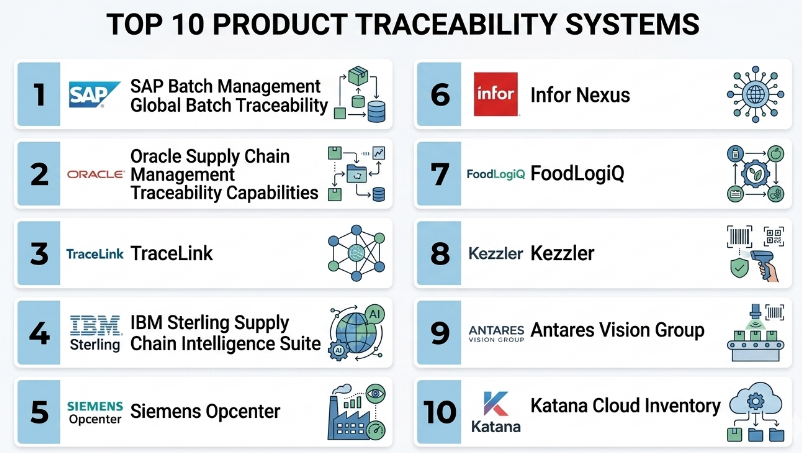
Top 10 Product Traceability Systems
#1 — SAP Batch Management and Global Batch Traceability
Short description :
SAP Batch Management and Global Batch Traceability help companies track batches, lots, materials, and finished products across manufacturing and supply chain operations. These capabilities are useful for companies already using SAP ERP, SAP S/4HANA, SAP Extended Warehouse Management, or SAP manufacturing tools. The system helps connect supplier materials, production batches, quality records, inventory movement, and customer shipments. It is especially valuable for food, pharma, chemicals, automotive, and industrial manufacturers that need traceability inside enterprise operations. SAP is a strong choice when traceability must connect deeply with finance, procurement, production, inventory, and compliance workflows.
Key Features
- Batch and lot traceability
- Material genealogy tracking
- Supplier-to-customer product visibility
- Integration with SAP ERP and manufacturing processes
- Quality and compliance record support
- Recall and investigation support
- Multi-site enterprise traceability workflows
Pros
- Strong fit for SAP-centered enterprises
- Connects traceability with procurement, production, inventory, and sales
- Useful for regulated and complex manufacturing environments
Cons
- Implementation can be complex
- Best value comes when SAP master data is clean
- Smaller businesses may find it too enterprise-heavy
Platforms / Deployment
Web / Enterprise SAP environment.
Cloud / Hybrid / On-premise: Varies / N/A.
Security & Compliance
Enterprise controls may be available depending on SAP environment and deployment.
SSO/SAML, MFA, encryption, audit logs, RBAC: Not publicly stated in detail.
SOC 2, ISO 27001, GDPR, HIPAA: Not publicly stated.
Integrations & Ecosystem
SAP traceability works best when product, material, batch, quality, warehouse, and shipment data are already managed in SAP or connected systems.
- SAP ERP and S/4HANA
- SAP Extended Warehouse Management
- SAP manufacturing and quality workflows
- Procurement and supplier data
- Sales and shipment records
- Reporting and analytics systems
Support & Community
SAP has a large enterprise support ecosystem, implementation partners, documentation, training resources, and customer community. Support experience may vary by region, partner, and deployment scope.
#2 — Oracle Supply Chain Management Traceability Capabilities
Short description :
Oracle Supply Chain Management supports product traceability through inventory, manufacturing, quality, order management, procurement, and supply chain workflows. It is useful for businesses that want traceability connected with Oracle Cloud ERP and Oracle SCM operations. The platform can help track lots, serial numbers, product movement, supplier materials, and customer shipments. Oracle is suitable for manufacturers, distributors, retailers, healthcare companies, and industrial businesses that need enterprise-level product visibility. It is a strong choice when traceability must be part of a broader cloud supply chain system.
Key Features
- Lot and serial number tracking
- Inventory and shipment traceability
- Manufacturing and quality process connection
- Supplier and procurement visibility
- Recall and investigation support
- Oracle ERP and SCM integration
- Reporting and compliance support
Pros
- Strong fit for Oracle-centered enterprises
- Useful for cloud-based supply chain operations
- Connects traceability with inventory, orders, and finance workflows
Cons
- Traceability depth may depend on configuration
- Implementation requires data and process alignment
- Smaller teams may not need the full enterprise suite
Platforms / Deployment
Web / Mobile / Enterprise environment.
Cloud deployment.
Hybrid integration options: Varies / N/A.
Security & Compliance
Enterprise security controls may be available depending on Oracle environment and configuration.
SSO/SAML, MFA, encryption, audit logs, RBAC: Not publicly stated in detail.
SOC 2, ISO 27001, GDPR, HIPAA: Not publicly stated.
Integrations & Ecosystem
Oracle traceability capabilities fit into enterprise environments where product movement, production, inventory, and business processes must work together.
- Oracle ERP and SCM
- Procurement systems
- Manufacturing workflows
- Warehouse operations
- Quality management processes
- Analytics and reporting tools
Support & Community
Oracle provides enterprise documentation, cloud support, implementation partners, training resources, and customer support. Support quality may vary by contract, region, and implementation partner.
#3 — TraceLink
Short description :
TraceLink is a supply chain traceability and serialization platform widely known in life sciences and pharmaceutical supply chains. It helps companies manage product serialization, regulatory compliance, supply chain visibility, and partner collaboration. The platform is useful for pharmaceutical manufacturers, wholesalers, distributors, contract manufacturers, and healthcare supply chain organizations. TraceLink supports product identity, movement, and compliance workflows across trading partners. It is a strong choice for regulated industries where product authenticity, serialization, and compliance reporting are critical.
Key Features
- Product serialization support
- Pharmaceutical supply chain traceability
- Partner network collaboration
- Regulatory compliance workflows
- Product movement visibility
- Exception and investigation support
- Reporting and audit support
Pros
- Strong fit for pharma and life sciences traceability
- Useful for regulated serialization workflows
- Supports multi-partner supply chain collaboration
Cons
- May be less suitable for simple non-regulated inventory tracking
- Best value comes in life sciences and regulated environments
- Implementation may require partner onboarding and data readiness
Platforms / Deployment
Web / Enterprise network environment.
Cloud deployment is commonly expected.
Security & Compliance
Enterprise controls may be available depending on configuration.
SSO/SAML, MFA, encryption, audit logs, RBAC: Not publicly stated in detail.
SOC 2, ISO 27001, GDPR, HIPAA: Not publicly stated.
Integrations & Ecosystem
TraceLink fits into pharmaceutical and life sciences supply chains where serialization, compliance data, and trading partner collaboration matter.
- ERP and manufacturing systems
- Packaging line systems
- Wholesaler and distributor systems
- Regulatory reporting workflows
- Partner network data exchange
- Quality and compliance records
Support & Community
Support is vendor-led and focused on life sciences supply chain users. Documentation, onboarding, partner support, and compliance guidance may vary by customer scope.
#4 — IBM Sterling Supply Chain Intelligence Suite
Short description :
IBM Sterling Supply Chain Intelligence Suite helps companies improve supply chain visibility, collaboration, risk monitoring, and product movement intelligence. It can support traceability use cases by connecting supplier, order, inventory, shipment, and partner data across the supply chain. The platform is useful for retailers, manufacturers, distributors, logistics teams, and enterprises needing broader supply chain visibility. It is especially relevant when product traceability must connect with supplier risk, order visibility, and supply chain event management. IBM Sterling is a strong option for companies that want traceability as part of broader supply chain intelligence.
Key Features
- Supply chain visibility and intelligence
- Partner collaboration support
- Order and shipment visibility
- Supplier and inventory data connection
- Exception management
- Analytics and reporting
- Supply chain risk monitoring support
Pros
- Strong fit for enterprise supply chain visibility
- Useful when traceability requires partner and shipment data
- Good for multi-party supply chain collaboration
Cons
- Not only a dedicated product traceability tool
- Requires integration with operational systems
- Best value depends on data availability and ecosystem fit
Platforms / Deployment
Web / Enterprise environment.
Cloud / Hybrid: Varies / N/A.
Security & Compliance
Enterprise security controls may be available depending on deployment.
SSO/SAML, MFA, encryption, audit logs, RBAC: Not publicly stated in detail.
SOC 2, ISO 27001, GDPR, HIPAA: Not publicly stated.
Integrations & Ecosystem
IBM Sterling fits into enterprise supply chain environments where traceability depends on supplier, order, shipment, inventory, and partner data.
- ERP systems
- Supplier collaboration workflows
- Order management systems
- Logistics and shipment platforms
- Inventory systems
- Reporting and analytics tools
Support & Community
Support is enterprise-focused, with documentation, implementation partners, training resources, and customer support. Community strength is strong in supply chain and enterprise integration environments.
#5 — Siemens Opcenter
Short description :
Siemens Opcenter is a manufacturing operations and MES platform that supports production execution, quality, material movement, and traceability across manufacturing environments. It is useful for companies that need detailed product genealogy from raw materials through production steps and finished goods. The platform can help track which materials, machines, operators, recipes, batches, tools, and process events contributed to a finished product. Siemens Opcenter is especially valuable in electronics, automotive, medical devices, aerospace, industrial manufacturing, and process manufacturing. It is a strong choice when traceability must be deeply connected with shop-floor production control.
Key Features
- Manufacturing execution and process tracking
- Product genealogy and material traceability
- Batch, lot, and serial tracking support
- Quality and production record management
- Equipment and process data connection
- Shop-floor data collection
- Compliance and reporting support
Pros
- Strong fit for manufacturing traceability
- Useful for production genealogy and quality investigations
- Good for complex manufacturing environments
Cons
- Implementation may require detailed process mapping
- Best value comes with MES maturity
- May be more than simple warehouse traceability needs
Platforms / Deployment
Web / Enterprise manufacturing environment.
Cloud / Hybrid / On-premise: Varies / N/A.
Security & Compliance
Enterprise controls may be available depending on deployment.
SSO/SAML, MFA, encryption, audit logs, RBAC: Not publicly stated in detail.
SOC 2, ISO 27001, GDPR, HIPAA: Not publicly stated.
Integrations & Ecosystem
Siemens Opcenter fits into manufacturing environments where product traceability must connect with machines, production lines, quality systems, and enterprise planning.
- ERP systems
- MES workflows
- Quality management systems
- Equipment and shop-floor data
- Warehouse and inventory systems
- Analytics and reporting tools
Support & Community
Support is vendor-led and enterprise-focused, with documentation, training, implementation partners, and technical services. Community strength is strong in manufacturing and industrial operations.
#6 — Infor Nexus
Short description :
Infor Nexus is a supply chain network platform that helps companies manage supplier collaboration, shipment visibility, order tracking, and multi-party supply chain processes. It can support product traceability by connecting suppliers, logistics partners, orders, shipments, and inventory movement across global supply chains. The platform is useful for retailers, manufacturers, apparel brands, consumer goods companies, and enterprises with complex supplier networks. Infor Nexus is especially valuable when traceability depends on upstream supplier visibility and partner collaboration. It is a strong option for companies that need traceability across extended supply chains, not only inside their own warehouse.
Key Features
- Supplier collaboration
- Multi-party supply chain visibility
- Shipment and order tracking
- Inventory and product movement visibility
- Partner network workflows
- Exception and event management
- Reporting and analytics support
Pros
- Strong fit for global supplier networks
- Useful for upstream supply chain traceability
- Good for retailers, apparel, and consumer goods companies
Cons
- Not only a dedicated batch or serial tracking system
- Requires supplier and partner participation
- Best value depends on network adoption and data quality
Platforms / Deployment
Web / Enterprise supply chain network environment.
Cloud deployment is commonly expected.
Hybrid: Varies / N/A.
Security & Compliance
Enterprise controls may be available depending on deployment.
SSO/SAML, MFA, encryption, audit logs, RBAC: Not publicly stated in detail.
SOC 2, ISO 27001, GDPR, HIPAA: Not publicly stated.
Integrations & Ecosystem
Infor Nexus fits into environments where product traceability depends on supplier, shipment, purchase order, and partner data.
- Supplier systems
- ERP and procurement workflows
- Logistics and freight systems
- Order management systems
- Inventory visibility tools
- Reporting and analytics platforms
Support & Community
Support is vendor-led with customer support, implementation assistance, documentation, and supply chain network expertise. Community strength is strongest among global supply chain and supplier collaboration users.
#7 — FoodLogiQ
Short description :
FoodLogiQ is a traceability, supplier management, and food safety platform focused on the food and beverage industry. It helps companies track products, suppliers, ingredients, compliance documents, quality events, and recall processes. The platform is useful for food manufacturers, restaurants, retailers, distributors, and brands that need better supply chain transparency. FoodLogiQ helps teams manage supplier documentation, trace ingredients, investigate quality issues, and prepare for recalls. It is a strong choice for food companies where safety, supplier compliance, and product traceability are core business needs.
Key Features
- Food product traceability
- Supplier compliance management
- Ingredient and lot tracking support
- Recall management workflows
- Quality incident tracking
- Document management
- Supply chain transparency dashboards
Pros
- Strong fit for food and beverage traceability
- Useful for supplier compliance and recall readiness
- Helps improve food safety documentation
Cons
- Less suitable for non-food manufacturing use cases
- Supplier participation is important for best results
- Integration scope should be validated carefully
Platforms / Deployment
Web / Mobile environment.
Cloud deployment is commonly expected.
Security & Compliance
SSO/SAML, MFA, encryption, audit logs, RBAC: Not publicly stated in detail.
SOC 2, ISO 27001, GDPR, HIPAA: Not publicly stated.
Integrations & Ecosystem
FoodLogiQ fits into food supply chain environments where supplier documents, ingredient traceability, quality data, and recall workflows must connect.
- Supplier portals
- ERP and inventory systems
- Quality management systems
- Recall workflows
- Document management systems
- Reporting and compliance dashboards
Support & Community
Support is vendor-led and focused on food safety, supplier compliance, and traceability users. Documentation, onboarding, and customer support may vary by scope.
#8 — Kezzler
Short description :
Kezzler provides product digitization and traceability solutions that help companies assign unique digital identities to products, packages, or batches. It is useful for brands that need product authentication, supply chain visibility, consumer engagement, and anti-counterfeit capabilities. The platform supports QR codes, serialization, product journey tracking, and digital product records. Kezzler is especially relevant for consumer goods, food, pharma, luxury, and regulated product environments where authenticity and transparency matter. It is a strong option when traceability needs to extend from production to distribution and even to customer interaction.
Key Features
- Product serialization and unique digital IDs
- QR code and scan-based traceability
- Product authentication support
- Supply chain event tracking
- Consumer-facing product transparency
- Anti-counterfeit workflows
- Reporting and analytics
Pros
- Strong product identity and digitization focus
- Useful for anti-counterfeit and consumer transparency
- Good fit for brands needing item-level traceability
Cons
- May require packaging and labeling process changes
- Best value depends on scan adoption and partner participation
- May need integration with ERP, packaging, and logistics systems
Platforms / Deployment
Web / Mobile / API-enabled environment.
Cloud deployment is commonly expected.
Security & Compliance
SSO/SAML, MFA, encryption, audit logs, RBAC: Not publicly stated in detail.
SOC 2, ISO 27001, GDPR, HIPAA: Not publicly stated.
Integrations & Ecosystem
Kezzler fits into product identity environments where serialization, packaging, supply chain movement, and consumer engagement need to connect.
- Packaging and labeling systems
- ERP and product data systems
- Supply chain event systems
- Mobile scan workflows
- Consumer engagement platforms
- Reporting and analytics tools
Support & Community
Support is vendor-led and focused on product digitization, serialization, and traceability programs. Implementation support may vary based on use case and product volume.
#9 — Antares Vision Group
Short description :
Antares Vision Group provides traceability, inspection, serialization, and supply chain visibility solutions for industries such as pharmaceuticals, food and beverage, cosmetics, and consumer goods. It helps companies manage product identity, packaging line serialization, regulatory compliance, quality inspection, and product movement visibility. The platform is especially useful for regulated industries that require precise product tracking and authentication. Antares Vision Group is a strong choice where product traceability must connect with packaging lines, quality inspection, regulatory requirements, and supply chain transparency. It is suitable for organizations needing both traceability and inspection-related capabilities.
Key Features
- Serialization and traceability
- Packaging line integration
- Product inspection support
- Regulatory compliance workflows
- Product authentication
- Supply chain visibility
- Reporting and audit support
Pros
- Strong fit for regulated product traceability
- Useful for pharma, food, cosmetics, and consumer goods
- Combines traceability with inspection and serialization capabilities
Cons
- Implementation may require packaging line integration
- Best value comes in regulated or high-volume environments
- May be too specialized for simple inventory traceability
Platforms / Deployment
Web / Enterprise / Packaging line environment.
Cloud / Hybrid / On-premise: Varies / N/A.
Security & Compliance
Enterprise controls may be available depending on deployment.
SSO/SAML, MFA, encryption, audit logs, RBAC: Not publicly stated in detail.
SOC 2, ISO 27001, GDPR, HIPAA: Not publicly stated.
Integrations & Ecosystem
Antares Vision Group fits into environments where product traceability must connect with serialization, packaging, inspection, and supply chain data.
- Packaging line systems
- ERP and MES platforms
- Quality inspection systems
- Regulatory reporting workflows
- Warehouse and logistics systems
- Product authentication workflows
Support & Community
Support is vendor-led and industry-focused, with implementation assistance, technical services, and customer support. Community strength is strongest in regulated product and serialization environments.
#10 — Katana Cloud Inventory
Short description :
Katana Cloud Inventory is an inventory and manufacturing management platform that supports small and mid-sized manufacturers with material tracking, production planning, stock control, and order fulfillment. While it is not an enterprise traceability platform, it can support practical batch and inventory visibility for growing businesses. It is useful for small manufacturers, food makers, consumer goods brands, and eCommerce product companies that need better production and stock tracking. Katana helps teams understand material usage, finished goods, inventory movement, and order status. It is a good option when businesses need simple operational traceability without the complexity of enterprise systems.
Key Features
- Inventory and stock tracking
- Production order management
- Material and finished goods visibility
- Batch tracking support: Varies / N/A
- Order and sales channel integration
- Manufacturing workflow support
- Reporting and operational dashboards
Pros
- Good fit for small and mid-sized manufacturers
- Easier to adopt than large enterprise systems
- Useful for basic production and inventory visibility
Cons
- Not built for complex regulated traceability at enterprise scale
- Advanced serialization and recall workflows may be limited
- Compliance-heavy industries may need specialized systems
Platforms / Deployment
Web-based platform.
Cloud deployment.
Security & Compliance
SSO/SAML, MFA, encryption, audit logs, RBAC: Not publicly stated in detail.
SOC 2, ISO 27001, GDPR, HIPAA: Not publicly stated.
Integrations & Ecosystem
Katana fits into small business environments where inventory, production, sales, and fulfillment data need to be connected.
- eCommerce platforms
- Accounting systems
- Shipping and fulfillment tools
- Inventory and production workflows
- Sales order systems
- Reporting dashboards
Support & Community
Support is vendor-led with documentation, onboarding resources, and customer support. Community strength is strongest among small manufacturers, product businesses, and inventory-focused users.
Comparison Table
| Tool Name | Best For | Platform(s) Supported | Deployment | Standout Feature | Public Rating |
|---|---|---|---|---|---|
| SAP Batch Management and Global Batch Traceability | SAP-centered enterprise traceability | Web / Enterprise SAP | Cloud / Hybrid / On-premise: Varies | Batch traceability connected with enterprise operations | N/A |
| Oracle Supply Chain Management Traceability Capabilities | Oracle-centered supply chain traceability | Web / Mobile / Enterprise | Cloud | Lot and serial tracking inside Oracle SCM | N/A |
| TraceLink | Pharma serialization and supply chain traceability | Web / Enterprise network | Cloud | Life sciences serialization and partner network | N/A |
| IBM Sterling Supply Chain Intelligence Suite | Enterprise supply chain visibility | Web / Enterprise | Cloud / Hybrid: Varies | Supply chain intelligence and partner visibility | N/A |
| Siemens Opcenter | Manufacturing genealogy and shop-floor traceability | Web / Enterprise manufacturing | Cloud / Hybrid / On-premise: Varies | Production genealogy connected with MES | N/A |
| Infor Nexus | Supplier and global network traceability | Web / Enterprise network | Cloud / Varies | Multi-party supplier and shipment visibility | N/A |
| FoodLogiQ | Food safety and supplier traceability | Web / Mobile | Cloud | Food traceability and recall readiness | N/A |
| Kezzler | Product digitization and authentication | Web / Mobile / API-enabled | Cloud | Unique digital product identity | N/A |
| Antares Vision Group | Serialization and regulated product traceability | Web / Enterprise / Packaging line | Cloud / Hybrid / On-premise: Varies | Serialization plus inspection and compliance | N/A |
| Katana Cloud Inventory | Small manufacturer inventory traceability | Web | Cloud | Simple production and inventory visibility | N/A |
Evaluation & Product Traceability Systems
The scoring below is comparative and based on practical product traceability needs. It considers core features, ease of use, integrations, security signals, performance, support, and value. Scores should not be treated as final purchasing advice because the best fit depends on industry, product complexity, regulatory requirements, supplier network, production process, and existing systems.
| Tool Name | Core (25%) | Ease (15%) | Integrations (15%) | Security (10%) | Performance (10%) | Support (10%) | Value (15%) | Weighted Total (0–10) |
|---|---|---|---|---|---|---|---|---|
| SAP Batch Management and Global Batch Traceability | 9 | 7 | 9 | 8 | 9 | 9 | 7 | 8.30 |
| Oracle Supply Chain Management Traceability Capabilities | 8 | 8 | 9 | 8 | 8 | 8 | 8 | 8.15 |
| TraceLink | 9 | 8 | 8 | 8 | 8 | 8 | 8 | 8.25 |
| IBM Sterling Supply Chain Intelligence Suite | 8 | 7 | 9 | 8 | 8 | 8 | 7 | 7.90 |
| Siemens Opcenter | 9 | 7 | 9 | 8 | 9 | 8 | 7 | 8.20 |
| Infor Nexus | 8 | 8 | 8 | 7 | 8 | 8 | 8 | 7.85 |
| FoodLogiQ | 8 | 9 | 7 | 7 | 8 | 8 | 8 | 7.90 |
| Kezzler | 8 | 8 | 8 | 7 | 8 | 8 | 8 | 7.85 |
| Antares Vision Group | 9 | 7 | 8 | 8 | 9 | 8 | 7 | 8.05 |
| Katana Cloud Inventory | 6 | 9 | 7 | 6 | 8 | 8 | 9 | 7.40 |
A higher score usually means stronger overall fit across broad traceability needs. However, the best platform depends on the business use case. SAP and Oracle are strong for enterprise traceability inside ERP and supply chain workflows. TraceLink and Antares Vision Group are stronger for regulated serialization. Siemens Opcenter is strong for manufacturing genealogy. FoodLogiQ is practical for food traceability, while Katana is suitable for smaller manufacturers needing simpler inventory visibility.
Which Product Traceability System Should You Choose?
Solo / Freelancer
Solo consultants, quality advisors, supply chain experts, and traceability auditors usually do not need a full enterprise traceability platform for personal use. They may need templates, audit checklists, process maps, and data models to help clients improve traceability.
Good approach:
- Map raw material to finished goods flow
- Review batch, lot, and serial number controls
- Identify supplier data gaps
- Build recall simulation templates
- Review product labeling and scanning processes
- Recommend software based on industry risk and system maturity
For client work, the right system should depend on product type, recall risk, regulatory pressure, supplier complexity, and existing ERP or MES environment.
SMB
Small and mid-sized businesses usually need practical traceability without heavy enterprise complexity. They may start with inventory tracking, batch records, supplier documents, barcode scanning, and simple recall workflows.
Good options:
- Katana Cloud Inventory for small manufacturers
- FoodLogiQ for food companies needing supplier and recall traceability
- Kezzler for product authentication and QR-based traceability
- Oracle SCM traceability capabilities for growing cloud-first businesses
- Infor Nexus for supplier-network visibility
SMBs should start by cleaning product records, supplier records, lot numbers, production logs, and shipment data before investing in complex automation.
Mid-Market
Mid-market companies often need stronger traceability across multiple warehouses, suppliers, production lines, and customer channels. They may also need better recall management, supplier compliance, and integration with ERP or WMS.
Good options:
- FoodLogiQ for food supply chain traceability
- Siemens Opcenter for manufacturing genealogy
- TraceLink for pharma and regulated serialization
- Infor Nexus for supplier and shipment network traceability
- Kezzler for digital product identity and anti-counterfeit workflows
- Oracle SCM traceability capabilities for Oracle-centered operations
Mid-market buyers should focus on integrations, recall readiness, scan accuracy, and user adoption across production and warehouse teams.
Enterprise
Large enterprises need scalable product traceability systems that support multiple sites, suppliers, regions, product lines, compliance requirements, and trading partners. They also need strong governance, reporting, audit trails, and enterprise integrations.
Good options:
- SAP Batch Management and Global Batch Traceability for SAP-centered enterprises
- Oracle SCM traceability capabilities for Oracle-centered enterprises
- TraceLink for pharma serialization and regulated supply chains
- Siemens Opcenter for manufacturing genealogy and MES-connected traceability
- IBM Sterling Supply Chain Intelligence Suite for supply chain-wide visibility
- Antares Vision Group for serialization, inspection, and regulated product traceability
- Infor Nexus for supplier network traceability
Enterprise buyers should involve quality, supply chain, production, warehouse, IT, compliance, procurement, logistics, and finance teams before final selection.
Budget vs Premium
Budget-focused teams should first identify the traceability problem they need to solve. Some companies need batch tracking, while others need serialization, supplier traceability, recall management, anti-counterfeit protection, or full product genealogy.
Budget-friendly path:
- Standardize lot and batch numbering
- Use barcode or QR scanning
- Maintain supplier document records
- Track production inputs and outputs
- Run mock recall exercises
- Integrate with inventory and production systems later
Premium traceability systems make sense when the company needs:
- Multi-site product genealogy
- Regulated serialization
- Supplier-to-customer visibility
- Recall automation
- Anti-counterfeit verification
- Real-time scanning and tracking
- ERP, MES, WMS, and QMS integration
- Consumer-facing transparency
- Audit-ready compliance records
- Enterprise reporting and governance
The right budget depends on recall risk, regulatory exposure, product value, supplier complexity, and customer requirements.
Feature Depth vs Ease of Use
Traceability software must be accurate and easy to use. If operators, warehouse staff, suppliers, or quality teams do not capture data properly, the system will not provide reliable traceability.
Choose feature depth when:
- Products are regulated
- Recalls are high-risk
- Serial-level tracking is required
- Supplier networks are complex
- Production genealogy is important
- Multiple sites must follow standard processes
- ERP, MES, WMS, and QMS integration is required
Choose ease of use when:
- The team is new to traceability software
- Batch tracking is the first priority
- Internal IT support is limited
- Supplier participation is low
- Mobile scanning adoption matters
- The first goal is recall readiness
The best system should make traceability part of daily work, not an extra burden.
Integrations & Scalability
Product Traceability Systems become more valuable when they connect with production, inventory, quality, supplier, and logistics systems. Manual entry can create gaps, delays, and errors.
Important integration areas include:
- ERP systems
- MES platforms
- WMS platforms
- QMS systems
- LIMS platforms
- PLM systems
- Supplier portals
- Barcode and QR code systems
- RFID systems
- Packaging line systems
- Shipping and logistics platforms
- Customer service and warranty systems
- Reporting and analytics tools
Scalability matters when the business expands across more suppliers, facilities, products, markets, and compliance requirements.
Security & Compliance Needs
Product traceability systems store sensitive product, supplier, customer, quality, production, shipment, and compliance data. Security should be reviewed carefully before rollout.
Buyers should ask about:
- Role-based access control
- SSO and MFA
- Encryption
- Audit logs
- Data retention rules
- Secure supplier access
- User activity tracking
- Recall record protection
- Backup and recovery
- Secure integrations
- Product data governance
- Support for internal security review
Never assume a platform has a specific security certification unless the vendor clearly confirms it.
Frequently Asked Questions
1. What is a Product Traceability System?
A Product Traceability System tracks products, materials, batches, lots, components, serial numbers, and shipments across production and supply chain processes. It helps companies understand product history and movement.
2. Who uses Product Traceability Systems?
Manufacturers, food companies, pharma companies, medical device firms, automotive suppliers, electronics companies, retailers, distributors, logistics providers, quality teams, and compliance teams use traceability systems.
3. How is product traceability different from inventory tracking?
Inventory tracking shows what stock is available and where it is stored. Product traceability goes deeper by showing the history of materials, batches, production steps, suppliers, quality events, shipments, and customers.
4. What is lot traceability?
Lot traceability tracks a group of products or materials produced, received, or shipped together. It is important for recall management, quality investigations, and compliance reporting.
5. What is serial number traceability?
Serial number traceability tracks each individual product unit. It is common in electronics, medical devices, pharma, automotive parts, aerospace components, and high-value goods.
6. What is product genealogy?
Product genealogy shows how raw materials, components, machines, operators, process steps, and quality checks are connected to a finished product. It is very important in manufacturing and regulated industries.
7. Can traceability systems help with recalls?
Yes, traceability systems help identify affected lots, batches, customers, suppliers, shipments, and production records quickly. This can reduce recall scope, response time, and business risk.
8. Can traceability systems prevent counterfeiting?
They can help reduce counterfeiting by using unique product IDs, QR codes, serialization, authentication checks, and scan-based verification. However, anti-counterfeit success depends on proper implementation and market participation.
9. Do traceability systems need barcodes or RFID?
Not always, but barcodes, QR codes, and RFID make traceability more accurate and easier to capture. Manual tracking may work at low volume, but scanning is better for scale and accuracy.
10. Can traceability systems integrate with ERP?
Yes, many traceability systems integrate with ERP platforms to use product, supplier, inventory, order, purchasing, production, and shipment data. ERP integration reduces duplicate entry and improves accuracy.
Conclusion
Product Traceability Systems help businesses track product history, improve recall readiness, strengthen compliance, reduce quality risk, fight counterfeiting, and provide better supply chain visibility. The right system can show where materials came from, how products were made, where they moved, and which customers received them. However, the best platform depends on industry, product complexity, compliance needs, supplier network, existing systems, and traceability depth required. SAP and Oracle are strong for enterprise ERP-connected traceability. TraceLink and Antares Vision Group are strong for regulated serialization.
