Introduction
Global Trade Management, also called GTM, Systems are software platforms that help companies manage import, export, customs, trade compliance, duty management, product classification, restricted party screening, origin management, logistics documentation, and cross-border trade workflows. In simple words, GTM systems help businesses move goods across countries while staying compliant with trade rules and controlling landed cost.
Global trade is not just about shipping goods from one country to another. It includes customs declarations, tariff classification, export controls, sanctions screening, free trade agreements, duty calculations, documentation, broker coordination, supplier data, shipment visibility, and audit readiness. If these activities are handled manually, companies may face shipment delays, penalties, incorrect duty payments, compliance gaps, and poor visibility into trade cost.
GTM systems are used by manufacturers, retailers, distributors, logistics providers, importers, exporters, customs brokers, freight forwarders, pharma companies, electronics companies, automotive firms, aerospace companies, and global supply chain teams.
Common use cases include import management, export management, customs documentation, denied party screening, HS code classification, duty drawback support, free trade agreement qualification, country-of-origin tracking, landed cost calculation, broker management, and trade compliance reporting.
Buyers should evaluate:
- Import and export workflow coverage
- Product classification and HS code support
- Restricted party and sanctions screening
- Customs documentation and broker collaboration
- Duty, tax, and landed cost calculation
- Free trade agreement and origin management
- Integration with ERP, TMS, WMS, procurement, order, and finance systems
- Global country and regulatory coverage
- Workflow approvals and audit trails
- Reporting and trade compliance dashboards
- Security, access control, and data governance
- Vendor trade expertise and implementation support
Best for: Importers, exporters, manufacturers, retailers, distributors, logistics companies, freight forwarders, customs brokers, compliance teams, procurement teams, finance teams, and enterprises with regular cross-border trade operations.
Not ideal for: Very small businesses with rare international shipments, simple product catalogs, or companies that fully outsource customs and trade compliance work to freight forwarders or brokers. In those cases, a broker portal, basic screening tool, or manual trade checklist may be enough.
Key Global Trade Management GTM System Trends
- Trade compliance is becoming more connected with supply chain operations. Companies no longer want trade compliance to sit separately from procurement, order management, logistics, and finance.
- Restricted party screening is becoming a standard requirement. Businesses need to screen customers, suppliers, partners, carriers, and shipment parties against denied and restricted lists.
- Product classification is becoming more structured. GTM systems help teams manage HS codes, export control codes, product attributes, classification approvals, and audit history.
- Free trade agreement management is becoming more important. Companies want to reduce duty cost by managing origin rules, supplier certificates, and qualification workflows properly.
- Landed cost visibility is a major business need. Finance and supply chain teams want to understand total import cost, including duties, taxes, freight, insurance, and compliance-related charges.
- Customs and broker collaboration is becoming more digital. Companies want fewer emails and more structured workflows for document submission, customs status, and broker communication.
- ERP integration is now essential. GTM systems must connect with product data, suppliers, sales orders, purchase orders, invoices, shipments, and financial systems.
- Audit readiness is a major focus. Companies need searchable records for classification decisions, screening results, origin data, customs documents, licenses, and approvals.
- AI-assisted document processing is emerging. Some GTM workflows are moving toward automated data extraction from invoices, packing lists, certificates, and shipping documents.
- Supply chain risk and trade compliance are merging. GTM systems increasingly support wider risk areas such as supplier risk, sanctions exposure, forced labor concerns, and geopolitical trade changes.
How We Selected These Tools
The tools below were selected using practical global trade, customs, compliance, logistics, and enterprise software evaluation criteria.
- Recognition in global trade management, customs, trade compliance, screening, classification, or supply chain execution
- Ability to support import, export, customs, duty, origin, documentation, and compliance workflows
- Fit for manufacturers, retailers, importers, exporters, logistics providers, brokers, and global enterprises
- Support for restricted party screening, product classification, export controls, and customs documentation
- Integration potential with ERP, TMS, WMS, procurement, order management, broker, and finance systems
- Scalability across countries, regions, business units, products, suppliers, and customers
- Usability for compliance teams, logistics teams, customs teams, procurement teams, and finance users
- Workflow approval, audit trail, reporting, and document management strength
- Security, role-based access, and enterprise governance readiness
- Vendor support, product maturity, implementation ecosystem, and trade domain expertise
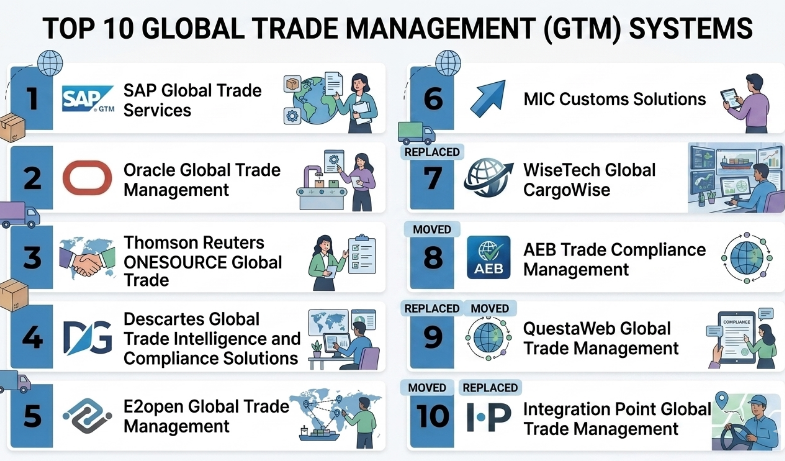
Top 10 Global Trade Management GTM Systems
#1 — SAP Global Trade Services
Short description :
SAP Global Trade Services is a major GTM system designed for companies that need trade compliance, customs management, import/export control, product classification, and screening connected with SAP enterprise workflows. It helps organizations manage trade processes directly across sales, procurement, logistics, finance, and customs operations. The platform is useful for large manufacturers, retailers, distributors, and global enterprises with complex cross-border trade activity. SAP GTS is especially strong when trade compliance decisions must be embedded inside SAP ERP or SAP S/4HANA workflows. It is a strong choice for companies that want global trade management aligned closely with enterprise business processes.
Key Features
- Import and export compliance workflows
- Restricted party screening
- Product classification support
- Customs management capabilities
- Export control and license checks
- Duty and trade document management
- Integration with SAP ERP and logistics workflows
Pros
- Strong fit for SAP-centered enterprises
- Connects trade compliance with sales, procurement, logistics, and finance
- Useful for large global import/export operations
Cons
- Implementation can be complex
- Best value comes when SAP data and processes are mature
- Smaller businesses may find it too heavy
Platforms / Deployment
Web / Enterprise SAP environment.
Cloud / Hybrid / On-premise: Varies / N/A.
Security & Compliance
Enterprise security controls may be available depending on SAP environment and deployment.
SSO/SAML, MFA, encryption, audit logs, RBAC: Not publicly stated in detail.
SOC 2, ISO 27001, GDPR, HIPAA: Not publicly stated.
Integrations & Ecosystem
SAP Global Trade Services fits naturally into SAP environments where trade data must connect with business transactions and logistics execution.
- SAP ERP and S/4HANA
- Procurement and supplier workflows
- Sales and order management
- Logistics and shipping systems
- Product master data
- Customs and compliance workflows
Support & Community
SAP has a large enterprise support ecosystem, implementation partners, documentation, training resources, and customer community. Support quality may vary by partner, region, and deployment scope.
#2 — Oracle Global Trade Management
Short description :
Oracle Global Trade Management is a cloud-focused GTM platform that helps companies manage import/export compliance, customs documentation, product classification, restricted party screening, and trade controls. It is useful for organizations using Oracle ERP, Oracle SCM, transportation management, procurement, and order management systems. The platform helps companies connect trade compliance checks with operational workflows instead of handling them separately. Oracle GTM is especially suitable for cloud-first enterprises that want trade compliance, logistics, and business processes connected in one environment. It is a strong option for companies already invested in the Oracle ecosystem.
Key Features
- Global trade compliance management
- Restricted party screening support
- Import and export documentation workflows
- Product classification support
- Export control and license management
- Oracle SCM and ERP integration
- Compliance reporting and audit support
Pros
- Strong fit for Oracle-centered enterprises
- Useful for connecting trade compliance with supply chain operations
- Good for companies with broad import/export workflows
Cons
- Implementation may require configuration and process mapping
- Best value comes inside Oracle ecosystem environments
- Dedicated customs depth may vary by use case
Platforms / Deployment
Web / Enterprise environment.
Cloud deployment is commonly expected.
Hybrid: Varies / N/A.
Security & Compliance
Enterprise security controls may be available depending on Oracle environment and configuration.
SSO/SAML, MFA, encryption, audit logs, RBAC: Not publicly stated in detail.
SOC 2, ISO 27001, GDPR, HIPAA: Not publicly stated.
Integrations & Ecosystem
Oracle GTM fits into enterprise environments where trade compliance must connect with order, procurement, transportation, finance, and logistics systems.
- Oracle ERP and SCM
- Transportation management workflows
- Order management systems
- Procurement and supplier data
- Product master data
- Reporting and analytics platforms
Support & Community
Oracle provides enterprise documentation, cloud support, implementation partners, training resources, and customer support. Support quality may vary by contract, region, and implementation partner.
#3 — Thomson Reuters ONESOURCE Global Trade
Short description :
Thomson Reuters ONESOURCE Global Trade helps companies manage trade compliance, product classification, restricted party screening, import/export controls, duty management, and global trade documentation. It is useful for importers, exporters, manufacturers, retailers, and enterprise compliance teams that need strong governance across countries, products, suppliers, and customers. The platform focuses on trade data accuracy, compliance controls, and audit readiness. It helps organizations reduce risk by improving classification, screening, documentation, and reporting processes. ONESOURCE is a strong choice for enterprises that need structured global trade compliance management.
Key Features
- Global trade compliance management
- Product classification workflows
- Restricted party screening
- Import and export process support
- Duty and tax-related trade data
- Trade documentation and audit support
- Enterprise compliance reporting
Pros
- Strong compliance and governance focus
- Useful for large import/export organizations
- Good fit for enterprise trade compliance teams
Cons
- May be broader than a simple screening tool
- Implementation may require master data cleanup
- Best value comes in complex global trade environments
Platforms / Deployment
Web / Enterprise environment.
Cloud deployment is commonly expected.
Hybrid: Varies / N/A.
Security & Compliance
Enterprise controls may be available depending on configuration.
SSO/SAML, MFA, encryption, audit logs, RBAC: Not publicly stated in detail.
SOC 2, ISO 27001, GDPR, HIPAA: Not publicly stated.
Integrations & Ecosystem
ONESOURCE Global Trade fits into enterprise environments where trade compliance must connect with ERP, tax, procurement, sales, and logistics systems.
- ERP systems
- Product master data
- Supplier and customer records
- Screening databases
- Import/export documentation workflows
- Compliance audit tools
Support & Community
Support is enterprise-focused with documentation, implementation support, customer service, and trade compliance expertise. Community strength is strong among tax, trade, and enterprise compliance teams.
#4 — Descartes Global Trade Intelligence and Compliance Solutions
Short description :
Descartes provides global trade intelligence, customs, denied party screening, classification, and compliance solutions for companies involved in international supply chains. It is useful for importers, exporters, logistics providers, freight forwarders, manufacturers, retailers, and brokers. The platform helps companies manage trade data, regulatory content, customs documents, screening workflows, and shipment-related compliance processes. Descartes is especially relevant when global trade management must connect with logistics visibility, transportation workflows, and customs operations. It is a strong choice for organizations that want GTM capabilities inside a broader logistics technology ecosystem.
Key Features
- Denied party and sanctions screening
- Global trade content and compliance data
- Product classification support
- Customs and import/export workflow support
- Trade documentation support
- Logistics and trade visibility
- Reporting and audit support
Pros
- Strong logistics and global trade ecosystem
- Useful for importers, exporters, brokers, and logistics providers
- Good fit when trade compliance must connect with supply chain visibility
Cons
- Product scope may vary by module and region
- Implementation may require trade process alignment
- Smaller companies may not need the full ecosystem
Platforms / Deployment
Web / Enterprise environment.
Cloud deployment is commonly expected.
Hybrid: Varies / N/A.
Security & Compliance
Enterprise controls may be available depending on deployment.
SSO/SAML, MFA, encryption, audit logs, RBAC: Not publicly stated in detail.
SOC 2, ISO 27001, GDPR, HIPAA: Not publicly stated.
Integrations & Ecosystem
Descartes fits into trade and logistics environments where compliance data must connect with shipment visibility, transportation, customs, and enterprise systems.
- TMS and logistics platforms
- ERP and finance systems
- Customs workflows
- Carrier and freight forwarding systems
- Trade data platforms
- Reporting and analytics tools
Support & Community
Support is vendor-led with documentation, implementation assistance, customer support, and trade compliance expertise. Community strength is strong in logistics, customs, and global trade operations.
#5 — E2open Global Trade Management
Short description :
E2open Global Trade Management helps companies manage import/export compliance, restricted party screening, customs documentation, duty optimization, supplier collaboration, and supply chain trade workflows. It is useful for global manufacturers, retailers, technology companies, logistics providers, and enterprises that need trade compliance connected with supply chain execution. The platform supports compliance visibility across suppliers, customers, shipments, documents, and partner networks. E2open is especially valuable when trade compliance must operate as part of a connected global supply chain network. It is a strong option for companies that want trade compliance, logistics visibility, and partner collaboration in one ecosystem.
Key Features
- Import and export compliance workflows
- Restricted party screening
- Customs and trade documentation
- Duty and trade cost visibility
- Supplier and partner collaboration
- Integration with supply chain execution data
- Reporting and compliance dashboards
Pros
- Strong connected supply chain orientation
- Useful for companies with many suppliers and logistics partners
- Good fit for trade compliance tied to supply chain operations
Cons
- Product scope may depend on selected modules
- Implementation may require supplier and partner data alignment
- Smaller businesses may not need the broader network platform
Platforms / Deployment
Web / Enterprise environment.
Cloud deployment is commonly expected.
Hybrid: Varies / N/A.
Security & Compliance
Enterprise controls may be available depending on configuration.
SSO/SAML, MFA, encryption, audit logs, RBAC: Not publicly stated in detail.
SOC 2, ISO 27001, GDPR, HIPAA: Not publicly stated.
Integrations & Ecosystem
E2open fits into environments where trade compliance must connect with suppliers, logistics partners, transportation, and enterprise business systems.
- ERP and SCM systems
- Supplier collaboration workflows
- Freight forwarding and logistics data
- Customs and documentation workflows
- Trade compliance screening
- Analytics and dashboards
Support & Community
Support is vendor-led with enterprise onboarding, documentation, training, and customer support. Community strength is connected to global supply chain, logistics, and trade users.
#6 — MIC Customs Solutions
Short description :
MIC Customs Solutions provides customs and global trade compliance software for multinational companies that manage import, export, classification, origin, duty, and customs processes across multiple countries. It is useful for manufacturers, automotive companies, retailers, and trade compliance teams with complex international customs and trade requirements. The platform supports customs automation, tariff classification, origin management, preference handling, bonded warehouse processes, and export controls depending on selected modules. MIC is especially strong for organizations that need customs specialization across multiple countries. It is a strong GTM option when customs automation and compliance control are central business needs.
Key Features
- Customs and trade compliance workflows
- Import and export process support
- Tariff classification management
- Origin and preference management
- Export control support
- Duty and customs reporting
- Multi-country process support
Pros
- Strong customs and trade specialization
- Useful for multinational import/export operations
- Good fit for complex customs process automation
Cons
- May be too advanced for small businesses
- Implementation requires trade process knowledge
- Module selection and country coverage should be validated carefully
Platforms / Deployment
Web / Enterprise environment.
Cloud / Hybrid / On-premise: Varies / N/A.
Security & Compliance
SSO/SAML, MFA, encryption, audit logs, RBAC: Not publicly stated in detail.
SOC 2, ISO 27001, GDPR, HIPAA: Not publicly stated.
Integrations & Ecosystem
MIC fits into global trade environments where customs and compliance data must connect with ERP, logistics, product master data, and reporting systems.
- ERP systems
- Product classification data
- Import and export documentation
- Customs filing workflows
- Compliance screening and controls
- Audit and reporting systems
Support & Community
Support is vendor-led and trade-focused, with implementation assistance, documentation, and customs compliance expertise. Community strength is strongest among global trade and customs compliance teams.
#7 — WiseTech Global CargoWise
Short description :
CargoWise is a logistics execution platform widely used by freight forwarders, customs brokers, 3PLs, and global logistics service providers. While it is known strongly for freight forwarding and brokerage operations, it also supports many GTM-related workflows such as customs documentation, shipment records, client files, compliance data, and operational visibility. CargoWise is especially useful for logistics providers that need global trade processes connected with forwarding, customs brokerage, accounting, and shipment execution. It helps teams manage high shipment volume across multiple offices and regions. It is a strong choice for logistics companies that want trade management closely tied to freight operations.
Key Features
- Customs brokerage workflow support
- Freight forwarding and logistics execution
- Shipment documentation management
- Client and job file management
- Accounting and billing support
- Customs declaration support by region
- Operational reporting and visibility
Pros
- Strong fit for freight forwarders and customs brokers
- Connects customs work with shipment operations
- Suitable for multi-office logistics providers
Cons
- Can be complex for small teams
- Requires training and process discipline
- Customs coverage and workflows vary by country and configuration
Platforms / Deployment
Web / Enterprise logistics environment.
Cloud deployment is commonly expected.
Desktop or local components: Varies / N/A.
Security & Compliance
Enterprise controls may be available depending on configuration.
SSO/SAML, MFA, encryption, audit logs, RBAC: Not publicly stated in detail.
SOC 2, ISO 27001, GDPR, HIPAA: Not publicly stated.
Integrations & Ecosystem
CargoWise fits into logistics environments where customs brokerage, freight forwarding, accounting, and shipment execution must work together.
- Freight forwarding systems
- Carrier and shipment workflows
- Accounting and billing processes
- Document management
- Customer portals and reporting
- Customs filing workflows by region
Support & Community
Support includes vendor documentation, training resources, implementation partners, and customer support. Community strength is strong among freight forwarders, customs brokers, and logistics providers.
#8 — AEB Trade Compliance Management
Short description :
AEB Trade Compliance Management helps companies manage export controls, sanctions list screening, customs processes, product classification, and international trade compliance workflows. It is useful for manufacturers, exporters, logistics companies, and businesses that need reliable trade compliance automation. The platform supports screening, export license checks, compliance workflows, and integration with enterprise systems. AEB is especially relevant for European and global companies managing export compliance and cross-border trade processes. It is a strong option for businesses that want focused GTM capabilities around screening, export controls, and trade workflow automation.
Key Features
- Sanctions and restricted party screening
- Export control management
- License check workflows
- Customs and trade process support
- Product classification support
- ERP integration support
- Compliance audit trails
Pros
- Strong fit for export compliance workflows
- Useful for companies with sanctions and license checking needs
- Good option for European and international trade teams
Cons
- Regional coverage and rules should be validated
- May require configuration for complex enterprise workflows
- Product scope depends on selected modules
Platforms / Deployment
Web / Enterprise environment.
Cloud / Hybrid / On-premise: Varies / N/A.
Security & Compliance
SSO/SAML, MFA, encryption, audit logs, RBAC: Not publicly stated in detail.
SOC 2, ISO 27001, GDPR, HIPAA: Not publicly stated.
Integrations & Ecosystem
AEB fits into trade compliance environments where screening, export controls, customs, and enterprise business processes need to connect.
- ERP systems
- Order management workflows
- Shipping and logistics systems
- Product classification data
- Screening list data
- Reporting and compliance workflows
Support & Community
Support is vendor-led with documentation, customer support, and trade compliance expertise. Community strength is strongest among European logistics and trade compliance users.
#9 — QuestaWeb Global Trade Management
Short description :
QuestaWeb Global Trade Management supports import, export, customs compliance, broker management, duty management, and trade documentation workflows. It is useful for importers, exporters, brokers, and companies that need better control over international trade operations. The platform helps teams manage customs-related data, track shipment compliance, process trade documents, and support audit readiness. QuestaWeb is especially relevant for organizations that need a focused global trade and customs workflow platform. It is a practical option for businesses looking to reduce manual GTM work and improve cross-border process visibility.
Key Features
- Import and export management
- Customs compliance workflows
- Broker management support
- Duty and tax visibility
- Document management
- Shipment compliance tracking
- Reporting and audit support
Pros
- Focused global trade management capabilities
- Useful for importers, exporters, and brokers
- Supports audit and documentation needs
Cons
- Integration scope should be reviewed carefully
- May require trade compliance process setup
- Public security and certification details may be limited
Platforms / Deployment
Web / Enterprise environment.
Cloud / Hybrid: Varies / N/A.
Security & Compliance
SSO/SAML, MFA, encryption, audit logs, RBAC: Not publicly stated in detail.
SOC 2, ISO 27001, GDPR, HIPAA: Not publicly stated.
Integrations & Ecosystem
QuestaWeb fits into trade compliance environments where import/export data, broker workflows, shipment documents, and enterprise systems need to connect.
- ERP systems
- Customs broker workflows
- Import/export documentation
- Duty and tax records
- Shipment and logistics data
- Reporting and audit workflows
Support & Community
Support is vendor-led with implementation assistance, documentation, and customer support. Community strength is mainly among global trade and customs compliance users.
#10 — Integration Point Global Trade Management
Short description :
Integration Point Global Trade Management, now commonly associated with Thomson Reuters, supports import/export management, classification, denied party screening, free trade agreement management, duty-related workflows, and trade documentation. It is useful for companies that need structured global trade processes across multiple regions and business units. The platform helps teams improve trade data control, documentation quality, and compliance governance. Integration Point is especially relevant for organizations focused on audit readiness, classification discipline, and global trade process standardization. It is a practical GTM option for enterprise teams that need structured import/export management and compliance workflows.
Key Features
- Import and export management
- Product classification support
- Denied party screening
- Free trade agreement workflows
- Duty and tax-related visibility
- Trade documentation management
- Compliance reporting and audit trails
Pros
- Strong global trade process coverage
- Useful for compliance governance and documentation
- Good fit for enterprise import/export teams
Cons
- Product packaging may vary under current ownership
- Implementation may require data standardization
- Smaller teams may find it too broad
Platforms / Deployment
Web / Enterprise environment.
Cloud / Hybrid: Varies / N/A.
Security & Compliance
SSO/SAML, MFA, encryption, audit logs, RBAC: Not publicly stated in detail.
SOC 2, ISO 27001, GDPR, HIPAA: Not publicly stated.
Integrations & Ecosystem
Integration Point capabilities fit into enterprise environments where global trade data must connect with ERP, procurement, logistics, and compliance processes.
- ERP systems
- Product master data
- Supplier and customer records
- Customs and documentation workflows
- Screening databases
- Reporting and audit systems
Support & Community
Support is vendor-led through current product ownership and customer services. Documentation, implementation support, and training may vary based on deployment and product scope.
Comparison Table
| Tool Name | Best For | Platform(s) Supported | Deployment | Standout Feature | Public Rating |
|---|---|---|---|---|---|
| SAP Global Trade Services | SAP-centered global trade operations | Web / Enterprise SAP | Cloud / Hybrid / On-premise: Varies | Trade compliance connected with SAP ERP | N/A |
| Oracle Global Trade Management | Oracle-centered global trade operations | Web / Enterprise | Cloud / Hybrid: Varies | GTM connected with Oracle SCM and ERP | N/A |
| Thomson Reuters ONESOURCE Global Trade | Enterprise compliance governance | Web / Enterprise | Cloud / Varies | Strong classification and compliance governance | N/A |
| Descartes Global Trade Intelligence and Compliance Solutions | Logistics-connected global trade workflows | Web / Enterprise | Cloud / Hybrid: Varies | Trade content plus logistics visibility ecosystem | N/A |
| E2open Global Trade Management | Connected supply chain trade compliance | Web / Enterprise | Cloud / Hybrid: Varies | Partner collaboration with GTM workflows | N/A |
| MIC Customs Solutions | Multi-country customs and trade automation | Web / Enterprise | Cloud / Hybrid / On-premise: Varies | Specialized customs and trade process depth | N/A |
| WiseTech Global CargoWise | Freight forwarders and customs brokers | Web / Enterprise logistics | Cloud / Varies | GTM workflows connected with freight forwarding | N/A |
| AEB Trade Compliance Management | Export control and screening workflows | Web / Enterprise | Cloud / Hybrid / On-premise: Varies | Export compliance workflow automation | N/A |
| QuestaWeb Global Trade Management | Import/export and broker management workflows | Web / Enterprise | Cloud / Hybrid: Varies | Focused trade documentation and customs workflows | N/A |
| Integration Point Global Trade Management | Enterprise import/export compliance workflows | Web / Enterprise | Cloud / Hybrid: Varies | Broad trade process and audit support | N/A |
Evaluation & Global Trade Management GTM Systems
The scoring below is comparative and based on practical GTM needs. It considers core features, ease of use, integrations, security signals, performance, support, and value. Scores should not be treated as final purchasing advice because the best fit depends on ERP environment, country coverage, shipment volume, product complexity, customs needs, and compliance risk.
| Tool Name | Core (25%) | Ease (15%) | Integrations (15%) | Security (10%) | Performance (10%) | Support (10%) | Value (15%) | Weighted Total (0–10) |
|---|---|---|---|---|---|---|---|---|
| SAP Global Trade Services | 9 | 7 | 9 | 8 | 8 | 8 | 7 | 7.95 |
| Oracle Global Trade Management | 8 | 8 | 9 | 8 | 8 | 8 | 8 | 8.15 |
| Thomson Reuters ONESOURCE Global Trade | 9 | 7 | 8 | 8 | 8 | 8 | 7 | 7.95 |
| Descartes Global Trade Intelligence and Compliance Solutions | 9 | 8 | 9 | 8 | 8 | 8 | 8 | 8.35 |
| E2open Global Trade Management | 9 | 8 | 8 | 8 | 8 | 8 | 8 | 8.20 |
| MIC Customs Solutions | 9 | 7 | 8 | 7 | 8 | 8 | 7 | 7.80 |
| WiseTech Global CargoWise | 8 | 7 | 9 | 8 | 9 | 8 | 8 | 8.05 |
| AEB Trade Compliance Management | 8 | 8 | 8 | 7 | 8 | 8 | 8 | 7.85 |
| QuestaWeb Global Trade Management | 8 | 8 | 7 | 7 | 8 | 7 | 8 | 7.60 |
| Integration Point Global Trade Management | 8 | 7 | 8 | 7 | 8 | 8 | 7 | 7.55 |
A higher score usually means stronger overall GTM fit across compliance, documentation, integration, and scalability needs. However, the right system depends on business context. SAP and Oracle are strong for companies already using those ERP ecosystems. Descartes and E2open are strong when GTM must connect with logistics and supply chain networks. Thomson Reuters and MIC are strong for compliance-heavy operations. CargoWise is especially useful for freight forwarders and customs brokers.
Which Global Trade Management GTM System Should You Choose?
Solo / Freelancer
Solo trade consultants, customs advisors, compliance freelancers, and independent logistics experts usually do not need a full enterprise GTM system for personal use. They may need templates, classification trackers, compliance checklists, screening tools, and client advisory frameworks.
Good approach:
- Maintain product classification records
- Build import/export document checklists
- Review customs and broker workflows
- Create landed cost models
- Track restricted party screening requirements
- Recommend software based on client trade volume and risk
For client projects, the right system should depend on region coverage, product complexity, broker involvement, shipment volume, and ERP environment.
SMB
Small and mid-sized businesses usually need practical trade controls without unnecessary complexity. They may begin with screening, document management, broker collaboration, and basic classification governance before moving into full GTM automation.
Good options:
- AEB Trade Compliance Management for export control and screening
- QuestaWeb Global Trade Management for focused import/export documentation
- Descartes solutions for logistics-connected GTM workflows
- E2open if partner collaboration is important
- CargoWise if the business is a freight forwarder or customs broker
SMBs should first standardize product data, supplier records, customer data, commercial invoices, packing lists, and broker communication.
Mid-Market
Mid-market companies usually manage more suppliers, products, customers, countries, and freight partners. They need stronger workflow approvals, product classification control, broker management, and system integration.
Good options:
- Descartes Global Trade Intelligence and Compliance Solutions for logistics and trade visibility
- E2open Global Trade Management for connected supply chain trade workflows
- Thomson Reuters ONESOURCE Global Trade for compliance governance
- MIC Customs Solutions for customs and trade automation
- AEB Trade Compliance Management for export controls
- Oracle Global Trade Management for Oracle-centered operations
Mid-market buyers should focus on integration effort, screening coverage, customs workflow fit, document control, and audit readiness.
Enterprise
Large enterprises need scalable GTM systems that support many countries, products, suppliers, customers, business units, customs brokers, and compliance rules. They also need strong governance, approvals, reporting, and ERP integration.
Good options:
- SAP Global Trade Services for SAP-centered enterprises
- Oracle Global Trade Management for Oracle-centered enterprises
- Thomson Reuters ONESOURCE Global Trade for compliance governance
- Descartes Global Trade Intelligence and Compliance Solutions for trade content and logistics alignment
- E2open Global Trade Management for connected supply chain networks
- MIC Customs Solutions for multi-country customs and trade automation
Enterprise buyers should involve trade compliance, customs, logistics, procurement, finance, legal, IT, tax, and supply chain teams before selecting a platform.
Budget vs Premium
Budget-focused teams should first decide which GTM problem matters most. Some companies need restricted party screening first, while others need customs documents, product classification, duty calculation, broker management, or free trade agreement support.
Budget-friendly path:
- Clean product master data
- Standardize HS code records
- Add restricted party screening
- Digitize customs documents
- Track broker status and customs holds
- Improve supplier certificate collection
- Add advanced GTM automation after trade volume grows
Premium GTM systems make sense when the organization needs:
- Multi-country customs workflows
- Automated restricted party screening
- Export control and license checks
- Product classification governance
- Free trade agreement management
- Broker collaboration
- ERP integration
- Landed cost visibility
- Duty optimization
- Audit-ready trade records
- Executive compliance reporting
The right budget depends on shipment volume, compliance exposure, product complexity, region count, and internal trade expertise.
Feature Depth vs Ease of Use
GTM systems must balance compliance depth with usability. A powerful platform can fail if users keep managing trade work through spreadsheets, email, and shared folders.
Choose feature depth when:
- Multiple countries are involved
- Product classification is complex
- Export controls apply
- Customs filing volume is high
- ERP integration is required
- Free trade agreements matter
- Audit readiness is critical
Choose ease of use when:
- Trade volume is moderate
- Users are new to GTM software
- Broker collaboration is the main need
- Screening is the first priority
- Internal compliance team is small
- Fast adoption matters more than deep customization
The best GTM system should reduce risk while making daily trade work more organized and easier to manage.
Integrations & Scalability
Global Trade Management Systems become more valuable when they connect with operational and master data systems. Manual re-entry of product, customer, supplier, and shipment data creates errors and delays.
Important integration areas include:
- ERP systems
- TMS platforms
- WMS platforms
- Procurement systems
- Order management systems
- Product master data systems
- Supplier management systems
- Customer databases
- Customs brokerage systems
- Freight forwarding systems
- Document management platforms
- Screening databases
- Reporting and analytics tools
Scalability matters when the company expands into new countries, adds more products, increases shipment volume, or manages more suppliers and brokers.
Security & Compliance Needs
GTM systems store sensitive business and regulatory data, including product details, shipment values, customer records, supplier data, classification codes, licenses, customs documents, and screening results. Security should be reviewed carefully.
Buyers should ask about:
- Role-based access control
- SSO and MFA
- Encryption
- Audit logs
- Compliance record retention
- Secure document storage
- User activity tracking
- Secure integrations
- Data backup and recovery
- Regional data handling
- Approval workflow controls
- Support for internal security review
Never assume a tool has a specific security certification unless the vendor clearly confirms it.
Frequently Asked Questions
1. What is a Global Trade Management GTM System?
A Global Trade Management GTM System helps companies manage import, export, customs, compliance, screening, duty, product classification, documentation, and cross-border trade workflows in one structured platform.
2. Who uses GTM Systems?
Importers, exporters, manufacturers, retailers, distributors, customs teams, logistics providers, freight forwarders, customs brokers, procurement teams, finance teams, and trade compliance teams use GTM systems.
3. How is GTM different from Trade Compliance Software?
Trade Compliance Software focuses mainly on screening, export controls, classification, and compliance governance. GTM is broader and may include customs workflows, duty management, landed cost, broker collaboration, origin management, and trade documentation.
4. How is GTM different from Customs Brokerage Software?
Customs Brokerage Software focuses on customs entry preparation, filing, broker workflows, and clearance processes. GTM systems cover a wider range of trade operations, including classification, screening, origin management, duty optimization, and compliance reporting.
5. What is restricted party screening?
Restricted party screening checks customers, suppliers, carriers, partners, and other parties against sanctions, denied party, and restricted lists. It helps companies avoid prohibited or high-risk transactions.
6. What is HS code classification?
HS code classification is the process of assigning product codes used for customs, duties, taxes, and trade rules. Incorrect classification can lead to wrong duty payments, shipment delays, audits, or penalties.
7. Can GTM systems reduce customs delays?
Yes, GTM systems can reduce delays by improving document accuracy, classification quality, broker coordination, screening, customs data control, and workflow approvals. However, final clearance still depends on customs authorities and local rules.
8. Can GTM systems calculate duties and landed cost?
Many GTM systems support duty calculation and landed cost visibility, but accuracy depends on product classification, origin, valuation, trade agreements, freight cost, taxes, and system configuration.
9. Can GTM systems integrate with ERP?
Yes, ERP integration is one of the most important GTM requirements. It helps pull product, customer, supplier, order, invoice, and shipment data into compliance and customs workflows.
10. Can GTM systems support free trade agreement management?
Yes, many GTM systems support origin management, supplier certificates, qualification rules, and free trade agreement workflows. Buyers should validate coverage for their specific trade agreements and countries.
Conclusion
Global Trade Management GTM Systems help companies manage cross-border trade with better control, visibility, compliance, and cost awareness. A strong GTM platform can improve product classification, automate restricted party screening, organize customs documents, support duty and landed cost visibility, manage origin data, improve broker collaboration, and strengthen audit readiness. However, the best system depends on company size, ERP ecosystem, countries served, product complexity, shipment volume, broker network, compliance risk, and internal trade expertise. SAP and Oracle are strong for enterprises already using those business systems.
