Introduction
Enterprise Risk Management (ERM) tools are software platforms designed to help organizations identify, assess, monitor, and mitigate risks across all aspects of business operations. In simple terms, ERM tools centralize risk data, provide structured workflows, track incidents, analyze exposures, and offer dashboards for decision-makers. They help executives, risk managers, and compliance teams understand potential threats to the organization and plan responses before risks escalate.
ERM tools are increasingly critical as businesses face more complex global operations, regulatory pressures, cybersecurity threats, operational challenges, and financial uncertainties. A strong ERM platform enables proactive risk management, facilitates compliance reporting, supports strategic decision-making, and improves resilience.
Common use cases include enterprise risk identification, risk scoring and prioritization, incident and issue management, control and policy monitoring, compliance management, audit readiness, scenario analysis, risk reporting to executives, and strategic risk planning.
Buyers should evaluate features such as risk identification and assessment capabilities, workflow flexibility, reporting and dashboards, integration with existing systems, compliance support, scalability, ease of use, analytics and scenario modeling, security controls, and implementation support.
Best for: Risk managers, compliance teams, internal audit, legal departments, finance teams, operational leaders, and executives in organizations of all sizes that require structured risk management across multiple domains.
Not ideal for: Very small businesses with low complexity risk exposure, organizations managing only isolated risks without the need for centralized reporting, or teams that can operate effectively with simple spreadsheets and manual workflows.
Key Trends in Enterprise Risk Management Tools
- Integration of ERM and GRC: Organizations increasingly prefer ERM tools that integrate with governance, risk, and compliance platforms to provide holistic visibility.
- AI-assisted risk scoring and predictive analytics: ERM platforms now use AI to predict emerging risks, assess trends, and prioritize mitigation efforts.
- Cloud-based platforms: Cloud ERM solutions are favored for scalability, remote access, faster deployment, and lower IT overhead.
- Scenario planning and simulation: Tools offer advanced scenario modeling to simulate operational, financial, or strategic risks under various conditions.
- Risk dashboards and visualization: Executives increasingly rely on real-time dashboards to monitor risk exposure across the organization.
- Regulatory compliance alignment: Modern ERM tools include frameworks to support compliance with GDPR, ISO 31000, COSO, and other standards.
- Mobile risk reporting: Field teams can now submit incidents, audit findings, or near-miss events via mobile applications, ensuring timely data capture.
- Automated workflows: Approval processes, issue tracking, and risk mitigation tasks are increasingly automated to reduce manual effort and increase accountability.
- Vendor and third-party risk management: ERM platforms now often include third-party risk modules to track supplier, partner, and contractor exposures.
- API-based integration: Integration with ERP, HR, finance, EHS, security, and business intelligence systems has become a key requirement.
How We Selected These Tools Methodology
- Considered platforms widely recognized in enterprise risk management, compliance, audit, and operational risk markets.
- Focused on tools with broad capabilities including risk identification, scoring, mitigation, and reporting.
- Evaluated flexibility and workflow configurability for diverse industries and enterprise sizes.
- Reviewed analytics, scenario modeling, dashboards, and reporting functionality.
- Considered integration potential with ERP, HR, finance, GRC, EHS, and BI systems.
- Included tools suitable for mid-market to enterprise organizations with complex risk profiles.
- Avoided guessing security certifications, ratings, or pricing details.
- Balanced mature ERM platforms with newer cloud-first solutions offering modern usability and flexibility.
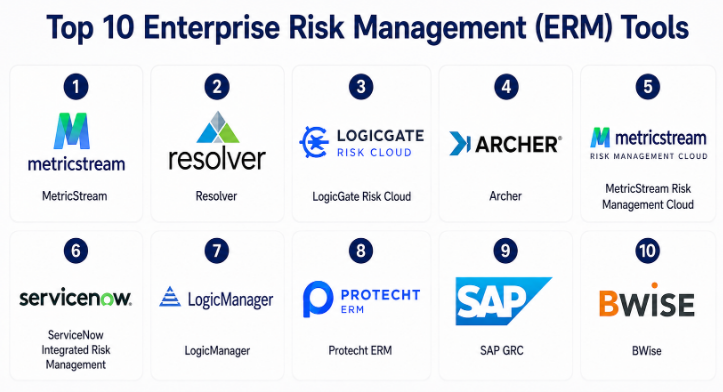
#1 — MetricStream
Short description: MetricStream is a leading ERM platform used by enterprises to manage operational, financial, strategic, and compliance risks. It enables centralized risk registers, dashboards, scenario planning, incident tracking, control assessment, and audit management. MetricStream is particularly suited for large organizations with complex risk management needs that require both ERM and GRC capabilities in a single platform.
Key Features
- Enterprise risk register and scoring.
- Incident and issue management.
- Compliance and control tracking.
- Audit management workflows.
- Scenario modeling and risk simulation.
- Dashboards and executive reporting.
- Workflow automation for mitigation and approvals.
Pros
- Comprehensive ERM and GRC coverage.
- Strong analytics and reporting capabilities.
- Suitable for large, complex enterprises.
Cons
- Implementation can be resource-intensive.
- Configuration complexity for smaller teams.
- Requires trained administrators for advanced features.
Platforms / Deployment
- Web
- Cloud / Hybrid
Security & Compliance
Not publicly stated.
Integrations & Ecosystem
Supports integration with ERP, finance, HR, EHS, and compliance systems. APIs allow data exchange with dashboards and BI platforms.
Support & Community
Enterprise support, training programs, and implementation assistance available. Customer community mainly enterprise-focused.
#2 — Resolver
Short description: Resolver is an ERM platform that provides operational risk, incident management, and compliance tracking. It allows organizations to consolidate risk data, streamline workflows, manage controls, and create executive dashboards. Resolver is well suited for mid-market and enterprise organizations needing centralized operational risk and audit management. Its flexibility allows organizations to adapt workflows to industry-specific risk needs.
Key Features
- Incident and issue tracking.
- Risk assessment and scoring.
- Compliance and control monitoring.
- Audit workflow management.
- Executive dashboards and reporting.
- Automated alerts and workflows.
- Risk intelligence analytics.
Pros
- Strong operational and incident management.
- Flexible for multiple industries.
- Executive reporting and dashboards are easy to configure.
Cons
- Insurance-focused RMIS features may be limited.
- Customization may require additional setup.
- May not include advanced scenario modeling by default.
Platforms / Deployment
- Web
- Cloud
Security & Compliance
Not publicly stated.
Integrations & Ecosystem
Resolver can integrate with HR, finance, EHS, and GRC systems. Supports workflow automation and executive reporting tools.
Support & Community
Documentation, onboarding, and enterprise-level support available. Community interaction is limited to customer and partner channels.
#3 — LogicGate Risk Cloud
Short description: LogicGate Risk Cloud is a flexible ERM platform designed for risk, compliance, and audit teams. Its no-code workflow configuration allows organizations to create custom risk assessments, incident management, control testing, and reporting processes. LogicGate is best suited for mid-market and growing enterprises seeking adaptable ERM workflows without heavy IT dependency.
Key Features
- Customizable risk workflows.
- Enterprise risk assessment.
- Control and compliance management.
- Incident and issue tracking.
- Dashboards and analytics.
- Workflow automation.
- Reporting for executives and risk teams.
Pros
- Highly configurable workflows.
- No-code platform reduces IT dependency.
- Quick to adapt to organizational needs.
Cons
- May lack deep scenario modeling for large portfolios.
- Limited out-of-the-box industry-specific modules.
- Advanced analytics may require configuration effort.
Platforms / Deployment
- Web
- Cloud
Security & Compliance
Not publicly stated.
Integrations & Ecosystem
Supports API integration with HR, finance, GRC, and ERP systems. Enables workflow automation and reporting integration.
Support & Community
Enterprise support and onboarding available. Customer community is moderate, mostly through product resources and training.
#4 — Archer
Short description: Archer provides a highly configurable GRC and ERM platform used by large enterprises to manage risk, compliance, audit, third-party risk, and operational issues. While Archer is not a traditional RMIS, many organizations use it for ERM workflows including risk registers, incident tracking, reporting, and scenario modeling. Its strength is flexibility and support for regulated environments, making it suitable for industries like finance, healthcare, and energy.
Key Features
- Enterprise risk registers and scoring.
- Compliance and control management.
- Audit and issue tracking.
- Third-party and vendor risk workflows.
- Scenario planning and simulation.
- Dashboards and executive reporting.
- Workflow automation.
Pros
- Highly configurable for large, complex organizations.
- Strong audit and compliance support.
- Excellent for regulated industries.
Cons
- Implementation is complex and time-intensive.
- Requires trained administrators.
- Can be overkill for smaller organizations.
Platforms / Deployment
- Web
- Cloud / Hybrid
Security & Compliance
Not publicly stated.
Integrations & Ecosystem
Supports GRC, ERP, HR, finance, and business intelligence integrations. Enables enterprise-wide risk consolidation.
Support & Community
Enterprise-level support, professional services, and partner ecosystem available. Community engagement is mostly enterprise-focused.
#5 — MetricStream Risk Management Cloud
Short description: MetricStream Risk Management Cloud is a modern SaaS ERM solution that provides risk registers, issue management, audit and control management, scenario analysis, and dashboards. It helps enterprises integrate risk, compliance, and operational data into a single system for better decision-making. Its cloud-first approach allows scalability and rapid deployment.
Key Features
- Risk register and scoring.
- Incident and issue management.
- Audit and compliance tracking.
- Scenario planning and modeling.
- Dashboards for risk reporting.
- Workflow automation for approvals.
- Vendor and third-party risk management.
Pros
- Cloud-first deployment simplifies access and updates.
- Strong enterprise reporting.
- Integrated operational risk workflows.
Cons
- Complex configuration may require professional services.
- May be too advanced for small teams.
- Integration with legacy systems can require effort.
Platforms / Deployment
- Web
- Cloud
Security & Compliance
Not publicly stated.
Integrations & Ecosystem
Supports ERP, HR, finance, and BI integrations. Workflow and reporting APIs enable enterprise data flow.
Support & Community
Enterprise support, implementation guidance, and training resources available.
#6 — ServiceNow Integrated Risk Management
Short description: ServiceNow Integrated Risk Management (IRM) helps organizations manage enterprise risks, compliance, audits, vendor exposures, and operational workflows within the broader ServiceNow ecosystem. Its strength is workflow automation, enterprise integration, and centralized risk reporting, making it particularly attractive to organizations already using ServiceNow for IT, security, or business operations.
Key Features
- Risk registers and scoring.
- Control and compliance workflows.
- Incident and issue tracking.
- Audit and assessment management.
- Dashboards and executive reporting.
- Vendor and third-party risk modules.
- Workflow automation across risk processes.
Pros
- Strong workflow integration for enterprises.
- Connects risk management with IT and operations.
- Centralized reporting and dashboards.
Cons
- Requires familiarity with ServiceNow platform.
- Implementation can be complex for large enterprises.
- May need configuration for ERM-specific features.
Platforms / Deployment
- Web
- Cloud
Security & Compliance
Not publicly stated.
Integrations & Ecosystem
Supports IT, HR, ERP, security, GRC, and reporting integration via APIs.
Support & Community
Enterprise support, documentation, and partner ecosystem available. Community is large due to ServiceNow platform.
#7 — LogicManager
Short description: LogicManager is an ERM platform focused on risk, compliance, audit, and governance workflows. It helps organizations centralize risk data, automate assessments, manage incidents, and create dashboards for executives. LogicManager is well suited for mid-market and enterprise organizations seeking an easy-to-use, configurable risk management platform with strong reporting.
Key Features
- Risk register and assessment.
- Incident and issue management.
- Compliance tracking and workflow automation.
- Audit and control management.
- Vendor and third-party risk modules.
- Dashboards and reporting.
- Workflow and task automation.
Pros
- Configurable for multiple industries.
- User-friendly interface.
- Effective for risk reporting and mitigation tracking.
Cons
- May require configuration for advanced scenario modeling.
- Smaller customer base than enterprise-focused competitors.
- Integration depth varies by organization.
Platforms / Deployment
- Web
- Cloud
Security & Compliance
Not publicly stated.
Integrations & Ecosystem
Supports ERP, finance, HR, and BI integration for reporting and risk workflows.
Support & Community
Documentation, onboarding, and customer support available. Community interaction is moderate.
#8 — Protecht ERM
Short description: Protecht ERM provides a structured platform for enterprise risk, operational risk, compliance, and audit management. It centralizes risk data, enables scoring, supports mitigation tracking, and provides dashboards for executives. It is suitable for enterprises replacing spreadsheets and manual processes with structured risk governance.
Key Features
- Enterprise risk registers and scoring.
- Incident and issue management.
- Control and compliance tracking.
- Audit workflows and reporting.
- Mitigation action tracking.
- Dashboards and analytics.
- Workflow automation.
Pros
- Strong enterprise risk focus.
- Structured workflow and reporting capabilities.
- Useful for replacing spreadsheet-based processes.
Cons
- May not include deep GRC modules out of the box.
- Setup requires planning and configuration.
- Advanced analytics may need configuration.
Platforms / Deployment
- Web
- Cloud
Security & Compliance
Not publicly stated.
Integrations & Ecosystem
Supports integration with finance, HR, ERP, and reporting systems via APIs.
Support & Community
Customer support and onboarding available. Community mostly enterprise-focused.
#9 — SAP GRC (Risk Management Module)
Short description: SAP GRC provides ERM capabilities as part of the broader GRC suite. Organizations use it for enterprise risk, operational risk, compliance, controls, and audit workflows. It is particularly attractive to companies already using SAP ERP for integrated risk and compliance management. SAP GRC enables workflow automation, dashboards, and reporting to support enterprise risk governance.
Key Features
- Enterprise and operational risk management.
- Compliance and control tracking.
- Audit and issue workflows.
- Reporting and dashboards.
- Risk scoring and prioritization.
- Integration with SAP ERP modules.
- Workflow automation.
Pros
- Deep integration with SAP ERP systems.
- Strong audit and compliance support.
- Enterprise-scale risk management.
Cons
- May be complex for non-SAP environments.
- Implementation is resource-intensive.
- Less flexible for smaller organizations.
Platforms / Deployment
- Web
- Cloud / Hybrid
Security & Compliance
Not publicly stated.
Integrations & Ecosystem
Integrates with SAP ERP, finance, HR, and reporting systems.
Support & Community
Enterprise support, professional services, and documentation available.
#10 — BWise (SAS GRC)
Short description: BWise is an ERM and GRC platform focused on enterprise risk, compliance, internal controls, and audit management. It centralizes risk data, provides workflows, dashboards, and reporting for executives, risk managers, and auditors. It is suitable for organizations seeking integrated risk management for multiple domains including operational, financial, and regulatory risks.
Key Features
- Enterprise risk register and scoring.
- Incident and issue management.
- Compliance and control monitoring.
- Audit and assurance workflows.
- Dashboards and executive reporting.
- Workflow automation.
- Risk scenario and mitigation tracking.
Pros
- Strong enterprise GRC and risk coverage.
- Effective dashboards and reporting.
- Useful for multiple risk domains.
Cons
- Implementation can be lengthy.
- Requires expertise to configure workflows and dashboards.
- Smaller organizations may find it complex.
Platforms / Deployment
- Web
- Cloud / Hybrid
Security & Compliance
Not publicly stated.
Comparison Table Top 10
| Tool Name | Best For | Platform(s) Supported | Deployment | Standout Feature | Public Rating |
|---|---|---|---|---|---|
| MetricStream | Large enterprises with integrated ERM & GRC | Web | Cloud / Hybrid | Broad risk and compliance coverage | N/A |
| Resolver | Mid-market to enterprise operational risk | Web | Cloud | Incident-led ERM visibility | N/A |
| LogicGate Risk Cloud | Flexible ERM workflows | Web | Cloud | Configurable no-code workflows | N/A |
| Archer | Enterprise GRC-heavy organizations | Web | Cloud / Hybrid | Highly configurable | N/A |
| MetricStream Risk Management Cloud | Cloud-first enterprise ERM | Web | Cloud | Scalable cloud deployment | N/A |
| ServiceNow IRM | Enterprises using ServiceNow ecosystem | Web | Cloud | Integration with IT & operations | N/A |
| LogicManager | Mid-market ERM and audit | Web | Cloud | User-friendly and configurable | N/A |
| Protecht ERM | Enterprise operational and risk teams | Web | Cloud | Structured ERM & reporting | N/A |
| SAP GRC Risk Module | SAP ERP enterprises | Web | Cloud / Hybrid | ERP-integrated risk management | N/A |
| BWise (SAS GRC) | Enterprise compliance and audit-heavy organizations | Web | Cloud / Hybrid | Multi-domain risk and compliance | N/A |
Evaluation & ERM Tools
| Tool Name | Core 25% | Ease 15% | Integrations 15% | Security 10% | Performance 10% | Support 10% | Value 15% | Weighted Total 0–10 |
|---|---|---|---|---|---|---|---|---|
| MetricStream | 9 | 6 | 8 | 7 | 8 | 8 | 7 | 7.85 |
| Resolver | 8 | 7 | 7 | 7 | 8 | 7 | 7 | 7.35 |
| LogicGate Risk Cloud | 8 | 8 | 7 | 7 | 7 | 7 | 7 | 7.50 |
| Archer | 9 | 6 | 8 | 7 | 8 | 8 | 7 | 7.70 |
| MetricStream Risk Management Cloud | 9 | 7 | 8 | 7 | 8 | 8 | 7 | 7.90 |
| ServiceNow IRM | 8 | 7 | 9 | 7 | 8 | 8 | 7 | 7.80 |
| LogicManager | 8 | 8 | 7 | 7 | 7 | 7 | 7 | 7.60 |
| Protecht ERM | 8 | 7 | 7 | 7 | 7 | 7 | 7 | 7.35 |
| SAP GRC | 9 | 6 | 8 | 7 | 8 | 8 | 7 | 7.70 |
| BWise | 9 | 6 | 8 | 7 | 8 | 8 | 7 | 7.70 |
Scores are comparative; a higher score indicates relative suitability for enterprises with complex ERM needs. Buyers should consider fit for their organization, integrations, workflow complexity, and reporting needs.
Which Enterprise Risk Management Tools
Solo / Freelancer
Smaller consultants may not need full ERM platforms. Lightweight risk registers or configurable workflow tools like LogicGate or LogicManager may suffice.
SMB
Mid-sized organizations may need centralized dashboards, incident tracking, and basic reporting. Resolver, LogicGate, or Protecht ERM are good options.
Mid-Market
Requires deeper dashboards, scenario analysis, workflow automation, and executive reporting. MetricStream, Resolver, LogicGate, LogicManager, or Protecht ERM are suitable.
Enterprise
Large companies need scalable platforms supporting risk, compliance, audit, and incident workflows. MetricStream, Archer, SAP GRC, ServiceNow IRM, and BWise are strong options.
Budget vs Premium
Budget: LogicGate, LogicManager, Resolver.
Premium: MetricStream, Archer, ServiceNow IRM, SAP GRC, BWise.
Feature Depth vs Ease of Use
Deep features: MetricStream, Archer, SAP GRC, BWise.
Ease of use: LogicGate, LogicManager, Protecht ERM.
Integrations & Scalability
Enterprise platforms (MetricStream, Archer, SAP GRC) scale to thousands of users, integrate with ERP, HR, finance, GRC, and EHS systems. Mid-market tools may need custom integrations.
Security & Compliance Needs
Verify encryption, SSO/MFA, audit logs, RBAC, and data retention. Enterprise tools often include certifications; others may require vendor validation.
Frequently Asked Questions (FAQs)
1. What is an ERM tool?
An ERM tool centralizes enterprise risk management processes including risk identification, assessment, monitoring, mitigation, and reporting.
2. Who uses ERM tools?
Risk managers, compliance teams, internal audit, legal, finance, safety, and operational leaders use ERM tools to monitor and mitigate organizational risks.
3. How is ERM different from RMIS?
ERM covers enterprise-level strategic, operational, and financial risk, while RMIS is often focused on insurance, claims, and operational incidents.
4. Can ERM replace spreadsheets?
Yes, ERM platforms centralize risk data, provide workflows, dashboards, and reporting, eliminating manual spreadsheets for enterprise-scale risk management.
5. Are cloud ERM tools better than on-prem?
Cloud tools offer scalability, remote access, and faster updates. On-prem is preferred for strict data control or internal IT requirements.
6. How long does ERM implementation take?
Deployment can range from a few weeks for mid-market tools to several months for enterprise platforms due to configuration, workflows, integrations, and data migration.
7. What are common mistakes when choosing ERM?
Not defining workflows, ignoring integrations, underestimating training needs, poor stakeholder involvement, and selecting a platform too complex or too simple.
8. Can ERM integrate with other systems?
Yes, most ERM platforms integrate with ERP, HR, finance, GRC, EHS, BI, and operational systems to streamline risk workflows.
9. Are ERM dashboards useful?
Yes, dashboards help executives monitor risk trends, incident counts, controls effectiveness, insurance exposures, and operational vulnerabilities in real time.
10. What alternatives exist?
Alternatives include spreadsheets, project management software, compliance checklists, GRC platforms, or custom databases. They may work for simple workflows but not for enterprise-scale risk management.
Conclusion
Enterprise Risk Management (ERM) tools enable organizations to consolidate risk data, improve visibility, standardize workflows, and provide actionable insights to executives and risk teams. There is no single “best” platform; the ideal tool depends on organizational size, risk maturity, integration needs, workflow complexity, and budget. MetricStream, Archer, ServiceNow IRM, and SAP GRC are strong for enterprise-grade ERM and GRC integration, while LogicGate, LogicManager, Resolver, and Protecht ERM provide flexible, configurable workflows for mid-market and growing organizations.
