Introduction
Healthcare Interoperability APIs help healthcare systems, applications, providers, payers, labs, pharmacies, and digital health platforms exchange clinical and administrative data in a structured way. In simple words, these APIs allow different healthcare software systems to “talk to each other” using common standards such as HL7, FHIR, CDA, DICOM, X12, SMART on FHIR, and terminology services.
These tools matter because healthcare data is often locked inside different systems. A hospital may use one EHR, a lab may use another system, a payer may use a claims platform, and a patient app may need secure access to clinical records. Interoperability APIs help connect these systems so that patient data can move more safely, faster, and with better meaning.
Common use cases include EHR integration, patient record exchange, lab result exchange, claims data access, care coordination, patient app connectivity, digital front door platforms, public health reporting, clinical decision support, and healthcare analytics.
Buyers should evaluate FHIR support, HL7 support, API documentation, authentication, consent management, terminology mapping, scalability, security, developer experience, EHR connectivity, monitoring, and compliance readiness.
Best for: Hospitals, health systems, EHR vendors, payer organizations, digital health startups, health information exchanges, healthcare SaaS companies, public health platforms, care coordination teams, and healthcare data engineering teams.
Not ideal for: Very small clinics that only need basic EHR usage, teams with no integration requirements, or organizations that only need manual file uploads instead of real-time healthcare data exchange.
Key Trends in Healthcare Interoperability APIs HL7/FHIR
- FHIR-first healthcare platforms are becoming more common, especially for digital health apps, patient access, care coordination, and modern healthcare data exchange.
- SMART on FHIR adoption is growing, allowing apps to launch securely inside or alongside EHR workflows.
- API-based interoperability is replacing older point-to-point integrations, although HL7 v2 is still widely used in hospitals, labs, and clinical operations.
- Patient access APIs are becoming more important, especially for patient-facing apps, digital front doors, care navigation, and consumer health platforms.
- Payer-provider data exchange is expanding, with APIs used for prior authorization, claims, eligibility, quality reporting, and care gap workflows.
- Terminology services are becoming more important, because clean data exchange depends on consistent use of code systems and value sets.
- Cloud-based interoperability platforms are growing, helping healthcare organizations scale integrations without building everything from scratch.
- API security is a top priority, including OAuth, OpenID Connect, consent controls, audit logs, role-based access, encryption, and monitoring.
- Event-driven healthcare integration is increasing, using notifications, subscriptions, and real-time updates for admissions, discharges, lab results, and care events.
- AI-ready healthcare data pipelines depend on interoperability, because analytics and AI tools need clean, normalized, well-governed clinical data.
How We Selected These Tools
- We selected tools that are widely recognized for healthcare interoperability, HL7 integration, FHIR APIs, EHR connectivity, or healthcare data exchange.
- We considered fit for providers, payers, digital health companies, health systems, health information exchanges, and healthcare SaaS vendors.
- We prioritized platforms that support real-world integration workflows such as FHIR APIs, HL7 v2 messaging, terminology services, patient access, clinical data exchange, and data normalization.
- We included both enterprise-grade interoperability platforms and developer-friendly API platforms.
- We considered support for security, authentication, consent, auditability, monitoring, and healthcare compliance requirements.
- We looked at developer experience, documentation quality, scalability, EHR connectivity, and ability to support production healthcare workflows.
- We avoided guessing public ratings, certifications, or security claims where details are uncertain.
- We used N/A, Varies / N/A, and Not publicly stated where details are not confidently known.
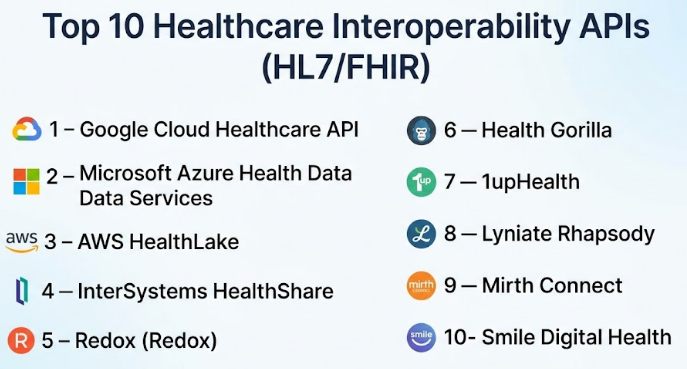
#1 — Google Cloud Healthcare API
Short description: Google Cloud Healthcare API is a cloud-based healthcare data platform that helps organizations manage and exchange healthcare data using standards such as FHIR, HL7 v2, and DICOM. It is useful for hospitals, health systems, research teams, analytics teams, and healthcare technology companies that need scalable healthcare data storage, APIs, and integration with cloud analytics. The platform is a strong fit for organizations that want to build modern healthcare data pipelines, application integrations, and AI-ready data environments.
Key Features
- FHIR data store support.
- HL7 v2 message ingestion.
- DICOM data management.
- RESTful API access.
- Cloud-native scalability.
- Integration with analytics and data tools.
- Healthcare data de-identification and processing options.
Pros
- Strong cloud scalability for healthcare data projects.
- Useful for analytics, research, and application development.
- Supports multiple healthcare data standards in one platform.
Cons
- Requires cloud and healthcare data engineering skills.
- Not a plug-and-play EHR integration solution for every workflow.
- Cost can vary based on storage, API usage, and cloud services.
Platforms / Deployment
Web / API
Cloud
Security & Compliance
Google Cloud environments commonly provide identity management, encryption, audit logging, and access controls. Specific healthcare compliance details depend on configuration, region, and customer agreement. Compliance details: Varies / N/A.
Integrations & Ecosystem
Google Cloud Healthcare API works well for cloud-native healthcare data platforms and analytics workflows.
- FHIR API integrations.
- HL7 v2 ingestion.
- DICOM imaging workflows.
- Cloud data warehouse connections.
- AI and analytics tools.
- Identity and access management integrations.
Support & Community
Support depends on the Google Cloud support plan and partner ecosystem. Documentation and developer resources are strong, but production healthcare implementations usually need experienced cloud and healthcare integration teams.
#2 — Microsoft Azure Health Data Services
Short description: Microsoft Azure Health Data Services provides managed healthcare APIs and data services for FHIR, DICOM, and healthcare data exchange use cases. It is useful for healthcare organizations, payers, research teams, and software vendors building cloud-based healthcare applications and analytics platforms. The service works well for organizations already using Microsoft Azure, Microsoft identity services, and enterprise cloud environments. It is a strong option for teams that need secure, scalable healthcare data APIs with cloud ecosystem support.
Key Features
- Managed FHIR service.
- DICOM service support.
- Healthcare data APIs.
- Cloud-based scalability.
- Identity and access integration.
- Analytics and data platform connectivity.
- Healthcare data management workflows.
Pros
- Strong fit for Microsoft Azure environments.
- Good for cloud-based healthcare apps and analytics.
- Useful for organizations standardizing on FHIR APIs.
Cons
- Requires Azure skills and healthcare integration planning.
- Not a complete end-to-end integration platform by itself.
- Pricing depends on usage, storage, and related Azure services.
Platforms / Deployment
Web / API
Cloud
Security & Compliance
Azure environments commonly support identity controls, encryption, access management, monitoring, and audit-related capabilities. Specific healthcare compliance depends on configuration and customer agreement. Compliance details: Varies / N/A.
Integrations & Ecosystem
Azure Health Data Services connects well with Microsoft cloud, analytics, security, and development tools.
- FHIR API integrations.
- DICOM workflows.
- Azure analytics tools.
- Identity and access systems.
- Application development platforms.
- Data lake and reporting workflows.
Support & Community
Microsoft provides documentation, cloud support plans, partner support, and a large developer ecosystem. Healthcare implementation success depends on architecture, data governance, and integration planning.
#3 — AWS HealthLake
Short description: AWS HealthLake is a cloud-based service for storing, transforming, querying, and analyzing healthcare data using FHIR-based data models. It is useful for healthcare providers, payers, analytics teams, and life sciences organizations that need to manage large healthcare datasets in a cloud environment. The platform can support clinical data search, analytics, machine learning workflows, and application development. It is best for teams already invested in AWS and looking to build healthcare data platforms around FHIR.
Key Features
- FHIR-based healthcare data store.
- Healthcare data ingestion.
- Search and query capabilities.
- Analytics and machine learning integration.
- Cloud-native scalability.
- Data transformation support.
- Integration with AWS services.
Pros
- Good fit for AWS-based healthcare data platforms.
- Useful for analytics and machine learning workflows.
- Scales for large healthcare datasets.
Cons
- Requires AWS cloud expertise.
- Not a simple low-code integration platform.
- Integration with live EHR workflows may require additional tools.
Platforms / Deployment
Web / API
Cloud
Security & Compliance
AWS environments commonly support encryption, access controls, monitoring, logging, and identity management. Specific healthcare compliance depends on service configuration and customer agreement. Compliance details: Varies / N/A.
Integrations & Ecosystem
AWS HealthLake fits well into AWS analytics, storage, security, and application development ecosystems.
- FHIR API workflows.
- Data lake integration.
- Analytics and BI tools.
- Machine learning services.
- Identity and access management.
- Application development pipelines.
Support & Community
AWS provides documentation, cloud support plans, partner resources, and a broad developer community. Healthcare teams usually need cloud architects and healthcare data experts for production deployment.
#4 — InterSystems HealthShare
Short description: InterSystems HealthShare is a healthcare interoperability and information exchange platform used by health systems, regional networks, and healthcare organizations that need connected patient records across multiple systems. It supports clinical data exchange, health information exchange, patient indexing, analytics, and interoperability workflows. HealthShare is useful for organizations that need enterprise-scale interoperability, longitudinal records, and data sharing across care networks.
Key Features
- Health information exchange support.
- Clinical data integration.
- Patient identity management.
- FHIR and HL7 interoperability support.
- Longitudinal patient record capabilities.
- Analytics and reporting support.
- Enterprise healthcare data sharing.
Pros
- Strong fit for large health systems and care networks.
- Useful for building longitudinal patient records.
- Mature healthcare interoperability focus.
Cons
- May be too large for small digital health teams.
- Implementation can be complex.
- Best suited for enterprise healthcare environments.
Platforms / Deployment
Web / Varies / N/A
Cloud / Self-hosted / Hybrid / Varies / N/A
Security & Compliance
Security capabilities may include access control, audit trails, identity management, and controlled data sharing. Specific certifications: Not publicly stated.
Integrations & Ecosystem
InterSystems HealthShare is designed for healthcare-wide interoperability and data sharing.
- EHR integration.
- HL7 messaging.
- FHIR APIs.
- Health information exchange workflows.
- Patient identity systems.
- Analytics and reporting platforms.
Support & Community
InterSystems provides enterprise support, implementation services, documentation, and partner resources. Community strength is strongest among healthcare interoperability professionals and enterprise users.
#5 — Redox
Short description: Redox is a healthcare integration platform that helps digital health companies, healthcare SaaS vendors, and provider organizations connect with EHRs and healthcare systems. It supports modern API-based workflows and helps reduce the burden of building custom point-to-point healthcare integrations. Redox is a strong fit for product teams that need EHR connectivity, data exchange workflows, and faster integration with healthcare customers.
Key Features
- EHR integration support.
- FHIR and HL7 workflow support.
- API-based healthcare data exchange.
- Integration monitoring.
- Data normalization workflows.
- Partner connectivity.
- Developer-friendly integration tools.
Pros
- Strong fit for digital health vendors.
- Helps reduce custom integration burden.
- Useful for EHR connectivity and API-based workflows.
Cons
- May not replace a full enterprise interoperability platform.
- Cost and scope depend on integration volume and use case.
- Some workflows may still require customer-specific work.
Platforms / Deployment
Web / API
Cloud
Security & Compliance
Security capabilities may include access control, encryption, audit-related features, and secure data exchange. Specific certifications: Not publicly stated.
Integrations & Ecosystem
Redox is designed to connect healthcare applications with provider systems and EHR environments.
- EHR connectivity.
- HL7 workflows.
- FHIR API workflows.
- Scheduling and patient data exchange.
- Order and result workflows.
- Developer API ecosystem.
Support & Community
Redox provides developer documentation, integration support, onboarding assistance, and customer success resources. Community strength is stronger among digital health builders and healthcare integration teams.
#6 — Health Gorilla
Short description: Health Gorilla is a healthcare interoperability platform focused on clinical data exchange, patient data access, provider connectivity, and network-based healthcare information sharing. It helps healthcare companies access and exchange clinical records across provider networks, labs, and other healthcare sources. The platform is useful for digital health companies, care management organizations, payers, providers, and healthcare platforms that need broad clinical data access and exchange workflows.
Key Features
- Clinical data exchange.
- Patient record access.
- Provider network connectivity.
- FHIR API support.
- Lab and diagnostic data workflows.
- Identity and access workflows.
- Care coordination support.
Pros
- Useful for broad clinical data access.
- Good fit for digital health and care management platforms.
- Supports network-based interoperability use cases.
Cons
- Use case fit should be carefully validated.
- Data availability may depend on network and partner coverage.
- Pricing and access terms should be reviewed directly.
Platforms / Deployment
Web / API
Cloud
Security & Compliance
Security features may include access controls, secure data exchange, and audit-related capabilities. Specific certifications: Not publicly stated.
Integrations & Ecosystem
Health Gorilla supports healthcare data exchange across clinical networks and application workflows.
- FHIR API integration.
- Clinical record exchange.
- Lab data workflows.
- Provider network access.
- Care coordination systems.
- Digital health platform integrations.
Support & Community
Health Gorilla provides vendor-led support, documentation, onboarding, and customer success resources. Public community strength is limited, but platform relevance is strong in healthcare data exchange.
#7 — 1upHealth
Short description: 1upHealth provides healthcare interoperability APIs focused on FHIR data access, patient data exchange, payer-provider workflows, and healthcare data platforms. It is useful for payers, providers, digital health companies, and healthcare technology teams that need API-driven access to clinical and claims-related data. The platform is a strong fit for organizations that want to build modern healthcare apps, analytics workflows, and interoperability solutions around FHIR.
Key Features
- FHIR API support.
- Healthcare data access.
- Patient data exchange.
- Payer-provider interoperability workflows.
- Data platform capabilities.
- Developer API support.
- Data normalization support.
Pros
- Strong fit for FHIR-first healthcare applications.
- Useful for payer and provider data exchange.
- Developer-friendly API approach.
Cons
- May require technical implementation expertise.
- Some use cases may need additional data governance work.
- Product fit should be validated for each workflow.
Platforms / Deployment
Web / API
Cloud
Security & Compliance
Security and compliance details vary by implementation and customer agreement. Specific certifications: Not publicly stated.
Integrations & Ecosystem
1upHealth supports FHIR-based data exchange and healthcare application development.
- FHIR API workflows.
- Patient access workflows.
- Payer data exchange.
- Provider data connectivity.
- Analytics data pipelines.
- Developer integrations.
Support & Community
1upHealth provides documentation, customer support, onboarding, and implementation guidance. Community strength is stronger among FHIR developers and healthcare technology teams.
#8 — Lyniate Rhapsody
Short description: Lyniate Rhapsody is a healthcare integration engine used by hospitals, labs, health systems, and healthcare organizations to connect systems using standards such as HL7, FHIR, and other healthcare messaging formats. It is useful for teams that need message routing, transformation, interface monitoring, and reliable healthcare integration operations. Rhapsody is best suited for organizations with mature interface teams and production healthcare integration needs.
Key Features
- Healthcare integration engine.
- HL7 message routing.
- FHIR support.
- Message transformation.
- Interface monitoring.
- Error handling and alerts.
- System-to-system integration workflows.
Pros
- Strong fit for healthcare interface teams.
- Useful for HL7-heavy environments.
- Good for operational message routing and monitoring.
Cons
- Requires integration engine expertise.
- May not be ideal for digital health teams wanting only simple APIs.
- Setup and maintenance can require skilled resources.
Platforms / Deployment
Web / Windows / Linux / Varies / N/A
Self-hosted / Hybrid / Cloud / Varies / N/A
Security & Compliance
Security details vary by deployment and customer environment. Specific certifications: Not publicly stated.
Integrations & Ecosystem
Rhapsody is designed to connect healthcare systems through structured message workflows.
- HL7 v2 interfaces.
- FHIR integrations.
- Lab system connections.
- EHR integrations.
- Message transformation.
- Monitoring and alerting workflows.
Support & Community
Support is enterprise and vendor-led, with documentation, implementation help, and healthcare integration expertise. Community is strongest among interface engine professionals.
#9 — Mirth Connect
Short description: Mirth Connect is a healthcare integration engine commonly used for HL7 messaging, interface development, message transformation, routing, and healthcare system integration. It is popular among healthcare integration teams because it provides flexibility for building and managing interfaces. Mirth Connect is useful for hospitals, labs, clinics, health IT vendors, and developers working with HL7-heavy environments.
Key Features
- HL7 interface engine.
- Message routing.
- Message transformation.
- Channel-based integration workflows.
- Support for multiple protocols.
- Monitoring and logging.
- Custom scripting support.
Pros
- Flexible for healthcare interface development.
- Widely recognized among HL7 integration teams.
- Useful for custom healthcare data workflows.
Cons
- Requires technical interface skills.
- Maintenance depends on internal expertise.
- FHIR-first workflows may require additional planning.
Platforms / Deployment
Windows / Linux / macOS / Varies / N/A
Self-hosted / Cloud / Hybrid / Varies / N/A
Security & Compliance
Security details vary by deployment and configuration. Specific certifications: Not publicly stated.
Integrations & Ecosystem
Mirth Connect can connect different healthcare systems through configurable interface channels.
- HL7 v2 interfaces.
- EHR connections.
- Lab system connections.
- Database integrations.
- File and API workflows.
- Custom transformation scripts.
Support & Community
Mirth Connect has a broad healthcare integration user base and strong recognition among interface developers. Support options depend on the edition, vendor arrangement, and internal technical capability.
#10 — Smile Digital Health
Short description: Smile Digital Health provides a healthcare data and interoperability platform focused on FHIR, clinical data repositories, terminology services, and healthcare data exchange. It is useful for payers, providers, health information exchanges, digital health companies, and governments that need scalable FHIR-based infrastructure. The platform is a strong fit for organizations building modern interoperability layers, healthcare data platforms, and digital health ecosystems.
Key Features
- FHIR server capabilities.
- Clinical data repository support.
- Terminology services.
- API-based healthcare data exchange.
- Data normalization workflows.
- Security and access control support.
- Scalable interoperability architecture.
Pros
- Strong FHIR platform focus.
- Useful for enterprise interoperability programs.
- Good fit for healthcare data platform modernization.
Cons
- Requires technical implementation planning.
- May be more advanced than small teams need.
- Deployment and package details should be validated.
Platforms / Deployment
Web / API / Varies / N/A
Cloud / Self-hosted / Hybrid / Varies / N/A
Security & Compliance
Security capabilities may include access control, identity integration, audit logging, and secure API workflows. Specific certifications: Not publicly stated.
Integrations & Ecosystem
Smile Digital Health supports FHIR-first healthcare interoperability and data platform workflows.
- FHIR API integration.
- Terminology services.
- Clinical data repositories.
- EHR integration workflows.
- Analytics and reporting pipelines.
- Healthcare application development.
Support & Community
Smile Digital Health provides enterprise support, implementation guidance, documentation, and professional services. Community strength is strongest among FHIR, healthcare platform, and interoperability teams.
Comparison Table
| Tool Name | Best For | Platform(s) Supported | Deployment | Standout Feature | Public Rating |
|---|---|---|---|---|---|
| Google Cloud Healthcare API | Cloud healthcare data platforms | Web / API | Cloud | FHIR, HL7 v2, and DICOM in cloud data workflows | N/A |
| Microsoft Azure Health Data Services | Microsoft-based healthcare cloud teams | Web / API | Cloud | Managed FHIR and DICOM services | N/A |
| AWS HealthLake | AWS healthcare analytics and FHIR data | Web / API | Cloud | FHIR-based healthcare data lake workflows | N/A |
| InterSystems HealthShare | Enterprise health information exchange | Web / Varies | Cloud / Self-hosted / Hybrid / Varies | Longitudinal patient record and HIE workflows | N/A |
| Redox | Digital health EHR integration | Web / API | Cloud | Developer-friendly healthcare integration platform | N/A |
| Health Gorilla | Clinical data exchange networks | Web / API | Cloud | Network-based clinical record access | N/A |
| 1upHealth | FHIR-first payer and provider APIs | Web / API | Cloud | FHIR API data access workflows | N/A |
| Lyniate Rhapsody | Hospital interface teams | Web / Windows / Linux / Varies | Self-hosted / Hybrid / Cloud / Varies | HL7 message routing and transformation | N/A |
| Mirth Connect | Custom HL7 interface development | Windows / Linux / macOS / Varies | Self-hosted / Cloud / Hybrid / Varies | Flexible HL7 interface engine | N/A |
| Smile Digital Health | FHIR infrastructure and data platforms | Web / API / Varies | Cloud / Self-hosted / Hybrid / Varies | Enterprise FHIR platform capabilities | N/A |
Evaluation & Healthcare Interoperability APIs HL7/FHIR
| Tool Name | Core (25%) | Ease (15%) | Integrations (15%) | Security (10%) | Performance (10%) | Support (10%) | Value (15%) | Weighted Total |
|---|---|---|---|---|---|---|---|---|
| Google Cloud Healthcare API | 9 | 7 | 9 | 8 | 9 | 8 | 8 | 8.25 |
| Microsoft Azure Health Data Services | 9 | 7 | 9 | 8 | 9 | 8 | 8 | 8.25 |
| AWS HealthLake | 8 | 7 | 8 | 8 | 9 | 8 | 8 | 8.00 |
| InterSystems HealthShare | 9 | 6 | 9 | 8 | 9 | 9 | 7 | 8.15 |
| Redox | 8 | 8 | 9 | 8 | 8 | 8 | 7 | 8.00 |
| Health Gorilla | 8 | 8 | 8 | 8 | 8 | 8 | 7 | 7.85 |
| 1upHealth | 8 | 8 | 8 | 7 | 8 | 7 | 8 | 7.75 |
| Lyniate Rhapsody | 8 | 6 | 9 | 7 | 8 | 8 | 7 | 7.65 |
| Mirth Connect | 8 | 6 | 8 | 7 | 8 | 7 | 8 | 7.55 |
| Smile Digital Health | 9 | 7 | 9 | 8 | 8 | 8 | 7 | 8.10 |
These scores are comparative and should be used as a starting point. A cloud healthcare API platform may score high for scalability and analytics, while an interface engine may be better for hospital HL7 operations. A developer-friendly API platform may be ideal for digital health vendors, while a full health information exchange platform may be better for regional or enterprise data sharing. Always validate the tool against your data standards, workflows, integration partners, security needs, and production support expectations.
Which Healthcare Interoperability API Should You Choose?
Solo / Freelancer
Solo developers, healthcare consultants, or independent integration specialists should focus on tools that are easy to test, well-documented, and practical for specific use cases. Mirth Connect can be useful for HL7 interface work if technical skills are available. Cloud services like Google Cloud Healthcare API, Azure Health Data Services, or AWS HealthLake may be useful for prototypes, data platforms, and API-first healthcare projects.
SMB
Small and mid-sized healthcare technology companies should choose based on speed, developer experience, and EHR connectivity. Redox, 1upHealth, Health Gorilla, and cloud healthcare APIs can be practical depending on whether the business needs patient access, EHR integration, FHIR APIs, or clinical data exchange. SMBs should avoid overbuilding complex infrastructure unless they have a clear long-term need.
Mid-Market
Mid-market providers, payers, and healthcare SaaS companies usually need stronger integration governance, monitoring, security, and scalability. Redox, Health Gorilla, 1upHealth, Smile Digital Health, and cloud healthcare APIs can be strong options depending on whether the priority is EHR connectivity, FHIR infrastructure, network access, or analytics. Interface-heavy organizations may also consider Rhapsody or Mirth Connect.
Enterprise
Large health systems, payers, government programs, and health information exchanges need scalable platforms, strong security, high availability, auditability, and broad standards support. InterSystems HealthShare, Smile Digital Health, Google Cloud Healthcare API, Azure Health Data Services, AWS HealthLake, and Rhapsody are stronger enterprise options depending on architecture and existing technology investments.
Budget vs Premium
Budget-focused teams may start with focused integration engines, open or lower-cost tooling, or cloud-native services that scale with usage. Premium buyers should focus on enterprise support, operational monitoring, compliance readiness, broad EHR connectivity, service-level expectations, and long-term data governance.
Feature Depth vs Ease of Use
Cloud healthcare APIs and developer-friendly platforms can be easier for modern application development, but they may not solve every operational integration challenge. Enterprise platforms and interface engines offer deeper control but require more technical and governance expertise. The right choice depends on whether your main need is application API access, HL7 interface routing, FHIR infrastructure, HIE connectivity, or analytics.
Integrations & Scalability
Healthcare interoperability depends heavily on real-world integrations. Buyers should validate support for HL7 v2, FHIR, SMART on FHIR, CDA, DICOM, X12, terminology services, identity systems, and data mapping. Scalability also matters because healthcare data volume can grow quickly as more applications, departments, payers, providers, and patients are connected.
Security & Compliance Needs
Healthcare APIs must be reviewed carefully for authentication, authorization, consent, audit logs, encryption, access control, monitoring, data retention, and incident response. Teams should also check support for OAuth, OpenID Connect, SMART on FHIR, role-based access, tenant separation, and secure API gateway patterns.
Frequently Asked Questions
1. What are Healthcare Interoperability APIs?
Healthcare Interoperability APIs help different healthcare systems exchange data in a structured and secure way. They commonly use standards such as HL7, FHIR, DICOM, CDA, and X12 to support clinical, administrative, and imaging workflows.
2. What is FHIR?
FHIR is a modern healthcare data exchange standard designed around web APIs and reusable healthcare resources. It is commonly used for patient access, digital health apps, EHR integrations, payer-provider exchange, and healthcare data platforms.
3. What is HL7?
HL7 is a family of healthcare data exchange standards. HL7 v2 is widely used in hospitals for messages such as admissions, discharges, lab results, orders, and patient updates.
4. What is the difference between HL7 and FHIR?
HL7 v2 is message-based and widely used in traditional hospital workflows. FHIR is more API-based and developer-friendly, making it better suited for modern applications, patient apps, and cloud healthcare platforms.
5. Which tool is best for digital health startups?
Redox, 1upHealth, Health Gorilla, and cloud healthcare APIs can be strong options for digital health startups depending on the use case. Startups should focus on developer experience, EHR connectivity, data access scope, security, and implementation effort.
6. Which tool is best for hospitals?
Hospitals often need strong HL7 interface support, monitoring, transformation, and operational reliability. Rhapsody, Mirth Connect, InterSystems HealthShare, and enterprise healthcare platforms can be strong options depending on existing architecture.
7. Are healthcare interoperability APIs secure?
They can be secure when implemented correctly. Buyers should review authentication, authorization, encryption, audit logs, consent controls, access policies, monitoring, and vendor security documentation before using any platform in production.
8. Can these tools integrate with EHR systems?
Yes, many healthcare interoperability tools are designed to connect with EHR systems. However, integration depth varies by EHR vendor, data type, API availability, customer permissions, and workflow complexity.
9. How much do healthcare interoperability APIs cost?
Pricing varies widely based on API usage, data volume, number of integrations, support level, deployment model, and enterprise requirements. Some platforms charge by usage, while others use contract-based pricing.
10. What common mistakes should buyers avoid?
Common mistakes include assuming all FHIR APIs are the same, ignoring consent workflows, underestimating data mapping effort, skipping security review, and failing to test with real production-like healthcare data.
11. Can interoperability APIs support healthcare analytics?
Yes. Many platforms can support analytics by normalizing and moving healthcare data into data warehouses, lakes, or reporting platforms. However, teams must still manage data quality, terminology mapping, governance, and privacy rules.
12. What alternatives exist to healthcare interoperability APIs?
Alternatives include manual data uploads, flat files, direct database exports, custom point-to-point interfaces, interface engines, or EHR-native reporting tools. These may work for simple needs but can become difficult to scale and maintain.
Conclusion
Healthcare Interoperability APIs are now central to modern healthcare technology because they help connect EHRs, labs, payers, apps, analytics platforms, public health systems, and patient-facing tools. The best option depends on your main need: cloud healthcare data infrastructure, EHR connectivity, HL7 interface management, FHIR APIs, health information exchange, clinical data access, or analytics-ready data pipelines. Google Cloud Healthcare API, Azure Health Data Services, and AWS HealthLake are strong for cloud data platforms. Redox, Health Gorilla, and 1upHealth are practical for API-based healthcare data exchange.
