Introduction
HPC (High-Performance Computing) job schedulers are software systems that manage and allocate compute resources—such as CPUs, GPUs, memory, and storage—across large computing clusters. In simple terms, they decide which job runs where, when, and with how many resources, ensuring that expensive supercomputing infrastructure is used efficiently.
In HPC job schedulers are becoming even more important due to rapid growth in AI training, scientific simulations, climate modeling, genomics research, and large-scale engineering workloads. As compute demand increases, organizations need smarter scheduling systems to avoid resource bottlenecks, reduce queue times, and maximize cluster utilization.
Common use cases include:
- AI model training and distributed deep learning
- Weather and climate simulations
- Genomics and drug discovery workloads
- Financial risk modeling and simulations
- Engineering simulations (CFD, FEA, structural analysis)
- Rendering and visual effects pipelines
When evaluating HPC job schedulers, buyers should consider:
- Scheduling algorithms (fair-share, priority, backfilling)
- GPU and multi-node support
- Scalability across thousands of nodes
- Multi-user and multi-tenant isolation
- Integration with cloud and on-prem clusters
- Fault tolerance and job recovery
- Monitoring, logging, and accounting features
- Ease of configuration and management
- Security controls (RBAC, authentication, auditing)
- Ecosystem compatibility with HPC tools and frameworks
Best for:
HPC administrators, research institutions, AI infrastructure teams, government labs, and enterprises running large-scale compute-intensive workloads.
Not ideal for:
Small single-server workloads, lightweight applications, or teams that do not operate distributed compute clusters.
Key Trends in HPC Job Schedulers
- Shift toward hybrid HPC + cloud scheduling models
- Increased GPU-aware scheduling for AI workloads
- Integration with Kubernetes for cloud-native HPC
- AI-driven scheduling optimization and predictive load balancing
- Growth of containerized HPC workloads
- Stronger multi-tenant isolation and security controls
- Adoption of elastic HPC clusters with autoscaling
- Improved support for heterogeneous compute environments
- Enhanced observability and real-time cluster analytics
- Rise of workflow-based scheduling for complex pipelines
How We Selected These Tools (Methodology)
- Adoption in enterprise HPC and research environments
- Performance and scalability in real-world clusters
- Support for GPU and heterogeneous workloads
- Scheduling efficiency and fairness mechanisms
- Integration with cloud, storage, and orchestration systems
- Security, governance, and multi-user support
- Ecosystem maturity and extensibility
- Reliability under large-scale production workloads
- Community and enterprise support strength
- Flexibility across scientific, AI, and engineering workloads
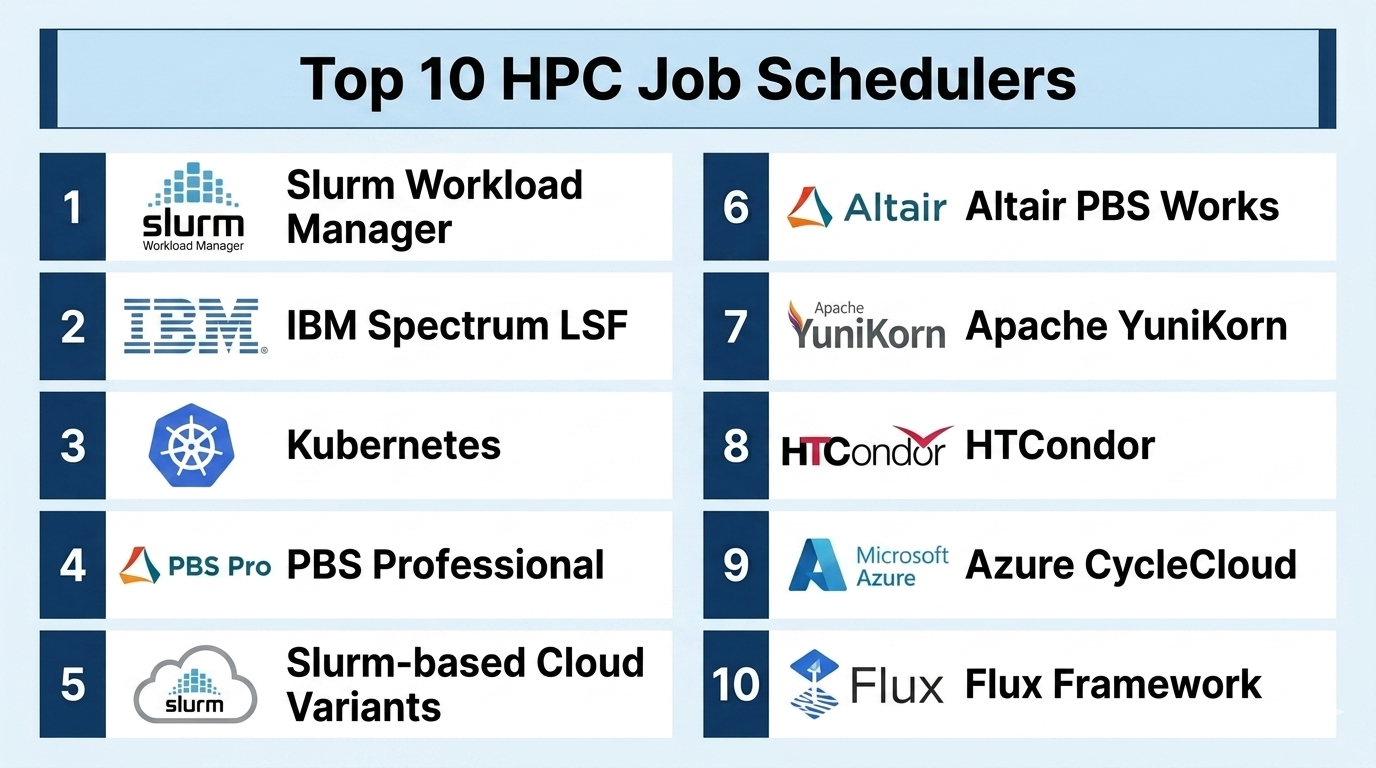
Top 10 HPC Job Schedulers
#1 — Slurm Workload Manager
Short description:
Slurm is one of the most widely used open-source HPC job schedulers in the world. It is designed for large-scale compute clusters and is heavily used in research institutions, universities, and supercomputing centers. It efficiently manages batch jobs, GPU workloads, and distributed computing tasks with advanced scheduling policies.
Key Features
- Advanced job queue management
- Fair-share scheduling system
- GPU-aware resource allocation
- Job prioritization and backfilling
- Multi-node cluster support
- Resource accounting and reporting
- Highly configurable scheduling policies
Pros
- Extremely mature and stable
- Excellent for large HPC clusters
- Strong resource control and fairness
Cons
- Steep learning curve
- Complex configuration and administration
Platforms / Deployment
- Linux
- Self-hosted / Hybrid
Security & Compliance
- Authentication plugins
- Access control policies
- Audit logging (config-dependent)
Integrations & Ecosystem
- MPI workloads
- HPC storage systems (Lustre, NFS)
- GPU drivers and libraries
- Workflow tools and schedulers
Support & Community
Strong global HPC community and widespread academic adoption.
#2 — IBM Spectrum LSF
Short description:
IBM Spectrum LSF is an enterprise-grade workload scheduler designed for high-performance computing environments. It is widely used in industries requiring mission-critical compute workloads such as finance, engineering, and life sciences.
Key Features
- Advanced workload scheduling engine
- Multi-cluster job distribution
- GPU and CPU resource management
- Priority-based scheduling
- Job dependency management
- Resource accounting and monitoring
- Workflow automation support
Pros
- Highly reliable enterprise scheduler
- Excellent scalability for large clusters
- Strong policy control and governance
Cons
- Complex setup and licensing
- Higher operational cost
Platforms / Deployment
- Linux
- Self-hosted / Hybrid
Security & Compliance
- Role-based access control
- Enterprise authentication systems
- Audit logging capabilities
Integrations & Ecosystem
- HPC storage systems
- Cloud integrations (varies by setup)
- Scientific computing frameworks
- AI and ML workloads
Support & Community
Strong enterprise IBM support and long-term maintenance.
#3 — Kubernetes (HPC + Batch Scheduling)
Short description:
Kubernetes, when extended with batch and HPC scheduling capabilities, is increasingly used for managing containerized HPC workloads. It is especially popular for hybrid AI and HPC environments where workloads are containerized and dynamically scaled.
Key Features
- Container-based job scheduling
- GPU resource allocation
- Horizontal scaling and autoscaling
- Namespace-based isolation
- Advanced scheduling policies
- Integration with custom operators
- Hybrid cloud workload support
Pros
- Highly flexible and extensible
- Strong ecosystem support
- Works well for hybrid AI/HPC workloads
Cons
- Not HPC-native by default
- Requires significant configuration
Platforms / Deployment
- Linux
- Cloud / Self-hosted / Hybrid
Security & Compliance
- RBAC-based access control
- Namespace isolation
- Policy-based governance
Integrations & Ecosystem
- CI/CD pipelines
- Container registries
- Monitoring systems (Prometheus, Grafana)
- GPU operators
Support & Community
Massive global open-source and enterprise ecosystem.
#4 — PBS Professional
Short description:
PBS Professional is a commercial HPC job scheduler widely used in enterprise and research computing environments. It focuses on scalable workload management and efficient resource utilization.
Key Features
- Advanced batch scheduling system
- Multi-node workload distribution
- GPU support for compute workloads
- Job priority and fair-share policies
- Resource usage tracking
- Workflow dependency management
- High availability support
Pros
- Strong enterprise reliability
- Excellent for large HPC clusters
- Mature scheduling capabilities
Cons
- Commercial licensing required
- Less flexible than open-source alternatives
Platforms / Deployment
- Linux
- Self-hosted / Hybrid
Security & Compliance
- Authentication and authorization controls
- Audit logging features
- Enterprise security policies (varies)
Integrations & Ecosystem
- HPC storage systems
- Scientific computing frameworks
- Cloud environments (limited)
- Job workflow tools
Support & Community
Enterprise vendor support with stable long-term updates.
#5 — Slurm-based Cloud Variants (Managed Slurm Systems)
Short description:
Managed Slurm systems extend traditional Slurm into cloud environments, providing scalable HPC scheduling without requiring full on-prem infrastructure management. They are widely used for hybrid HPC workloads.
Key Features
- Slurm-based scheduling engine
- Cloud burst scaling capabilities
- GPU workload scheduling
- Automated cluster provisioning
- Hybrid cloud integration
- Job queue management
- Resource monitoring tools
Pros
- Easier deployment than raw Slurm
- Cloud scalability benefits
- Familiar Slurm ecosystem
Cons
- Vendor-specific implementations vary
- Potential cloud dependency
Platforms / Deployment
- Cloud / Hybrid
Security & Compliance
- Cloud IAM integration
- Role-based access control (varies)
Integrations & Ecosystem
- Cloud compute services
- Storage systems
- HPC toolchains
- AI frameworks
Support & Community
Depends on provider and ecosystem implementation.
#6 — Altair PBS Works
Short description:
Altair PBS Works is a workload management suite designed for HPC environments, combining job scheduling, resource optimization, and analytics.
Key Features
- High-performance job scheduling
- GPU and CPU workload management
- Advanced resource optimization
- Workload analytics dashboard
- Multi-cluster scheduling
- Policy-based scheduling rules
- Workflow automation
Pros
- Strong enterprise HPC tooling
- Good visualization and analytics
- Scalable architecture
Cons
- Commercial product
- Requires configuration expertise
Platforms / Deployment
- Linux
- Self-hosted / Hybrid
Security & Compliance
- Role-based access control
- Enterprise authentication support
Integrations & Ecosystem
- HPC storage systems
- Cloud integrations (varies)
- Engineering simulation tools
- AI workloads
Support & Community
Enterprise-grade Altair support.
#7 — Apache YuniKorn
Short description:
Apache YuniKorn is a modern, cloud-native scheduler designed for containerized workloads, including HPC and GPU-based workloads in Kubernetes environments.
Key Features
- Hierarchical queue scheduling
- Kubernetes-native integration
- Fair-share resource allocation
- Multi-tenant workload management
- Dynamic resource scheduling
- Extensible plugin system
- Real-time scheduling decisions
Pros
- Strong cloud-native design
- Flexible scheduling policies
- Good multi-tenant support
Cons
- Still maturing ecosystem
- Requires tuning for HPC workloads
Platforms / Deployment
- Linux
- Cloud / Self-hosted
Security & Compliance
- Kubernetes RBAC integration
Integrations & Ecosystem
- Kubernetes clusters
- Containerized workloads
- Monitoring tools
- GPU scheduling extensions
Support & Community
Growing open-source community adoption.
#8 — HTCondor
Short description:
HTCondor is a distributed workload management system designed for high-throughput computing. It is widely used in academic and research environments for managing large-scale batch jobs.
Key Features
- High-throughput job scheduling
- Distributed compute resource pooling
- Fault-tolerant job execution
- Job prioritization and queues
- Checkpointing support
- Resource matchmaking system
- Flexible workload policies
Pros
- Excellent for distributed workloads
- Strong fault tolerance
- Highly scalable
Cons
- Less focused on GPU-heavy workloads
- Complex configuration for beginners
Platforms / Deployment
- Linux, Windows
- Self-hosted / Hybrid
Security & Compliance
- Authentication mechanisms
- Access control policies
Integrations & Ecosystem
- HPC clusters
- Grid computing systems
- Scientific research tools
- Cloud integrations (limited)
Support & Community
Strong academic and research community support.
#9 — Azure CycleCloud
Short description:
Azure CycleCloud is a cloud HPC orchestration platform that enables scheduling and management of HPC clusters on Microsoft Azure infrastructure.
Key Features
- HPC cluster lifecycle management
- GPU workload scheduling
- Auto-scaling compute clusters
- Job queue management
- Hybrid HPC support
- Template-based cluster creation
- Azure integration features
Pros
- Strong Azure ecosystem integration
- Easy cloud HPC provisioning
- Good scalability
Cons
- Azure lock-in
- Requires cloud expertise
Platforms / Deployment
- Cloud / Hybrid
Security & Compliance
- Azure Active Directory integration
- Role-based access control
Integrations & Ecosystem
- Azure Machine Learning
- Storage and compute services
- HPC workflows
- Container systems
Support & Community
Strong Microsoft enterprise support.
#10 — Flux Framework
Short description:
Flux is a next-generation HPC resource management framework designed for extreme-scale computing environments. It focuses on flexible scheduling and dynamic resource allocation.
Key Features
- Hierarchical scheduling architecture
- Dynamic resource allocation
- Support for extreme-scale HPC systems
- GPU and CPU workload management
- Workflow orchestration support
- Fault-tolerant execution
- Highly extensible design
Pros
- Designed for modern exascale computing
- Highly flexible architecture
- Strong performance focus
Cons
- Emerging ecosystem
- Requires advanced expertise
Platforms / Deployment
- Linux
- Self-hosted / Hybrid
Security & Compliance
- Not publicly stated
Integrations & Ecosystem
- HPC simulation frameworks
- MPI workloads
- Container systems
- Research computing stacks
Support & Community
Growing research and HPC community adoption.
Comparison Table (Top 10)
| Tool Name | Best For | Platform(s) Supported | Deployment | Standout Feature | Public Rating |
|---|---|---|---|---|---|
| Slurm | Large HPC clusters | Linux | Self/Hybrid | Batch scheduling engine | N/A |
| IBM LSF | Enterprise HPC | Linux | Self/Hybrid | Policy-driven scheduling | N/A |
| Kubernetes | Cloud-native HPC | Linux | Cloud/Self/Hybrid | Container orchestration | N/A |
| PBS Professional | Enterprise HPC | Linux | Self/Hybrid | Reliable batch scheduling | N/A |
| Managed Slurm | Cloud HPC | Cloud | Cloud/Hybrid | Cloud scaling | N/A |
| Altair PBS Works | Engineering HPC | Linux | Self/Hybrid | Analytics + scheduling | N/A |
| YuniKorn | Kubernetes HPC | Linux | Cloud/Self | Fair-share queues | N/A |
| HTCondor | Distributed computing | Linux/Windows | Self/Hybrid | High-throughput jobs | N/A |
| Azure CycleCloud | Azure HPC | Linux | Cloud/Hybrid | HPC lifecycle automation | N/A |
| Flux Framework | Exascale HPC | Linux | Self/Hybrid | Extreme-scale scheduling | N/A |
Evaluation & Scoring (HPC Job Schedulers)
| Tool Name | Core (25%) | Ease (15%) | Integrations (15%) | Security (10%) | Performance (10%) | Support (10%) | Value (15%) | Total |
|---|---|---|---|---|---|---|---|---|
| Slurm | 10 | 6 | 9 | 8 | 10 | 9 | 10 | 8.9 |
| IBM LSF | 9 | 6 | 8 | 9 | 10 | 9 | 8 | 8.5 |
| Kubernetes | 9 | 7 | 10 | 8 | 9 | 9 | 9 | 8.7 |
| PBS Professional | 9 | 7 | 8 | 9 | 9 | 9 | 8 | 8.5 |
| Managed Slurm | 8 | 8 | 9 | 8 | 9 | 8 | 9 | 8.4 |
| Altair PBS | 8 | 7 | 8 | 9 | 8 | 9 | 8 | 8.2 |
| YuniKorn | 8 | 7 | 9 | 8 | 8 | 7 | 9 | 8.1 |
| HTCondor | 8 | 7 | 8 | 8 | 8 | 8 | 10 | 8.3 |
| Azure CycleCloud | 9 | 7 | 9 | 9 | 8 | 9 | 8 | 8.6 |
| Flux | 8 | 6 | 8 | 8 | 9 | 8 | 9 | 8.1 |
Scores are comparative and reflect real-world suitability across HPC environments. Higher scores indicate stronger scalability, maturity, and enterprise readiness. Selection should depend on workload type, infrastructure model, and organizational maturity rather than a single “best” tool.
Which HPC Job Schedulers
Solo / Freelancer
Light research or small clusters:
HTCondor, lightweight Kubernetes setups
SMB
Moderate compute workloads:
YuniKorn, Managed Slurm, Azure CycleCloud
Mid-Market
Growing HPC + AI workloads:
Slurm, PBS Professional, Kubernetes-based HPC
Enterprise
Large-scale HPC environments:
IBM LSF, Slurm, Flux Framework, Altair PBS Works
Budget vs Premium
- Budget-friendly: Slurm, HTCondor, Kubernetes (self-managed)
- Premium: IBM LSF, Altair PBS Works, managed enterprise HPC platforms
Feature Depth vs Ease of Use
- Deep control: Slurm, LSF, Flux
- Easier adoption: CycleCloud, Managed Slurm, HTCondor
Integrations & Scalability
- High scalability: Slurm, Kubernetes, LSF
- Strong integrations: Azure CycleCloud, PBS Works, YuniKorn
Security & Compliance Needs
- Enterprise governance: IBM LSF, Azure, Altair PBS Works
- Open-source flexibility: Slurm, Kubernetes, HTCondor
Frequently Asked Questions (FAQs)
1. What is an HPC job scheduler?
It is a system that manages compute jobs across a cluster, allocating CPUs, GPUs, and memory efficiently while ensuring fair usage among users.
2. Why are HPC schedulers important?
They maximize utilization of expensive compute infrastructure and reduce job waiting times in shared environments.
3. What industries use HPC schedulers?
They are used in scientific research, AI training, finance, engineering simulations, and climate modeling.
4. What is the difference between HPC and Kubernetes scheduling?
HPC schedulers are optimized for batch scientific workloads, while Kubernetes focuses on container orchestration and cloud-native applications.
5. Do HPC schedulers support GPUs?
Yes, most modern schedulers like Slurm, Kubernetes, and LSF support GPU-aware scheduling.
6. Are HPC schedulers cloud-based?
They can be on-prem, cloud-based, or hybrid depending on deployment model.
7. Is Slurm still widely used?
Yes, Slurm remains one of the most widely adopted HPC schedulers globally.
8. Are these tools difficult to learn?
Some like Slurm and LSF require advanced expertise, while managed systems are easier to adopt.
9. Can HPC schedulers handle AI workloads?
Yes, modern schedulers increasingly support AI training and GPU-based workloads.
10. What is the future of HPC scheduling?
Future systems will include AI-driven scheduling, serverless HPC, and deeper integration with cloud-native ecosystems.
Conclusion
HPC job schedulers are a foundational component of modern high-performance computing environments. They ensure that massive compute resources are efficiently allocated, balanced, and optimized across users and workloads. As AI and simulation demands continue to grow, these tools are becoming more intelligent, scalable, and hybrid-cloud friendly.There is no single best scheduler—each tool serves different needs. Slurm dominates research computing, IBM LSF leads in enterprise HPC, and Kubernetes is increasingly important for cloud-native hybrid environments. The right choice depends on workload type, infrastructure strategy, and operational expertise.
