Introduction
Grid Operations Software, mainly known as EMS and DMS, helps utilities monitor, control, optimize, and protect electricity networks. EMS means Energy Management System and is mostly used for transmission grid control, generation coordination, power flow, stability, and dispatch. DMS means Distribution Management System and is used for distribution networks, feeder operations, outage response, switching, voltage management, and field coordination.
In simple English, EMS/DMS software helps utility control room teams see what is happening on the grid, make safer decisions, restore power faster, manage voltage, reduce losses, and operate electricity networks more reliably.
These systems matter because modern grids are becoming more complex. Utilities now manage renewable energy, distributed energy resources, electric vehicles, battery storage, smart meters, changing demand, cybersecurity risks, and customer expectations for faster outage restoration.
Common use cases include:
- Transmission grid monitoring and control
- Distribution network visibility and switching
- Outage detection and restoration support
- Load flow and power flow analysis
- Voltage and reactive power optimization
- Fault location, isolation, and service restoration
- DER and renewable energy coordination
- Control room decision support
- SCADA, OMS, GIS, AMI, and asset system integration
Buyers should evaluate:
- EMS, DMS, or combined ADMS capability
- SCADA and real-time data integration
- Network model quality
- Outage and fault management support
- Advanced power flow and state estimation
- DER and renewable energy support
- Cybersecurity and access control
- GIS, OMS, AMI, and asset system integration
- Operator usability and control room workflows
- Vendor implementation experience
- Reliability, scalability, and performance
- Support for regulatory and operational requirements
Best for: Electric utilities, transmission operators, distribution utilities, grid operators, municipal utilities, energy control centers, renewable-heavy utilities, smart grid teams, outage management teams, and power system operations leaders.
Not ideal for: Very small utilities with simple manual operations, companies that only need basic outage tracking, or organizations without SCADA, GIS, AMI, or real-time operational data needs.
Key Grid Operations EMS DMS Software Trends
- Advanced Distribution Management Systems are becoming more important because utilities need DMS, OMS, SCADA, DER, and analytics connected in one operational environment.
- DER management integration is growing because solar, batteries, EV charging, and distributed generation are changing grid behavior.
- Real-time grid visibility is now critical for safe switching, outage restoration, and operational decision-making.
- AI-assisted grid analytics is helping teams detect abnormal conditions, forecast load, prioritize incidents, and support faster restoration.
- Cybersecurity controls are becoming more important because grid control systems are sensitive infrastructure.
- Cloud and hybrid deployment models are increasing, but many utilities still prefer controlled on-premise or private environments for operational systems.
- GIS and network model accuracy are major success factors because poor network models can weaken DMS recommendations.
- AMI and smart meter data integration is improving outage detection, restoration verification, and customer-level visibility.
- Voltage optimization and loss reduction are becoming common operational goals as utilities seek efficiency.
- Operator-friendly interfaces are becoming a differentiator because control room teams need fast, clear, and reliable decision support.
How We Selected These Tools
The tools below were selected using a practical utility-focused evaluation approach:
- Recognized presence in EMS, DMS, ADMS, SCADA, grid control, or utility operations software.
- Ability to support real-time grid monitoring, control, analysis, or restoration workflows.
- Suitability for transmission, distribution, municipal, cooperative, and large enterprise utility environments.
- Strength in network model management, power flow, switching, outage support, and operator workflows.
- Integration capability with SCADA, GIS, OMS, AMI, DERMS, asset management, and enterprise systems.
- Reliability and scalability for critical grid operations.
- Support for modern grid needs such as DER, renewables, EV loads, and demand response.
- Security, audit, role-based access, and operational control capabilities where confidently known.
- Vendor maturity, implementation experience, support resources, and utility domain knowledge.
- Balanced inclusion of large enterprise platforms, ADMS suites, SCADA-centered solutions, and utility operations platforms.
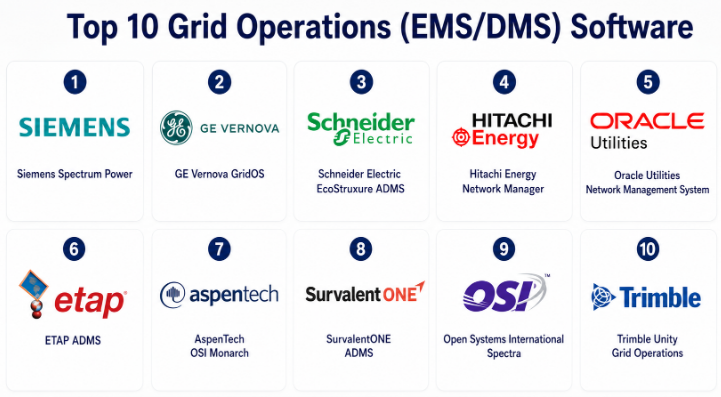
Top 10 Grid Operations EMS DMS Software
#1 — Siemens Spectrum Power
Short description :
Siemens Spectrum Power is a grid control and energy management platform used by utilities for transmission, distribution, and grid operations. It supports real-time monitoring, SCADA, EMS, DMS, network analysis, control room operations, and power system optimization. The platform is suitable for large utilities, transmission operators, and distribution companies that need reliable grid visibility and operational control. It is especially useful for organizations modernizing control centers and integrating renewable energy resources. Siemens Spectrum Power is best for utilities that need deep grid operations functionality and proven utility-domain capability.
Key Features
- EMS, DMS, and SCADA support
- Real-time grid monitoring and control
- Network analysis and power flow tools
- State estimation and operational decision support
- Outage and switching workflow support
- Renewable and DER integration support depending on setup
- Control center visualization and operator workflows
Pros
- Strong fit for large and complex utility operations.
- Deep grid control and power system functionality.
- Suitable for transmission and distribution use cases.
Cons
- Implementation can be complex and resource-heavy.
- May be more advanced than small utilities need.
- Requires strong utility operations and IT planning.
Platforms / Deployment
Web / Control center workstation options may vary
On-premise / Private cloud / Hybrid options may vary
Security & Compliance
Enterprise utility security controls, role-based access, audit trails, and operational controls may be available depending on deployment. Specific certifications are Not publicly stated here and should be verified directly.
Integrations & Ecosystem
Siemens Spectrum Power is useful when grid operations must connect with real-time utility systems and enterprise workflows.
- SCADA systems
- GIS and network model tools
- OMS and outage workflows
- DER and renewable systems
- Asset management systems
- Utility analytics and reporting tools
Support & Community
Siemens provides enterprise support, implementation services, documentation, training, and utility-domain consulting. Community strength is strongest among large utilities, grid operators, and control center teams.
#2 — GE Vernova GridOS
Short description :
GE Vernova GridOS is a grid software portfolio designed for modern transmission and distribution operations. It supports grid orchestration, EMS, ADMS, DER coordination, grid analytics, and operational decision support. The platform is relevant for utilities dealing with renewable energy growth, distributed resources, grid complexity, and reliability pressure. It helps grid teams improve situational awareness, optimize operations, and manage dynamic grid conditions. GE Vernova GridOS is best for utilities that want a modern grid operations platform with strong focus on energy transition and digital grid control.
Key Features
- EMS, ADMS, and grid orchestration capabilities
- Real-time grid visibility and control
- Advanced analytics and operational intelligence
- DER and renewable energy support depending on configuration
- Outage, switching, and distribution operations workflows
- Network modeling and power flow analysis
- Control room and enterprise grid workflows
Pros
- Strong focus on modern grid transformation.
- Useful for utilities managing DER and renewable complexity.
- Broad grid operations and analytics capabilities.
Cons
- Implementation can require significant planning.
- Exact module fit should be validated by utility use case.
- May be too advanced for smaller, simpler networks.
Platforms / Deployment
Web / Control center workstation options may vary
Cloud / On-premise / Hybrid options may vary
Security & Compliance
Enterprise utility security controls may be available. Specific certifications, standards alignment, and compliance coverage should be verified directly.
Integrations & Ecosystem
GE Vernova GridOS works well when utilities need grid operations connected with analytics, DER, outage, and enterprise systems.
- SCADA and grid telemetry
- GIS and network models
- OMS and outage workflows
- DERMS and renewable systems
- AMI and meter data systems
- Enterprise reporting and analytics
Support & Community
Vendor support, implementation services, training, and grid modernization expertise are available. Community strength is strong among utilities and grid transformation teams.
#3 — Schneider Electric EcoStruxure ADMS
Short description :
Schneider Electric EcoStruxure ADMS is an Advanced Distribution Management System designed to help utilities manage distribution networks more safely and efficiently. It combines capabilities such as SCADA, DMS, OMS, outage restoration, network analysis, and distribution optimization. The platform is useful for utilities that need better visibility into feeders, substations, switching plans, outages, and distributed energy resources. It is especially relevant for utilities modernizing distribution operations and improving outage response. EcoStruxure ADMS is best for distribution utilities that want integrated operational control and restoration workflows.
Key Features
- Advanced Distribution Management System functionality
- SCADA, DMS, and OMS-related workflows
- Fault location, isolation, and service restoration support
- Network model and distribution power flow
- Switching management and operator decision support
- Voltage optimization and grid efficiency tools
- DER and smart grid integration support depending on setup
Pros
- Strong integrated ADMS capability.
- Useful for outage response and distribution grid visibility.
- Good fit for utilities modernizing distribution operations.
Cons
- Requires accurate GIS and network model data.
- Implementation can involve significant process change.
- Smaller utilities may not need the full ADMS depth.
Platforms / Deployment
Web / Control center workstation options may vary
On-premise / Cloud / Hybrid options may vary
Security & Compliance
Enterprise security controls, role-based access, audit trails, and operational controls may be available. Specific certifications are Not publicly stated here.
Integrations & Ecosystem
EcoStruxure ADMS is useful when distribution operations must connect with outage, field, meter, and network systems.
- SCADA systems
- GIS and network model sources
- OMS and outage workflows
- AMI and smart meter data
- DER systems
- Asset and work management tools
Support & Community
Schneider Electric provides support, implementation services, documentation, training, and utility consulting. Community strength is strong among distribution utilities and ADMS users.
#4 — Hitachi Energy Network Manager
Short description :
Hitachi Energy Network Manager is a grid control platform used for transmission, distribution, and utility operations. It supports EMS, DMS, SCADA, outage workflows, network analysis, and control room operations. The platform is designed for utilities that need reliable power system monitoring, analysis, and operational control. It is especially useful in complex grid environments where transmission and distribution visibility are critical. Hitachi Energy Network Manager is best for utilities that need proven grid control functionality and strong operational reliability.
Key Features
- EMS, DMS, and SCADA capabilities
- Real-time grid monitoring and control
- Power flow and network analysis
- State estimation and decision support
- Switching and outage support workflows
- Control center visualization
- Utility operations integration
Pros
- Strong fit for transmission and distribution operations.
- Mature grid control and network management capabilities.
- Useful for utilities needing reliable control center workflows.
Cons
- Implementation may require significant utility expertise.
- Exact module scope should be validated by project.
- May require careful integration with existing systems.
Platforms / Deployment
Web / Control center workstation options may vary
On-premise / Hosted / Hybrid options may vary
Security & Compliance
Enterprise utility security controls may be available depending on deployment. Specific certifications and compliance details are Not publicly stated here.
Integrations & Ecosystem
Hitachi Energy Network Manager fits environments where grid control must connect with operational and enterprise utility systems.
- SCADA and telemetry
- GIS and network models
- OMS and outage systems
- Asset and work management
- Market or transmission systems
- Reporting and analytics platforms
Support & Community
Vendor support, implementation services, training, and utility-domain resources are available. Community strength is strong among transmission and distribution grid operators.
#5 — Oracle Utilities Network Management System
Short description :
Oracle Utilities Network Management System is a grid operations and outage management solution used by electric utilities to manage distribution network events, switching, outages, crews, and operational response. It supports utility teams in improving outage response, service restoration, and network visibility. The platform is especially useful when connected with customer systems, meter data, GIS, and field operations. It is a strong fit for utilities already using Oracle Utilities products. Oracle Utilities Network Management System is best for utilities needing outage and network operations connected with enterprise customer and utility systems.
Key Features
- Distribution network and outage management
- Switching and restoration workflows
- Crew and field operation coordination support
- Network model and grid visualization
- Customer outage information support
- Integration with Oracle utility ecosystem
- Operational reporting and event tracking
Pros
- Strong fit for utilities using Oracle ecosystem.
- Useful for outage response and distribution operations.
- Good integration potential with customer and meter systems.
Cons
- Best value depends on Oracle utility environment fit.
- Implementation can require accurate network and customer data.
- May not replace full EMS needs for transmission operators.
Platforms / Deployment
Web
Cloud / Enterprise deployment options may vary
Security & Compliance
Oracle enterprise security capabilities may apply depending on deployment. Specific certifications and compliance scope should be verified directly.
Integrations & Ecosystem
Oracle Utilities Network Management System works best when outage and network operations must connect with customer, billing, meter, and enterprise utility systems.
- Oracle utility applications
- GIS and network models
- AMI and meter data
- Customer information systems
- Field service systems
- Reporting and analytics tools
Support & Community
Oracle provides support, implementation partners, documentation, training, and enterprise consulting. Community strength is strong among Oracle utility customers.
#6 — ETAP ADMS
Short description :
ETAP ADMS is a grid operations platform that supports real-time distribution management, network analysis, simulation, optimization, and operational decision-making. ETAP is known for electrical power system modeling and analysis, and its ADMS capabilities extend this into operational distribution management. The platform is useful for utilities, industrial power networks, campuses, microgrids, and organizations that need strong engineering analysis connected with operations. It is especially relevant where detailed electrical modeling and simulation are important. ETAP ADMS is best for organizations that want engineering-grade analysis with grid operations workflows.
Key Features
- Distribution management and operational analysis
- Load flow and power system studies
- Real-time monitoring and control support
- Switching and restoration decision support
- Microgrid and industrial power system support
- Simulation and operator training possibilities
- Electrical digital twin capabilities depending on setup
Pros
- Strong engineering and power system analysis foundation.
- Useful for utilities, microgrids, and industrial power networks.
- Good fit where modeling accuracy is a major priority.
Cons
- Operational deployment requires careful integration.
- May require skilled power system engineers.
- Full utility-scale ADMS fit should be validated by use case.
Platforms / Deployment
Windows / Web options may vary
On-premise / Cloud / Hybrid options may vary
Security & Compliance
Enterprise controls may be available depending on deployment. Specific certifications are Not publicly stated here.
Integrations & Ecosystem
ETAP ADMS is useful when real-time operations must connect with electrical modeling, simulation, and engineering workflows.
- SCADA and real-time data
- GIS and network models
- DER and microgrid systems
- Asset and engineering tools
- Operator training systems
- Reporting and analytics workflows
Support & Community
Vendor support, engineering documentation, training, and professional services are available. Community strength is strong among power engineers, industrial electrical teams, and utility engineers.
#7 — AspenTech OSI Monarch
Short description :
AspenTech OSI Monarch is a control center platform used for SCADA, EMS, DMS, and utility operations. It supports real-time monitoring, control, network applications, outage workflows, and operational decision support. The platform is suitable for electric utilities, transmission operators, distribution utilities, and public power organizations. It is especially useful where utilities need reliable SCADA and control room technology with advanced grid applications. AspenTech OSI Monarch is best for utilities seeking a control center platform with EMS and DMS capabilities.
Key Features
- SCADA, EMS, and DMS support
- Real-time grid monitoring and control
- Network analysis and operational applications
- Outage and distribution management support
- Control room visualization
- Historical data and reporting support
- Utility integration capabilities
Pros
- Strong control center and SCADA foundation.
- Useful for transmission and distribution operations.
- Suitable for utilities needing real-time operational reliability.
Cons
- Implementation requires strong utility and control system expertise.
- Exact application scope should be validated.
- May require integration effort with existing OMS, GIS, and AMI systems.
Platforms / Deployment
Control center workstation / Web options may vary
On-premise / Hosted / Hybrid options may vary
Security & Compliance
Utility-grade controls, access permissions, and audit capabilities may be available. Specific certifications are Not publicly stated here.
Integrations & Ecosystem
AspenTech OSI Monarch is useful when SCADA and grid operations must connect with utility applications and control center workflows.
- SCADA telemetry
- EMS and DMS applications
- GIS and network data
- OMS and outage systems
- Historian and reporting systems
- Enterprise analytics platforms
Support & Community
Vendor support, implementation services, documentation, and control center expertise are available. Community strength is strongest among utility control room and SCADA teams.
#8 — SurvalentONE ADMS
Short description :
SurvalentONE ADMS is a utility operations platform that combines SCADA, outage management, distribution management, and advanced applications for electric utilities. It is especially relevant for municipal utilities, electric cooperatives, public power utilities, and mid-sized distribution operators. The platform helps control room teams monitor networks, manage outages, perform switching, and improve distribution reliability. SurvalentONE is often valued for practical deployment in smaller and mid-sized utility environments. It is best for utilities that need strong distribution operations without overly heavy enterprise complexity.
Key Features
- SCADA and distribution management
- Outage management support
- Switching and network operation workflows
- Fault location and restoration support depending on setup
- Real-time monitoring and visualization
- Distribution automation support
- Reporting and operational dashboards
Pros
- Practical fit for municipal utilities and cooperatives.
- Strong distribution operations focus.
- Can be more approachable than very large enterprise platforms.
Cons
- Very large transmission-heavy environments should validate fit.
- Advanced analytics depth may vary by module.
- Integration with existing systems should be tested carefully.
Platforms / Deployment
Web / Control center workstation options may vary
On-premise / Hosted / Hybrid options may vary
Security & Compliance
Role-based access, audit trails, and operational controls may be available. Specific certifications are Not publicly stated here.
Integrations & Ecosystem
SurvalentONE ADMS is useful when distribution operations must connect with field, outage, meter, and control systems.
- SCADA and automation devices
- GIS and network models
- OMS workflows
- AMI and smart meter data
- Field crew workflows
- Reporting and analytics tools
Support & Community
Vendor support, training, implementation services, and documentation are available. Community strength is strong among municipal utilities, cooperatives, and public power organizations.
#9 — Open Systems International Spectra
Short description :
Open Systems International Spectra is a utility control and automation platform used for SCADA, EMS, DMS, and grid operations. It is designed to support real-time control, monitoring, power system analysis, and operational workflows for utilities and grid operators. The platform is useful for organizations that need dependable control room systems with grid management capabilities. It can support transmission, distribution, generation, and related utility operations depending on configuration. Spectra is best for utilities needing a flexible control and automation platform.
Key Features
- SCADA, EMS, and DMS capabilities
- Real-time monitoring and control
- Network analysis and power system applications
- Control center visualization
- Event and alarm management
- Historical data and reporting
- Utility automation workflows
Pros
- Strong utility control and automation background.
- Useful for real-time grid operations.
- Flexible for different utility control center needs.
Cons
- Implementation depends on utility requirements and integrations.
- Exact module capabilities should be validated.
- May require experienced control system teams.
Platforms / Deployment
Control center workstation / Web options may vary
On-premise / Hosted / Hybrid options may vary
Security & Compliance
Utility-grade access control and operational security features may be available. Specific certifications are Not publicly stated here.
Integrations & Ecosystem
Spectra works well when utility control systems need to integrate real-time data, network applications, and enterprise reporting.
- SCADA telemetry
- EMS and DMS applications
- GIS and network data
- Historian systems
- OMS and field systems
- Reporting and analytics tools
Support & Community
Vendor support, implementation services, documentation, and training are available. Community strength is strongest among utility SCADA and grid operations teams.
#10 — Trimble Unity Grid Operations
Short description :
Trimble Unity Grid Operations supports distribution utilities with outage, asset, field, and network operations workflows. It is useful for utilities that need better coordination between office teams, field crews, GIS data, and outage response. The platform is especially relevant for smaller and mid-sized utilities that want practical operational visibility and field workflow support. While it may not replace a full enterprise EMS platform, it can help improve distribution operations and service reliability. Trimble Unity Grid Operations is best for utilities seeking connected field and grid operations workflows.
Key Features
- Distribution operations support
- Outage and field workflow coordination
- GIS-connected utility workflows
- Asset and network visibility
- Mobile field crew support
- Work and service management alignment
- Reporting and operational dashboards
Pros
- Strong field and GIS workflow alignment.
- Useful for small and mid-sized distribution utilities.
- Practical for outage response and operational coordination.
Cons
- Not a full transmission EMS replacement.
- Advanced power system analytics may be limited compared with large ADMS platforms.
- Best fit depends on GIS and field workflow requirements.
Platforms / Deployment
Web / Mobile options may vary
Cloud / Hosted options may vary
Security & Compliance
Cloud and role-based access controls may be available. Specific certifications are Not publicly stated here.
Integrations & Ecosystem
Trimble Unity Grid Operations is useful when utilities need to connect grid operations with field teams, assets, and GIS.
- GIS and asset systems
- Field crew mobile workflows
- Outage management processes
- Work management systems
- Customer and service data
- Reporting and operational dashboards
Support & Community
Vendor support, documentation, training, and implementation guidance are available. Community strength is strongest among utilities using GIS, field operations, and asset workflow tools.
Comparison Table
| Tool Name | Best For | Platform(s) Supported | Deployment | Standout Feature | Public Rating |
|---|---|---|---|---|---|
| Siemens Spectrum Power | Large transmission and distribution utilities | Web / Workstation options vary | On-premise / Private cloud / Hybrid | Deep EMS, DMS, and SCADA grid control | N/A |
| GE Vernova GridOS | Modern grid transformation programs | Web / Workstation options vary | Cloud / On-premise / Hybrid | Grid orchestration and DER-ready operations | N/A |
| Schneider Electric EcoStruxure ADMS | Distribution utilities and outage restoration | Web / Workstation options vary | Cloud / On-premise / Hybrid | Integrated ADMS with DMS and OMS workflows | N/A |
| Hitachi Energy Network Manager | Transmission and distribution grid control | Web / Workstation options vary | On-premise / Hosted / Hybrid | Mature grid control and network management | N/A |
| Oracle Utilities Network Management System | Oracle utility ecosystem users | Web | Cloud / Enterprise options vary | Outage and network operations integrated with utility systems | N/A |
| ETAP ADMS | Engineering-focused grid and microgrid operations | Windows / Web options vary | Cloud / On-premise / Hybrid | Electrical modeling and operational analysis together | N/A |
| AspenTech OSI Monarch | Control center SCADA, EMS, and DMS | Web / Workstation options vary | On-premise / Hosted / Hybrid | Real-time control center platform | N/A |
| SurvalentONE ADMS | Municipal utilities and cooperatives | Web / Workstation options vary | On-premise / Hosted / Hybrid | Practical ADMS for distribution operations | N/A |
| Open Systems International Spectra | Utility SCADA and grid automation | Web / Workstation options vary | On-premise / Hosted / Hybrid | Flexible SCADA, EMS, and DMS control platform | N/A |
| Trimble Unity Grid Operations | Field-connected distribution operations | Web / Mobile options vary | Cloud / Hosted options vary | GIS and field workflow alignment | N/A |
Evaluation & Grid Operations EMS DMS Software
| Tool Name | Core (25%) | Ease (15%) | Integrations (15%) | Security (10%) | Performance (10%) | Support (10%) | Value (15%) | Weighted Total (0–10) |
|---|---|---|---|---|---|---|---|---|
| Siemens Spectrum Power | 10 | 6 | 9 | 9 | 9 | 8 | 7 | 8.45 |
| GE Vernova GridOS | 9 | 7 | 9 | 8 | 9 | 8 | 7 | 8.30 |
| Schneider Electric EcoStruxure ADMS | 9 | 7 | 9 | 8 | 9 | 8 | 8 | 8.45 |
| Hitachi Energy Network Manager | 9 | 7 | 8 | 8 | 9 | 8 | 7 | 8.10 |
| Oracle Utilities Network Management System | 8 | 7 | 9 | 8 | 8 | 8 | 7 | 7.95 |
| ETAP ADMS | 8 | 7 | 8 | 7 | 8 | 8 | 8 | 7.75 |
| AspenTech OSI Monarch | 9 | 7 | 8 | 8 | 9 | 8 | 7 | 8.10 |
| SurvalentONE ADMS | 8 | 8 | 7 | 7 | 8 | 8 | 8 | 7.75 |
| Open Systems International Spectra | 8 | 7 | 8 | 8 | 8 | 8 | 7 | 7.75 |
| Trimble Unity Grid Operations | 7 | 8 | 8 | 7 | 7 | 8 | 8 | 7.55 |
These scores are comparative and should be used for shortlisting, not as final purchasing advice. Large EMS/DMS platforms score higher for control-room depth, scalability, and grid analysis, but they may be expensive and complex for smaller utilities. More focused platforms may be easier to adopt but may not provide the same advanced transmission or distribution control functions. Buyers should test real network models, SCADA integration, outage workflows, operator screens, cybersecurity controls, and performance before selecting a system.
Which Grid Operations EMS DMS Software Should You Choose?
Solo / Freelancer
Solo consultants, power system advisors, and independent utility specialists usually do not need to buy EMS/DMS software themselves. However, they should understand platforms such as Siemens Spectrum Power, GE Vernova GridOS, Schneider Electric EcoStruxure ADMS, Hitachi Energy Network Manager, and ETAP ADMS because many utilities use these tools internally.
Consultants working with smaller utilities may also need knowledge of SurvalentONE ADMS, Trimble Unity Grid Operations, and Oracle Utilities Network Management System depending on the client’s operational environment.
SMB
Small and mid-sized utilities should focus on practical distribution visibility, outage response, switching safety, field workflows, and customer restoration improvement. SurvalentONE ADMS, Trimble Unity Grid Operations, ETAP ADMS, and selected modules from larger vendors may be suitable depending on network complexity.
SMBs should avoid overbuying. A full enterprise EMS/DMS platform may be powerful, but it can create unnecessary cost and operational burden if the utility does not have the data, staff, or process maturity to use it fully.
Mid-Market
Mid-market utilities often need stronger SCADA integration, network model management, outage workflows, switching support, voltage optimization, and AMI integration. Schneider Electric EcoStruxure ADMS, Oracle Utilities Network Management System, SurvalentONE ADMS, AspenTech OSI Monarch, and Hitachi Energy Network Manager may be strong options.
The best choice depends on whether the utility’s main issue is outage restoration, grid control, field coordination, voltage optimization, or DER visibility.
Enterprise
Large transmission and distribution utilities should prioritize reliability, scalability, operator workflows, cybersecurity, high-availability architecture, advanced network applications, and deep integration. Siemens Spectrum Power, GE Vernova GridOS, Schneider Electric EcoStruxure ADMS, Hitachi Energy Network Manager, and AspenTech OSI Monarch are strong enterprise candidates.
Enterprise buyers should test performance with realistic network models, real-time data volumes, failover scenarios, cyber controls, switching plans, outage workflows, and integration with GIS, OMS, AMI, DERMS, and asset systems.
Budget vs Premium
Budget-conscious utilities should first identify whether they need full EMS/DMS functionality or a more focused outage, field, or distribution operations system. SurvalentONE ADMS, Trimble Unity Grid Operations, or focused ETAP capabilities may be more practical for some utilities.
Premium buyers with complex networks, transmission operations, DER growth, and high reliability expectations should evaluate Siemens, GE Vernova, Schneider Electric, Hitachi Energy, and AspenTech OSI.
Feature Depth vs Ease of Use
For feature depth, Siemens Spectrum Power, GE Vernova GridOS, Schneider Electric EcoStruxure ADMS, Hitachi Energy Network Manager, and AspenTech OSI Monarch are stronger because they support large-scale control room operations.
For ease of use and focused operational improvement, SurvalentONE ADMS, Trimble Unity Grid Operations, and ETAP ADMS may be more approachable depending on utility size and use case.
Integrations & Scalability
EMS/DMS software rarely works alone. It often needs to connect with SCADA, GIS, OMS, AMI, DERMS, CIS, asset management, field mobility, historian systems, and enterprise reporting.
Large utilities should prioritize proven integration capability and scalability. Smaller utilities should prioritize clean data flow, simple operator workflows, and vendor support during implementation.
Security & Compliance Needs
Grid operations software is mission-critical infrastructure. Buyers should ask vendors about SSO, MFA, RBAC, encryption, audit logs, secure remote access, network segmentation, incident response, backup, disaster recovery, and high availability.
For control room systems, security should be evaluated together with reliability, operational continuity, operator access, failover, patching, and regulatory requirements.
Frequently Asked Questions
1. What is Grid Operations EMS DMS Software?
Grid Operations EMS/DMS Software helps utilities monitor, control, and optimize electric transmission and distribution networks. EMS is commonly used for transmission operations, while DMS is used for distribution network operations.
2. What is the difference between EMS and DMS?
EMS focuses more on transmission grid control, generation coordination, power flow, and stability. DMS focuses on distribution feeders, switching, outages, voltage control, fault restoration, and local network operations.
3. What is ADMS?
ADMS means Advanced Distribution Management System. It combines distribution management, outage workflows, SCADA, switching, network analysis, and sometimes DER-related capabilities into one modern distribution operations platform.
4. Who uses EMS/DMS software?
EMS/DMS software is used by electric utilities, transmission operators, distribution companies, municipal utilities, grid control centers, outage teams, field operations teams, and power system engineers.
5. How much does EMS/DMS software cost?
Pricing varies widely based on utility size, modules, network model complexity, deployment model, integrations, support, implementation services, and high-availability requirements. Most enterprise EMS/DMS systems use custom pricing.
6. Can small utilities use EMS/DMS software?
Yes, but small utilities should choose carefully. They may not need a full enterprise EMS/DMS. A focused ADMS, SCADA, outage, or field operations platform may provide better value and easier adoption.
7. Does EMS/DMS software replace SCADA?
No. EMS/DMS usually works with SCADA or includes SCADA-related capabilities depending on the platform. SCADA collects and controls real-time field data, while EMS/DMS adds grid analysis, network operations, optimization, and decision support.
8. Can EMS/DMS help reduce outage duration?
Yes. DMS and ADMS tools can support fault location, switching, outage visibility, restoration planning, and crew coordination. Actual improvement depends on data quality, process maturity, field integration, and operator adoption.
9. Can EMS/DMS support renewable energy and DER?
Many modern EMS/DMS and ADMS platforms support renewable and DER-related workflows, but depth varies by vendor and module. Buyers should validate solar, battery, EV, demand response, and DERMS integration needs.
10. What is the biggest mistake buyers make?
The biggest mistake is choosing software before fixing data foundations. Poor GIS data, weak network models, incomplete SCADA points, and unclear outage processes can reduce the value of even a strong EMS/DMS platform.
Conclusion
Grid Operations EMS/DMS Software is essential for utilities that need safer, faster, and more reliable control of modern electric networks. As grids become more dynamic with renewable energy, DER, smart meters, EVs, battery storage, and higher customer expectations, utilities need better visibility and decision support across transmission and distribution operations.
