Introduction
Geology Modeling Software helps geologists, mining teams, exploration companies, hydrogeologists, geotechnical engineers, and resource estimation professionals build digital models of the subsurface. In simple English, it helps users understand what is under the ground by combining drillhole data, assays, lithology, structures, faults, surfaces, geophysics, geochemistry, and geological interpretations into 2D and 3D models.
These tools are important because geological decisions directly affect exploration success, mine planning, resource estimation, geotechnical design, groundwater studies, and project investment. A weak geological model can lead to poor drilling decisions, wrong resource estimates, bad mine designs, and costly operational mistakes.
Common use cases include:
- 3D geological modeling
- Drillhole data visualization
- Mineral resource estimation
- Stratigraphic and structural modeling
- Fault and lithology interpretation
- Geostatistical analysis
- Mine planning support
- Hydrogeology and groundwater modeling support
- Exploration targeting
- Geotechnical and civil subsurface studies
Buyers should evaluate:
- 3D modeling capability
- Drillhole and assay data handling
- Implicit and explicit modeling tools
- Resource estimation workflows
- Structural geology and fault modeling
- Geostatistics and block modeling
- Visualization and collaboration features
- Integration with mine planning tools
- Data import/export flexibility
- Performance with large datasets
- Ease of use for geologists and engineers
- Vendor support and training resources
Best for: Exploration geologists, mining companies, resource geologists, geostatisticians, mine planning teams, hydrogeologists, geotechnical consultants, universities, research teams, and engineering firms working with subsurface data.
Not ideal for: Teams that only need simple map drawing, users without geological or drilling data, or organizations that only need basic GIS mapping without 3D interpretation, modeling, or resource estimation workflows.
Key Geology Modeling Software Trends
- Implicit modeling is becoming standard because it helps geologists build and update models faster from drillhole and surface data.
- Cloud collaboration is becoming more important as geology, resource, and engineering teams work across multiple sites and offices.
- AI-assisted geological interpretation is growing, especially for pattern recognition, anomaly detection, and exploration targeting.
- Integrated mine planning workflows are increasingly important because geological models must connect with block models, pit designs, schedules, and production plans.
- Real-time model updating is becoming valuable as new drilling data arrives during exploration and mining operations.
- Geostatistics and uncertainty modeling are becoming more important because decision-makers need confidence ranges, not just single model outputs.
- Geophysics and geochemistry integration is becoming more common in exploration modeling workflows.
- Large dataset performance is now a major buying factor because projects can include thousands of drillholes, dense point clouds, remote sensing data, and complex block models.
- Open data exchange formats are important because geology software must often connect with GIS, CAD, mine planning, database, and reporting systems.
- Visual communication is becoming a stronger requirement because investors, engineers, planners, and non-geologists need clear 3D model views.
How We Selected These Tools
The tools below were selected using a practical geology and mining software evaluation approach:
- Recognized presence in geology modeling, mining geology, exploration, resource estimation, or subsurface interpretation.
- Ability to support drillhole data, 3D geological modeling, surfaces, faults, lithology, assays, and geological interpretation.
- Suitability for exploration, mining, hydrogeology, geotechnical, and resource estimation workflows.
- Strength in implicit modeling, block modeling, geostatistics, visualization, and model updates.
- Integration potential with mine planning, GIS, CAD, database, geophysics, and reporting systems.
- Usability for geologists, resource modelers, engineers, and technical teams.
- Ability to handle complex geological datasets and large projects.
- Vendor maturity, support, documentation, training, and industry adoption.
- Flexibility for both early-stage exploration and advanced mining operations.
- Balanced inclusion of enterprise mining suites, specialist geology tools, open-source options, and technical modeling platforms.
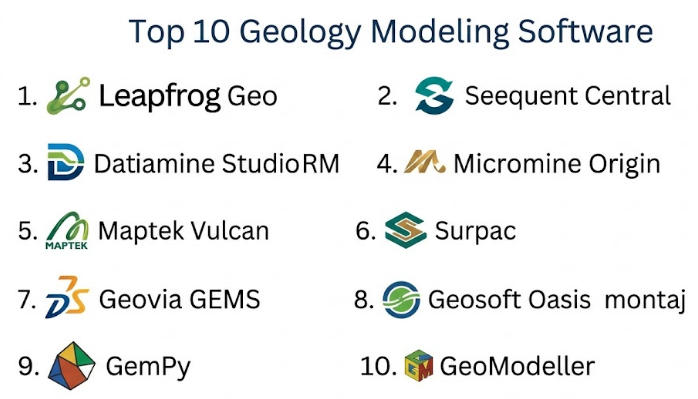
Top 10 Geology Modeling Software
#1 — Leapfrog Geo
Short description :
Leapfrog Geo is one of the most widely recognized geology modeling tools for implicit 3D geological modeling. It helps geologists build, update, and visualize geological models using drillhole data, surfaces, structural measurements, and other geological information. The software is especially useful for exploration, mining, hydrogeology, and environmental projects where models need to change quickly as new data arrives. Leapfrog Geo is known for fast model updates and strong 3D visualization. It is best for teams that need dynamic geological interpretation and clear communication of subsurface models.
Key Features
- Fast implicit geological modeling
- Drillhole data visualization and interpretation
- Lithology, fault, vein, and surface modeling
- Structural data integration
- Dynamic model updating with new data
- 3D visualization and model sharing
- Integration with mining and resource workflows
Pros
- Strong for fast, dynamic geology modeling.
- Easy visual communication for technical and non-technical stakeholders.
- Useful for exploration and mining teams that update models frequently.
Cons
- Advanced geostatistical workflows may require companion tools.
- Licensing cost may be high for small teams.
- Complex modeling still requires strong geological judgment.
Platforms / Deployment
Windows
Cloud collaboration options may vary
Security & Compliance
Enterprise access and data controls may be available depending on deployment and licensing. Specific certifications are Not publicly stated here.
Integrations & Ecosystem
Leapfrog Geo works well when geological models need to connect with resource estimation, mine planning, and exploration workflows.
- Drillhole databases
- Mine planning tools
- GIS and CAD files
- Block model workflows
- Structural geology datasets
- 3D model exports and reporting workflows
Support & Community
Vendor support, documentation, training, webinars, and a strong geology user community are available. Community strength is high among exploration geologists, mining geologists, and resource teams.
#2 — Seequent Central
Short description :
Seequent Central is a model management and collaboration platform used with geology modeling workflows, especially in teams using Leapfrog and related tools. It helps organizations manage geological models, track versions, share updates, and improve collaboration between geologists, engineers, consultants, and decision-makers. It is especially useful for teams working across multiple offices, mine sites, and technical disciplines. While it is not a standalone modeling engine in the same way as Leapfrog Geo, it plays an important role in managing geological model governance. It is best for organizations that need controlled model sharing and version management.
Key Features
- Geological model version management
- Team collaboration and model sharing
- Review and approval workflows
- Centralized project visibility
- Integration with Seequent modeling ecosystem
- Model change tracking
- Support for distributed technical teams
Pros
- Strong for collaboration and model governance.
- Useful for teams working across multiple locations.
- Helps reduce confusion around model versions and updates.
Cons
- Best value depends on Seequent ecosystem usage.
- Not a replacement for modeling software itself.
- Smaller teams may not need separate model management.
Platforms / Deployment
Web
Cloud
Security & Compliance
Enterprise access controls and permissions may be available. Specific certifications are Not publicly stated here.
Integrations & Ecosystem
Seequent Central is useful when geology models need to be reviewed, shared, and managed across teams.
- Leapfrog modeling workflows
- Geological project files
- Technical review workflows
- Model version history
- Collaboration dashboards
- Project communication workflows
Support & Community
Vendor support, documentation, onboarding, and training resources are available. Community strength is high among organizations using Seequent geology and mining tools.
#3 — Datamine Studio RM
Short description :
Datamine Studio RM is a resource modeling and estimation platform used by mining companies, consultants, and resource geologists. It supports geological modeling, block modeling, grade estimation, drillhole data analysis, and reporting workflows. The software is especially useful for mineral resource estimation and technical reporting processes. It is strong in geostatistics, estimation, and block model workflows, making it suitable for advanced mining and resource evaluation projects. Datamine Studio RM is best for teams that need strong resource modeling and estimation capability.
Key Features
- Drillhole data management and validation
- Geological and wireframe modeling
- Block modeling and grade estimation
- Geostatistical analysis
- Resource reporting workflows
- Model validation tools
- Integration with mine planning workflows
Pros
- Strong for mineral resource estimation.
- Useful for geostatistics and block modeling.
- Good fit for mining companies and consulting teams.
Cons
- Learning curve can be high for new users.
- Interface and workflows may feel technical.
- May require experienced resource geologists for best results.
Platforms / Deployment
Windows
Deployment options vary
Security & Compliance
Not publicly stated.
Integrations & Ecosystem
Datamine Studio RM is useful when geological interpretation must connect with resource estimation and mine planning.
- Drillhole databases
- Block model workflows
- Mine planning systems
- CAD and GIS files
- Estimation and reporting workflows
- Geostatistical datasets
Support & Community
Vendor support, documentation, training, and consulting services are available. Community strength is strong among mining geologists, resource modelers, and consultants.
#4 — Micromine Origin
Short description :
Micromine Origin is a geology, exploration, and resource modeling platform used by exploration geologists, mine geologists, and resource teams. It helps users manage drillhole data, visualize geology, create geological interpretations, model mineralization, and support resource estimation. The software is especially useful for exploration projects that need strong drilling, mapping, and modeling workflows. It supports both early-stage exploration and more advanced mining geology work. Micromine Origin is best for teams that need practical geology modeling and exploration data management.
Key Features
- Drillhole data visualization and validation
- Geological interpretation and modeling
- Exploration data management
- Wireframing and surface modeling
- Resource estimation support
- 3D visualization
- Mapping and reporting workflows
Pros
- Strong exploration and geology workflow support.
- Useful for drillhole data and 3D interpretation.
- Good fit for mining and exploration teams.
Cons
- Advanced workflows may require training.
- Large complex models may need careful data management.
- Some enterprise collaboration features may require additional tools.
Platforms / Deployment
Windows
Deployment options vary
Security & Compliance
Not publicly stated.
Integrations & Ecosystem
Micromine Origin works well when exploration and geological modeling workflows need to connect with drilling, mapping, and resource estimation.
- Drillhole databases
- GIS and CAD files
- Assay and geology datasets
- Resource estimation workflows
- Mine planning systems
- Reporting and visualization tools
Support & Community
Vendor support, training, documentation, and technical services are available. Community strength is strong among exploration geologists and mining professionals.
#5 — Maptek Vulcan
Short description :
Maptek Vulcan is a mining software platform used for geological modeling, mine planning, resource modeling, grade control, and engineering workflows. It is widely used in open-pit and underground mining environments. For geology teams, Vulcan supports drillhole visualization, geological interpretation, block modeling, surfaces, solids, and resource estimation workflows. It is especially useful when geology models need to connect directly with mine planning and operational workflows. Maptek Vulcan is best for mining companies that need geology, resource, and planning capabilities in one strong technical environment.
Key Features
- Geological modeling and interpretation
- Drillhole and assay data visualization
- Block modeling and resource estimation
- Grade control workflows
- Surface and solid modeling
- Open-pit and underground mine planning support
- Integration with mine design and scheduling workflows
Pros
- Strong mining industry adoption.
- Useful for geology, resource, and mine planning teams.
- Good fit for operations that need connected technical workflows.
Cons
- Learning curve can be significant.
- May be more complex than small exploration teams need.
- Licensing and training requirements should be considered.
Platforms / Deployment
Windows
Deployment options vary
Security & Compliance
Not publicly stated.
Integrations & Ecosystem
Maptek Vulcan is useful when geological models must connect with mine design, grade control, and production planning.
- Drillhole databases
- Survey and mine design data
- Block models
- Grade control workflows
- Mine scheduling tools
- GIS and CAD files
Support & Community
Vendor support, documentation, training, and technical consulting are available. Community strength is strong among mining engineers, geologists, and technical services teams.
#6 — Surpac
Short description :
Surpac is a geology and mine planning software platform used for geological modeling, resource estimation, mine design, and planning workflows. It supports drillhole data, block models, surfaces, solids, geostatistics, and mine design tasks. The software is used in both open-pit and underground mining environments. Surpac is especially relevant for mining teams that need geology and engineering workflows connected in one system. It is best for resource geologists, mine planners, and mining consultants working on technical mining projects.
Key Features
- Geological modeling and interpretation
- Drillhole data management
- Block modeling and estimation
- Surface and solid modeling
- Open-pit and underground mine design
- Geostatistical workflows
- Reporting and visualization
Pros
- Strong for geology and mine planning workflows.
- Useful for resource estimation and block modeling.
- Good fit for mining consultants and technical teams.
Cons
- Interface and workflows may feel technical for beginners.
- Training is important for advanced use.
- Collaboration features may depend on broader ecosystem tools.
Platforms / Deployment
Windows
Deployment options vary
Security & Compliance
Not publicly stated.
Integrations & Ecosystem
Surpac is useful when geological modeling needs to connect with resource estimation and mine design.
- Drillhole databases
- Block model workflows
- Mine planning tools
- Survey and design files
- CAD and GIS formats
- Reporting workflows
Support & Community
Vendor support, training, documentation, and technical services are available. Community strength is strong among geologists, resource modelers, and mining engineers.
#7 — Geovia GEMS
Short description :
Geovia GEMS is a geology and mine planning software platform used for exploration, geological modeling, resource estimation, and mine planning. It supports 3D modeling, drillhole data, block modeling, mine design, and production planning workflows. The platform is especially useful for mining companies that need to move from exploration data to resource models and mine plans. It is suitable for both open-pit and underground mining projects. Geovia GEMS is best for teams that need connected geological and mine planning workflows in a mining-focused environment.
Key Features
- Geological modeling and interpretation
- Drillhole and assay data handling
- Block modeling and resource estimation
- Mine design and planning support
- 3D visualization
- Production and technical reporting workflows
- Open-pit and underground project support
Pros
- Strong mining geology and planning focus.
- Useful for exploration-to-production workflows.
- Good fit for technical mining teams.
Cons
- May require training for advanced use.
- Exact module availability should be validated.
- Smaller exploration teams may find it more than needed.
Platforms / Deployment
Windows
Deployment options vary
Security & Compliance
Not publicly stated.
Integrations & Ecosystem
Geovia GEMS works well when geology, resources, and mine planning need to stay connected.
- Drillhole databases
- Block models
- Mine design tools
- CAD and GIS data
- Production planning workflows
- Reporting outputs
Support & Community
Vendor support, documentation, training, and technical resources are available. Community strength is strongest among mining geology and planning users.
#8 — Geosoft Oasis montaj
Short description :
Geosoft Oasis montaj is a geoscience data analysis and visualization platform widely used for geophysical, geochemical, geological, and exploration data. It is especially useful for exploration teams working with magnetic, gravity, radiometric, electromagnetic, geochemical, and spatial datasets. While it is not mainly a 3D geology modeling tool like Leapfrog, it plays an important role in exploration targeting and geological interpretation. It helps teams process, visualize, and analyze large geoscience datasets. Geosoft Oasis montaj is best for exploration teams that rely heavily on geophysics and geochemistry.
Key Features
- Geophysical data processing and visualization
- Geochemical and geological data analysis
- Mapping and spatial interpretation
- Gridding, filtering, and anomaly detection
- Exploration targeting workflows
- Support for large geoscience datasets
- Integration with GIS and modeling workflows
Pros
- Strong for geophysical and geochemical interpretation.
- Useful for early-stage exploration targeting.
- Good fit for technical exploration teams.
Cons
- Not a full geology modeling and resource estimation platform by itself.
- 3D modeling workflows may require companion tools.
- Advanced geophysical interpretation needs specialist knowledge.
Platforms / Deployment
Windows
Deployment options vary
Security & Compliance
Not publicly stated.
Integrations & Ecosystem
Oasis montaj is useful when exploration data must be processed and interpreted before geological modeling.
- Geophysical survey data
- Geochemical datasets
- GIS and mapping systems
- Drillhole and exploration datasets
- 3D modeling tools
- Exploration reporting workflows
Support & Community
Vendor support, documentation, training, and geoscience technical resources are available. Community strength is high among exploration geologists and geophysicists.
#9 — GemPy
Short description :
GemPy is an open-source Python-based tool for implicit 3D geological modeling. It is especially useful for researchers, universities, technical users, and teams that want programmatic geological modeling workflows. GemPy allows users to build geological models using Python, integrate with scientific libraries, and experiment with reproducible modeling methods. It is not a commercial enterprise mining suite, but it is valuable for research, education, and customized modeling workflows. GemPy is best for technically skilled users who want open-source flexibility and scripting control.
Key Features
- Open-source implicit geological modeling
- Python-based workflows
- Reproducible model building
- Integration with scientific computing tools
- Useful for research and education
- Custom modeling and experimentation
- 3D geological visualization support
Pros
- Open-source and flexible.
- Good for research, teaching, and reproducible workflows.
- Useful for technical users who prefer scripting.
Cons
- Requires Python and technical skills.
- Not a full commercial mining workflow suite.
- Enterprise support and polished UI may be limited.
Platforms / Deployment
Windows / macOS / Linux
Self-hosted / Local Python environment
Security & Compliance
Not publicly stated.
Integrations & Ecosystem
GemPy works well when geological modeling needs to be integrated with custom Python analytics and research workflows.
- Python scientific libraries
- Jupyter notebooks
- Research datasets
- Custom modeling pipelines
- Visualization libraries
- Open-source geoscience workflows
Support & Community
Community support, documentation, and open-source resources are available. Community strength is strongest among researchers, students, and technical geoscience users.
#10 — GeoModeller
Short description :
GeoModeller is a 3D geological modeling platform focused on structural geology, geophysics, and implicit modeling. It supports geological interpretation using structural data, surfaces, faults, geophysical information, and field observations. The software is especially useful for projects where structural geology and geophysical constraints are important. It can support mineral exploration, geothermal, groundwater, and regional geological modeling. GeoModeller is best for technical geology teams that need structurally informed 3D geological models.
Key Features
- 3D implicit geological modeling
- Structural geology data support
- Fault and surface modeling
- Geophysical data integration
- Geological cross-section and map interpretation
- Regional and project-scale modeling
- Support for exploration and subsurface studies
Pros
- Strong for structurally informed geological modeling.
- Useful for exploration, geothermal, and regional studies.
- Good fit when geophysics and geology must be modeled together.
Cons
- May require structural geology expertise.
- Commercial ecosystem may be smaller than larger mining suites.
- Resource estimation workflows may require other tools.
Platforms / Deployment
Windows
Deployment options vary
Security & Compliance
Not publicly stated.
Integrations & Ecosystem
GeoModeller is useful when geological interpretation must integrate structure, faults, surfaces, and geophysical constraints.
- Structural field data
- Geophysical datasets
- Geological maps and sections
- 3D model exports
- Exploration workflows
- Regional geology studies
Support & Community
Vendor or partner support, documentation, and technical resources may be available. Community strength is strongest among structural geologists, geophysicists, and technical modeling teams.
Comparison Table
| Tool Name | Best For | Platform(s) Supported | Deployment | Standout Feature | Public Rating |
|---|---|---|---|---|---|
| Leapfrog Geo | Fast implicit 3D geological modeling | Windows | Local / Cloud collaboration options vary | Dynamic geological model updates | N/A |
| Seequent Central | Geological model collaboration and governance | Web | Cloud | Model versioning and team collaboration | N/A |
| Datamine Studio RM | Resource modeling and estimation | Windows | Varies / N/A | Strong block modeling and grade estimation | N/A |
| Micromine Origin | Exploration and geology modeling | Windows | Varies / N/A | Practical exploration and drillhole workflows | N/A |
| Maptek Vulcan | Mining geology and mine planning | Windows | Varies / N/A | Geology, resource, and planning integration | N/A |
| Surpac | Geology, resource estimation, and mine design | Windows | Varies / N/A | Mining-focused modeling and estimation workflows | N/A |
| Geovia GEMS | Exploration-to-mine planning workflows | Windows | Varies / N/A | Connected geology and mine planning tools | N/A |
| Geosoft Oasis montaj | Geophysics and exploration targeting | Windows | Varies / N/A | Geophysical and geochemical data analysis | N/A |
| GemPy | Open-source geological modeling research | Windows / macOS / Linux | Self-hosted / Local | Python-based implicit modeling | N/A |
| GeoModeller | Structural and geophysical 3D modeling | Windows | Varies / N/A | Structurally constrained geological modeling | N/A |
Evaluation & Geology Modeling Software
| Tool Name | Core (25%) | Ease (15%) | Integrations (15%) | Security (10%) | Performance (10%) | Support (10%) | Value (15%) | Weighted Total (0–10) |
|---|---|---|---|---|---|---|---|---|
| Leapfrog Geo | 9 | 9 | 8 | 7 | 9 | 9 | 8 | 8.45 |
| Seequent Central | 7 | 8 | 8 | 8 | 8 | 8 | 7 | 7.60 |
| Datamine Studio RM | 9 | 7 | 8 | 6 | 9 | 8 | 8 | 7.95 |
| Micromine Origin | 8 | 8 | 8 | 6 | 8 | 8 | 8 | 7.80 |
| Maptek Vulcan | 9 | 7 | 9 | 6 | 9 | 8 | 7 | 8.00 |
| Surpac | 8 | 7 | 8 | 6 | 8 | 8 | 8 | 7.55 |
| Geovia GEMS | 8 | 7 | 8 | 6 | 8 | 8 | 7 | 7.40 |
| Geosoft Oasis montaj | 8 | 7 | 8 | 6 | 9 | 8 | 8 | 7.75 |
| GemPy | 7 | 5 | 8 | 5 | 7 | 6 | 10 | 6.95 |
| GeoModeller | 8 | 7 | 7 | 5 | 8 | 7 | 7 | 7.15 |
These scores are comparative and should be used for shortlisting, not as final purchasing advice. A tool that scores highly for implicit modeling may not be the best tool for geostatistics. A resource estimation platform may not be the easiest tool for early exploration visualization. Open-source tools may offer strong value but require technical skill. Buyers should test real drillhole data, modeling workflows, exports, performance, collaboration needs, and support quality before selecting software.
Which Geology Modeling Software Should You Choose?
Solo / Freelancer
Solo geology consultants usually need software that is flexible, practical, and accepted by clients. Leapfrog Geo is a strong choice for fast 3D geological modeling and communication. Micromine Origin, Datamine Studio RM, Surpac, or Maptek Vulcan may be better if the work includes resource estimation or mining workflows.
For technical users comfortable with Python, GemPy can be useful for research, experimentation, and reproducible workflows. Freelancers working with geophysics-heavy exploration projects may find Geosoft Oasis montaj valuable.
SMB
Small and mid-sized exploration companies should focus on fast modeling, drillhole visualization, and clear communication with investors, consultants, and technical teams. Leapfrog Geo, Micromine Origin, and Geosoft Oasis montaj are strong candidates depending on the project type.
If the company is moving toward resource estimation, Datamine Studio RM, Surpac, or Maptek Vulcan may become more relevant. Smaller teams should avoid overbuying before they have clean drillhole and assay data.
Mid-Market
Mid-market mining and exploration companies often need connected workflows from exploration data to geological modeling, resource estimation, and mine planning. Leapfrog Geo, Datamine Studio RM, Micromine Origin, Maptek Vulcan, Surpac, and Geovia GEMS are strong candidates.
A team focused on rapid model updates may prefer Leapfrog Geo. A team focused on resource estimation may prefer Datamine Studio RM or Surpac. A mine planning-heavy team may prefer Maptek Vulcan or Geovia GEMS.
Enterprise
Large mining companies should prioritize model governance, collaboration, integration, performance, auditability, and compatibility with mine planning workflows. Leapfrog Geo, Seequent Central, Maptek Vulcan, Datamine Studio RM, Surpac, and Geovia GEMS are strong enterprise candidates.
Enterprises often use multiple tools together. For example, a team may use Leapfrog Geo for geological interpretation, Datamine Studio RM for estimation, and Maptek Vulcan for mine planning and grade control.
Budget vs Premium
Budget-conscious users may consider GemPy if they have technical Python skills. It is useful for research, education, and custom modeling, but it is not a polished enterprise mining suite.
Premium buyers with commercial mining and resource workflows should evaluate Leapfrog Geo, Datamine Studio RM, Micromine Origin, Maptek Vulcan, Surpac, and Geovia GEMS. Premium tools usually provide stronger support, workflows, visualization, and industry acceptance.
Feature Depth vs Ease of Use
For ease of use and fast 3D modeling, Leapfrog Geo is one of the strongest choices. Micromine Origin is also practical for exploration teams.
For feature depth in resource estimation and mining workflows, Datamine Studio RM, Maptek Vulcan, Surpac, and Geovia GEMS are stronger. For geophysics-heavy exploration workflows, Geosoft Oasis montaj is highly relevant.
Integrations & Scalability
Geology modeling software often needs to connect with drillhole databases, GIS tools, CAD files, geophysical datasets, mine planning tools, block models, resource estimation workflows, and reporting systems.
Large mining teams should prioritize clean data exchange, consistent coordinate systems, version control, block model compatibility, and model governance. Smaller teams should prioritize ease of use, reliable imports, and clear visualization.
Security & Compliance Needs
Geological data can include confidential exploration targets, drillhole results, resource models, mine plans, and investment-sensitive information. Buyers should ask vendors about user permissions, access controls, model versioning, data storage, backups, audit trails, and collaboration security.
For listed mining companies or formal resource reporting, model governance, version history, data validation, and reviewer access can be just as important as modeling speed.
Frequently Asked Questions
1. What is Geology Modeling Software?
Geology Modeling Software helps geologists build digital models of the subsurface using drillholes, assays, lithology, surfaces, faults, structures, maps, geophysics, and other geological data.
2. What is 3D geological modeling?
3D geological modeling is the process of creating a three-dimensional representation of rocks, structures, mineralization, faults, and surfaces below the ground. It helps teams understand geology more clearly than flat maps or sections alone.
3. What is implicit modeling?
Implicit modeling uses mathematical methods to generate geological surfaces and volumes from data points, drillholes, and interpretations. It allows models to update faster when new data is added.
4. What is the difference between geology modeling and resource estimation?
Geology modeling defines geological units, structures, and mineralized zones. Resource estimation uses geological models, assay data, statistics, and block models to estimate the quantity and grade of mineral resources.
5. Which software is best for fast geological modeling?
Leapfrog Geo is widely used for fast implicit geological modeling and dynamic model updates. It is especially useful when teams need to update geological interpretations frequently as new drillhole data arrives.
6. Which software is best for resource estimation?
Datamine Studio RM, Maptek Vulcan, Surpac, and Geovia GEMS are strong candidates for resource estimation and block modeling. The best choice depends on team experience, reporting requirements, and mine planning workflow.
7. Which software is best for exploration geophysics?
Geosoft Oasis montaj is highly relevant for exploration geophysics and geochemical data analysis. It is often used for processing and interpreting magnetic, gravity, radiometric, electromagnetic, and spatial datasets.
8. Is open-source geology modeling software available?
Yes. GemPy is an open-source Python-based geology modeling tool. It is useful for research, education, and custom workflows, but it requires technical skills and may not replace commercial mining software for enterprise use.
9. Can geology modeling software integrate with mine planning tools?
Yes, many geology modeling tools can export surfaces, solids, block models, and other data into mine planning software. Buyers should test file formats, coordinate systems, block model compatibility, and workflow handoffs.
10. What is the biggest mistake buyers make?
The biggest mistake is choosing software before cleaning geological data. Poor drillhole collar data, missing survey data, inconsistent lithology codes, weak QA/QC, and bad coordinate systems can damage model quality.
Conclusion
Geology Modeling Software is essential for teams that need to understand the subsurface, build reliable geological interpretations, support exploration decisions, estimate mineral resources, and connect geology with mine planning. The right platform can help geologists work faster, reduce interpretation errors, communicate models clearly, and improve confidence in technical decisions. However, the best software depends on project stage, data quality, geology complexity, reporting needs, team skills, and integration requirements.
