Introduction
Pipeline Integrity Management Software helps pipeline operators monitor, assess, maintain, and protect pipeline assets throughout their lifecycle. In simple English, it helps teams understand the health of pipelines, detect risks, plan inspections, manage repairs, track corrosion, document compliance, and reduce the chance of leaks, failures, or safety incidents.
Pipeline networks are complex because they often cover long distances, harsh environments, multiple asset types, changing operating conditions, and strict safety requirements. Operators must manage inspection data, pressure data, corrosion records, inline inspection findings, geospatial data, maintenance history, risk models, and regulatory documentation. When this information is scattered across spreadsheets, PDFs, GIS files, and disconnected systems, it becomes harder to make safe and timely decisions.
Common use cases include:
- Pipeline risk assessment and integrity planning
- Inline inspection data management
- Corrosion and cathodic protection tracking
- Leak detection and anomaly management
- Repair and maintenance prioritization
- Regulatory compliance documentation
- GIS-based pipeline asset visualization
- Integrity threat assessment and risk ranking
- Work order and inspection planning
- Audit-ready pipeline records management
Buyers should evaluate:
- Pipeline risk modeling capabilities
- GIS and spatial data integration
- Inline inspection and anomaly management
- Corrosion and cathodic protection workflows
- Compliance and audit trail support
- Work order and maintenance integration
- Asset hierarchy and data model quality
- Reporting and dashboard flexibility
- Integration with SCADA, GIS, EAM, CMMS, ERP, and inspection systems
- Security, permissions, and data governance
- Vendor experience in pipeline operations
- Support for oil, gas, water, chemicals, or multi-product pipelines
Best for: Pipeline operators, oil and gas companies, midstream companies, utilities, transmission companies, integrity engineers, corrosion engineers, maintenance teams, HSE teams, compliance teams, asset managers, and organizations responsible for pipeline safety and reliability.
Not ideal for: Very small asset owners with limited pipeline infrastructure, teams that only need basic map viewing, or organizations that do not manage regulated pipeline integrity, inspection, or maintenance workflows.
Key Pipeline Integrity Management Software Trends
- Risk-based integrity management is becoming a core requirement because operators need to prioritize limited inspection and maintenance resources.
- GIS-driven pipeline visibility is increasingly important because location, terrain, population density, crossings, and environmental context affect risk.
- Inline inspection data integration is becoming more valuable as teams manage large volumes of anomaly, defect, corrosion, and geometry data.
- Predictive analytics is helping operators identify high-risk segments, corrosion growth patterns, and potential failure scenarios earlier.
- Cathodic protection and corrosion monitoring are becoming more digital as teams replace manual records with structured workflows.
- Regulatory and audit readiness is a major buying factor because pipeline operators must prove that integrity processes are documented and repeatable.
- Integration with SCADA and operational data is growing because pressure, flow, temperature, alarms, and operating history can affect integrity assessments.
- Mobile inspection workflows are useful for field crews collecting survey data, photos, readings, and repair evidence.
- Digital twin and asset model approaches are becoming more popular for connecting engineering, operations, inspection, and maintenance data.
- Cybersecurity and access control matter because pipeline integrity data includes critical infrastructure, asset locations, operating conditions, and safety-sensitive records.
How We Selected These Tools
The tools below were selected using a practical pipeline operations and asset integrity evaluation approach:
- Recognized presence in pipeline integrity, asset integrity, corrosion management, inspection data management, GIS, or enterprise asset management.
- Ability to support pipeline risk, inspection, anomaly, corrosion, compliance, or maintenance workflows.
- Suitability for oil, gas, water, chemicals, utilities, and infrastructure operators.
- Strength in pipeline data management, analytics, reporting, and decision support.
- Integration capability with GIS, SCADA, EAM, CMMS, ERP, inline inspection systems, and field inspection tools.
- Support for engineering, integrity, maintenance, HSE, and compliance teams.
- Ability to manage audit trails, documentation, evidence, and regulatory reporting.
- Scalability for small operators, mid-market pipeline companies, and large enterprise asset owners.
- Vendor maturity, implementation support, documentation, and domain knowledge.
- Balanced inclusion of specialist pipeline integrity tools, GIS platforms, corrosion systems, and enterprise asset management platforms.
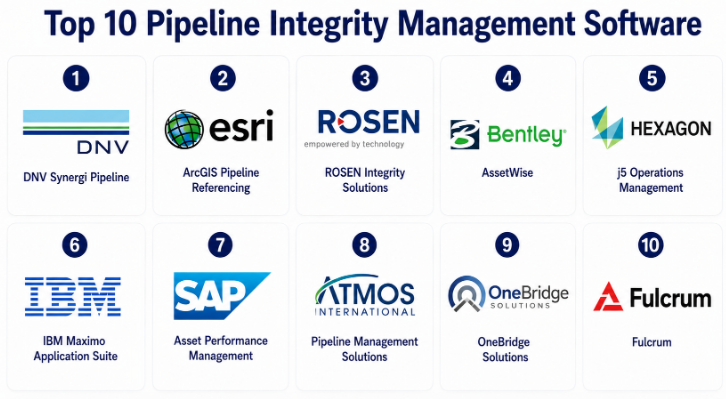
Top 10 Pipeline Integrity Management Software
#1 — DNV Synergi Pipeline
Short description :
DNV Synergi Pipeline is a pipeline integrity management platform used by pipeline operators to manage risk, inspection data, threats, maintenance planning, and compliance workflows. It helps integrity teams assess pipeline threats, prioritize actions, manage inspection findings, and support regulatory documentation. The platform is especially useful for oil and gas transmission and distribution operators with structured integrity programs. It can support risk-based decision-making and pipeline lifecycle management. DNV Synergi Pipeline is best for organizations that need specialized pipeline integrity functionality from a vendor with strong engineering and risk expertise.
Key Features
- Pipeline integrity and risk management
- Threat assessment and risk ranking
- Inline inspection and anomaly data support
- Maintenance and mitigation planning
- Compliance documentation workflows
- Integrity dashboards and reporting
- Engineering and asset integrity decision support
Pros
- Strong pipeline integrity domain focus.
- Useful for risk-based integrity management.
- Good fit for operators needing structured compliance and engineering workflows.
Cons
- May require implementation support and data preparation.
- Can be more advanced than small operators need.
- Exact module scope and pricing should be validated directly.
Platforms / Deployment
Web / Desktop options may vary
Cloud / On-premise / Hybrid options may vary
Security & Compliance
Enterprise access controls and audit-supporting workflows may be available depending on deployment. Specific certifications are Not publicly stated here.
Integrations & Ecosystem
DNV Synergi Pipeline is useful when pipeline integrity data must connect with engineering, GIS, inspection, and maintenance workflows.
- GIS and spatial pipeline data
- Inline inspection data
- Corrosion and threat records
- Maintenance planning systems
- Compliance reporting workflows
- Engineering analysis tools
Support & Community
Vendor support, professional services, documentation, training, and pipeline engineering expertise are available. Community strength is strongest among pipeline integrity engineers and asset integrity teams.
#2 — Esri ArcGIS Pipeline Referencing
Short description :
Esri ArcGIS Pipeline Referencing helps pipeline operators manage linear referenced pipeline data inside a GIS environment. It supports pipeline location data, assets, events, routes, measures, and geospatial context. While it is not a complete integrity management system by itself, it is highly relevant because pipeline integrity depends heavily on accurate location-based asset data. The platform helps operators connect pipeline assets with inspections, repairs, risk areas, environmental context, crossings, and population data. It is best for organizations that need a strong GIS foundation for pipeline integrity workflows.
Key Features
- Linear referencing for pipeline networks
- GIS-based asset and event management
- Route and measure data support
- Spatial analysis and mapping
- Integration with inspection and maintenance records
- Pipeline location and asset visualization
- Support for regulatory and operational mapping workflows
Pros
- Strong GIS foundation for pipeline integrity programs.
- Useful for connecting pipeline risk with location context.
- Scalable for large and complex pipeline networks.
Cons
- Not a full pipeline integrity platform alone.
- Requires GIS data quality and skilled administration.
- Integrity calculations may require integration with specialist tools.
Platforms / Deployment
Web / Desktop / Mobile options may vary
Cloud / On-premise / Hybrid options may vary
Security & Compliance
Enterprise GIS security controls may be available depending on deployment. Specific certifications should be verified directly in the customer environment.
Integrations & Ecosystem
ArcGIS Pipeline Referencing is useful when pipeline data must be mapped, analyzed, and connected to other integrity and operational systems.
- GIS and mapping workflows
- Inspection and anomaly data
- Maintenance and work management systems
- Environmental and land data
- Asset management platforms
- Reporting and dashboard tools
Support & Community
Esri provides documentation, training, support, partner services, and a large GIS community. Community strength is very strong among GIS professionals, infrastructure operators, and pipeline mapping teams.
#3 — ROSEN Integrity Solutions
Short description :
ROSEN Integrity Solutions supports pipeline operators with integrity management, inspection data analysis, risk assessment, anomaly management, and engineering decision support. It is especially relevant for operators using inline inspection and integrity engineering services. The software and services ecosystem helps teams understand pipeline condition, prioritize threats, and plan mitigation actions. It is useful for oil and gas pipeline operators that need deep inspection and engineering expertise. ROSEN Integrity Solutions is best for organizations that want software-supported integrity workflows combined with strong inspection and analysis knowledge.
Key Features
- Pipeline integrity data management
- Inline inspection data analysis support
- Anomaly and defect management
- Risk assessment and prioritization
- Integrity planning and reporting
- Engineering assessment workflows
- Pipeline condition and threat visibility
Pros
- Strong inspection and pipeline integrity expertise.
- Useful for anomaly management and engineering analysis.
- Good fit for operators with inline inspection-heavy programs.
Cons
- Software scope may depend on service model and engagement.
- Buyers should validate exact platform modules.
- May require specialist engineering input for best results.
Platforms / Deployment
Web / Desktop options may vary
Cloud / On-premise / Hybrid options may vary
Security & Compliance
Not publicly stated.
Integrations & Ecosystem
ROSEN Integrity Solutions is useful when inspection, anomaly, and engineering assessment data need to support integrity decisions.
- Inline inspection datasets
- Pipeline asset records
- GIS and location data
- Risk assessment workflows
- Engineering assessment tools
- Maintenance planning processes
Support & Community
Vendor support, engineering services, documentation, and specialist integrity expertise are available. Community strength is strongest among pipeline inspection, integrity, and engineering teams.
#4 — Bentley AssetWise
Short description :
Bentley AssetWise is an infrastructure asset management and digital twin platform that can support pipeline asset management, reliability, inspection, and lifecycle workflows. It is useful for organizations managing large infrastructure assets where engineering records, inspection data, maintenance, and asset performance must be connected. For pipelines, it can help teams manage asset information, integrity-related documentation, inspections, and operational context. It is especially valuable when pipeline integrity is part of a broader infrastructure asset management strategy. Bentley AssetWise is best for asset-heavy organizations that need connected engineering and asset lifecycle data.
Key Features
- Infrastructure asset information management
- Asset lifecycle and reliability workflows
- Inspection and maintenance record support
- Digital twin and engineering data alignment
- Risk and performance visibility
- Document and record management
- Integration with engineering and operational systems
Pros
- Strong for infrastructure asset lifecycle management.
- Useful when engineering, inspection, and maintenance data must connect.
- Good fit for large asset-heavy organizations.
Cons
- Not a pipeline-only integrity tool.
- Requires configuration for pipeline-specific workflows.
- May need integration with GIS or specialist integrity systems.
Platforms / Deployment
Web / Desktop options may vary
Cloud / On-premise / Hybrid options may vary
Security & Compliance
Enterprise access controls and data governance features may be available. Specific certifications are Not publicly stated here.
Integrations & Ecosystem
Bentley AssetWise is useful when pipeline asset data must connect with engineering records, maintenance, inspection, and digital twin workflows.
- Engineering design systems
- Asset management platforms
- Inspection and maintenance records
- GIS and spatial data
- Document management systems
- Reporting and analytics workflows
Support & Community
Vendor support, documentation, implementation partners, training, and infrastructure expertise are available. Community strength is strong among infrastructure owners, engineering teams, and asset managers.
#5 — Hexagon j5 Operations Management
Short description :
Hexagon j5 Operations Management helps industrial organizations manage operations logs, shift handovers, inspections, standing orders, permits, actions, and operational risk workflows. For pipeline operators, it can support field operations, control room communication, inspections, maintenance coordination, and safety-critical records. While it is not a pipeline integrity platform by itself, it can strengthen the operational side of pipeline integrity by ensuring consistent communication and task follow-up. It is best for operators that need structured operations management connected with safety, maintenance, and compliance processes.
Key Features
- Operations logbook and shift handover
- Inspection and checklist workflows
- Action tracking and follow-up
- Permit and operational control support
- Field and control room communication
- Audit trails and operational records
- Integration with industrial systems
Pros
- Strong for operational discipline and communication.
- Useful for pipeline control room and field operations.
- Helps document actions, inspections, and operational events.
Cons
- Not a full pipeline risk modeling system.
- Integrity calculations and anomaly management may need other tools.
- Best value depends on operations team adoption.
Platforms / Deployment
Web / Mobile options may vary
Cloud / On-premise / Hybrid options may vary
Security & Compliance
Enterprise controls may be available depending on deployment. Specific certifications are Not publicly stated here.
Integrations & Ecosystem
Hexagon j5 is useful when pipeline operations data must connect with maintenance, safety, inspection, and control room workflows.
- SCADA and operational systems
- Maintenance systems
- Permit and safety workflows
- Inspection checklists
- Reporting dashboards
- Action tracking workflows
Support & Community
Vendor support, implementation guidance, documentation, and industrial operations expertise are available. Community strength is strongest among industrial operations, control room, and safety teams.
#6 — IBM Maximo Application Suite
Short description :
IBM Maximo Application Suite is an enterprise asset management platform used by oil and gas, utilities, and infrastructure organizations for work orders, asset lifecycle management, inspections, maintenance, reliability, and inventory. For pipeline integrity, it can support maintenance actions, inspection work, repair history, asset records, and preventive maintenance programs. It is not a specialist pipeline risk engine, but it is highly useful when integrity work must connect with field execution and enterprise asset management. IBM Maximo is best for large operators that need strong maintenance governance and asset lifecycle control.
Key Features
- Enterprise asset management
- Work order and repair management
- Preventive and predictive maintenance support
- Asset hierarchy and lifecycle records
- Inspection and maintenance planning
- Inventory and spare parts workflows
- Enterprise reporting and integration support
Pros
- Strong for maintenance execution and asset lifecycle management.
- Useful for pipeline repair, inspection, and work history.
- Scalable for large asset-heavy organizations.
Cons
- Not a pipeline-specific risk assessment platform.
- Requires configuration for pipeline integrity workflows.
- May need integration with GIS and specialist integrity tools.
Platforms / Deployment
Web / Mobile options may vary
Cloud / On-premise / Hybrid options may vary
Security & Compliance
IBM enterprise security capabilities may apply depending on deployment and configuration. Specific certifications should be verified directly in the customer environment.
Integrations & Ecosystem
IBM Maximo works well when pipeline integrity actions must connect with work management, maintenance, inventory, and enterprise systems.
- GIS and asset data systems
- SCADA and IoT sources where configured
- ERP and finance systems
- Inventory and procurement workflows
- Mobile inspection tools
- Reporting and analytics platforms
Support & Community
IBM provides enterprise support, implementation partners, documentation, training, and a strong asset management ecosystem. Community strength is strong among utilities, oil and gas companies, and enterprise maintenance teams.
#7 — SAP Asset Performance Management
Short description :
SAP Asset Performance Management helps organizations improve asset reliability, maintenance strategy, risk assessment, and asset performance. For pipeline operators using SAP, it can help connect integrity-related work with maintenance planning, reliability strategies, equipment records, and enterprise business processes. It is especially relevant for organizations already using SAP ERP, S/4HANA, or SAP enterprise asset management workflows. While it is not a dedicated pipeline integrity system by itself, it can support asset performance and risk-based maintenance decisions. SAP Asset Performance Management is best for SAP-centric pipeline operators that need integrity-related maintenance aligned with enterprise systems.
Key Features
- Asset performance and reliability management
- Risk and criticality assessment support
- Maintenance strategy planning
- Equipment and asset records
- Integration with SAP maintenance workflows
- Analytics and performance dashboards
- Enterprise process alignment
Pros
- Strong fit for SAP-based pipeline operators.
- Useful for connecting integrity work with enterprise maintenance.
- Good for reliability and risk-based asset strategies.
Cons
- Not a pipeline-specific inline inspection system.
- Best value depends on SAP ecosystem adoption.
- Pipeline-specific integrity modeling may require other tools.
Platforms / Deployment
Web
Cloud / Hybrid options may vary
Security & Compliance
SAP enterprise security controls may apply depending on configuration and deployment. Specific certifications and compliance details should be verified directly.
Integrations & Ecosystem
SAP Asset Performance Management is useful when pipeline asset performance must connect with maintenance, finance, procurement, and enterprise operations.
- SAP EAM and ERP workflows
- Maintenance and reliability systems
- Asset hierarchy and equipment records
- Finance and procurement workflows
- Analytics and reporting tools
- Work management systems
Support & Community
SAP provides documentation, support, partner services, and a large enterprise ecosystem. Community strength is strong among SAP asset management and enterprise operations teams.
#8 — Atmos International Pipeline Management Solutions
Short description :
Atmos International provides pipeline leak detection, simulation, theft detection, batch tracking, and pipeline management solutions. These tools are relevant to pipeline integrity because operating conditions, leak detection, and monitoring data are closely connected to pipeline safety and risk. The platform ecosystem is useful for operators that need real-time or near-real-time pipeline monitoring, leak detection, and operational decision support. It is especially relevant for oil, gas, water, and product pipeline operators. Atmos International is best for organizations focused on pipeline monitoring, leak detection, and operational risk reduction.
Key Features
- Pipeline leak detection support
- Pipeline simulation and modeling
- Theft detection and abnormal event detection
- Batch tracking and operational visibility
- Real-time monitoring support
- Alarm and event workflows
- Pipeline safety and operational decision support
Pros
- Strong focus on leak detection and pipeline monitoring.
- Useful for operational integrity and incident response.
- Good fit for pipeline operators needing real-time visibility.
Cons
- Not a full asset integrity document and inspection platform by itself.
- May need integration with GIS, EAM, and integrity systems.
- Exact capabilities should be validated by pipeline type and use case.
Platforms / Deployment
Web / Control room options may vary
Cloud / On-premise / Hybrid options may vary
Security & Compliance
Not publicly stated.
Integrations & Ecosystem
Atmos International solutions are useful when pipeline operational data must support leak detection, alarms, and pipeline safety decisions.
- SCADA systems
- Pipeline control systems
- Hydraulic models
- Alarm management workflows
- Operational dashboards
- Reporting and incident workflows
Support & Community
Vendor support, implementation services, technical guidance, and pipeline monitoring expertise are available. Community strength is strongest among pipeline control, operations, and leak detection teams.
#9 — OneBridge Solutions
Short description :
OneBridge Solutions focuses on pipeline integrity management, data science, risk analytics, and decision support for pipeline operators. It helps teams manage pipeline threats, inspection findings, risk models, and integrity planning workflows. The platform is relevant for operators that want to use data-driven methods to prioritize integrity work and improve visibility into pipeline condition. It is especially useful where teams need analytics-driven insights from multiple pipeline data sources. OneBridge Solutions is best for operators seeking modern data and risk analytics for pipeline integrity.
Key Features
- Pipeline integrity analytics
- Risk modeling and prioritization
- Inspection and anomaly data workflows
- Threat and condition assessment
- Data-driven integrity planning
- Dashboards and reporting
- Support for pipeline decision-making
Pros
- Strong focus on pipeline integrity analytics.
- Useful for risk-based prioritization.
- Good fit for operators trying to improve data-driven decision-making.
Cons
- Exact product scope should be validated directly.
- May require clean source data and integration work.
- Field execution may require integration with work management tools.
Platforms / Deployment
Web
Cloud options may vary
Security & Compliance
Not publicly stated.
Integrations & Ecosystem
OneBridge Solutions is useful when pipeline data from multiple sources needs to support risk, integrity, and planning decisions.
- Inline inspection data
- GIS and pipeline asset data
- Threat and anomaly records
- Maintenance and repair records
- Risk analytics workflows
- Integrity reporting dashboards
Support & Community
Vendor support, onboarding, data services, and pipeline integrity expertise are available. Community strength is strongest among integrity engineers and data-driven pipeline operations teams.
#10 — Fulcrum
Short description :
Fulcrum is a mobile field data collection and inspection platform that can support pipeline inspections, right-of-way surveys, cathodic protection readings, environmental observations, and maintenance documentation. It is not a full pipeline integrity management system, but it is useful for collecting structured field data with maps, photos, forms, GPS locations, and offline access. Pipeline operators can use it to reduce paper forms and improve inspection data quality. Fulcrum is best for teams that need flexible mobile field inspection workflows connected with GIS or integrity systems.
Key Features
- Mobile field inspections and forms
- Offline data collection
- GPS and map-based workflows
- Photos, notes, signatures, and attachments
- Inspection checklist automation
- Data exports and integrations
- Useful for pipeline surveys and field documentation
Pros
- Strong for field inspection and mobile data capture.
- Useful for remote pipeline locations.
- Flexible and faster to deploy than heavy enterprise systems.
Cons
- Not a full pipeline risk or anomaly management platform.
- Requires integration with GIS, EAM, or integrity systems for full lifecycle management.
- Advanced integrity calculations are outside its core scope.
Platforms / Deployment
Web / iOS / Android
Cloud
Security & Compliance
Enterprise security controls may be available depending on plan. Specific certifications are Not publicly stated here.
Integrations & Ecosystem
Fulcrum is useful when pipeline field teams need structured data collection connected to maps, inspections, and reporting systems.
- GIS systems
- Asset management platforms
- Inspection workflows
- Compliance reporting tools
- Cloud storage and BI tools
- API and data export workflows
Support & Community
Vendor support, documentation, onboarding, and field data collection resources are available. Community strength is strong among inspection, GIS, infrastructure, and field operations teams.
Comparison Table
| Tool Name | Best For | Platform(s) Supported | Deployment | Standout Feature | Public Rating |
|---|---|---|---|---|---|
| DNV Synergi Pipeline | Pipeline integrity and risk teams | Web / Desktop options vary | Cloud / On-premise / Hybrid options vary | Specialized pipeline integrity and risk workflows | N/A |
| Esri ArcGIS Pipeline Referencing | GIS-based pipeline asset management | Web / Desktop / Mobile options vary | Cloud / On-premise / Hybrid options vary | Linear referencing and geospatial pipeline data | N/A |
| ROSEN Integrity Solutions | Inline inspection and integrity engineering teams | Web / Desktop options vary | Cloud / On-premise / Hybrid options vary | Inspection data and engineering assessment expertise | N/A |
| Bentley AssetWise | Infrastructure asset lifecycle management | Web / Desktop options vary | Cloud / On-premise / Hybrid options vary | Engineering records and asset lifecycle visibility | N/A |
| Hexagon j5 Operations Management | Pipeline operations and shift workflows | Web / Mobile options vary | Cloud / On-premise / Hybrid options vary | Operations logs, inspections, and action tracking | N/A |
| IBM Maximo Application Suite | Enterprise pipeline maintenance and EAM | Web / Mobile options vary | Cloud / On-premise / Hybrid options vary | Work orders and asset lifecycle management | N/A |
| SAP Asset Performance Management | SAP-based pipeline operators | Web | Cloud / Hybrid options vary | Asset performance and reliability strategy | N/A |
| Atmos International Pipeline Management Solutions | Leak detection and operational monitoring | Web / Control room options vary | Cloud / On-premise / Hybrid options vary | Pipeline leak detection and simulation | N/A |
| OneBridge Solutions | Pipeline integrity analytics | Web | Cloud options vary | Data-driven risk and integrity decision support | N/A |
| Fulcrum | Mobile pipeline inspections and surveys | Web / iOS / Android | Cloud | Field inspection forms with GIS-friendly data capture | N/A |
Evaluation & Pipeline Integrity Management Software
| Tool Name | Core (25%) | Ease (15%) | Integrations (15%) | Security (10%) | Performance (10%) | Support (10%) | Value (15%) | Weighted Total (0–10) |
|---|---|---|---|---|---|---|---|---|
| DNV Synergi Pipeline | 9 | 7 | 8 | 7 | 9 | 9 | 7 | 8.05 |
| Esri ArcGIS Pipeline Referencing | 8 | 7 | 9 | 8 | 8 | 9 | 8 | 8.10 |
| ROSEN Integrity Solutions | 9 | 7 | 8 | 6 | 9 | 9 | 7 | 7.95 |
| Bentley AssetWise | 8 | 7 | 9 | 8 | 8 | 8 | 7 | 7.85 |
| Hexagon j5 Operations Management | 7 | 8 | 8 | 8 | 8 | 8 | 8 | 7.75 |
| IBM Maximo Application Suite | 8 | 7 | 9 | 9 | 8 | 9 | 7 | 8.10 |
| SAP Asset Performance Management | 8 | 7 | 9 | 9 | 8 | 8 | 7 | 8.00 |
| Atmos International Pipeline Management Solutions | 8 | 7 | 8 | 7 | 9 | 8 | 7 | 7.75 |
| OneBridge Solutions | 8 | 8 | 8 | 6 | 8 | 8 | 8 | 7.70 |
| Fulcrum | 6 | 9 | 8 | 7 | 8 | 8 | 9 | 7.65 |
These scores are comparative and should be used for shortlisting, not as final purchasing advice. A specialist integrity platform may score higher for risk and anomaly workflows, while a GIS platform may be stronger for location-based asset data. A field inspection tool may be easier to adopt but may not replace a full integrity management system. Buyers should test real pipeline data, inspection workflows, GIS integration, risk models, field forms, compliance reports, and security controls before choosing.
Which Pipeline Integrity Management Software Should You Choose?
Solo / Freelancer
Solo pipeline consultants, integrity advisors, and inspection specialists usually need tools that help review data, prepare reports, and support client workflows. Fulcrum can be useful for mobile field inspections and surveys. Esri ArcGIS Pipeline Referencing is useful for GIS-heavy consulting work. Specialists working on risk and integrity analysis may need familiarity with DNV Synergi Pipeline, ROSEN Integrity Solutions, or OneBridge Solutions depending on client environments.
Consultants should choose based on whether their work is field data capture, GIS mapping, engineering analysis, or integrity program support.
SMB
Small and mid-sized pipeline operators should focus on practical data management, inspection tracking, field workflows, and risk prioritization. Fulcrum, OneBridge Solutions, Esri ArcGIS Pipeline Referencing, and selected specialist tools may be practical depending on the maturity of the integrity program.
SMBs should avoid buying a large enterprise platform before cleaning asset records, GIS data, inspection records, and maintenance workflows. A phased approach often works better.
Mid-Market
Mid-market operators often need stronger integrity planning, anomaly tracking, GIS integration, corrosion workflows, maintenance coordination, and compliance reporting. DNV Synergi Pipeline, ROSEN Integrity Solutions, OneBridge Solutions, Bentley AssetWise, and IBM Maximo can be strong candidates depending on the use case.
A mid-market operator may use one tool for GIS, another for integrity analytics, and another for maintenance work execution. Integration between these systems is often more important than choosing one tool for everything.
Enterprise
Large pipeline operators should prioritize scalability, data governance, audit trails, GIS integration, risk modeling, inspection data management, maintenance integration, security, and compliance documentation. DNV Synergi Pipeline, Esri ArcGIS Pipeline Referencing, ROSEN Integrity Solutions, Bentley AssetWise, IBM Maximo, and SAP Asset Performance Management are strong enterprise candidates.
Enterprise buyers should validate integration with SCADA, GIS, EAM, CMMS, ERP, inspection vendors, document management, and reporting tools.
Budget vs Premium
Budget-conscious teams may begin with Fulcrum for mobile inspection workflows, Esri for GIS-based pipeline records, or focused analytics platforms depending on immediate needs.
Premium buyers with complex regulated assets may need specialist platforms such as DNV Synergi Pipeline, ROSEN Integrity Solutions, OneBridge Solutions, or enterprise systems such as IBM Maximo, SAP Asset Performance Management, and Bentley AssetWise.
Feature Depth vs Ease of Use
For feature depth in pipeline integrity, DNV Synergi Pipeline, ROSEN Integrity Solutions, and OneBridge Solutions are strong candidates. For GIS depth, Esri ArcGIS Pipeline Referencing is highly relevant. For enterprise maintenance and work execution, IBM Maximo and SAP Asset Performance Management are stronger.
For ease of use in field data capture, Fulcrum is more approachable. For operations communication, Hexagon j5 can be useful because it focuses on practical operational workflows.
Integrations & Scalability
Pipeline integrity management often requires many integrations. Important systems include GIS, SCADA, inline inspection data, cathodic protection systems, corrosion databases, EAM, CMMS, ERP, document management, field inspection tools, and reporting platforms.
Large operators should prioritize strong data architecture, clear asset hierarchy, consistent location referencing, and integration governance. Smaller teams should start with clean asset records and structured field data.
Security & Compliance Needs
Pipeline integrity data can include critical infrastructure information, pipeline locations, inspection results, operating conditions, risk scores, repair history, and compliance records. Buyers should ask vendors about SSO, MFA, RBAC, encryption, audit logs, backups, data residency, access reviews, and incident response.
For regulated pipeline operations, security should be reviewed together with audit trails, evidence retention, approval workflows, regulatory reporting, and data lineage.
Frequently Asked Questions
1. What is Pipeline Integrity Management Software?
Pipeline Integrity Management Software helps operators assess, monitor, and maintain pipeline health. It supports risk assessment, inspection data, anomaly tracking, corrosion management, repair planning, compliance documentation, and asset records.
2. Why is pipeline integrity management important?
Pipeline integrity management helps reduce the risk of leaks, failures, safety incidents, environmental damage, and unplanned outages. It also helps operators prioritize inspections, repairs, and maintenance based on risk.
3. What types of data are used in pipeline integrity software?
Common data includes GIS records, inline inspection results, corrosion data, cathodic protection readings, pressure history, flow data, maintenance records, repair history, environmental data, crossing information, and compliance documents.
4. Can pipeline integrity software integrate with GIS?
Yes, many pipeline integrity programs depend heavily on GIS. Tools such as Esri ArcGIS Pipeline Referencing are especially useful for managing location-based pipeline asset and event data.
5. Does pipeline integrity software replace EAM or CMMS tools?
Not always. Integrity software identifies risks, threats, and required actions. EAM or CMMS tools such as IBM Maximo or SAP are often used to manage work orders, repairs, maintenance schedules, and asset lifecycle records.
6. Can these tools support inline inspection data?
Yes, specialist tools such as DNV Synergi Pipeline, ROSEN Integrity Solutions, and OneBridge Solutions can support inline inspection and anomaly-related workflows. Buyers should validate data format, analysis depth, and reporting needs.
7. What is the biggest mistake buyers make?
The biggest mistake is buying software before cleaning pipeline asset data. Poor GIS data, inconsistent segment naming, missing inspection records, and weak asset hierarchy can reduce the value of any integrity platform.
8. Can mobile field inspection tools help pipeline integrity?
Yes. Tools like Fulcrum can help field crews collect inspection data, photos, GPS locations, cathodic readings, survey notes, and maintenance evidence. However, they usually need integration with broader integrity or asset systems.
9. Which software is best for large pipeline operators?
Large operators may evaluate DNV Synergi Pipeline, Esri ArcGIS Pipeline Referencing, ROSEN Integrity Solutions, Bentley AssetWise, IBM Maximo, SAP Asset Performance Management, and Atmos International depending on their needs.
10. Which software is best for smaller pipeline operators?
Smaller operators may start with Fulcrum for field inspections, Esri for GIS records, or focused integrity analytics tools depending on their current maturity. The right choice depends on budget, regulatory pressure, and data readiness.
Conclusion
Pipeline Integrity Management Software is essential for organizations responsible for safe, reliable, and compliant pipeline operations. The right software helps teams connect inspection data, GIS records, corrosion information, operational data, repair history, maintenance actions, and compliance documentation into a more structured decision-making process. This improves visibility, reduces manual work, supports risk-based planning, and helps operators act before small defects become serious problems.
