Introduction
Mining Operations Management Software helps mining companies plan, monitor, control, and improve daily mining activities across open-pit mines, underground mines, processing plants, haulage operations, maintenance teams, safety teams, and production planning groups. In simple English, it gives mine operators one system to track production, equipment, workers, material movement, safety, maintenance, dispatch, and operational performance.
Mining is a high-cost, high-risk, asset-heavy industry. A delay in trucks, shovel downtime, poor grade control, safety incidents, weak maintenance planning, or inaccurate production data can affect output and profitability. That is why modern mining teams need more than spreadsheets, radio updates, and disconnected systems. They need real-time visibility, operational dashboards, equipment tracking, work management, safety workflows, and reliable reporting.
Common use cases include:
- Mine planning and production scheduling
- Fleet management and truck dispatch
- Equipment monitoring and maintenance planning
- Ore movement and material tracking
- Safety, compliance, and incident reporting
- Workforce and shift management
- Drill and blast tracking
- Processing plant performance visibility
- Asset health and reliability management
- Mine-to-market production reporting
Buyers should evaluate:
- Open-pit and underground mining support
- Fleet management and dispatch capabilities
- Production tracking and reporting
- Equipment health and maintenance workflows
- Integration with ERP, EAM, SCADA, IoT, GPS, and fleet systems
- Safety and compliance workflows
- Mobile and offline field access
- Real-time dashboards and analytics
- Grade control and material movement visibility
- Security, user permissions, and audit trails
- Vendor mining-domain experience
- Scalability across multiple mines and regions
Best for: Mining companies, mine operators, quarry operators, metals producers, coal operators, mineral processing teams, equipment maintenance teams, dispatch teams, mine planners, HSE teams, operations leaders, and asset managers responsible for improving mine productivity and reliability.
Not ideal for: Very small quarry teams that only need simple job tracking, companies without connected equipment or production data, or organizations that only need accounting software without operational mine visibility.
Key Mining Operations Management Software Trends
- Real-time fleet visibility is becoming essential because haul trucks, loaders, shovels, drills, and support equipment drive daily mine productivity.
- Autonomous and semi-autonomous mining operations are increasing the need for connected dispatch, control, and monitoring systems.
- Predictive maintenance is growing as mining companies use equipment data to reduce unplanned downtime.
- Digital mine dashboards are replacing manual reports by giving supervisors faster visibility into production, delays, utilization, and safety.
- Ore tracking and material movement visibility are becoming more important for grade control, reconciliation, and processing efficiency.
- Integration with ERP and EAM systems is important because mining operations directly affect maintenance, procurement, finance, and inventory.
- Safety and compliance digitization is becoming a priority because mining environments need strong incident, inspection, permit, and audit workflows.
- IoT and sensor data are helping teams monitor equipment health, fuel usage, vibration, environmental conditions, and operator behavior.
- Remote operations centers are becoming more common as companies centralize monitoring, planning, and decision-making.
- Sustainability and ESG reporting are influencing mining software decisions because operators need better data on energy, emissions, water, waste, and safety performance.
How We Selected These Tools
The tools below were selected using practical mining operations evaluation logic:
- Recognized presence in mining operations, fleet management, mine planning, asset management, production tracking, or industrial operations.
- Ability to support mining workflows such as dispatch, equipment monitoring, maintenance, production reporting, safety, or planning.
- Suitability for open-pit, underground, quarry, metals, coal, minerals, or multi-site mining environments.
- Strength in real-time operational visibility, equipment utilization, production analytics, and operational reporting.
- Integration capability with ERP, EAM, CMMS, SCADA, fleet systems, GPS, IoT, and business intelligence tools.
- Support for maintenance, reliability, safety, and workforce workflows.
- Scalability for single-site mines, mid-sized operators, and global mining groups.
- Vendor maturity, implementation support, documentation, and mining industry knowledge.
- Security, audit, permissions, and governance capabilities where confidently known.
- Balanced inclusion of mining-specific platforms, enterprise asset systems, fleet management tools, mine planning tools, and field operations platforms.
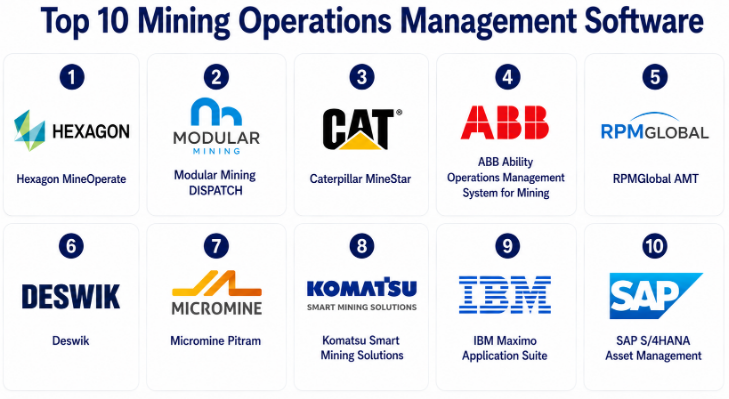
Top 10 Mining Operations Management Software
#1 — Hexagon MineOperate
Short description :
Hexagon MineOperate is a mining operations management platform designed to improve fleet performance, mine production, dispatch, safety, and operational visibility. It is used by mining companies that need real-time control over equipment, operators, material movement, and production activities. The platform supports mine dispatch, fleet management, machine guidance, collision avoidance, and operational analytics depending on configuration. It is especially useful for open-pit mines and large operations with complex equipment fleets. Hexagon MineOperate is best for mining operators that need real-time operational control and fleet productivity improvement.
Key Features
- Fleet management and dispatch
- Real-time equipment tracking
- Production and material movement visibility
- Operator and equipment performance monitoring
- Safety and collision avoidance ecosystem support
- Mine operations dashboards and reporting
- Integration with broader Hexagon mining solutions
Pros
- Strong fit for large open-pit mining operations.
- Useful for dispatch, production tracking, and fleet optimization.
- Good ecosystem alignment with mine planning, safety, and equipment systems.
Cons
- Implementation can be complex for smaller mines.
- Best value depends on strong data and equipment integration.
- Exact modules and capabilities should be validated by mine type.
Platforms / Deployment
Web / Control room / Mobile options may vary
Cloud / On-premise / Hybrid options may vary
Security & Compliance
Enterprise access controls and operational security features may be available depending on deployment. Specific certifications are Not publicly stated here.
Integrations & Ecosystem
Hexagon MineOperate is useful when mining operations need to connect fleet, safety, planning, and production systems.
- Fleet and GPS systems
- Machine guidance systems
- Mine planning tools
- Safety and collision avoidance systems
- Production reporting tools
- Enterprise reporting and analytics platforms
Support & Community
Vendor support, implementation services, training, documentation, and mining-domain expertise are available. Community strength is strongest among large mining operators and mine technology teams.
#2 — Modular Mining DISPATCH
Short description :
Modular Mining DISPATCH is a well-known fleet management and mine dispatch system used in open-pit mining operations. It helps mining companies improve truck and shovel productivity, reduce idle time, manage equipment assignments, and track production performance. The platform is designed for real-time decision-making in mine control rooms. It is especially useful where haulage efficiency, fleet utilization, and production targets are critical. Modular Mining DISPATCH is best for mines that need mature dispatch and fleet optimization capability.
Key Features
- Truck and shovel dispatch
- Real-time fleet tracking
- Equipment utilization monitoring
- Production and haulage reporting
- Route and assignment optimization
- Delay and downtime tracking
- Control room decision support
Pros
- Strong reputation in mine fleet management.
- Useful for improving haulage productivity.
- Good fit for large open-pit operations.
Cons
- Less relevant for small mines without large mobile fleets.
- Implementation requires equipment data and process discipline.
- Broader enterprise workflows may require integration with other systems.
Platforms / Deployment
Control room / Web options may vary
On-premise / Hosted / Hybrid options may vary
Security & Compliance
Operational access controls may be available. Specific certifications are Not publicly stated here.
Integrations & Ecosystem
Modular Mining DISPATCH works well when dispatch data must connect with production, equipment, planning, and reporting workflows.
- GPS and fleet systems
- Mine planning systems
- Equipment monitoring tools
- Maintenance systems
- Production reporting platforms
- Business intelligence tools
Support & Community
Vendor support, implementation services, training, and mining operations expertise are available. Community strength is strong among open-pit mining fleet and dispatch teams.
#3 — Caterpillar MineStar
Short description :
Caterpillar MineStar is a mining technology platform that supports fleet management, equipment health, automation, safety, terrain management, and production visibility. It is especially relevant for mining operations using Caterpillar equipment, but it can also support broader mining workflows depending on configuration. The platform helps mine teams monitor machines, improve productivity, support autonomous operations, and manage equipment health. It is useful for open-pit and large-scale mining environments where equipment performance and fleet coordination are critical. Caterpillar MineStar is best for mines that want connected equipment, productivity, safety, and automation capabilities.
Key Features
- Fleet and equipment management
- Equipment health monitoring
- Production tracking and operational visibility
- Terrain and machine guidance support
- Safety and proximity awareness features depending on setup
- Automation and autonomous haulage support
- Reporting and performance analytics
Pros
- Strong equipment and mining operations ecosystem.
- Useful for mines using Caterpillar machines.
- Supports productivity, safety, and automation workflows.
Cons
- Best value may depend on Caterpillar equipment ecosystem.
- Implementation can require technical and operational planning.
- Non-Caterpillar mixed fleets should validate integration depth.
Platforms / Deployment
Web / Control room / Mobile options may vary
Cloud / On-premise / Hybrid options may vary
Security & Compliance
Enterprise and operational controls may be available depending on deployment. Specific certifications are Not publicly stated here.
Integrations & Ecosystem
Caterpillar MineStar is useful when equipment data, fleet performance, automation, and mine operations must work together.
- Caterpillar equipment systems
- GPS and fleet data
- Maintenance and equipment health systems
- Autonomous haulage systems
- Production reporting tools
- Mine control room workflows
Support & Community
Caterpillar dealer network, vendor support, implementation assistance, training, and documentation are available. Community strength is strong among mining operations using Caterpillar technology.
#4 — ABB Ability Operations Management System for Mining
Short description :
ABB Ability Operations Management System for Mining helps mining companies connect production, process control, asset performance, and operational workflows. It is useful for mines and processing plants that need integrated visibility across operations, maintenance, and production activities. The platform supports planning, execution, tracking, reporting, and decision support. It is especially relevant for mining companies that need better coordination between mine operations and mineral processing. ABB Ability OMS for Mining is best for operations that want integrated production management and digital mine visibility.
Key Features
- Mining operations and production management
- Process and plant performance visibility
- Operational planning and execution tracking
- Maintenance and asset performance alignment
- Dashboards and analytics
- Integration with automation and control systems
- Reporting and workflow management
Pros
- Strong fit for mining operations connected with process control.
- Useful for improving coordination across mine and plant activities.
- Good for operations seeking integrated digital mine workflows.
Cons
- May require significant implementation planning.
- Best value depends on existing automation and control systems.
- Smaller operations may not need the full platform depth.
Platforms / Deployment
Web / Control room options may vary
Cloud / On-premise / Hybrid options may vary
Security & Compliance
Enterprise and industrial security controls may be available depending on deployment. Specific certifications are Not publicly stated here.
Integrations & Ecosystem
ABB Ability OMS is useful when mining operations need to connect production, automation, maintenance, and reporting systems.
- Process control and automation systems
- SCADA and plant systems
- Maintenance and asset systems
- Production planning tools
- Reporting and analytics platforms
- Enterprise systems
Support & Community
Vendor support, implementation services, industrial automation expertise, documentation, and training are available. Community strength is strongest among mining and process industry operations teams.
#5 — RPMGlobal AMT
Short description :
RPMGlobal AMT is an asset management and maintenance budgeting tool designed for mining equipment and heavy mobile assets. It helps mining companies plan maintenance, forecast asset costs, manage equipment strategies, and improve lifecycle decision-making. The platform is especially useful for maintenance planners, reliability teams, and asset managers responsible for large mining fleets. It supports long-term equipment planning and maintenance cost visibility. RPMGlobal AMT is best for mining companies that need stronger asset lifecycle and maintenance strategy management.
Key Features
- Mining asset management and lifecycle planning
- Maintenance strategy and cost forecasting
- Equipment fleet budgeting
- Asset performance and maintenance planning
- Scenario analysis for equipment strategies
- Support for heavy mobile equipment
- Reporting for maintenance and asset teams
Pros
- Strong mining-specific asset management focus.
- Useful for maintenance cost forecasting and lifecycle planning.
- Good fit for large mining fleets.
Cons
- Not a real-time dispatch platform.
- Operational fleet tracking may require other systems.
- Requires good equipment and maintenance data for best results.
Platforms / Deployment
Web / Desktop options may vary
Cloud / Hosted / On-premise options may vary
Security & Compliance
Not publicly stated.
Integrations & Ecosystem
RPMGlobal AMT is useful when asset lifecycle and maintenance planning need to connect with operational and financial systems.
- Maintenance systems
- ERP and finance tools
- Equipment data sources
- Fleet planning workflows
- Budgeting and forecasting tools
- Reporting platforms
Support & Community
Vendor support, mining-domain consulting, documentation, and training resources are available. Community strength is strongest among mining asset management and maintenance planning teams.
#6 — Deswik
Short description :
Deswik provides mine planning, scheduling, design, and operational planning software for open-pit and underground mining. While it is not only an operations execution platform, it is highly relevant because mining operations depend on accurate plans, schedules, designs, and production scenarios. Deswik helps engineers and planners create mine plans, optimize schedules, and connect planning with execution. It is especially useful for technical mine planning teams. Deswik is best for mining companies that need strong planning and scheduling capability connected with operational decision-making.
Key Features
- Mine planning and design
- Open-pit and underground scheduling
- Production planning and scenario analysis
- Drill and blast planning support depending on module
- Survey and design workflows
- Reporting and planning visualization
- Integration with operational workflows where configured
Pros
- Strong mine planning and scheduling capability.
- Useful for technical planning teams.
- Supports both open-pit and underground mining workflows.
Cons
- Not a full real-time fleet dispatch platform.
- Operational execution workflows may require integration.
- Requires skilled mine planners and engineers.
Platforms / Deployment
Windows / Web options may vary
Cloud / On-premise options may vary
Security & Compliance
Not publicly stated.
Integrations & Ecosystem
Deswik works well when mine planning data must connect with production, scheduling, survey, and operational systems.
- Mine design data
- Survey systems
- Production reporting tools
- Fleet management systems
- Planning and scheduling workflows
- Business reporting tools
Support & Community
Vendor support, documentation, training, and mining engineering expertise are available. Community strength is strong among mine planners, engineers, and technical services teams.
#7 — Micromine Pitram
Short description :
Micromine Pitram is a mine control and operations management system used to track production, equipment, materials, personnel, and operational activities. It is especially useful for underground mines but can also support broader mining operations depending on deployment. The platform helps teams understand what is happening in the mine, track progress against plan, manage delays, and improve operational reporting. It supports data capture from equipment, operators, and mine systems. Pitram is best for mines that need real-time operational visibility and production tracking.
Key Features
- Mine control and operations tracking
- Production and material movement reporting
- Equipment and personnel tracking
- Delay and downtime management
- Underground mining workflow support
- Real-time operational dashboards
- Integration with mine planning and equipment systems
Pros
- Strong fit for underground mine operations.
- Useful for tracking production and equipment activity.
- Helps improve visibility between planning and execution.
Cons
- Implementation requires disciplined data capture.
- Open-pit fleet optimization may require additional tools.
- Exact module fit should be validated by mine type.
Platforms / Deployment
Web / Control room / Mobile options may vary
Cloud / On-premise / Hybrid options may vary
Security & Compliance
Access controls may be available depending on deployment. Specific certifications are Not publicly stated here.
Integrations & Ecosystem
Pitram is useful when underground production data must connect with planning, equipment, and reporting systems.
- Mine planning tools
- Equipment and telemetry systems
- Production reporting workflows
- Personnel tracking systems
- Maintenance systems
- Operational dashboards
Support & Community
Vendor support, implementation services, documentation, and mining operations expertise are available. Community strength is strongest among underground mine operations and technical services teams.
#8 — Komatsu Smart Mining Solutions
Short description :
Komatsu Smart Mining Solutions support mining equipment monitoring, fleet optimization, autonomous haulage, production visibility, and equipment performance. The ecosystem is especially relevant for mines using Komatsu equipment and automation technologies. It helps operators monitor machine health, improve productivity, and support safer mining operations. It is useful for large open-pit mines and operations that want stronger equipment-driven insights. Komatsu Smart Mining Solutions are best for mines that need equipment-centered operational visibility and automation support.
Key Features
- Equipment monitoring and health visibility
- Fleet and productivity support
- Autonomous haulage ecosystem capabilities
- Production and utilization tracking
- Maintenance and equipment performance insights
- Safety and operational awareness support
- Integration with mining equipment systems
Pros
- Strong fit for Komatsu equipment environments.
- Useful for automation and equipment performance monitoring.
- Good for large-scale open-pit operations.
Cons
- Best value depends on Komatsu ecosystem fit.
- Mixed-fleet operations should validate integration depth.
- Broader business workflows may require additional systems.
Platforms / Deployment
Web / Control room options may vary
Cloud / On-premise / Hybrid options may vary
Security & Compliance
Not publicly stated.
Integrations & Ecosystem
Komatsu Smart Mining Solutions are useful when equipment, automation, maintenance, and production data must work together.
- Komatsu equipment systems
- Autonomous haulage systems
- Equipment health monitoring
- Mine production systems
- Maintenance workflows
- Reporting and analytics platforms
Support & Community
Komatsu support, dealer services, implementation guidance, training, and equipment expertise are available. Community strength is strongest among mines using Komatsu mining equipment.
#9 — IBM Maximo Application Suite
Short description :
IBM Maximo Application Suite is an enterprise asset management platform used by asset-heavy industries including mining. It helps mining companies manage equipment maintenance, work orders, inspections, spare parts, reliability, asset lifecycle, and field work. It is especially useful for large mines with heavy mobile equipment, processing plants, conveyors, crushers, mills, pumps, and electrical assets. While it is not a mine dispatch system, it is highly relevant for mining operations because maintenance and asset availability drive production performance. IBM Maximo is best for mining companies that need enterprise-grade maintenance and asset lifecycle control.
Key Features
- Enterprise asset management
- Work order and maintenance planning
- Preventive and predictive maintenance support
- Asset lifecycle and reliability workflows
- Inventory and spare parts management
- Mobile maintenance support depending on setup
- Enterprise reporting and integration
Pros
- Strong for maintenance and reliability management.
- Useful for mining equipment, plants, and infrastructure assets.
- Scalable for enterprise mining organizations.
Cons
- Not mining-specific out of the box.
- Requires configuration for mining workflows.
- May need integration with fleet, dispatch, and production systems.
Platforms / Deployment
Web / Mobile options may vary
Cloud / On-premise / Hybrid options may vary
Security & Compliance
IBM enterprise security capabilities may apply depending on deployment and configuration. Specific certifications should be verified directly in the customer environment.
Integrations & Ecosystem
IBM Maximo works well when mining maintenance must connect with operations, inventory, finance, and field teams.
- ERP and finance systems
- Inventory and procurement workflows
- Fleet and equipment data where configured
- SCADA and IoT systems where configured
- Mobile field tools
- Reporting and analytics platforms
Support & Community
IBM provides enterprise support, implementation partners, documentation, training, and asset management expertise. Community strength is strong among maintenance, reliability, mining, and industrial asset teams.
#10 — SAP S/4HANA Asset Management
Short description :
SAP S/4HANA Asset Management helps asset-heavy companies manage maintenance, asset lifecycle, planning, procurement, inventory, and enterprise operations. For mining companies, it is useful when maintenance, equipment, finance, procurement, inventory, and production support workflows must connect in one enterprise environment. It can support preventive maintenance, corrective maintenance, asset records, spare parts, work orders, and reporting. It is especially relevant for mining companies already using SAP as their enterprise backbone. SAP S/4HANA Asset Management is best for enterprise mining companies that need maintenance and asset workflows tightly connected with business systems.
Key Features
- Enterprise asset and maintenance management
- Work order and maintenance planning
- Preventive and corrective maintenance workflows
- Equipment and asset master records
- Inventory and spare parts integration
- Procurement and finance alignment
- Enterprise reporting and analytics
Pros
- Strong fit for SAP-based mining companies.
- Good integration with finance, procurement, and inventory.
- Useful for enterprise maintenance governance.
Cons
- Not a mining-specific dispatch or production platform.
- Requires SAP expertise and configuration.
- Operational mine data integration may require additional systems.
Platforms / Deployment
Web
Cloud / On-premise / Hybrid options may vary
Security & Compliance
SAP enterprise security controls may apply depending on deployment and configuration. Specific certifications should be verified directly.
Integrations & Ecosystem
SAP S/4HANA Asset Management is useful when mining maintenance must connect with enterprise finance, procurement, inventory, and reporting.
- SAP ERP and finance workflows
- Procurement and inventory systems
- Maintenance planning tools
- Equipment records
- Production and operational systems where configured
- Analytics and reporting platforms
Support & Community
SAP provides documentation, enterprise support, partner services, training, and a large ecosystem. Community strength is strong among enterprise asset management, finance, and industrial operations teams.
Comparison Table
| Tool Name | Best For | Platform(s) Supported | Deployment | Standout Feature | Public Rating |
|---|---|---|---|---|---|
| Hexagon MineOperate | Large mine operations and fleet control | Web / Control room / Mobile options vary | Cloud / On-premise / Hybrid options vary | Real-time mine operations and fleet management | N/A |
| Modular Mining DISPATCH | Open-pit fleet dispatch teams | Control room / Web options vary | On-premise / Hosted / Hybrid options vary | Truck and shovel dispatch optimization | N/A |
| Caterpillar MineStar | Caterpillar equipment and automation users | Web / Control room / Mobile options vary | Cloud / On-premise / Hybrid options vary | Equipment-centered productivity and automation | N/A |
| ABB Ability OMS for Mining | Mine-to-plant operations visibility | Web / Control room options vary | Cloud / On-premise / Hybrid options vary | Integrated production and operations management | N/A |
| RPMGlobal AMT | Mining asset lifecycle and maintenance planning | Web / Desktop options vary | Cloud / Hosted / On-premise options vary | Maintenance strategy and lifecycle cost forecasting | N/A |
| Deswik | Mine planning and scheduling teams | Windows / Web options vary | Cloud / On-premise options vary | Open-pit and underground mine planning | N/A |
| Micromine Pitram | Underground mine control and production tracking | Web / Control room / Mobile options vary | Cloud / On-premise / Hybrid options vary | Real-time underground operations visibility | N/A |
| Komatsu Smart Mining Solutions | Komatsu equipment and autonomous mining users | Web / Control room options vary | Cloud / On-premise / Hybrid options vary | Equipment performance and automation ecosystem | N/A |
| IBM Maximo Application Suite | Enterprise mining maintenance and reliability | Web / Mobile options vary | Cloud / On-premise / Hybrid options vary | Enterprise asset lifecycle and work management | N/A |
| SAP S/4HANA Asset Management | SAP-based enterprise mining companies | Web | Cloud / On-premise / Hybrid options vary | Maintenance connected with finance and procurement | N/A |
Evaluation & Mining Operations Management Software
| Tool Name | Core (25%) | Ease (15%) | Integrations (15%) | Security (10%) | Performance (10%) | Support (10%) | Value (15%) | Weighted Total (0–10) |
|---|---|---|---|---|---|---|---|---|
| Hexagon MineOperate | 9 | 7 | 9 | 8 | 9 | 8 | 7 | 8.20 |
| Modular Mining DISPATCH | 9 | 7 | 8 | 7 | 9 | 8 | 8 | 8.05 |
| Caterpillar MineStar | 9 | 7 | 8 | 7 | 9 | 9 | 8 | 8.20 |
| ABB Ability OMS for Mining | 8 | 7 | 9 | 8 | 8 | 8 | 7 | 7.85 |
| RPMGlobal AMT | 8 | 7 | 8 | 7 | 8 | 8 | 8 | 7.75 |
| Deswik | 8 | 8 | 8 | 7 | 8 | 8 | 8 | 7.85 |
| Micromine Pitram | 8 | 8 | 8 | 7 | 8 | 8 | 8 | 7.85 |
| Komatsu Smart Mining Solutions | 8 | 7 | 8 | 7 | 9 | 9 | 8 | 8.00 |
| IBM Maximo Application Suite | 8 | 7 | 9 | 9 | 8 | 9 | 7 | 8.10 |
| SAP S/4HANA Asset Management | 8 | 7 | 9 | 9 | 8 | 9 | 7 | 8.10 |
These scores are comparative and should be used for shortlisting, not as final purchasing advice. Fleet management platforms are stronger for dispatch and production visibility, while asset management systems are stronger for maintenance, reliability, and lifecycle control. Mine planning tools are essential for technical services but may not replace real-time operations systems. Buyers should test real production workflows, fleet data, maintenance scenarios, integrations, reporting, security, and user adoption before selecting a platform.
Which Mining Operations Management Software Should You Choose?
Solo / Freelancer
Solo mining consultants, mine planners, and operational advisors usually need tools based on their consulting focus. For mine planning and scheduling work, Deswik may be highly relevant. For maintenance and asset strategy consulting, RPMGlobal AMT, IBM Maximo, or SAP S/4HANA Asset Management may be more useful.
Consultants working with large mine operators should also understand Hexagon MineOperate, Modular Mining DISPATCH, Caterpillar MineStar, and Micromine Pitram, because these tools are commonly used in operational mining environments.
SMB
Small and mid-sized mines should focus on practical value, ease of adoption, and the most urgent operational bottleneck. A small open-pit mine may need fleet visibility and dispatch support. An underground mine may need production tracking and shift visibility. A processing-heavy operation may need maintenance and plant performance tools.
For smaller teams, Micromine Pitram, Deswik, RPMGlobal AMT, or focused equipment ecosystem tools may be practical depending on the mine type. Enterprise platforms can be useful, but they may create unnecessary complexity if the operation is not ready.
Mid-Market
Mid-market mining companies often need better coordination between planning, production, maintenance, safety, and reporting. Hexagon MineOperate, Modular Mining DISPATCH, Caterpillar MineStar, Micromine Pitram, Deswik, and RPMGlobal AMT can be strong candidates.
A mid-market open-pit mine may prioritize dispatch and fleet optimization. An underground mine may prioritize production tracking and personnel visibility. A mine with maintenance cost challenges may prioritize Maximo, SAP, or RPMGlobal AMT.
Enterprise
Large mining groups should prioritize scalability, multi-site reporting, integration depth, equipment data, maintenance governance, safety workflows, and enterprise analytics. Hexagon MineOperate, Caterpillar MineStar, Modular Mining DISPATCH, ABB Ability OMS for Mining, IBM Maximo, and SAP S/4HANA Asset Management are strong enterprise candidates.
Enterprise buyers should validate how the software connects with ERP, EAM, fleet systems, SCADA, mine planning, dispatch, safety, inventory, procurement, and business intelligence platforms.
Budget vs Premium
Budget-conscious mines should start with the biggest value gap. If the issue is poor planning, evaluate Deswik. If the issue is equipment maintenance cost, evaluate RPMGlobal AMT, IBM Maximo, or SAP Asset Management depending on budget and ecosystem. If the issue is dispatch and haulage productivity, evaluate fleet management platforms.
Premium buyers with large fleets, complex operations, and automation goals should evaluate Hexagon MineOperate, Modular Mining DISPATCH, Caterpillar MineStar, Komatsu Smart Mining Solutions, and ABB Ability OMS for Mining.
Feature Depth vs Ease of Use
For operational depth, Hexagon MineOperate, Modular Mining DISPATCH, Caterpillar MineStar, and Micromine Pitram are strong options.
For planning depth, Deswik is highly relevant. For asset lifecycle and maintenance depth, IBM Maximo, SAP S/4HANA Asset Management, and RPMGlobal AMT are stronger.
For ease of adoption, the best option depends heavily on current systems, data readiness, equipment fleet, and team skills.
Integrations & Scalability
Mining operations software rarely works alone. It often needs to integrate with fleet systems, GPS, equipment telemetry, mine planning tools, ERP, EAM, SCADA, dispatch systems, safety platforms, inventory, procurement, and reporting dashboards.
Large mines should prioritize integration architecture and data governance before rollout. Smaller mines should start with one high-value workflow and expand gradually.
Security & Compliance Needs
Mining operations data can include production plans, equipment performance, worker locations, safety incidents, financial data, operational targets, and critical infrastructure details. Buyers should ask vendors about SSO, MFA, RBAC, encryption, audit logs, backups, access reviews, data residency, and incident response.
For safety-critical mining workflows, security should be evaluated together with operational continuity, offline access, disaster recovery, and system availability.
Frequently Asked Questions
1. What is Mining Operations Management Software?
Mining Operations Management Software helps mining companies manage daily mine activities such as production, fleet dispatch, equipment tracking, maintenance, safety, planning, material movement, and reporting.
2. How is mining operations software different from mine planning software?
Mine planning software focuses on design, schedules, reserves, sequencing, and production plans. Mining operations software focuses on executing and tracking daily activities such as dispatch, equipment utilization, delays, production, and maintenance.
3. Can mining operations software support both open-pit and underground mines?
Some platforms support both, but depth varies. Open-pit mines often need fleet dispatch and haulage optimization, while underground mines may need personnel tracking, activity tracking, shift reporting, and production visibility.
4. What is the biggest mistake buyers make?
The biggest mistake is buying software before fixing operational data quality. Poor equipment data, unclear delay codes, weak asset hierarchy, inconsistent shift reporting, and disconnected systems can reduce software value.
5. Can these tools improve equipment utilization?
Yes. Fleet and operations platforms can help reduce idle time, improve dispatch decisions, track delays, monitor equipment availability, and identify productivity bottlenecks. Actual improvement depends on adoption and process discipline.
6. Can mining software integrate with ERP and maintenance systems?
Yes, many mining platforms can integrate with ERP, EAM, CMMS, finance, inventory, procurement, and reporting systems. Buyers should test real integration scenarios during evaluation.
7. Which software is best for open-pit fleet dispatch?
Modular Mining DISPATCH, Hexagon MineOperate, Caterpillar MineStar, and Komatsu Smart Mining Solutions are strong candidates for open-pit fleet and equipment operations depending on fleet ecosystem and mine requirements.
8. Which software is best for underground mine operations?
Micromine Pitram is highly relevant for underground production tracking and mine control. Deswik is also important for underground planning and scheduling. The best setup may combine planning, tracking, and maintenance systems.
9. Which software is best for mining maintenance?
IBM Maximo, SAP S/4HANA Asset Management, and RPMGlobal AMT are strong candidates for maintenance, asset lifecycle, and reliability workflows. Caterpillar MineStar and Komatsu solutions may also support equipment health in specific ecosystems.
10. Can mining operations software help with safety?
Yes. Many platforms can support safety workflows through equipment tracking, personnel visibility, collision avoidance ecosystems, inspection workflows, incident reporting, and operational alerts. Exact safety features vary by tool and configuration.
Conclusion
Mining Operations Management Software is essential for mining companies that want better control over production, equipment, maintenance, planning, safety, and operational reporting. The right platform can help reduce downtime, improve fleet utilization, strengthen maintenance planning, connect planning with execution, and give leaders clearer visibility into mine performance. However, the best solution depends on mine type, equipment fleet, production model, data readiness, operational maturity, and integration needs.
