Introduction
Airline Crew Scheduling Tools are specialized software systems used by airlines to assign pilots, cabin crew, and other flight staff to flights while ensuring compliance with safety regulations, labor agreements, and operational constraints. In simple terms, these tools help airlines make sure the right crew is in the right place at the right time—without breaking rules or increasing costs.
In today’s aviation environment, scheduling has become far more complex due to global operations, dynamic flight changes, stricter compliance rules, and rising operational costs. Modern tools now use automation, optimization algorithms, and AI to manage crew efficiently and reduce disruptions.
Real-world use cases:
- Managing pilot and cabin crew rotations across multiple routes
- Handling last-minute disruptions like delays or cancellations
- Ensuring compliance with duty time regulations and rest requirements
- Optimizing crew costs while maintaining service quality
- Supporting crew self-service for shift swaps and preferences
What buyers should evaluate:
- Optimization capabilities (AI/algorithm-driven scheduling)
- Regulatory compliance handling (FAA, EASA, DGCA, etc.)
- Integration with flight operations and HR systems
- Real-time disruption management
- User experience for planners and crew
- Scalability across fleets and geographies
- Reporting and analytics capabilities
- Security and access controls
- Deployment flexibility (cloud vs on-prem)
Best for: Large airlines, regional carriers, aviation IT teams, and operations planners who need to manage complex crew logistics at scale.
Not ideal for: Small charter operators with minimal crew or organizations that rely on manual scheduling and do not require automation or compliance-heavy workflows.
Key Trends in Airline Crew Scheduling Tools
- AI-driven optimization for faster and more efficient crew assignments
- Real-time disruption management with automated re-planning
- Increased focus on regulatory compliance automation
- Mobile-first crew engagement and self-service portals
- Integration with enterprise systems like ERP, HRMS, and flight ops platforms
- Cloud-native deployments replacing legacy on-prem systems
- Predictive analytics for workforce planning and fatigue management
- Advanced visualization dashboards for planners
- API-first architectures for better interoperability
- Shift toward subscription-based pricing models
How We Selected These Tools (Methodology)
- Strong adoption across commercial airlines globally
- Proven capability in crew scheduling and optimization
- Reliability in handling complex airline operations
- Availability of compliance and regulatory support features
- Integration capabilities with aviation and enterprise systems
- Performance and scalability in large deployments
- Vendor reputation and long-term market presence
- Flexibility across airline sizes and operational models
- Usability for both planners and crew members
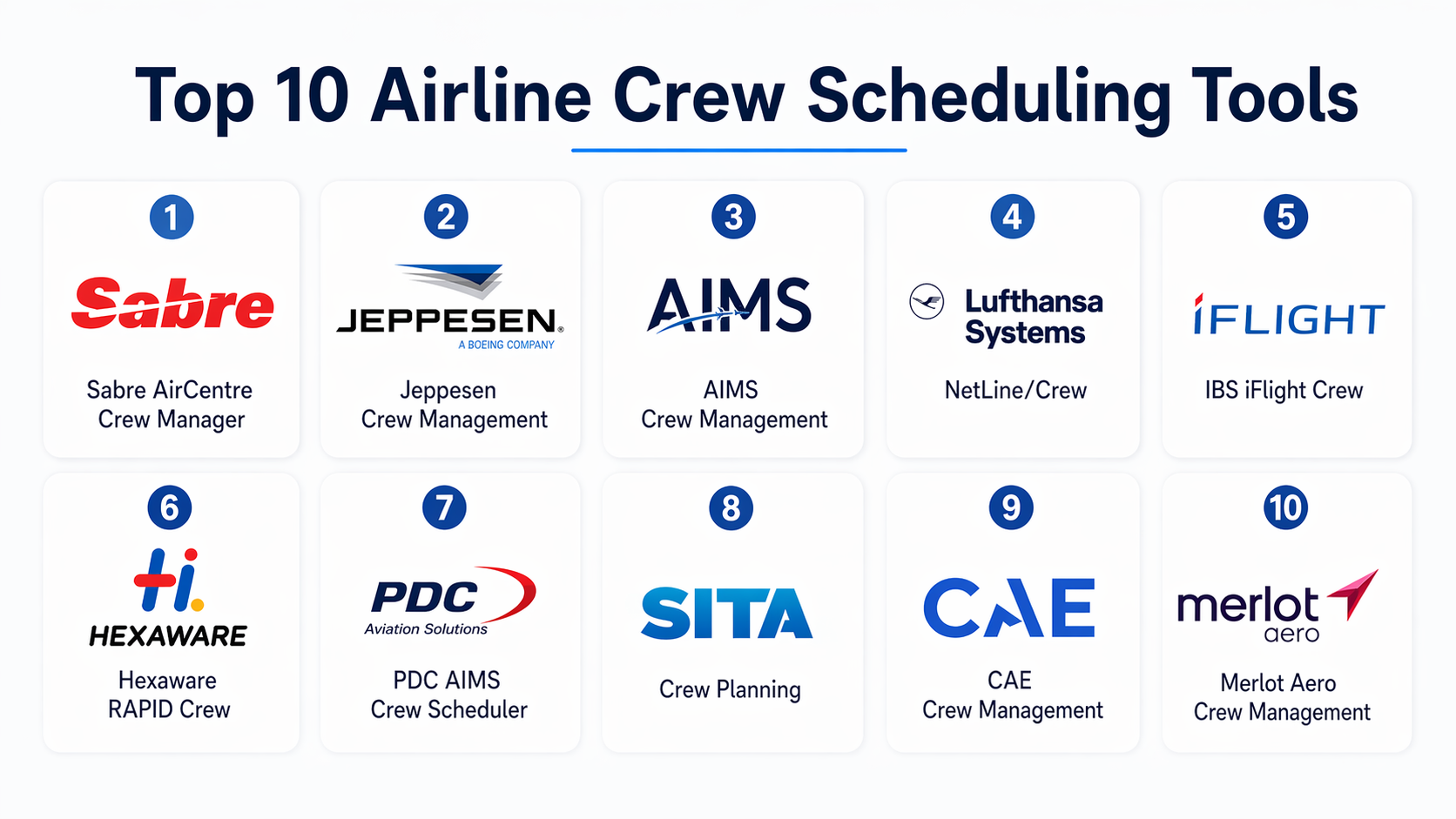
Top 10 Airline Crew Scheduling Tools
#1 — Sabre AirCentre Crew Manager
Short description: A comprehensive crew management solution designed for large airlines. It provides advanced optimization and real-time scheduling capabilities, making it suitable for complex global operations.
Key Features
- Advanced crew pairing and rostering
- Real-time disruption recovery
- Compliance rule engine
- Crew bidding and preferences
- Integrated analytics dashboard
Pros
- Highly scalable for large airlines
- Strong optimization algorithms
Cons
- Complex implementation
- Requires significant training
Platforms / Deployment
Web / Cloud / Hybrid
Security & Compliance
RBAC, audit logs, encryption (details not publicly stated)
Integrations & Ecosystem
Integrates with flight operations systems, HR tools, and maintenance platforms.
- API support
- ERP integration
- Data analytics tools
Support & Community
Enterprise-grade support with structured onboarding; limited public community.
#2 — Jeppesen Crew Management
Short description: A widely used aviation solution offering robust scheduling and optimization for crew operations, known for accuracy and regulatory compliance.
Key Features
- Crew pairing optimization
- Fatigue risk management
- Compliance automation
- Scenario planning
- Reporting tools
Pros
- Strong regulatory support
- Reliable performance
Cons
- Expensive
- Steep learning curve
Platforms / Deployment
Web / Cloud / On-prem
Security & Compliance
Not publicly stated
Integrations & Ecosystem
Supports integrations with flight planning and operations systems.
- API connectivity
- Aviation systems integration
Support & Community
Well-established vendor support; documentation available.
#3 — AIMS Crew Management
Short description: Part of the AIMS airline software suite, this tool focuses on integrated operations and crew scheduling.
Key Features
- Integrated airline operations
- Crew rostering
- Flight planning integration
- Cost optimization
- Reporting
Pros
- All-in-one solution
- Cost-effective for mid-size airlines
Cons
- Limited advanced analytics
- UI may feel dated
Platforms / Deployment
Web / Cloud
Security & Compliance
Not publicly stated
Integrations & Ecosystem
Integrated with AIMS ecosystem and external systems.
- API support
- Flight ops integration
Support & Community
Moderate support; vendor-driven.
#4 — Lufthansa Systems NetLine/Crew
Short description: A high-end enterprise solution offering detailed crew planning and scheduling for global airlines.
Key Features
- Long-term and short-term planning
- Optimization engine
- Crew communication tools
- Compliance tracking
- Scenario simulation
Pros
- Enterprise-grade capabilities
- Strong planning features
Cons
- High cost
- Complex setup
Platforms / Deployment
Web / Hybrid
Security & Compliance
Not publicly stated
Integrations & Ecosystem
Works with airline operational systems and ERP tools.
- API integrations
- Data exchange support
Support & Community
Strong enterprise support; limited open community.
#5 — IBS iFlight Crew
Short description: A modern crew management solution designed for efficiency and scalability, widely used by global carriers.
Key Features
- Crew pairing and rostering
- Mobile crew access
- Real-time updates
- Analytics dashboards
- Compliance management
Pros
- Modern interface
- Strong mobile support
Cons
- Limited customization
- Requires training
Platforms / Deployment
Web / Cloud
Security & Compliance
Not publicly stated
Integrations & Ecosystem
Supports airline ecosystem integrations.
- APIs
- Flight ops tools
Support & Community
Vendor support with onboarding programs.
#6 — Hexaware RAPID Crew
Short description: Focused on automation and efficiency, this tool helps airlines optimize crew operations with modern workflows.
Key Features
- AI-based scheduling
- Disruption handling
- Cost optimization
- Crew self-service
- Reporting
Pros
- Automation-focused
- Flexible deployment
Cons
- Less market adoption
- Limited documentation
Platforms / Deployment
Cloud
Security & Compliance
Not publicly stated
Integrations & Ecosystem
- API support
- HR integration
- Data systems
Support & Community
Varies / Not publicly stated
#7 — PDC AIMS Crew Scheduler
Short description: A specialized crew scheduling module within the AIMS ecosystem, designed for streamlined operations.
Key Features
- Crew planning
- Scheduling automation
- Reporting tools
- Integration with AIMS
Pros
- Easy integration
- Cost-effective
Cons
- Limited advanced features
- Smaller ecosystem
Platforms / Deployment
Web
Security & Compliance
Not publicly stated
Integrations & Ecosystem
- AIMS ecosystem
- Basic API support
Support & Community
Vendor-led support.
#8 — SITA Crew Planning
Short description: A cloud-based solution focusing on operational efficiency and integration across airline systems.
Key Features
- Cloud deployment
- Scheduling optimization
- Data analytics
- Integration capabilities
Pros
- Cloud-first approach
- Scalable
Cons
- Limited public details
- Customization may vary
Platforms / Deployment
Cloud
Security & Compliance
Not publicly stated
Integrations & Ecosystem
- API integration
- Airline ecosystem tools
Support & Community
Enterprise support model.
#9 — CAE Crew Management
Short description: Known for training and operations, CAE also offers crew management solutions integrated with simulation data.
Key Features
- Scheduling and planning
- Training integration
- Analytics
- Compliance tracking
Pros
- Training + scheduling integration
- Reliable vendor
Cons
- Niche focus
- Limited flexibility
Platforms / Deployment
Web / Cloud
Security & Compliance
Not publicly stated
Integrations & Ecosystem
- Training systems
- HR tools
Support & Community
Vendor-based support.
#10 — Merlot Aero Crew Management
Short description: A user-friendly scheduling solution designed for airlines and aviation operators with simpler workflows.
Key Features
- Crew rostering
- Mobile interface
- Alerts and notifications
- Reporting
Pros
- Easy to use
- Suitable for smaller airlines
Cons
- Limited enterprise features
- Less scalability
Platforms / Deployment
Cloud
Security & Compliance
Not publicly stated
Integrations & Ecosystem
- API support
- Basic integrations
Support & Community
Moderate support; smaller community.
Comparison Table (Top 10)
| Tool Name | Best For | Platform(s) Supported | Deployment | Standout Feature | Public Rating |
|---|---|---|---|---|---|
| Sabre AirCentre Crew Manager | Large airlines | Web | Cloud/Hybrid | Advanced optimization | N/A |
| Jeppesen Crew Management | Compliance-heavy ops | Web | Cloud/On-prem | Regulatory accuracy | N/A |
| AIMS Crew Management | Mid-size airlines | Web | Cloud | Integrated suite | N/A |
| Lufthansa NetLine/Crew | Enterprise airlines | Web | Hybrid | Planning depth | N/A |
| IBS iFlight Crew | Global carriers | Web | Cloud | Mobile-first access | N/A |
| Hexaware RAPID Crew | Automation-focused teams | Web | Cloud | AI scheduling | N/A |
| PDC AIMS Crew Scheduler | Smaller airlines | Web | Cloud | Cost efficiency | N/A |
| SITA Crew Planning | Cloud-first airlines | Web | Cloud | Scalability | N/A |
| CAE Crew Management | Training-integrated ops | Web | Cloud | Training linkage | N/A |
| Merlot Aero Crew | Small operators | Web | Cloud | Simplicity | N/A |
Evaluation & Scoring of Airline Crew Scheduling Tools
| Tool Name | Core (25%) | Ease (15%) | Integrations (15%) | Security (10%) | Performance (10%) | Support (10%) | Value (15%) | Weighted Total |
|---|---|---|---|---|---|---|---|---|
| Sabre AirCentre | 9 | 7 | 9 | 8 | 9 | 8 | 7 | 8.3 |
| Jeppesen | 9 | 6 | 8 | 8 | 9 | 8 | 6 | 8.0 |
| AIMS | 7 | 7 | 7 | 6 | 7 | 7 | 8 | 7.2 |
| Lufthansa NetLine | 9 | 6 | 8 | 8 | 9 | 8 | 6 | 8.1 |
| IBS iFlight | 8 | 8 | 8 | 7 | 8 | 7 | 7 | 7.7 |
| Hexaware RAPID | 7 | 7 | 7 | 6 | 7 | 6 | 7 | 6.9 |
| PDC AIMS | 6 | 7 | 6 | 6 | 6 | 6 | 8 | 6.5 |
| SITA | 7 | 7 | 8 | 7 | 7 | 7 | 7 | 7.1 |
| CAE | 7 | 6 | 7 | 6 | 7 | 7 | 6 | 6.8 |
| Merlot Aero | 6 | 8 | 6 | 6 | 6 | 6 | 8 | 6.9 |
How to interpret scores:
These scores are comparative and reflect overall strengths across key criteria. A higher score indicates a balanced solution, but the “best” tool depends on operational needs. Enterprise tools score high on features but may lose on ease of use or cost, while simpler tools score better in usability and value.
Which Airline Crew Scheduling Tools
Solo / Freelancer
Not applicable for most cases. Smaller aviation operators may consider lightweight tools like Merlot Aero.
SMB
Tools like AIMS and Merlot Aero offer good value with manageable complexity.
Mid-Market
IBS iFlight and SITA provide a balance between scalability and usability.
Enterprise
Sabre, Jeppesen, and Lufthansa NetLine are best suited for complex global operations.
Budget vs Premium
Budget tools offer simplicity but limited features; premium tools provide deep optimization and compliance.
Feature Depth vs Ease of Use
High-end tools offer powerful features but require training. Simpler tools are easier but less flexible.
Integrations & Scalability
Enterprise tools excel in integrations and scaling across fleets.
Security & Compliance Needs
Large airlines should prioritize tools with strong compliance automation and audit capabilities.
Frequently Asked Questions (FAQs)
1. What is the typical pricing model?
Most tools follow subscription-based or enterprise licensing models depending on airline size.
2. How long does implementation take?
Implementation can take weeks to months depending on system complexity.
3. Are these tools cloud-based?
Many modern tools are cloud-based, though some still offer on-prem options.
4. Do they support regulatory compliance?
Yes, most tools are designed to comply with aviation regulations.
5. Can crew access schedules on mobile?
Many tools now offer mobile apps or web access for crew members.
6. What are common mistakes when selecting tools?
Ignoring integration needs and underestimating training requirements.
7. Can these tools handle disruptions?
Yes, most advanced tools include real-time re-scheduling capabilities.
8. How scalable are these tools?
Enterprise tools are highly scalable across global operations.
9. Are integrations important?
Yes, integration with flight ops and HR systems is critical.
10. Can airlines switch tools easily?
Switching is possible but requires careful planning and data migration.
Conclusion
Airline Crew Scheduling Tools play a critical role in ensuring operational efficiency, regulatory compliance, and cost optimization in modern aviation. While enterprise solutions like Sabre, Jeppesen, and Lufthansa NetLine offer deep capabilities for complex global operations, mid-market and smaller solutions provide flexibility and ease of use for less demanding environments. There is no single “best” tool—only the best fit based on your airline’s size, complexity, and strategic goals. The most practical next step is to shortlist two or three tools that align with your operational needs, run a pilot implementation, and validate integration, usability, and compliance capabilities before making a final decision.