Introduction
AIOps Platforms (Artificial Intelligence for IT Operations) are tools that use machine learning and data analytics to automate and enhance IT operations. In simple terms, they collect massive volumes of data from logs, metrics, events, and alerts, then use AI to detect anomalies, reduce noise, identify root causes, and even automate responses.
As IT environments grow more complex—with microservices, cloud-native architectures, and hybrid infrastructures—manual monitoring and incident response are no longer sufficient. AIOps platforms help teams move from reactive troubleshooting to proactive and predictive operations.
Common use cases include:
- Detecting anomalies in infrastructure and applications
- Reducing alert noise through intelligent correlation
- Root cause analysis of incidents
- Predictive maintenance and capacity planning
- Automating incident response and remediation
Key evaluation criteria:
- AI/ML capabilities and accuracy
- Event correlation and noise reduction
- Root cause analysis features
- Integration with observability and monitoring tools
- Automation and remediation workflows
- Scalability across large environments
- Ease of implementation and use
- Visualization and reporting
- Security and compliance features
- Pricing and flexibility
Best for: Enterprise IT teams, SREs, DevOps engineers, and organizations managing complex, large-scale infrastructure.
Not ideal for: Small teams with simple environments where traditional monitoring tools are sufficient.
Key Trends in AIOps Platforms
- Predictive analytics adoption: Moving from reactive to proactive operations
- AI-driven root cause analysis: Faster identification of issues
- Event correlation and noise reduction: Reducing alert fatigue
- Integration with observability stacks: Unified visibility across logs, metrics, and traces
- Automation of remediation workflows: Self-healing systems
- Cloud-native AIOps: Support for Kubernetes and serverless
- Data lake integration: Handling large-scale telemetry data
- Explainable AI: Improving trust in AI-driven decisions
- Security and IT convergence: Combining AIOps with SecOps
- Low-code/no-code automation: Simplifying workflows
How We Selected These Tools (Methodology)
We evaluated AIOps Platforms based on:
- Market adoption and industry reputation
- Depth of AI/ML capabilities
- Event correlation and anomaly detection
- Integration with observability and IT tools
- Automation and remediation capabilities
- Scalability and performance
- Security and compliance features
- Ease of use and onboarding
- Vendor support and community
- Overall value for cost
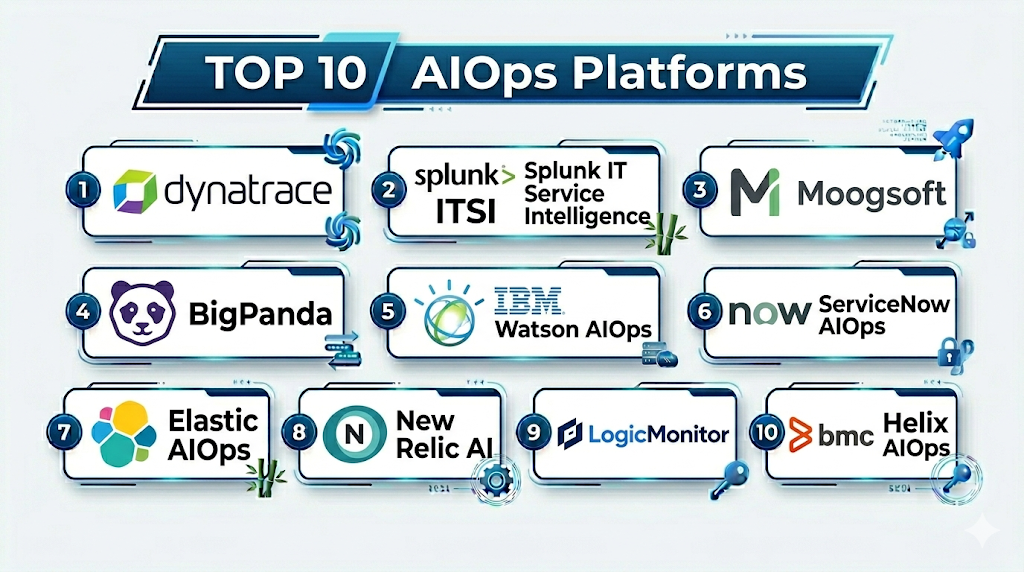
Top 10 AIOps Platforms
#1 — Dynatrace
Short description: An AI-powered observability and AIOps platform offering automated monitoring, root cause analysis, and performance insights.
Key Features
- AI-driven anomaly detection
- Automatic root cause analysis
- Full-stack observability
- Real-time monitoring
- Kubernetes and cloud support
- Automation workflows
Pros
- Advanced AI capabilities
- Deep visibility across systems
Cons
- Premium pricing
- Complex configuration
Platforms / Deployment
Cloud / Self-hosted
Security & Compliance
RBAC, encryption, audit logs
Integrations & Ecosystem
Dynatrace integrates with modern cloud and DevOps ecosystems.
- AWS, Azure, GCP
- Kubernetes
- CI/CD tools
Support & Community
Enterprise-grade support.
#2 — Splunk IT Service Intelligence (ITSI)
Short description: An AIOps platform built on Splunk for advanced analytics, event correlation, and incident management.
Key Features
- Event correlation
- Machine learning insights
- Service health monitoring
- Predictive analytics
- Custom dashboards
Pros
- Strong analytics capabilities
- Highly customizable
Cons
- Expensive
- Requires Splunk expertise
Platforms / Deployment
Cloud / Self-hosted
Security & Compliance
RBAC, encryption
Integrations & Ecosystem
Integrates with Splunk ecosystem and enterprise tools.
- Splunk platform
- Monitoring tools
Support & Community
Strong enterprise support.
#3 — Moogsoft
Short description: An AIOps platform focused on event correlation and noise reduction using machine learning.
Key Features
- Event correlation
- Anomaly detection
- Noise reduction
- Root cause analysis
- Automation workflows
Pros
- Reduces alert fatigue
- AI-driven insights
Cons
- Learning curve
- Pricing considerations
Platforms / Deployment
Cloud
Security & Compliance
RBAC, encryption
Integrations & Ecosystem
Moogsoft integrates with monitoring and IT tools.
- Observability tools
- Incident management platforms
Support & Community
Vendor support.
#4 — BigPanda
Short description: A data-driven AIOps platform focused on event correlation and incident management.
Key Features
- Event correlation
- Alert noise reduction
- Incident insights
- Automation
- Real-time analytics
Pros
- Strong event correlation
- Scalable platform
Cons
- Expensive
- Complex setup
Platforms / Deployment
Cloud
Security & Compliance
RBAC, encryption
Integrations & Ecosystem
Integrates with monitoring and DevOps tools.
- APM tools
- Cloud platforms
Support & Community
Enterprise support.
#5 — IBM Watson AIOps
Short description: An AI-powered platform for IT operations leveraging IBM Watson for analytics and automation.
Key Features
- AI-driven insights
- Event correlation
- Root cause analysis
- Automation
- Integration with IBM tools
Pros
- Strong AI capabilities
- Enterprise-grade features
Cons
- Complex implementation
- High cost
Platforms / Deployment
Cloud / Hybrid
Security & Compliance
RBAC, encryption
Integrations & Ecosystem
Integrates with IBM ecosystem and enterprise tools.
- ITSM tools
- Monitoring platforms
Support & Community
Enterprise support.
#6 — ServiceNow AIOps
Short description: An AIOps solution integrated with ServiceNow’s ITSM platform for automated incident management.
Key Features
- Event management
- AI-driven insights
- Automation workflows
- Integration with ITSM
- Predictive analytics
Pros
- Strong ITSM integration
- Automation capabilities
Cons
- Expensive
- Complex setup
Platforms / Deployment
Cloud
Security & Compliance
RBAC, audit logs
Integrations & Ecosystem
Integrates with enterprise IT systems.
- ServiceNow platform
- Monitoring tools
Support & Community
Enterprise support.
#7 — Elastic AIOps (Elastic Stack)
Short description: A flexible AIOps solution built on the Elastic Stack for data analysis and anomaly detection.
Key Features
- Anomaly detection
- Data analytics
- Custom dashboards
- Integration with logs and metrics
- Machine learning features
Pros
- Highly customizable
- Open-source flexibility
Cons
- Requires setup
- Learning curve
Platforms / Deployment
Cloud / Self-hosted
Security & Compliance
RBAC, encryption
Integrations & Ecosystem
Integrates with Elastic Stack and observability tools.
- Elasticsearch
- Kibana
- Beats
Support & Community
Strong community support.
#8 — New Relic AI
Short description: An AI-powered observability platform offering anomaly detection and performance insights.
Key Features
- AI-driven alerts
- Distributed tracing
- Metrics and logs integration
- Real-time analytics
- Automation
Pros
- Unified observability
- Easy to use
Cons
- Pricing complexity
- Limited deep AI features
Platforms / Deployment
Cloud
Security & Compliance
SSO, RBAC, encryption
Integrations & Ecosystem
Integrates with cloud and DevOps tools.
- Kubernetes
- CI/CD tools
Support & Community
Strong support.
#9 — LogicMonitor
Short description: A cloud-based monitoring platform with AIOps capabilities for anomaly detection and automation.
Key Features
- AI-driven monitoring
- Anomaly detection
- Automation
- Cloud monitoring
- Reporting
Pros
- Easy deployment
- Scalable
Cons
- Limited deep analytics
- Pricing tiers
Platforms / Deployment
Cloud
Security & Compliance
RBAC, encryption
Integrations & Ecosystem
Integrates with cloud and IT tools.
- AWS, Azure
- Monitoring tools
Support & Community
Vendor support.
#10 — BMC Helix AIOps
Short description: An AIOps platform offering AI-driven insights, automation, and service management.
Key Features
- Event correlation
- Predictive analytics
- Root cause analysis
- Automation
- Service management integration
Pros
- Strong enterprise features
- Automation capabilities
Cons
- Complex implementation
- Expensive
Platforms / Deployment
Cloud / Hybrid
Security & Compliance
RBAC, encryption
Integrations & Ecosystem
Integrates with BMC and enterprise tools.
- ITSM platforms
- Monitoring tools
Support & Community
Enterprise support.
Comparison Table (Top 10)
| Tool Name | Best For | Platform(s) Supported | Deployment | Standout Feature | Public Rating |
|---|---|---|---|---|---|
| Dynatrace | Enterprise | Cross-platform | Hybrid | AI insights | N/A |
| Splunk ITSI | Analytics | Cross-platform | Hybrid | Data analysis | N/A |
| Moogsoft | Noise reduction | Web | Cloud | Event correlation | N/A |
| BigPanda | Event correlation | Web | Cloud | Alert reduction | N/A |
| IBM Watson AIOps | Enterprise | Web | Hybrid | AI engine | N/A |
| ServiceNow AIOps | ITSM users | Web | Cloud | ITSM integration | N/A |
| Elastic AIOps | Custom setups | Cross-platform | Hybrid | Flexibility | N/A |
| New Relic AI | Observability | Web | Cloud | Ease of use | N/A |
| LogicMonitor | SMB/Mid | Web | Cloud | Simplicity | N/A |
| BMC Helix | Enterprise | Web | Hybrid | Automation | N/A |
AIOps Platforms Scoring
| Tool Name | Core (25%) | Ease (15%) | Integrations (15%) | Security (10%) | Performance (10%) | Support (10%) | Value (15%) | Weighted Total |
|---|---|---|---|---|---|---|---|---|
| Dynatrace | 10 | 8 | 10 | 10 | 10 | 9 | 7 | 9.3 |
| Splunk ITSI | 10 | 7 | 9 | 9 | 9 | 9 | 7 | 8.9 |
| Moogsoft | 9 | 7 | 8 | 8 | 8 | 8 | 7 | 8.1 |
| BigPanda | 9 | 7 | 9 | 9 | 9 | 8 | 7 | 8.5 |
| IBM Watson | 10 | 6 | 9 | 10 | 9 | 9 | 6 | 8.7 |
| ServiceNow | 9 | 7 | 9 | 10 | 9 | 9 | 6 | 8.6 |
| Elastic | 8 | 7 | 8 | 8 | 8 | 8 | 9 | 8.1 |
| New Relic | 8 | 9 | 9 | 9 | 9 | 9 | 8 | 8.7 |
| LogicMonitor | 8 | 9 | 8 | 8 | 8 | 8 | 8 | 8.2 |
| BMC Helix | 9 | 6 | 9 | 9 | 9 | 9 | 6 | 8.4 |
How to interpret scores:
- Scores are relative across platforms
- Enterprise tools lead in AI and automation
- Open platforms offer flexibility and value
- Simpler tools score higher in usability
- Choose based on environment complexity
Which AIOps Platforms Is Right for You?
Solo / Freelancer
- Use Elastic or LogicMonitor
- Focus on simplicity and affordability
SMB
- LogicMonitor or New Relic
- Balance ease of use and features
Mid-Market
- BigPanda or Moogsoft
- Focus on event correlation and scalability
Enterprise
- Dynatrace, Splunk ITSI, or ServiceNow
- Focus on automation, AI, and integration
Budget vs Premium
- Open-source and flexible tools reduce cost
- Premium tools offer advanced AI capabilities
Feature Depth vs Ease of Use
- Dynatrace = deep insights
- LogicMonitor = easy setup
Integrations & Scalability
- Choose tools with strong observability integrations
- Ensure scalability for large environments
Security & Compliance Needs
- Enterprises should prioritize audit logs and RBAC
- Smaller teams can focus on core monitoring
Frequently Asked Questions (FAQs)
What is AIOps?
It uses AI to automate and improve IT operations.
How is AIOps different from monitoring?
AIOps adds intelligence and automation to monitoring data.
Are AIOps tools expensive?
Many are enterprise-grade and priced accordingly.
Do AIOps tools replace humans?
No, they assist teams by reducing manual work.
Can AIOps tools automate fixes?
Yes, many support automated remediation.
Do they integrate with monitoring tools?
Yes, integration is essential.
Are they cloud-based?
Most support cloud and hybrid deployment.
How long does implementation take?
From weeks to months depending on complexity.
Can small teams use AIOps?
Yes, but benefits increase with scale.
Do AIOps tools improve uptime?
Yes, by detecting and resolving issues faster.
Conclusion
AIOps Platforms are transforming IT operations by introducing intelligence, automation, and predictive capabilities. They help organizations reduce downtime, improve performance, and manage complex environments more effectively.
