Introduction
Capacity Planning Tools are platforms that help organizations forecast, monitor, and optimize resource usage across infrastructure, applications, and teams. These tools enable businesses to ensure they have the right amount of compute, storage, network, and workforce capacity to meet current and future demand without overprovisioning or risking performance issues.
In modern environments driven by cloud computing, microservices, and dynamic workloads, capacity planning has become more complex. Organizations must balance cost efficiency with performance reliability, especially in multi-cloud and hybrid setups. Capacity planning tools provide data-driven insights, predictive analytics, and automation, helping teams make informed decisions.
Common use cases include:
- Forecasting infrastructure demand and scaling needs
- Optimizing cloud resource utilization and costs
- Planning workforce or project capacity
- Avoiding system overloads and downtime
- Supporting budgeting and strategic planning
What buyers should evaluate:
- Forecasting and predictive analytics capabilities
- Real-time monitoring and reporting
- Integration with cloud and infrastructure tools
- Cost optimization features
- Scalability for large environments
- Visualization and dashboards
- Automation and alerting
- Support for hybrid/multi-cloud environments
- Ease of use and implementation
- Pricing and licensing
Best for: DevOps teams, IT operations, finance teams, and enterprises managing dynamic workloads and infrastructure.
Not ideal for: Small teams with static workloads or organizations with minimal infrastructure complexity.
Key Trends in Capacity Planning Tools
- AI-driven forecasting: Predicting demand based on historical data
- Cloud cost optimization: Aligning capacity with cost efficiency
- Real-time analytics: Immediate visibility into resource usage
- Multi-cloud and hybrid support: Managing distributed environments
- Automation and scaling recommendations: Reducing manual planning
- Integration with observability platforms: Unified insights
- Scenario modeling: Simulating different growth scenarios
- Sustainability metrics: Optimizing energy and resource usage
- Self-service dashboards: Empowering teams with insights
- FinOps integration: Bridging finance and engineering teams
How We Selected These Tools (Methodology)
- Evaluated market adoption and credibility
- Assessed forecasting and analytics capabilities
- Reviewed integration with cloud and infrastructure tools
- Considered cost optimization features
- Analyzed scalability and performance
- Checked visualization and reporting capabilities
- Evaluated ease of use and onboarding
- Examined automation and alerting features
- Included both enterprise and SMB-friendly tools
- Focused on real-world infrastructure and capacity planning use cases
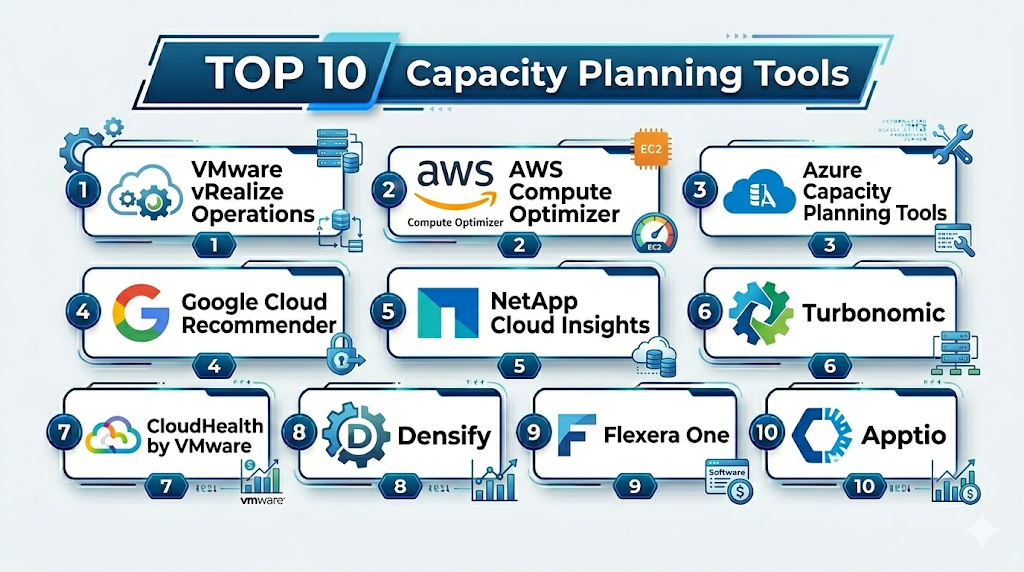
Top Capacity Planning Tools
#1 — VMware vRealize Operations
Short description: A comprehensive platform for capacity planning and performance optimization in virtualized environments.
Key Features
- Predictive analytics
- Capacity optimization
- Performance monitoring
- AI-driven insights
- Cost management
- Custom dashboards
Pros
- Strong analytics
- Enterprise-grade
Cons
- Complex setup
- Expensive
Platforms / Deployment
Cloud / On-prem / Hybrid
Security & Compliance
RBAC, encryption
Integrations & Ecosystem
VMware integrates with its ecosystem and beyond.
- VMware tools
- APIs
- Cloud platforms
Support & Community
Strong enterprise support.
#2 — AWS Compute Optimizer
Short description: A cloud-native tool for optimizing AWS resource capacity and costs.
Key Features
- Resource utilization analysis
- Cost optimization recommendations
- Machine learning insights
- Integration with AWS services
- Real-time monitoring
Pros
- Native AWS integration
- Easy to use
Cons
- Limited outside AWS
- Basic advanced features
Platforms / Deployment
Cloud (AWS)
Security & Compliance
IAM, encryption
Integrations & Ecosystem
- AWS services
- APIs
- Cloud tools
Support & Community
Strong AWS support.
#3 — Azure Capacity Planning Tools
Short description: A suite of tools for managing capacity in Azure environments.
Key Features
- Resource forecasting
- Cost management
- Integration with Azure services
- Real-time monitoring
- Reporting tools
Pros
- Strong Azure integration
- Scalable
Cons
- Azure dependency
- Limited multi-cloud
Platforms / Deployment
Cloud (Azure)
Security & Compliance
RBAC, encryption
Integrations & Ecosystem
- Azure services
- APIs
- DevOps tools
Support & Community
Strong support.
#4 — Google Cloud Recommender
Short description: A tool for optimizing resource usage and capacity in Google Cloud.
Key Features
- Usage insights
- Cost optimization
- Resource recommendations
- Integration with GCP services
- Analytics
Pros
- Easy to use
- Cloud-native
Cons
- Limited outside GCP
- Basic customization
Platforms / Deployment
Cloud (GCP)
Security & Compliance
Not publicly stated
Integrations & Ecosystem
- GCP services
- APIs
- Cloud tools
Support & Community
Strong support.
#5 — NetApp Cloud Insights
Short description: A platform for monitoring and optimizing infrastructure capacity.
Key Features
- Capacity planning
- Performance monitoring
- Cost analysis
- Multi-cloud support
- Visualization dashboards
Pros
- Multi-cloud visibility
- Strong analytics
Cons
- Pricing
- Complexity
Platforms / Deployment
Cloud
Security & Compliance
Not publicly stated
Integrations & Ecosystem
- Cloud providers
- APIs
- DevOps tools
Support & Community
Good support.
#6 — Turbonomic
Short description: An AI-powered platform for application resource management and capacity planning.
Key Features
- AI-driven resource optimization
- Real-time analytics
- Automation
- Cost optimization
- Integration support
Pros
- Advanced automation
- Strong insights
Cons
- Expensive
- Learning curve
Platforms / Deployment
Cloud / On-prem
Security & Compliance
RBAC, encryption
Integrations & Ecosystem
- Cloud platforms
- APIs
- DevOps tools
Support & Community
Enterprise support.
#7 — CloudHealth by VMware
Short description: A cloud management platform with capacity planning and cost optimization features.
Key Features
- Cost optimization
- Resource tracking
- Reporting
- Multi-cloud support
- Policy management
Pros
- Strong FinOps features
- Multi-cloud
Cons
- Complex UI
- Pricing
Platforms / Deployment
Cloud
Security & Compliance
RBAC, encryption
Integrations & Ecosystem
- Cloud providers
- APIs
- DevOps tools
Support & Community
Strong support.
#8 — Densify
Short description: A capacity planning and cloud optimization tool.
Key Features
- Resource optimization
- Predictive analytics
- Cost savings insights
- Automation
- Integration support
Pros
- Strong cost optimization
- Easy insights
Cons
- Limited ecosystem
- Pricing
Platforms / Deployment
Cloud
Security & Compliance
Not publicly stated
Integrations & Ecosystem
- Cloud tools
- APIs
- DevOps platforms
Support & Community
Moderate support.
#9 — Flexera One
Short description: A platform for IT asset management and capacity planning.
Key Features
- Resource tracking
- Cost management
- Analytics
- Multi-cloud support
- Reporting
Pros
- Strong asset tracking
- Enterprise-ready
Cons
- Complex
- Expensive
Platforms / Deployment
Cloud
Security & Compliance
Not publicly stated
Integrations & Ecosystem
- Cloud platforms
- APIs
- IT tools
Support & Community
Enterprise support.
#10 — Apptio
Short description: A financial and capacity planning platform for IT resources.
Key Features
- Cost analysis
- Resource planning
- Forecasting
- Reporting
- Integration support
Pros
- Strong financial insights
- Enterprise features
Cons
- Expensive
- Complex
Platforms / Deployment
Cloud
Security & Compliance
Not publicly stated
Integrations & Ecosystem
- APIs
- Cloud tools
- IT systems
Support & Community
Enterprise support.
Comparison Table (Top 10)
| Tool Name | Best For | Platform(s) Supported | Deployment | Standout Feature | Public Rating |
|---|---|---|---|---|---|
| VMware vRealize | Enterprise | Multi | Hybrid | Predictive analytics | N/A |
| AWS Compute Optimizer | AWS users | Cloud | Cloud | ML insights | N/A |
| Azure Tools | Azure users | Cloud | Cloud | Integration | N/A |
| GCP Recommender | GCP users | Cloud | Cloud | Simplicity | N/A |
| NetApp | Multi-cloud | Web | Cloud | Visibility | N/A |
| Turbonomic | Automation | Multi | Hybrid | AI optimization | N/A |
| CloudHealth | FinOps | Web | Cloud | Cost mgmt | N/A |
| Densify | Optimization | Web | Cloud | Insights | N/A |
| Flexera | Asset mgmt | Web | Cloud | Tracking | N/A |
| Apptio | Finance | Web | Cloud | Budgeting | N/A |
Capacity Planning Tools (Scoring)
| Tool Name | Core (25%) | Ease (15%) | Integrations (15%) | Security (10%) | Performance (10%) | Support (10%) | Value (15%) | Weighted Total |
|---|---|---|---|---|---|---|---|---|
| VMware | 10 | 7 | 9 | 9 | 9 | 9 | 7 | 8.8 |
| AWS Optimizer | 8 | 9 | 9 | 9 | 9 | 9 | 9 | 8.9 |
| Azure Tools | 8 | 9 | 9 | 9 | 9 | 9 | 9 | 8.9 |
| GCP | 8 | 9 | 8 | 8 | 9 | 8 | 9 | 8.5 |
| NetApp | 9 | 8 | 9 | 8 | 9 | 8 | 8 | 8.6 |
| Turbonomic | 10 | 7 | 9 | 9 | 9 | 9 | 7 | 8.9 |
| CloudHealth | 9 | 7 | 9 | 9 | 9 | 9 | 8 | 8.7 |
| Densify | 8 | 8 | 8 | 8 | 8 | 8 | 8 | 8.0 |
| Flexera | 9 | 7 | 9 | 8 | 9 | 9 | 7 | 8.5 |
| Apptio | 9 | 7 | 8 | 8 | 9 | 9 | 7 | 8.4 |
How to interpret:
- Scores compare relative strengths across tools
- Cloud-native tools excel in ease and integration
- Enterprise tools lead in analytics and depth
- Choose based on infrastructure and cost priorities
Which Service Mesh Platforms Is Right for You?
Solo / Freelancer
Use AWS Compute Optimizer or GCP Recommender.
SMB
Choose Densify or NetApp Cloud Insights.
Mid-Market
Use CloudHealth or Azure Tools.
Enterprise
Go with VMware vRealize, Turbonomic, or Flexera.
Budget vs Premium
- Budget: Cloud-native tools
- Premium: VMware, Turbonomic
Feature Depth vs Ease of Use
- Easy: AWS tools
- Advanced: VMware
Integrations & Scalability
- Best: CloudHealth, Turbonomic
- Moderate: Densify
Security & Compliance Needs
- High: VMware, Flexera
- Basic: Cloud-native tools
Capacity Planning Tools (FAQs)
What are capacity planning tools?
They help forecast and optimize resource usage.
Why are they important?
They prevent over/under-provisioning.
Are they cloud-based?
Many tools are cloud-native.
Do they support multi-cloud?
Yes, some tools do.
Can they reduce costs?
Yes, by optimizing resources.
Are they scalable?
Enterprise tools handle large environments.
Do they integrate with DevOps tools?
Yes, via APIs.
Are they complex?
Some enterprise tools are.
Can I switch tools?
Yes, but migration takes effort.
Are they secure?
Most include security features.
Conclusion
Capacity Planning Tools are critical for balancing performance, scalability, and cost efficiency in modern IT environments. Whether you choose cloud-native tools like AWS Compute Optimizer or enterprise platforms like VMware vRealize, the best choice depends on your infrastructure complexity, budget, and optimization goals.
