Introduction
In the evolving landscape of cloud-native systems, the ability to build platforms that are both agile and inherently secure has become the gold standard for high-performing engineering teams. The Certified DevSecOps Architect credential offers a strategic pathway for professionals looking to master the integration of automated security controls into the software supply chain. This guide is intended for experienced practitioners, including DevOps engineers, infrastructure leads, and security architects who want to move beyond basic tooling and understand the architectural patterns that drive modern enterprise resilience. By aligning your skill set with these advanced frameworks, you position yourself as a leader capable of solving complex operational challenges. For those aiming to integrate intelligence into their systems, expanding your knowledge with tools found in aiopsschool can further elevate your capability to maintain stable, automated environments.
What is the Certified DevSecOps Architect?
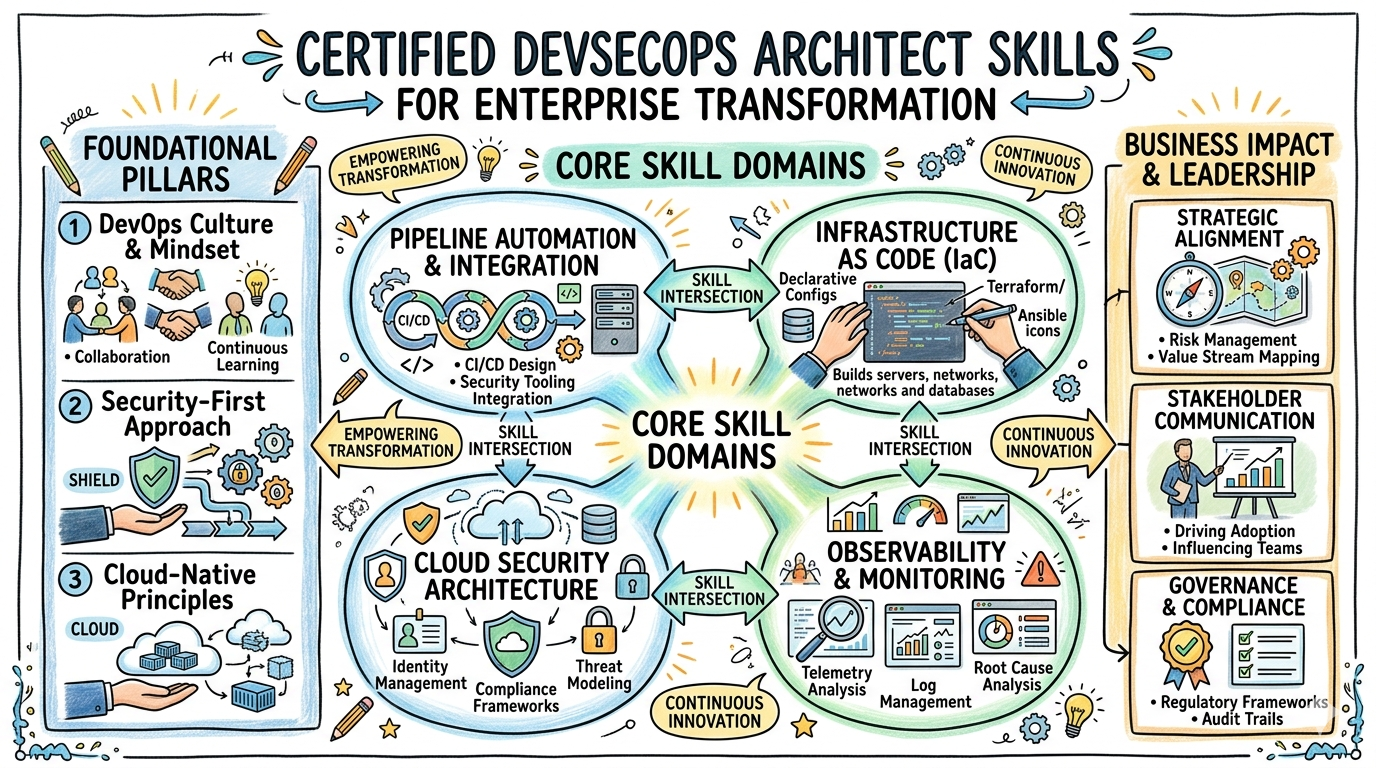
The Certified DevSecOps Architect designation represents the pinnacle of technical proficiency in creating a secure-by-design software development lifecycle. Unlike generalized security certifications, this program focuses on the practical application of security-as-code and compliance orchestration within high-velocity environments. It exists to provide engineers with a robust methodology for embedding security gates into CI/CD pipelines, ensuring that vulnerability management is a continuous, automated process rather than a manual, episodic intervention. It aligns with modern enterprise practices by treating security infrastructure with the same rigor and scalability as application code, enabling teams to deploy with confidence at scale.
Who Should Pursue Certified DevSecOps Architect?
This program is specifically curated for individuals operating in the “trenches” of modern platform engineering. It is perfectly suited for SREs and DevOps professionals who are often tasked with balancing system uptime with stringent security compliance requirements. Cloud engineers who are building infrastructure and security practitioners looking to gain deep, hands-on exposure to CI/CD pipelines will find the curriculum immediately applicable to their daily roles. Whether you are working in the growing Indian technology sector or a global engineering firm, this certification provides the practical blueprint needed to manage modern, distributed environments effectively.
Why Certified DevSecOps Architect
As businesses continue to migrate mission-critical applications to the cloud, the risk profile of every deployment increases. This certification provides long-term career value because it focuses on universal architectural patterns, such as zero-trust networking, automated compliance validation, and infrastructure hardening, which remain relevant regardless of which specific vendor tools are currently in fashion. Mastering these principles ensures that your skills remain durable in an industry defined by rapid change. The investment you make in this certification is returned through your enhanced capacity to architect resilient, secure, and highly performant platforms that businesses desperately need.
Certified DevSecOps Architect Certification Overview
This certification program is delivered via the Certified DevSecOps Architect comprehensive training syllabus and is hosted on devopsschool. The program emphasizes a performance-based assessment model, requiring candidates to demonstrate their ability to solve real-world problems in simulated environments. Ownership of the certification rests with the industry-recognized certifying authority, which ensures that your credentials hold significant weight in the professional market. The structure of the program guides you logically from the initial conceptualization of a secure pipeline through to advanced threat modeling and incident recovery.
Certified DevSecOps Architect Certification Tracks & Levels
The certification is organized into three progressive levels to support engineers at every stage of their career growth. The Foundation level provides a bedrock of knowledge in security automation, while the Professional level addresses the complexities of pipeline integration and defensive design. The Advanced level is reserved for architects tasked with designing holistic, multi-cloud security frameworks and automated compliance policies. This tiered approach allows you to build your expertise incrementally, ensuring that you have a solid grasp of fundamental concepts before moving into the high-stakes world of enterprise security architecture.
Complete Certified DevSecOps Architect Certification Table
| Track | Level | Who it’s for | Prerequisites | Skills Covered | Recommended Order |
|---|---|---|---|---|---|
| Foundation | Entry | Junior DevOps / Cloud | Basic Linux / Networking | Pipeline Basics, Secret Mgmt | 1 |
| Professional | Mid-Level | DevOps / SRE / Security | Foundation Level | Automation, Shift-Left, IAM | 2 |
| Advanced | Expert | Architect / Lead | Professional Level | Threat Modeling, Governance | 3 |
Detailed Guide for Each Certified DevSecOps Architect Certification
Certified DevSecOps Architect – Professional
What it is This certification validates advanced competency in architecting and maintaining integrated security solutions within high-velocity delivery pipelines.
Who should take it Engineers with practical experience who are ready to transition into architectural design roles and influence organizational security posture.
Skills you’ll gain
- Designing automated compliance-as-code frameworks.
- Implementing advanced secrets management at enterprise scale.
- Orchestrating security gates in complex CI/CD environments.
- Developing incident response playbooks for automated systems.
Real-world projects you should be able to do
- Build a fully automated security scanning bridge for a multi-cloud CI/CD pipeline.
- Implement a robust RBAC framework for an entire platform engineering team.
- Design a self-healing security monitoring system using standard observability tools.
Preparation plan
- 7–14 days: Deep dive into architectural design patterns and security automation theory.
- 30 days: Dedicate time to building and securing custom pipelines in a lab environment.
- 60 days: Conduct end-to-end security simulations and review architecture design logs.
Common mistakes Focusing too heavily on tool configurations while ignoring the underlying architecture and the integration of security within the broader business context.
Best next certification after this
- Same-track: Certified DevSecOps Architect – Advanced.
- Cross-track: Certified DataOps Architect.
- Leadership: Certified IT Operations Manager.
Choose Your Learning Path
DevOps Path
The DevOps path centers on the cultural and technical marriage of development and operations, with a heavy emphasis on CI/CD optimization. You will learn to automate deployment cycles while ensuring that every iteration is vetted for potential security vulnerabilities and operational risks.
DevSecOps Path
The DevSecOps path is a deep exploration into security-first engineering. It focuses on integrating security into every phase of the development lifecycle, ensuring that your infrastructure is hardened by design and continuously monitored for compliance deviations.
SRE Path
The SRE path is focused on system reliability, focusing on how security decisions impact availability. You will learn to build secure systems that are resilient to failures, focusing on observability, incident management, and automated recovery strategies.
AIOps Path
The AIOps path is dedicated to applying machine learning to operational challenges. You will learn to build intelligent systems that can detect security anomalies in real-time, providing proactive alerts and automated responses to threats.
MLOps Path
The MLOps path covers the operationalization of machine learning models, specifically focusing on the security of the model lifecycle. You will learn how to secure training data, model storage, and the serving environments for production models.
DataOps Path
The DataOps path focuses on the lifecycle of data and the infrastructure that supports it. You will learn to architect secure, high-throughput data pipelines that ensure data integrity, privacy, and regulatory compliance at every stage.
FinOps Path
The FinOps path deals with the fiscal responsibility of cloud operations. You will learn to balance security investments with budget requirements, ensuring that your cloud footprint is optimized for cost, performance, and risk mitigation.
Role → Recommended Certified DevSecOps Architect Certifications
| Role | Recommended Certifications |
|---|---|
| DevOps Engineer | Professional |
| SRE | Professional, Advanced |
| Platform Engineer | Professional |
| Cloud Engineer | Foundation, Professional |
| Security Engineer | Professional, Advanced |
| Data Engineer | Foundation, Professional |
| FinOps Practitioner | Professional |
| Engineering Manager | Advanced |
Next Certifications to Take After Certified DevSecOps Architect
Same Track Progression
Continue deepening your expertise by focusing on platform-specific security certifications, such as those for Kubernetes security architecture, or advanced cloud security design credentials that test your ability to build multi-cloud defenses.
Cross-Track Expansion
Expand your technical breadth by earning certifications in SRE or DataOps. These domains provide critical complementary skills that help you understand the broader reliability and data-handling requirements of any large-scale platform.
Leadership & Management Track
For those interested in management, pursue certifications focused on IT governance, project management, and leadership. These paths help you translate your technical security expertise into high-level business strategy and organizational change.
Training & Certification Support Providers for Certified DevSecOps Architect
DevOpsSchool is a globally recognized training provider that specializes in providing immersive, hands-on learning environments for DevOps and security professionals seeking industry-standard certifications.
Cotocus provides highly tailored training programs that focus on solving complex real-world engineering problems through active lab participation and expert mentorship.
Scmgalaxy offers a unique approach to technical education, focusing on configuration management and automated workflows that are vital for modern software engineers.
BestDevOps is committed to delivering structured, high-quality certification paths that help professionals build the practical skills needed to thrive in modern cloud-native organizations.
devsecopsschool is your dedicated partner for security-focused engineering education, offering highly specialized curriculum that addresses the most pressing challenges in security integration today.
sreschool provides essential training in site reliability, focusing on building resilient, scalable systems that are equipped to handle the demands of the modern enterprise.
aiopsschool is focused on the future of operations, teaching engineers how to leverage machine learning to build self-healing, intelligent platforms.
dataopsschool offers expert-led courses on data pipeline orchestration, ensuring that your team can manage large-scale data with reliability and security.
finopsschool delivers specialized training on cloud financial management, helping professionals master the art of cost-efficient and secure cloud operations.
Frequently Asked Questions (General)
- What is the primary benefit of achieving this certification? This certification validates your technical ability to design secure systems, significantly enhancing your credibility in the engineering market and opening doors to more complex architectural roles.
- How long does it typically take to prepare for these exams? Preparation time varies depending on your previous experience, but a consistent plan focusing on hands-on lab work can lead to success in three to six months for professional levels.
- Are the assessment methods theory-based or practical? The assessments are primarily performance-based, meaning you will be required to demonstrate your expertise by solving real-world scenarios rather than simply answering theory-based questions.
- How do I know which certification level is right for me? You should assess your current daily responsibilities and experience level; a foundation course is best for those starting, while professional courses suit those with established hands-on experience.
- Is there a need to maintain the certification through renewal? Most professional certifications require periodic updates or re-certification to ensure that your skills remain current with rapidly evolving industry best practices.
- Can these certifications lead to higher salary packages? Yes, architects with validated skills in both security and operations are highly sought after, and this certification serves as a formal proof of your specialized expertise.
- How does this program support different global markets? The curriculum is designed around universal engineering standards, ensuring that the skills you acquire are highly relevant in both Indian and global enterprise markets.
- Is this certification recognized by hiring managers? The certification is increasingly viewed as a benchmark for quality by technical managers who are looking for proven ability in complex environment management.
- Can I practice for the exams without a dedicated lab? While you can learn theory independently, the exam requires practical experience, making it vital to use the provided lab environments or set up your own simulation workspace.
- What if I have limited experience with security? The foundation track is specifically designed to bring engineers from an operational background up to speed on the core security principles needed for success.
- Are the instructors active practitioners in the field? Yes, the training programs are led by experienced engineers who actively work on complex projects, ensuring the curriculum reflects real-world challenges.
- Is there a path for managers without coding experience? While technical depth is encouraged, management-focused paths exist that concentrate on the governance and strategic aspects of secure platform architecture.
FAQs on Certified DevSecOps Architect
- How does this certification differ from a standard CISSP? This program is deeply technical and focused on pipeline architecture, whereas CISSP is broader and more focused on general security policy and risk management.
- Does this cover automated infrastructure security? Absolutely; the use of Infrastructure-as-Code (IaC) tools to enforce security standards is a core component of the syllabus.
- Are there practice exams available before the final assessment? Yes, each track includes practice components designed to prepare you for the format and difficulty level of the final assessment.
- Is this program suitable for remote learners? Yes, all coursework and labs are delivered online, making them accessible to engineers anywhere in the world.
- Does the architect level require knowledge of cloud providers? Yes, you will be expected to apply architectural principles across common cloud platforms to ensure consistency in your security design.
- Are there any hidden costs after the initial enrollment? No, the enrollment fee covers access to all necessary learning materials and the lab environments required for your specific track.
- Will I learn about threat modeling in this course? Yes, threat modeling is an essential part of the professional and advanced tracks, as it is a core architectural responsibility.
- Can I interact with instructors for guidance? Yes, the platforms typically provide channels for you to reach out to instructors to resolve technical blockers during your training journey.
Final Thoughts: Is Certified DevSecOps Architect Worth It?
In my two decades in this industry, I have seen too many architects build beautiful systems that collapse under the weight of security debt. The Certified DevSecOps Architect program is not about collecting a certificate; it is about adopting a mindset that security is a feature, not a friction point. If you are prepared to do the hard work of learning the tools, failing in the labs, and iterating on your designs, then this program will be a turning point for your career. It provides the architectural maturity that companies are desperately looking for, and it will give you the confidence to lead transformations in even the most complex environments. If you want to grow as an engineer, this is the path to take.
