Introduction
Security Data Lakes are centralized, scalable data platforms designed to store, process, and analyze massive volumes of security-related data such as logs, alerts, telemetry, network traffic, identity activity, endpoint signals, and cloud events. Unlike traditional SIEM systems that rely on structured schemas and limited retention, security data lakes are built for high-volume, low-cost storage and flexible analytics.
In security data lakes have become a core part of modern cybersecurity architectures because organizations now generate exponentially more telemetry from cloud-native systems, SaaS applications, remote endpoints, and AI-driven workloads. Traditional SIEMs alone cannot efficiently store or analyze this scale of data without high cost or performance limitations.
Security data lakes enable SOC teams to perform long-term threat hunting, forensic investigations, behavioral analytics, and machine learning-based detection across petabyte-scale datasets.
Common use cases include:
- Long-term security log retention and investigation
- Threat hunting across historical datasets
- Behavioral anomaly detection using ML models
- Cloud and identity security analytics
- Incident forensics and root cause analysis
- Compliance auditing and reporting
When evaluating Security Data Lakes, buyers should consider:
- Data ingestion scalability and velocity handling
- Storage cost optimization and tiering strategies
- Query performance at large scale
- Integration with SIEM, SOAR, and XDR tools
- Schema flexibility (structured + unstructured data)
- Built-in analytics and ML capabilities
- Security governance and access control
- Data lifecycle management and retention policies
- Multi-cloud and hybrid support
- Ease of querying and analyst usability
Best for: Large enterprises, cloud-native organizations, MSSPs, SOC teams, and security engineering teams dealing with high-volume telemetry and long-term analytics needs.
Not ideal for: Small organizations with limited telemetry volume or teams that only need basic alerting and dashboards.
Key Trends in Security Data Lakes
- Shift from SIEM-centric architecture to data lake–first security stacks
- Increased adoption of lakehouse architectures (data lake + warehouse hybrid)
- AI-driven threat detection across historical datasets
- Real-time streaming ingestion replacing batch log pipelines
- Security graph modeling built on top of data lakes
- Zero-copy data sharing between security tools
- Open table formats improving interoperability
- Native integration with XDR and SOAR platforms
- Cloud-native storage optimization for cost reduction
- Automated schema discovery and normalization using AI
How We Selected These Tools (Methodology)
The tools below were selected based on their relevance to modern security analytics and large-scale telemetry management.
Selection criteria included:
- Scalability for high-volume security data ingestion
- Query performance and analytical capabilities
- Integration with SIEM, SOAR, and XDR ecosystems
- Security and governance controls
- Cloud-native and hybrid architecture support
- Support for structured and unstructured data
- ML and behavioral analytics capabilities
- Adoption in enterprise SOC environments
- Cost efficiency at scale
- Flexibility for threat hunting and forensic analysis
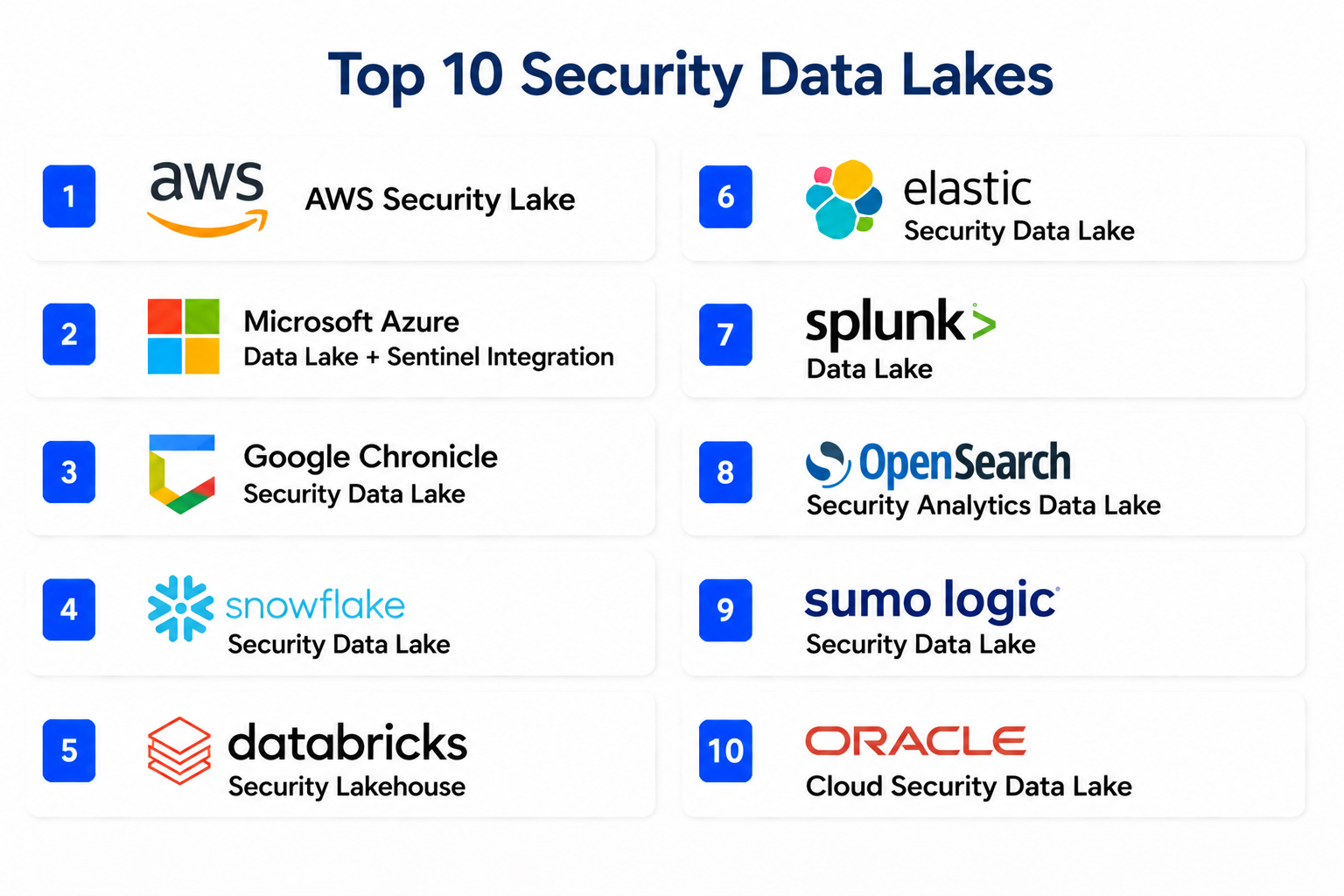
Top 10 Security Data Lakes
#1 — AWS Security Lake
Short description :
AWS Security Lake is a cloud-native security data lake designed to automatically centralize security data from AWS environments, SaaS tools, and third-party security sources. It normalizes security data into a standard schema and enables large-scale analytics using AWS-native services. It is widely used by cloud-first enterprises for centralized security visibility and long-term retention.
Key Features
- Automated security data ingestion
- Standardized schema normalization (OCSF-based)
- Scalable cloud storage
- Integration with AWS analytics tools
- Cross-account data aggregation
- Security event correlation
- Long-term retention capabilities
Pros
- Deep AWS ecosystem integration
- Highly scalable and cost-efficient
- Simplifies multi-source security ingestion
Cons
- Best suited for AWS-centric environments
- Limited flexibility outside AWS stack
- Requires additional tools for advanced analytics
Platforms / Deployment
- Cloud (AWS-native)
Security & Compliance
- IAM-based access control
- Encryption at rest and in transit
- Audit logging support
- Compliance alignment capabilities
Integrations & Ecosystem
- AWS security services
- SIEM platforms
- Threat intelligence feeds
- Data analytics tools
- SOAR systems
Support & Community
Strong AWS enterprise support and documentation ecosystem.
#2 — Microsoft Azure Data Lake + Sentinel Integration
Short description :
Microsoft Azure Data Lake combined with Microsoft Sentinel forms a powerful security data lake architecture for ingesting, storing, and analyzing security telemetry across cloud, identity, and endpoint systems. It enables unified security analytics across the Microsoft ecosystem and third-party integrations.
Key Features
- Scalable log ingestion and storage
- Integration with Sentinel analytics
- Advanced KQL-based querying
- Identity and endpoint telemetry ingestion
- Real-time security analytics
- Long-term data retention
- Cross-cloud security visibility
Pros
- Strong integration with Microsoft security stack
- Powerful query language (KQL)
- Unified security analytics environment
Cons
- Complex pricing model
- Best optimized for Microsoft environments
- Requires expertise for advanced analytics
Platforms / Deployment
- Cloud (Azure-native)
Security & Compliance
- RBAC and MFA
- Encryption at rest/in transit
- Compliance reporting tools
- Audit logging support
Integrations & Ecosystem
- Microsoft Defender XDR
- Azure Sentinel
- Third-party SIEM tools
- Identity providers
- Cloud security tools
Support & Community
Strong enterprise support and large SOC adoption base.
#3 — Google Chronicle Security Data Lake
Short description :
Google Chronicle is a cloud-native security data lake built for massive-scale telemetry ingestion and ultra-fast search across security datasets. It is designed for threat hunting, retrospective analysis, and long-term security data retention with high-speed query capabilities.
Key Features
- Ultra-fast security search engine
- Massive-scale log ingestion
- Built-in threat intelligence correlation
- Normalized security data model
- Long-term retention at scale
- Behavioral analytics support
- Cloud-native architecture
Pros
- Extremely fast search performance
- Designed for petabyte-scale security data
- Strong threat intelligence integration
Cons
- Limited flexibility outside Google ecosystem
- Requires SOC maturity for full usage
- Enterprise-focused pricing
Platforms / Deployment
- Cloud (Google Cloud-native)
Security & Compliance
- IAM-based access control
- Encryption support
- Audit logging
- Compliance features
Integrations & Ecosystem
- Google Cloud security tools
- SIEM/SOAR platforms
- Threat intelligence feeds
- Enterprise security tools
Support & Community
Enterprise support with strong cloud-native security ecosystem.
#4 — Snowflake Security Data Lake
Short description :
Snowflake is a cloud data platform widely used as a security data lake due to its scalability, performance, and flexibility. Security teams use it to store and analyze large-scale telemetry data for threat hunting, compliance, and forensic investigations.
Key Features
- Scalable data storage and compute separation
- Structured and semi-structured data support
- High-performance SQL querying
- Secure data sharing
- Time travel data recovery
- Multi-cloud deployment support
- Advanced analytics capabilities
Pros
- Highly scalable and flexible
- Strong performance for large datasets
- Multi-cloud support
Cons
- Requires engineering effort for security use cases
- Not security-specific by default
- Additional tools needed for SOC workflows
Platforms / Deployment
- Cloud (multi-cloud)
Security & Compliance
- RBAC
- Encryption at rest/in transit
- Audit logging
- Compliance certifications (varies by deployment)
Integrations & Ecosystem
- SIEM platforms
- Data engineering pipelines
- Security analytics tools
- Cloud security platforms
- Machine learning systems
Support & Community
Strong enterprise support and large data engineering ecosystem.
#5 — Databricks Security Lakehouse
Short description :
Databricks provides a lakehouse architecture that combines data lake scalability with data warehouse performance, making it a strong foundation for security analytics and threat detection workflows. It is widely used for AI-driven security analytics and behavioral modeling.
Key Features
- Lakehouse architecture
- ML-driven threat detection
- Scalable data ingestion
- Real-time streaming analytics
- Notebook-based investigation workflows
- Unified data processing engine
- Advanced query optimization
Pros
- Strong AI and ML capabilities
- Flexible analytics environment
- Excellent scalability
Cons
- Requires engineering maturity
- Not plug-and-play for SOC teams
- Complex setup for security workflows
Platforms / Deployment
- Cloud (multi-cloud)
Security & Compliance
- RBAC
- Encryption support
- Audit logging
- Enterprise governance controls
Integrations & Ecosystem
- SIEM tools
- Cloud platforms
- Data pipelines
- Security analytics systems
- AI/ML frameworks
Support & Community
Strong enterprise support and large data science ecosystem.
#6 — Elastic Security Data Lake
Short description :
Elastic Security functions as a flexible security data lake built on Elasticsearch, enabling real-time ingestion, search, and analytics across large-scale security datasets. It is widely used for SIEM and threat hunting use cases.
Key Features
- Full-text and structured search
- Real-time log ingestion
- Security analytics dashboards
- ML-based anomaly detection
- Scalable indexing engine
- Custom detection rules
- Threat hunting workflows
Pros
- Highly flexible and scalable
- Strong real-time search capabilities
- Cost-effective for large datasets
Cons
- Requires tuning and expertise
- Infrastructure management overhead
- Complex at enterprise scale
Platforms / Deployment
- Cloud / Self-hosted / Hybrid
Security & Compliance
- RBAC
- Encryption support
- Audit logging
- Compliance dashboards
Integrations & Ecosystem
- SIEM tools
- Cloud security platforms
- DevSecOps pipelines
- Threat intelligence feeds
Support & Community
Strong open-source community and enterprise support options.
#7 — Splunk Data Lake (via Splunk Platform + Storage Optimization)
Short description :
Splunk functions as a security data lake by ingesting and indexing massive volumes of machine data for real-time and historical security analysis. It is widely used in enterprise SOCs for threat hunting, correlation, and forensic investigation.
Key Features
- High-volume data ingestion
- Real-time search and analytics
- Security correlation engine
- Custom dashboards
- Threat hunting queries
- Machine data indexing
- Flexible data pipelines
Pros
- Extremely powerful analytics
- Mature SOC ecosystem
- Strong query capabilities
Cons
- High cost at scale
- Requires optimization for large datasets
- Complex administration
Platforms / Deployment
- Cloud / Hybrid / On-prem
Security & Compliance
- RBAC
- MFA
- Audit logging
- Encryption support
Integrations & Ecosystem
- SIEM/SOAR platforms
- Cloud services
- Security tools
- Threat intelligence feeds
Support & Community
Large enterprise support ecosystem and SOC community.
#8 — OpenSearch Security Analytics Data Lake
Short description :
OpenSearch is an open-source search and analytics engine used as a cost-effective security data lake for log ingestion, threat hunting, and observability workloads. It is widely adopted by organizations seeking flexible, self-managed security analytics infrastructure.
Key Features
- Distributed search engine
- Real-time log analytics
- Security analytics dashboards
- Custom detection rules
- Scalable ingestion pipelines
- Open-source extensibility
- Multi-tenant support
Pros
- Cost-effective and open-source
- Highly flexible architecture
- Strong community support
Cons
- Requires operational expertise
- Manual tuning required
- Less enterprise governance by default
Platforms / Deployment
- Cloud / Self-hosted / Hybrid
Security & Compliance
- RBAC
- Encryption support
- Audit logging
- Access control policies
Integrations & Ecosystem
- SIEM systems
- Cloud platforms
- Security tools
- DevSecOps pipelines
Support & Community
Strong open-source community with growing enterprise support.
#9 — Sumo Logic Security Data Lake
Short description :
Sumo Logic is a cloud-native security analytics platform that functions as a scalable security data lake for log ingestion, monitoring, and threat detection across cloud and hybrid environments.
Key Features
- Cloud-native log ingestion
- Real-time security analytics
- Threat detection rules
- Machine learning insights
- Dashboards and visualization
- Compliance reporting
- Scalable data storage
Pros
- Easy cloud deployment
- Strong SaaS observability integration
- Good real-time analytics
Cons
- Less flexible than open platforms
- Pricing can scale quickly
- Advanced customization requires effort
Platforms / Deployment
- Cloud
Security & Compliance
- RBAC
- MFA
- Encryption support
- Audit logging
Integrations & Ecosystem
- Cloud providers
- SIEM tools
- Security monitoring platforms
- DevOps pipelines
Support & Community
Strong enterprise SaaS support ecosystem.
#10 — Oracle Cloud Security Data Lake
Short description :
Oracle Cloud Security Data Lake provides centralized security telemetry storage and analytics across Oracle cloud environments and hybrid infrastructures. It is designed for enterprise-scale compliance, governance, and security analytics.
Key Features
- Centralized security data ingestion
- Cloud-native analytics engine
- Compliance reporting tools
- Identity and access logging
- Threat detection capabilities
- Scalable storage architecture
- Integration with Oracle security tools
Pros
- Strong enterprise governance features
- Good compliance alignment
- Scalable cloud infrastructure
Cons
- Best suited for Oracle ecosystems
- Limited third-party flexibility
- Requires Oracle cloud adoption
Platforms / Deployment
- Cloud (Oracle Cloud-native)
Security & Compliance
- RBAC
- Encryption support
- Audit logging
- Compliance reporting
Integrations & Ecosystem
- Oracle security suite
- Cloud monitoring tools
- SIEM platforms
- Identity systems
Support & Community
Enterprise support with Oracle cloud ecosystem integration.
Comparison Table (Top 10)
| Tool Name | Best For | Platform(s) Supported | Deployment | Standout Feature | Public Rating |
|---|---|---|---|---|---|
| AWS Security Lake | AWS-centric security data | Multi-cloud sources | Cloud | OCSF normalization | N/A |
| Azure Data Lake + Sentinel | Microsoft SOC | Multi-platform | Cloud | KQL analytics | N/A |
| Google Chronicle | Ultra-fast hunting | Multi-platform | Cloud | Petabyte-scale search | N/A |
| Snowflake | Data engineering security lake | Multi-cloud | Cloud | High-performance SQL | N/A |
| Databricks | AI-driven security analytics | Multi-cloud | Cloud | Lakehouse ML workflows | N/A |
| Elastic Security | Search-based SOC analytics | Multi-platform | Hybrid | Real-time search engine | N/A |
| Splunk Platform | Enterprise SOC analytics | Multi-platform | Hybrid | Advanced correlation engine | N/A |
| OpenSearch | Open-source security lake | Multi-platform | Hybrid | Cost-effective search engine | N/A |
| Sumo Logic | SaaS security analytics | Multi-platform | Cloud | Real-time log analytics | N/A |
| Oracle Cloud Security Lake | Oracle enterprise SOC | Multi-platform | Cloud | Governance and compliance focus | N/A |
Evaluation & Security Data Lakes
| Tool Name | Core (25%) | Ease (15%) | Integrations (15%) | Security (10%) | Performance (10%) | Support (10%) | Value (15%) | Weighted Total (0–10) |
|---|---|---|---|---|---|---|---|---|
| AWS Security Lake | 9 | 8 | 9 | 9 | 9 | 8 | 8 | 8.6 |
| Azure Data Lake + Sentinel | 9 | 8 | 9 | 9 | 9 | 8 | 8 | 8.6 |
| Google Chronicle | 10 | 8 | 9 | 9 | 10 | 9 | 7 | 8.8 |
| Snowflake | 9 | 7 | 9 | 9 | 9 | 8 | 8 | 8.4 |
| Databricks | 9 | 7 | 9 | 9 | 9 | 8 | 8 | 8.4 |
| Elastic Security | 8 | 7 | 9 | 8 | 8 | 8 | 9 | 8.1 |
| Splunk Platform | 9 | 6 | 10 | 9 | 9 | 9 | 6 | 8.2 |
| OpenSearch | 8 | 7 | 8 | 8 | 8 | 7 | 10 | 8.1 |
| Sumo Logic | 8 | 8 | 8 | 8 | 8 | 8 | 7 | 7.9 |
| Oracle Cloud Security Lake | 8 | 7 | 8 | 9 | 8 | 8 | 7 | 7.8 |
Which Security Data Lake Should You Choose?
Solo / Freelancer
OpenSearch or Elastic Security for cost-effective experimentation and learning environments.
SMB
Sumo Logic or AWS Security Lake for simplified cloud-native adoption.
Mid-Market
Elastic Security, Databricks, or Snowflake for scalable analytics and flexible architecture.
Enterprise
Google Chronicle, Splunk, AWS Security Lake, and Azure Data Lake + Sentinel for large-scale SOC operations.
Budget vs Premium
Open-source and cloud-efficient tools reduce cost, while enterprise platforms justify investment through scale and performance.
Feature Depth vs Ease of Use
Chronicle and Splunk offer deep capabilities, while AWS and Sumo Logic offer simpler cloud-native experiences.
Integrations & Scalability
Modern security stacks should prioritize API-first platforms with strong multi-cloud ingestion support.
Security & Compliance Needs
Regulated industries should prioritize encryption, RBAC, audit logging, and compliance reporting capabilities.
Frequently Asked Questions (FAQs)
1. What is a Security Data Lake?
A Security Data Lake is a centralized platform that stores and analyzes large-scale security data such as logs, alerts, and telemetry.
2. How is it different from a SIEM?
A SIEM focuses on real-time alerts, while a security data lake focuses on scalable storage and deep historical analysis.
3. Why are security data lakes important?
They enable long-term threat hunting, AI-driven analytics, and scalable storage for massive security datasets.
4. Do all organizations need a security data lake?
No, smaller organizations with low data volumes may rely on simpler SIEM tools.
5. What data is stored in a security data lake?
Logs, endpoint telemetry, network traffic, cloud events, identity activity, and security alerts.
6. Are security data lakes expensive?
They can be cost-efficient at scale but may require careful architecture design to optimize storage costs.
7. Can AI be used with security data lakes?
Yes, many platforms integrate ML models for anomaly detection and behavioral analysis.
8. What is lakehouse architecture?
It combines the scalability of data lakes with the structured performance of data warehouses.
9. Which industries use security data lakes?
Finance, healthcare, government, cloud providers, and large enterprises commonly use them.
10. What is the biggest challenge?
The biggest challenge is managing complexity, data normalization, and query performance at scale.
Conclusion
Security Data Lakes have become foundational to modern cybersecurity architectures, enabling organizations to store, process, and analyze massive volumes of telemetry data across cloud, endpoint, identity, and network systems. As attack surfaces expand and data volumes increase, traditional SIEM systems alone are no longer sufficient for long-term analytics and threat hunting. The best solution depends on ecosystem alignment, scalability requirements, and analytical maturity. Cloud-native organizations often prefer AWS Security Lake or Azure Data Lake with Sentinel, while large-scale SOCs rely on Google Chronicle or Splunk for high-performance security analytics.
