Introduction
Threat Hunting Platforms are advanced cybersecurity tools designed to proactively search for hidden cyber threats that bypass traditional security defenses. Instead of waiting for alerts, these platforms enable security teams to actively investigate endpoints, networks, cloud environments, identity systems, and logs to uncover stealthy attacker behavior.
In threat hunting has become a core security operation due to the rise of AI-powered attacks, faster attacker dwell times, identity-based breaches, and cloud-native exploitation. Modern attackers often evade signature-based detection, making proactive hunting essential for detecting advanced persistent threats (APTs), insider threats, and multi-stage attacks.
Typical use cases include:
- Detecting stealth malware and fileless attacks
- Investigating suspicious endpoint and identity activity
- Hunting lateral movement across networks
- Identifying abnormal cloud behavior
- Mapping attacker behavior using MITRE ATT&CK frameworks
When evaluating threat hunting platforms, buyers should consider:
- Depth of telemetry coverage (endpoint, cloud, network, identity)
- Query flexibility and hunting language capabilities
- Behavioral analytics and anomaly detection
- Integration with SIEM, EDR, XDR, and SOAR tools
- AI-assisted investigation and automation features
- Threat intelligence enrichment capabilities
- Scalability across large distributed environments
- Investigation workflow usability
- Response and containment capabilities
- Data retention and forensic visibility
Best for: SOC teams, threat intelligence teams, DFIR analysts, MSSPs, enterprise security operations centers, and organizations with mature cybersecurity operations.
Not ideal for: Small organizations without dedicated security teams or environments relying only on basic antivirus or firewall protection.
Key Trends in Threat Hunting Platforms
- AI-assisted threat hunting using natural language queries is becoming standard
- XDR platforms are merging EDR, SIEM, and hunting capabilities into one layer
- Automated hypothesis generation for hunting is increasing
- MITRE ATT&CK mapping is now built into most platforms
- Cloud-native telemetry hunting is replacing endpoint-only visibility
- Identity-based threat hunting (ITDR integration) is growing rapidly
- Managed threat hunting services are expanding for smaller teams
- Real-time streaming analytics are replacing batch log analysis
- Security graph technology is improving cross-domain correlation
- Open-source hunting frameworks are gaining enterprise adoption
How We Selected These Tools (Methodology)
The platforms listed below were selected based on a structured evaluation model focused on real-world threat hunting capability.
Selection criteria included:
- Industry adoption and SOC usage
- Depth of threat hunting functionality
- Behavioral analytics and detection quality
- Data coverage across security domains
- Query and investigation flexibility
- Integration ecosystem maturity
- Automation and AI capabilities
- Performance at scale (enterprise telemetry volume)
- Usability for analysts and SOC workflows
- Community and vendor support maturity
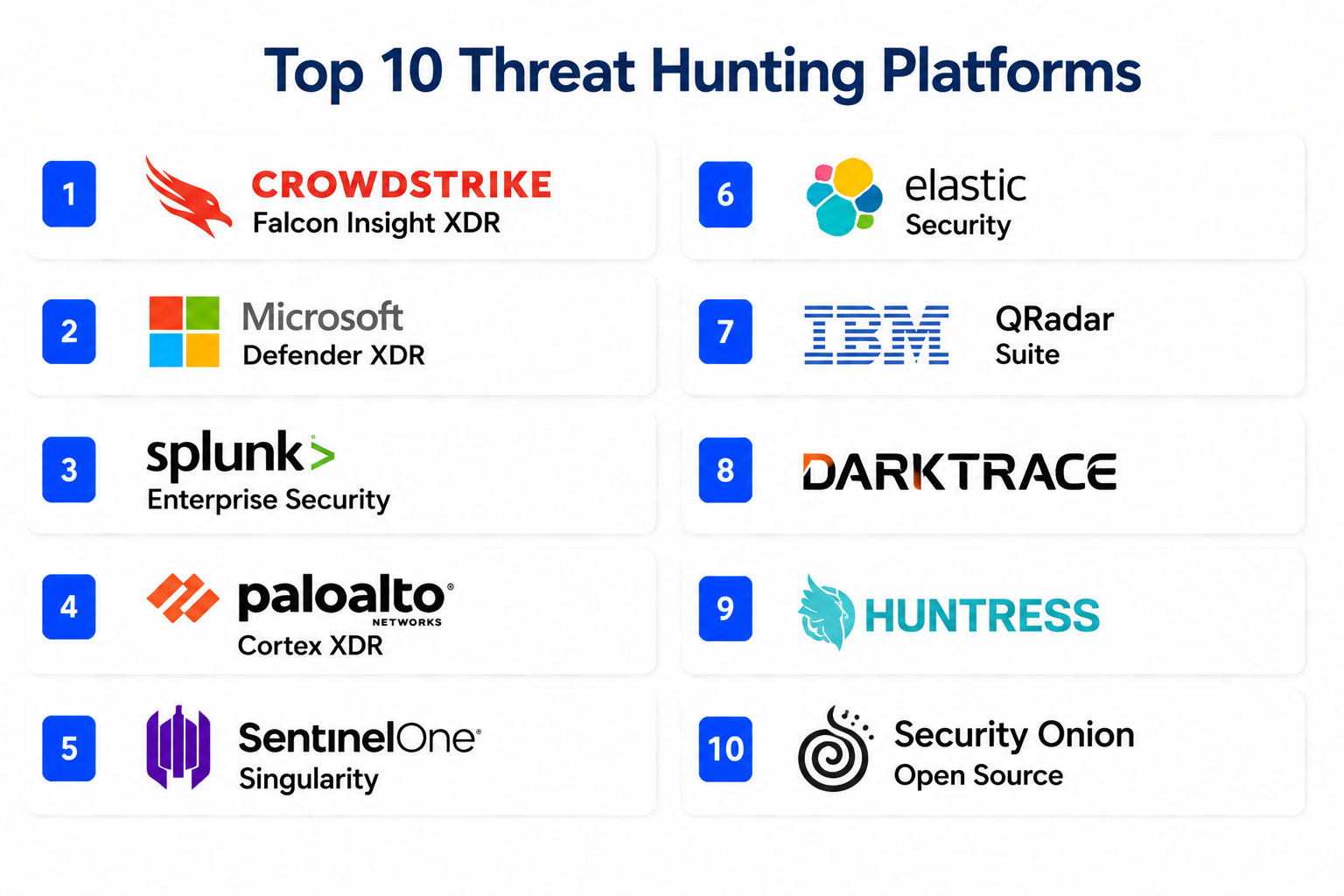
Top 10 Threat Hunting Platforms
#1 — CrowdStrike Falcon Insight XDR
Short description :
CrowdStrike Falcon Insight XDR is a cloud-native threat hunting and endpoint detection platform built for large-scale enterprise environments. It provides deep endpoint telemetry, AI-driven behavioral analytics, and advanced hunting capabilities through structured query language and security graph analysis. It is widely used by SOC teams for proactive hunting, incident investigation, and real-time response across distributed systems.
Key Features
- Advanced endpoint threat hunting
- Behavioral analytics and anomaly detection
- Security graph-based correlation engine
- AI-assisted hunting with natural language support
- Real-time telemetry from endpoints
- MITRE ATT&CK mapping
- Automated incident investigation workflows
Pros
- Extremely strong endpoint visibility at scale
- Fast and highly accurate threat correlation
- Mature AI-assisted hunting capabilities
Cons
- Premium enterprise pricing
- Requires mature SOC expertise for full utilization
- Heavy reliance on endpoint agent deployment
Platforms / Deployment
- Windows / macOS / Linux
- Cloud
Security & Compliance
- RBAC and MFA
- SSO/SAML integration
- Audit logs and activity tracking
- Encryption in transit and at rest
Integrations & Ecosystem
CrowdStrike integrates widely across enterprise security stacks:
- SIEM platforms
- SOAR automation tools
- Cloud security platforms
- Identity providers
- Threat intelligence feeds
- Network monitoring tools
Support & Community
Strong enterprise support with managed threat hunting services, training programs, and global SOC assistance.
#2 — Microsoft Defender XDR
Short description :
Microsoft Defender XDR is a unified threat hunting platform that combines endpoint, identity, email, and cloud telemetry into a single investigation environment. It enables SOC teams to hunt across multiple attack surfaces using advanced query languages and AI-driven insights. It is especially effective in Microsoft-centric environments.
Key Features
- Cross-domain threat hunting (endpoint + identity + cloud)
- Advanced hunting query language
- Automated investigation and response
- Identity-based attack detection
- AI-driven anomaly detection
- Threat intelligence enrichment
- Cloud workload visibility
Pros
- Strong integration with Microsoft ecosystem
- Unified visibility across multiple security layers
- Strong identity-based detection capabilities
Cons
- Best performance in Microsoft-heavy environments
- Licensing complexity
- Advanced hunting requires training
Platforms / Deployment
- Windows / macOS / Linux / mobile
- Cloud / Hybrid
Security & Compliance
- RBAC and MFA
- SSO integration
- Audit logging
- Compliance reporting support
Integrations & Ecosystem
- Microsoft Sentinel
- Azure cloud services
- Microsoft 365 security stack
- SIEM/SOAR integrations
- Identity providers
Support & Community
Strong enterprise support, documentation, and SOC training ecosystem.
#3 — Splunk Enterprise Security
Short description :
Splunk Enterprise Security is one of the most flexible threat hunting platforms, enabling analysts to hunt across massive datasets using a powerful search query language. It is widely adopted in enterprise SOC environments for deep forensic investigations and custom detection engineering.
Key Features
- Powerful search-based threat hunting (SPL language)
- Real-time log correlation
- Risk-based alerting
- Custom detection engineering
- Security dashboards and analytics
- Threat intelligence integration
- Behavioral anomaly detection
Pros
- Extremely flexible hunting capabilities
- Supports almost any data source
- Strong community-driven detection content
Cons
- Steep learning curve
- High infrastructure costs at scale
- Requires skilled analysts for best results
Platforms / Deployment
- Web / Linux / Windows
- Cloud / Hybrid / On-prem
Security & Compliance
- RBAC and MFA
- Audit logging
- Encryption support
- Compliance dashboards
Integrations & Ecosystem
- SIEM and SOAR tools
- Cloud platforms
- Threat intelligence feeds
- Endpoint security systems
- Network monitoring tools
Support & Community
Large global community, enterprise support, and extensive SOC training resources.
#4 — Palo Alto Networks Cortex XDR
Short description :
Cortex XDR is a behavioral threat hunting platform that correlates endpoint, network, and cloud data to detect advanced attacks. It focuses on automated investigation and strong correlation between multiple security signals.
Key Features
- Cross-domain threat hunting
- Behavioral analytics engine
- Automated incident investigation
- Endpoint and network correlation
- Malware detection and analysis
- MITRE ATT&CK mapping
- Threat intelligence integration
Pros
- Strong correlation across attack surfaces
- Good automated investigation capabilities
- Strong enterprise integration
Cons
- Complex configuration in large environments
- Requires tuning for optimal performance
- Premium pricing model
Platforms / Deployment
- Windows / macOS / Linux
- Cloud
Security & Compliance
- RBAC, MFA
- Audit logs
- Encryption support
- Compliance reporting
Integrations & Ecosystem
- Palo Alto security ecosystem
- SIEM and SOAR platforms
- Cloud environments
- Identity security tools
Support & Community
Enterprise-grade support and security operations training programs.
#5 — SentinelOne Singularity
Short description :
SentinelOne Singularity is an AI-driven threat hunting and endpoint security platform that provides autonomous detection, behavioral analytics, and real-time investigation capabilities across enterprise endpoints.
Key Features
- AI-based behavioral threat hunting
- Autonomous endpoint detection
- Real-time investigation workflows
- Automated remediation actions
- Threat intelligence integration
- MITRE ATT&CK mapping
- Cloud-based management console
Pros
- Strong autonomous detection capabilities
- Fast incident response automation
- Good scalability across endpoints
Cons
- Advanced customization may require expertise
- Cost increases with scale
- Requires strong endpoint deployment strategy
Platforms / Deployment
- Windows / macOS / Linux
- Cloud / Hybrid
Security & Compliance
- RBAC and MFA
- Audit logging
- Encryption support
- Compliance readiness features
Integrations & Ecosystem
- SIEM platforms
- Cloud security tools
- Identity providers
- SOAR automation systems
Support & Community
Strong enterprise support with SOC enablement programs and documentation.
#6 — Elastic Security
Short description :
Elastic Security is a flexible threat hunting platform built on Elasticsearch, offering powerful search-based investigations, behavioral analytics, and open data ingestion capabilities.
Key Features
- Search-driven threat hunting
- Behavioral analytics
- Custom detection rules
- SIEM and endpoint integration
- MITRE ATT&CK mapping
- Machine learning anomaly detection
- Scalable log ingestion
Pros
- Highly flexible and scalable
- Cost-effective for large data volumes
- Strong open-source ecosystem
Cons
- Requires technical expertise
- Setup complexity can be high
- Requires tuning for accuracy
Platforms / Deployment
- Web / Linux / Windows
- Cloud / Self-hosted / Hybrid
Security & Compliance
- RBAC, MFA
- Audit logging
- Encryption support
- Compliance dashboards
Integrations & Ecosystem
- Cloud platforms
- DevSecOps tools
- SIEM pipelines
- Security automation tools
Support & Community
Strong open-source community and enterprise support options.
#7 — IBM QRadar Suite
Short description :
IBM QRadar is a mature enterprise threat hunting and SIEM platform that provides network, endpoint, and log-based investigation capabilities with strong correlation and forensic analysis features.
Key Features
- Advanced log correlation
- Network flow analysis
- Threat hunting dashboards
- Behavioral anomaly detection
- AI-assisted investigation
- Threat intelligence integration
- Offense-based investigation model
Pros
- Strong enterprise-grade analytics
- Deep network visibility
- Mature threat intelligence integration
Cons
- Complex deployment and tuning
- High operational overhead
- Requires skilled analysts
Platforms / Deployment
- Windows / Linux / Cloud
- Hybrid / On-prem
Security & Compliance
- RBAC, MFA
- Audit logging
- Encryption support
- Compliance reporting
Integrations & Ecosystem
- SIEM/SOAR platforms
- Network security tools
- Endpoint security systems
- Cloud environments
Support & Community
Enterprise support with global SOC expertise and training programs.
#8 — Darktrace
Short description :
Darktrace is an AI-powered threat hunting platform that uses self-learning behavioral models to detect anomalies across networks, cloud environments, and endpoints without relying heavily on signatures.
Key Features
- Self-learning AI anomaly detection
- Autonomous response capabilities
- Network and cloud visibility
- Threat visualization tools
- Behavioral baselining
- Real-time alerting
- Incident investigation workflows
Pros
- Strong AI-driven anomaly detection
- Good for unknown threat detection
- Minimal signature dependency
Cons
- Black-box AI behavior concerns
- Requires tuning for accuracy
- Less transparent detection logic
Platforms / Deployment
- Cloud / Hybrid
Security & Compliance
- RBAC, MFA
- Audit logging
- Encryption support
- Compliance reporting
Integrations & Ecosystem
- SIEM platforms
- Cloud providers
- Network monitoring tools
- Security operations tools
Support & Community
Enterprise support with AI-focused security research teams.
#9 — Huntress
Short description :
Huntress is a managed threat hunting platform designed for small to mid-sized organizations, offering continuous monitoring, endpoint detection, and human-led threat analysis.
Key Features
- Managed threat hunting services
- Endpoint detection
- Identity threat detection
- Malware and persistence detection
- SOC-as-a-service monitoring
- Incident response support
- Lightweight deployment
Pros
- Excellent for small security teams
- Strong managed detection layer
- Simple deployment and onboarding
Cons
- Less customizable than enterprise platforms
- Limited deep analytics capabilities
- Dependency on vendor SOC
Platforms / Deployment
- Windows / macOS / Linux
- Cloud
Security & Compliance
- RBAC
- MFA
- Audit logs
- Encryption support
Integrations & Ecosystem
- EDR platforms
- SIEM tools
- Identity providers
- MSP ecosystems
Support & Community
Strong managed SOC support and 24/7 threat hunting services.
#10 — Open Source Security Onion
Short description :
Security Onion is an open-source threat hunting platform focused on network security monitoring, log analysis, and intrusion detection for SOC environments.
Key Features
- Network-based threat hunting
- Packet capture and analysis
- Intrusion detection systems
- Log aggregation and analysis
- Threat visualization dashboards
- Custom detection rules
- Open-source extensibility
Pros
- Free and highly flexible
- Strong network visibility
- Good for SOC training environments
Cons
- Requires technical expertise
- Manual configuration needed
- Limited enterprise support
Platforms / Deployment
- Linux
- Self-hosted
Security & Compliance
- RBAC support
- Audit logging
- Encryption support
- Access control configurations
Integrations & Ecosystem
- SIEM tools
- Network sensors
- Security analytics platforms
- Open-source SOC stacks
Support & Community
Strong open-source community with documentation and SOC practitioner support.
Comparison Table (Top 10)
| Tool Name | Best For | Platform(s) Supported | Deployment | Standout Feature | Public Rating |
|---|---|---|---|---|---|
| CrowdStrike Falcon | Enterprise endpoint hunting | Multi-platform | Cloud | Security graph hunting | N/A |
| Microsoft Defender XDR | Microsoft ecosystems | Multi-platform | Hybrid | Cross-domain visibility | N/A |
| Splunk ES | Advanced SOC analytics | Multi-platform | Hybrid | SPL query engine | N/A |
| Cortex XDR | Behavioral correlation | Multi-platform | Cloud | Automated investigation | N/A |
| SentinelOne Singularity | Autonomous response | Multi-platform | Cloud/Hybrid | AI remediation | N/A |
| Elastic Security | Flexible search hunting | Multi-platform | Hybrid | Open search analytics | N/A |
| IBM QRadar | Enterprise SIEM hunting | Multi-platform | Hybrid | Network correlation | N/A |
| Darktrace | AI anomaly detection | Multi-platform | Hybrid | Self-learning AI | N/A |
| Huntress | Managed threat hunting | Multi-platform | Cloud | Human-led SOC service | N/A |
| Security Onion | Open-source SOC hunting | Linux | Self-hosted | Network packet analysis | N/A |
Evaluation & Threat Hunting Platforms
| Tool Name | Core (25%) | Ease (15%) | Integrations (15%) | Security (10%) | Performance (10%) | Support (10%) | Value (15%) | Weighted Total (0–10) |
|---|---|---|---|---|---|---|---|---|
| CrowdStrike Falcon | 10 | 8 | 9 | 9 | 9 | 8 | 7 | 8.7 |
| Microsoft Defender XDR | 9 | 8 | 9 | 9 | 9 | 8 | 8 | 8.5 |
| Splunk ES | 9 | 7 | 10 | 9 | 9 | 8 | 6 | 8.3 |
| Cortex XDR | 9 | 7 | 8 | 9 | 8 | 8 | 7 | 8.0 |
| SentinelOne | 9 | 8 | 8 | 9 | 8 | 8 | 7 | 8.1 |
| Elastic Security | 8 | 7 | 9 | 8 | 8 | 7 | 9 | 8.0 |
| IBM QRadar | 9 | 6 | 9 | 9 | 9 | 8 | 6 | 7.9 |
| Darktrace | 8 | 7 | 8 | 8 | 8 | 8 | 6 | 7.6 |
| Huntress | 7 | 9 | 7 | 8 | 7 | 9 | 8 | 7.8 |
| Security Onion | 7 | 6 | 7 | 8 | 8 | 7 | 10 | 7.5 |
Which Threat Hunting Platform Should You Choose?
Solo / Freelancer
Security researchers and small teams benefit most from Security Onion, Elastic Security, or Huntress due to affordability and simplicity.
SMB
SMBs should prioritize Huntress, Microsoft Defender XDR, or SentinelOne for balanced automation and ease of deployment.
Mid-Market
Mid-market organizations should consider Cortex XDR, Elastic Security, or Splunk for scalable analytics and deeper investigation capabilities.
Enterprise
Large enterprises should focus on CrowdStrike, Microsoft Defender XDR, Splunk ES, and IBM QRadar for advanced correlation, telemetry scale, and automation.
Budget vs Premium
Open-source and hybrid tools provide strong cost efficiency, while enterprise platforms justify cost with AI-driven hunting and automation.
Feature Depth vs Ease of Use
Splunk and QRadar offer deep analytical power, while Huntress and Defender XDR prioritize usability.
Integrations & Scalability
Organizations should prioritize platforms with strong SIEM, SOAR, cloud, and identity integrations for scalable hunting operations.
Security & Compliance Needs
Regulated industries should prioritize RBAC, audit logs, encryption, and compliance reporting features.
Frequently Asked Questions (FAQs)
1. What is a threat hunting platform?
A threat hunting platform helps security teams proactively search for hidden cyber threats across systems instead of relying only on alerts.
2. Why is threat hunting important?
It helps detect advanced attacks that bypass automated security tools, especially AI-powered or stealth-based threats.
3. How is threat hunting different from SIEM?
SIEM collects and alerts on data, while threat hunting actively searches for unknown threats using hypotheses and analysis.
4. Do small businesses need threat hunting tools?
Small businesses can benefit from managed solutions like Huntress instead of complex enterprise platforms.
5. What skills are required for threat hunting?
Skills include log analysis, networking, endpoint behavior understanding, scripting, and cybersecurity fundamentals.
6. Can AI replace threat hunters?
No, AI assists threat hunting but human analysts are still needed for context, validation, and decision-making.
7. What data sources are used in threat hunting?
Endpoints, logs, cloud services, network traffic, identity systems, and threat intelligence feeds.
8. Is threat hunting automated?
Partially. Many platforms automate detection and correlation, but hypothesis-driven investigation remains human-led.
9. What is MITRE ATT&CK in threat hunting?
It is a framework used to map attacker behavior patterns and improve detection and investigation consistency.
10. What is the biggest challenge in threat hunting?
The biggest challenge is dealing with large volumes of data while identifying meaningful signals among noise.
Conclusion
Threat Hunting Platforms are becoming essential components of modern cybersecurity operations as organizations face faster, more complex, and AI-enhanced cyberattacks. These platforms allow security teams to move beyond passive alerting and adopt a proactive defense strategy that actively searches for hidden threats across endpoints, networks, cloud environments, and identity systems. The right platform depends on organizational maturity, infrastructure complexity, and security goals. Enterprise organizations often rely on CrowdStrike, Microsoft Defender XDR, Splunk, and IBM QRadar for large-scale telemetry analysis and automated investigation capabilities.
