Introduction
API Security Platforms help organizations protect application programming interfaces (APIs) from cyber threats, abuse, data leakage, unauthorized access, and misconfigurations. APIs have become the backbone of modern digital applications, cloud-native services, mobile apps, SaaS platforms, AI systems, and microservices architectures. As API adoption increases, APIs have also become one of the most targeted attack surfaces for cybercriminals.
In API security is no longer optional. Organizations now operate thousands of APIs across public cloud, hybrid, partner, and internal environments. Traditional web security tools often lack the visibility needed to monitor API behavior, detect abuse patterns, enforce schema validation, and identify sensitive data exposure. Modern API security platforms provide discovery, runtime protection, posture management, anomaly detection, and API governance across distributed environments.
Common real-world use cases include:
- Protecting public-facing APIs from attacks and abuse
- Discovering shadow and unmanaged APIs
- Monitoring API traffic and behavioral anomalies
- Enforcing authentication and authorization policies
- Securing microservices and cloud-native applications
When evaluating API security platforms, buyers should consider:
- API discovery and inventory visibility
- Runtime threat detection accuracy
- API posture management capabilities
- AI-driven anomaly detection
- Multi-cloud and Kubernetes support
- Integration with API gateways and SIEM tools
- Compliance and governance reporting
- Developer workflow integrations
- Scalability for high-volume traffic
- Ease of deployment and operational management
Best for: Enterprises, SaaS providers, fintech companies, healthcare organizations, telecom providers, cloud-native engineering teams, and organizations operating API-driven applications.
Not ideal for: Small static websites, low-traffic internal systems with minimal API usage, or organizations without modern application integration requirements.
Key Trends in API Security Platforms
- AI-powered behavioral analytics are improving API threat detection accuracy.
- API posture management is becoming a standard platform capability.
- Shadow API discovery is a major enterprise priority.
- Runtime API protection is increasingly integrated with WAF and WAAP platforms.
- API governance and compliance reporting are expanding significantly.
- GraphQL and gRPC security support are becoming more important.
- Kubernetes-native API visibility is rapidly improving.
- Zero-trust API authentication models are gaining adoption.
- API abuse prevention and bot mitigation are becoming tightly integrated.
- Unified API security and application security platforms are becoming more common.
How We Selected These Tools (Methodology)
The tools in this list were selected based on API security depth, enterprise adoption, cloud-native readiness, and ecosystem maturity.
Selection criteria included:
- Market adoption and industry reputation
- API discovery and inventory capabilities
- Runtime API threat detection quality
- Cloud-native and Kubernetes support
- Governance and compliance functionality
- DevSecOps and SIEM integrations
- Scalability and operational reliability
- AI-driven analytics and automation
- Ease of deployment and usability
- Enterprise support and ecosystem maturity
API Security Platforms
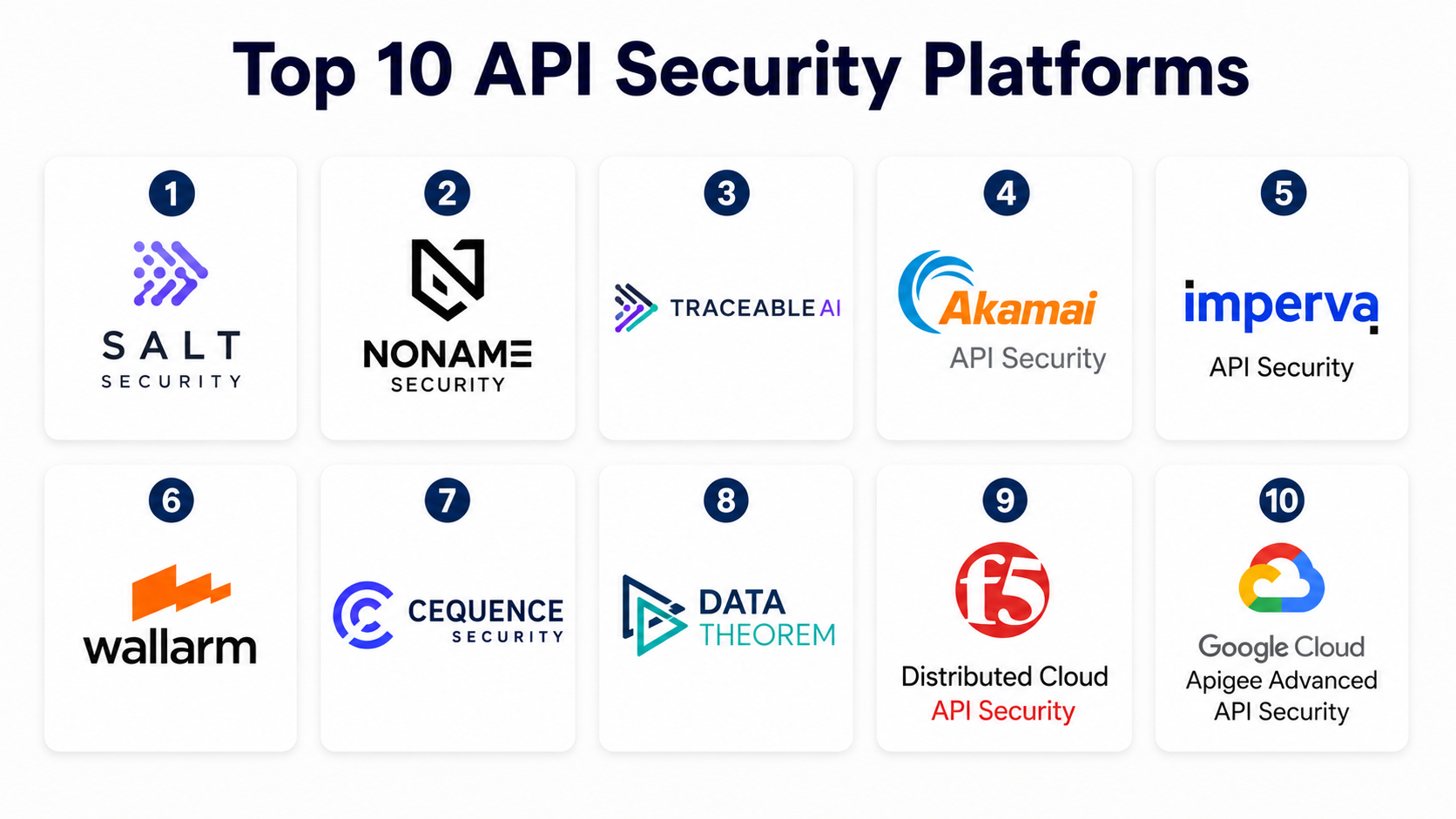
#1 — Salt Security
Short description :
Salt Security is one of the most recognized API security platforms focused on API discovery, runtime protection, behavioral analytics, and threat prevention. The platform uses AI-driven analysis to identify malicious activity, shadow APIs, and abnormal API usage patterns. Salt Security is commonly adopted by enterprises managing large-scale API ecosystems and cloud-native infrastructures.
Key Features
- API discovery and inventory management
- Runtime API threat detection
- AI-driven behavioral analytics
- Shadow API identification
- API posture management
- Sensitive data exposure detection
- Multi-cloud deployment support
Pros
- Strong behavioral analytics engine
- Excellent API discovery capabilities
- Mature enterprise API security workflows
Cons
- Enterprise pricing structure
- Advanced deployment may require tuning
- Smaller teams may find feature depth complex
Platforms / Deployment
- Web / Linux / Kubernetes
- Cloud / Hybrid
Security & Compliance
- SSO/SAML
- MFA
- RBAC
- Audit logs
- Encryption support
- Compliance reporting capabilities
Integrations & Ecosystem
Salt Security integrates into enterprise API and cloud environments.
- AWS
- Azure
- Google Cloud
- Kubernetes
- Splunk
- API gateways
Support & Community
Salt Security provides enterprise onboarding, technical support, and strong documentation resources.
#2 — Noname Security
Short description :
Noname Security provides API discovery, runtime security, posture management, and API governance capabilities for enterprise environments. The platform focuses on securing managed and unmanaged APIs across cloud, hybrid, and on-premises infrastructures. Noname Security is widely used in regulated industries and large API-driven organizations.
Key Features
- API discovery
- Runtime API protection
- API posture management
- Behavioral anomaly detection
- Compliance monitoring
- Sensitive data analysis
- API governance visibility
Pros
- Strong API governance features
- Broad enterprise visibility
- Good multi-cloud support
Cons
- Enterprise-focused operational complexity
- Premium pricing
- Initial deployment may require planning
Platforms / Deployment
- Linux / Kubernetes
- Cloud / Self-hosted / Hybrid
Security & Compliance
- SSO/SAML
- MFA
- RBAC
- Audit logging
- Compliance-oriented controls
Integrations & Ecosystem
Noname Security integrates into enterprise security and API ecosystems.
- SIEM platforms
- API gateways
- Kubernetes
- AWS
- Azure
- CI/CD pipelines
Support & Community
Noname provides enterprise support programs, onboarding services, and technical documentation.
#3 — Traceable AI
Short description :
Traceable AI is an API security platform focused on runtime threat detection, API observability, and behavioral analytics. It emphasizes distributed tracing and deep runtime visibility for modern cloud-native applications and microservices environments. Traceable AI is particularly popular among organizations operating large-scale API infrastructures.
Key Features
- Runtime API threat detection
- Distributed tracing visibility
- API discovery
- Behavioral analytics
- API posture management
- Cloud-native monitoring
- Sensitive data exposure analysis
Pros
- Strong runtime observability
- Excellent cloud-native architecture
- Deep API behavior visibility
Cons
- Enterprise-oriented pricing
- Advanced environments may require tuning
- Smaller ecosystems compared to legacy vendors
Platforms / Deployment
- Linux / Kubernetes
- Cloud / Hybrid
Security & Compliance
- SSO/SAML
- RBAC
- MFA
- Audit logs
- Encryption support
Integrations & Ecosystem
Traceable AI integrates into cloud-native observability and security environments.
- Kubernetes
- AWS
- Datadog
- Splunk
- API gateways
- SIEM systems
Support & Community
Traceable AI offers enterprise onboarding, support services, and cloud-native documentation.
#4 — Akamai API Security
Short description :
Akamai API Security provides API discovery, runtime protection, and attack detection capabilities integrated into Akamai’s broader application security ecosystem. It is designed for enterprises operating globally distributed APIs and customer-facing applications. The platform focuses heavily on runtime monitoring and edge-based security enforcement.
Key Features
- API discovery
- Runtime API monitoring
- Behavioral threat detection
- Edge security integration
- Compliance reporting
- Sensitive data analysis
- Threat intelligence integration
Pros
- Strong global infrastructure
- Mature enterprise security ecosystem
- Excellent DDoS integration
Cons
- Premium enterprise pricing
- Configuration complexity
- Developer-focused workflows are lighter
Platforms / Deployment
- Web / Linux
- Cloud / Hybrid
Security & Compliance
- SSO/SAML
- MFA
- RBAC
- Audit logs
- Compliance reporting
Integrations & Ecosystem
Akamai integrates into enterprise application security ecosystems.
- SIEM platforms
- API gateways
- AWS
- Azure
- Kubernetes
- Security analytics tools
Support & Community
Akamai provides enterprise support programs and extensive technical documentation.
#5 — Imperva API Security
Short description :
Imperva API Security combines runtime API protection, discovery, and risk analysis with Imperva’s broader web application security portfolio. The platform helps organizations secure APIs against abuse, data leakage, and advanced attacks. It is commonly adopted by enterprises with hybrid and multi-cloud infrastructures.
Key Features
- API discovery
- Runtime API protection
- Risk scoring
- Behavioral analytics
- Sensitive data detection
- Threat intelligence integration
- API governance visibility
Pros
- Strong enterprise security ecosystem
- Good hybrid infrastructure support
- Mature threat intelligence capabilities
Cons
- Enterprise operational complexity
- Premium licensing costs
- Advanced tuning may require expertise
Platforms / Deployment
- Windows / Linux
- Cloud / Hybrid
Security & Compliance
- SSO/SAML
- RBAC
- MFA
- Audit logs
- Compliance support
Integrations & Ecosystem
Imperva integrates into enterprise application and API security environments.
- SIEM platforms
- AWS
- Azure
- Kubernetes
- API gateways
- Security analytics tools
Support & Community
Imperva provides enterprise support, onboarding services, and professional consulting programs.
#6 — Wallarm
Short description :
Wallarm is an API and application security platform focused on API protection, attack detection, and cloud-native security automation. It supports modern API architectures including REST, GraphQL, and gRPC. Wallarm is commonly used by DevOps-focused organizations and cloud-native engineering teams.
Key Features
- API attack prevention
- API discovery
- GraphQL and gRPC protection
- Behavioral analysis
- API vulnerability detection
- Cloud-native deployment
- CI/CD integrations
Pros
- Strong modern API protocol support
- Good Kubernetes integration
- Developer-friendly deployment model
Cons
- Smaller enterprise ecosystem
- Advanced analytics vary by deployment
- Governance depth lighter than some competitors
Platforms / Deployment
- Linux / Kubernetes
- Cloud / Self-hosted / Hybrid
Security & Compliance
- RBAC
- Audit logs
- Encryption support
- SSO support varies by edition
Integrations & Ecosystem
Wallarm integrates into DevSecOps and cloud-native environments.
- Kubernetes
- NGINX
- AWS
- API gateways
- Jenkins
- GitHub
Support & Community
Wallarm provides technical documentation, onboarding support, and active developer engagement.
#7 — Cequence Security
Short description :
Cequence Security provides unified API security and bot management capabilities focused on protecting digital applications from automated abuse and API attacks. The platform uses behavioral analysis and machine learning to identify malicious activity and suspicious API interactions.
Key Features
- API discovery
- Runtime attack prevention
- Bot mitigation
- Behavioral analytics
- API posture management
- Risk scoring
- Threat intelligence integration
Pros
- Strong bot protection capabilities
- Good runtime analytics
- Unified API and abuse prevention workflows
Cons
- Enterprise-focused pricing
- Operational tuning may be required
- Smaller developer ecosystem
Platforms / Deployment
- Linux / Kubernetes
- Cloud / Hybrid
Security & Compliance
- SSO/SAML
- RBAC
- Audit logging
- Encryption support
Integrations & Ecosystem
Cequence integrates into enterprise API and application security environments.
- SIEM systems
- API gateways
- AWS
- Azure
- Kubernetes
- Security analytics tools
Support & Community
Cequence provides enterprise support and onboarding assistance for large-scale deployments.
#8 — Data Theorem
Short description:
Data Theorem offers API security posture management, runtime protection, and application security capabilities focused on enterprise and cloud-native infrastructures. The platform emphasizes API governance, risk visibility, and continuous security monitoring across distributed environments.
Key Features
- API posture management
- Runtime API monitoring
- API discovery
- Compliance visibility
- Threat analytics
- Risk prioritization
- Cloud-native deployment support
Pros
- Strong governance capabilities
- Good compliance visibility
- Broad application security coverage
Cons
- Enterprise deployment complexity
- Smaller market visibility
- Advanced workflows may require expertise
Platforms / Deployment
- Linux / Kubernetes
- Cloud / Hybrid
Security & Compliance
- RBAC
- Audit logging
- Encryption support
- Compliance-oriented reporting
Integrations & Ecosystem
Data Theorem integrates into enterprise cloud and application security ecosystems.
- AWS
- Azure
- Kubernetes
- SIEM platforms
- API gateways
- DevSecOps tools
Support & Community
Data Theorem provides enterprise onboarding resources and technical support programs.
#9 — F5 Distributed Cloud API Security
Short description :
F5 Distributed Cloud API Security combines API discovery, runtime protection, and behavioral analytics with F5’s broader application delivery and security ecosystem. It is designed for organizations operating distributed applications and hybrid cloud environments.
Key Features
- API discovery
- Runtime API protection
- Behavioral anomaly detection
- Multi-cloud security visibility
- Threat intelligence integration
- API governance controls
- Hybrid deployment support
Pros
- Strong enterprise networking integration
- Good hybrid cloud support
- Mature API protection workflows
Cons
- Enterprise operational complexity
- Premium pricing structure
- Smaller developer-focused tooling ecosystem
Platforms / Deployment
- Windows / Linux / Kubernetes
- Cloud / Hybrid
Security & Compliance
- SSO/SAML
- MFA
- RBAC
- Audit logs
- Compliance reporting
Integrations & Ecosystem
F5 integrates deeply into enterprise networking and security environments.
- AWS
- Azure
- Kubernetes
- SIEM systems
- API gateways
- Security analytics tools
Support & Community
F5 provides enterprise support services, onboarding assistance, and professional services.
#10 — Google Cloud Apigee Advanced API Security
Short description :
Apigee Advanced API Security extends Google Cloud’s API management platform with advanced threat detection, API abuse monitoring, and security analytics. It is designed for organizations already invested in Google Cloud and API-centric architectures.
Key Features
- API threat detection
- Runtime abuse monitoring
- API traffic analytics
- Threat intelligence
- API governance
- Cloud-native deployment
- Integration with Google Cloud services
Pros
- Strong Google Cloud integration
- Good API traffic visibility
- Useful for API-centric architectures
Cons
- Best suited for Google Cloud environments
- Hybrid support may vary
- Enterprise licensing complexity
Platforms / Deployment
- Web / Linux
- Cloud
Security & Compliance
- SSO/SAML
- MFA
- RBAC
- Audit logs
- Encryption support
Integrations & Ecosystem
Apigee integrates into Google Cloud and API management ecosystems.
- Google Cloud
- Kubernetes
- API gateways
- SIEM platforms
- CI/CD systems
- Analytics tools
Support & Community
Google provides enterprise support, documentation, and onboarding resources for Apigee deployments.
Comparison Table (Top 10)
| Tool Name | Best For | Platform(s) Supported | Deployment | Standout Feature | Public Rating |
|---|---|---|---|---|---|
| Salt Security | Enterprise API discovery | Linux, Kubernetes | Hybrid | AI-driven API behavioral analytics | N/A |
| Noname Security | API governance and posture management | Linux, Kubernetes | Hybrid | Broad API inventory visibility | N/A |
| Traceable AI | Cloud-native API observability | Linux, Kubernetes | Hybrid | Distributed tracing analytics | N/A |
| Akamai API Security | Global edge API protection | Web, Linux | Cloud / Hybrid | Edge-integrated API defense | N/A |
| Imperva API Security | Hybrid enterprise API security | Windows, Linux | Hybrid | Unified API and WAAP protection | N/A |
| Wallarm | Modern API protocol security | Linux, Kubernetes | Hybrid | GraphQL and gRPC support | N/A |
| Cequence Security | API abuse and bot mitigation | Linux, Kubernetes | Hybrid | Unified API and bot defense | N/A |
| Data Theorem | API posture governance | Linux, Kubernetes | Hybrid | Continuous API risk monitoring | N/A |
| F5 Distributed Cloud API Security | Distributed enterprise applications | Windows, Linux, Kubernetes | Hybrid | Hybrid cloud API visibility | N/A |
| Google Cloud Apigee Advanced API Security | Google Cloud API ecosystems | Web, Linux | Cloud | Integrated API analytics | N/A |
Evaluation & API Security Platforms
| Tool Name | Core (25%) | Ease (15%) | Integrations (15%) | Security (10%) | Performance (10%) | Support (10%) | Value (15%) | Weighted Total (0–10) |
|---|---|---|---|---|---|---|---|---|
| Salt Security | 9 | 8 | 9 | 9 | 8 | 8 | 7 | 8.3 |
| Noname Security | 9 | 7 | 8 | 9 | 8 | 8 | 7 | 8.0 |
| Traceable AI | 8 | 8 | 8 | 8 | 9 | 8 | 7 | 8.0 |
| Akamai API Security | 8 | 7 | 8 | 9 | 9 | 8 | 6 | 7.9 |
| Imperva API Security | 8 | 7 | 8 | 9 | 8 | 8 | 6 | 7.7 |
| Wallarm | 8 | 8 | 8 | 8 | 8 | 7 | 8 | 7.9 |
| Cequence Security | 8 | 7 | 8 | 8 | 8 | 7 | 7 | 7.6 |
| Data Theorem | 7 | 7 | 7 | 8 | 8 | 7 | 7 | 7.3 |
| F5 Distributed Cloud API Security | 8 | 6 | 8 | 9 | 8 | 8 | 6 | 7.5 |
| Google Cloud Apigee Advanced API Security | 8 | 8 | 8 | 8 | 8 | 8 | 7 | 7.9 |
These scores are comparative and intended to help organizations evaluate API security platforms across multiple operational priorities. Enterprise-focused tools often provide stronger governance and runtime visibility, while developer-focused platforms emphasize usability and cloud-native flexibility. Buyers should align platform selection with API scale, infrastructure complexity, and compliance requirements.
Which API Security Platforms
Solo / Freelancer
Individual developers and smaller engineering teams may benefit from lighter-weight API security tooling or cloud-native gateway security solutions rather than full enterprise platforms.
SMB
SMBs often benefit from Wallarm or Google Cloud Apigee Advanced API Security because of easier cloud-native deployment and strong API visibility.
Mid-Market
Mid-market organizations should evaluate Traceable AI, Salt Security, and Imperva API Security for stronger runtime protection and API governance.
Enterprise
Large enterprises typically require advanced API discovery, posture management, compliance visibility, and hybrid cloud support. Salt Security, Noname Security, Akamai, and F5 are strong enterprise-oriented choices.
Budget vs Premium
Premium platforms provide stronger runtime analytics, API governance, and enterprise support, while smaller organizations may prioritize ease of deployment and operational simplicity.
Feature Depth vs Ease of Use
Salt Security and Noname Security provide deeper governance and analytics capabilities, while Wallarm and Apigee focus more on developer-friendly cloud-native deployment workflows.
Integrations & Scalability
Organizations operating large API ecosystems should prioritize Kubernetes, SIEM, cloud provider, and API gateway integrations.
Security & Compliance Needs
Regulated industries often require detailed audit logs, API inventory visibility, runtime monitoring, and governance reporting. Salt Security, Imperva, and Noname Security are especially strong in these areas.
Frequently Asked Questions (FAQs)
1. What is an API Security Platform?
An API security platform helps organizations discover, monitor, secure, and manage APIs against attacks, abuse, data leakage, and misconfigurations.
2. Why is API security important in 2026?
Modern applications rely heavily on APIs for cloud services, mobile applications, AI integrations, and microservices. APIs are now one of the largest enterprise attack surfaces.
3. What are shadow APIs?
Shadow APIs are unmanaged or undocumented APIs that exist outside formal governance processes and can introduce significant security risks.
4. Can API security platforms protect GraphQL APIs?
Yes. Many modern API security platforms now support GraphQL, REST, gRPC, and other modern API architectures.
5. How do API security platforms detect attacks?
Most platforms use behavioral analytics, runtime monitoring, AI-assisted anomaly detection, and threat intelligence to identify malicious API activity.
6. Are API security platforms cloud-native?
Many modern platforms are designed specifically for Kubernetes, containers, multi-cloud environments, and microservices architectures.
7. What integrations are commonly supported?
Common integrations include SIEM systems, API gateways, CI/CD pipelines, cloud platforms, observability tools, and identity providers.
8. Can API security platforms help with compliance?
Yes. Many platforms provide audit logs, governance visibility, sensitive data monitoring, and compliance-oriented reporting.
9. What industries benefit most from API security?
Financial services, healthcare, SaaS, telecommunications, retail, and government organizations heavily benefit from API security platforms.
10. How difficult is deployment?
Deployment complexity varies depending on infrastructure scale, API volume, governance requirements, and cloud-native maturity. SaaS-based platforms are generally easier to deploy than large hybrid environments.
Conclusion
API Security Platforms have become essential components of modern cybersecurity and application protection strategies. As organizations continue adopting APIs, microservices, cloud-native applications, AI integrations, and distributed architectures, securing APIs is now critical for protecting sensitive data, maintaining uptime, and meeting compliance requirements. Traditional perimeter defenses alone are no longer sufficient for identifying shadow APIs, monitoring runtime API behavior, or preventing sophisticated API abuse.
