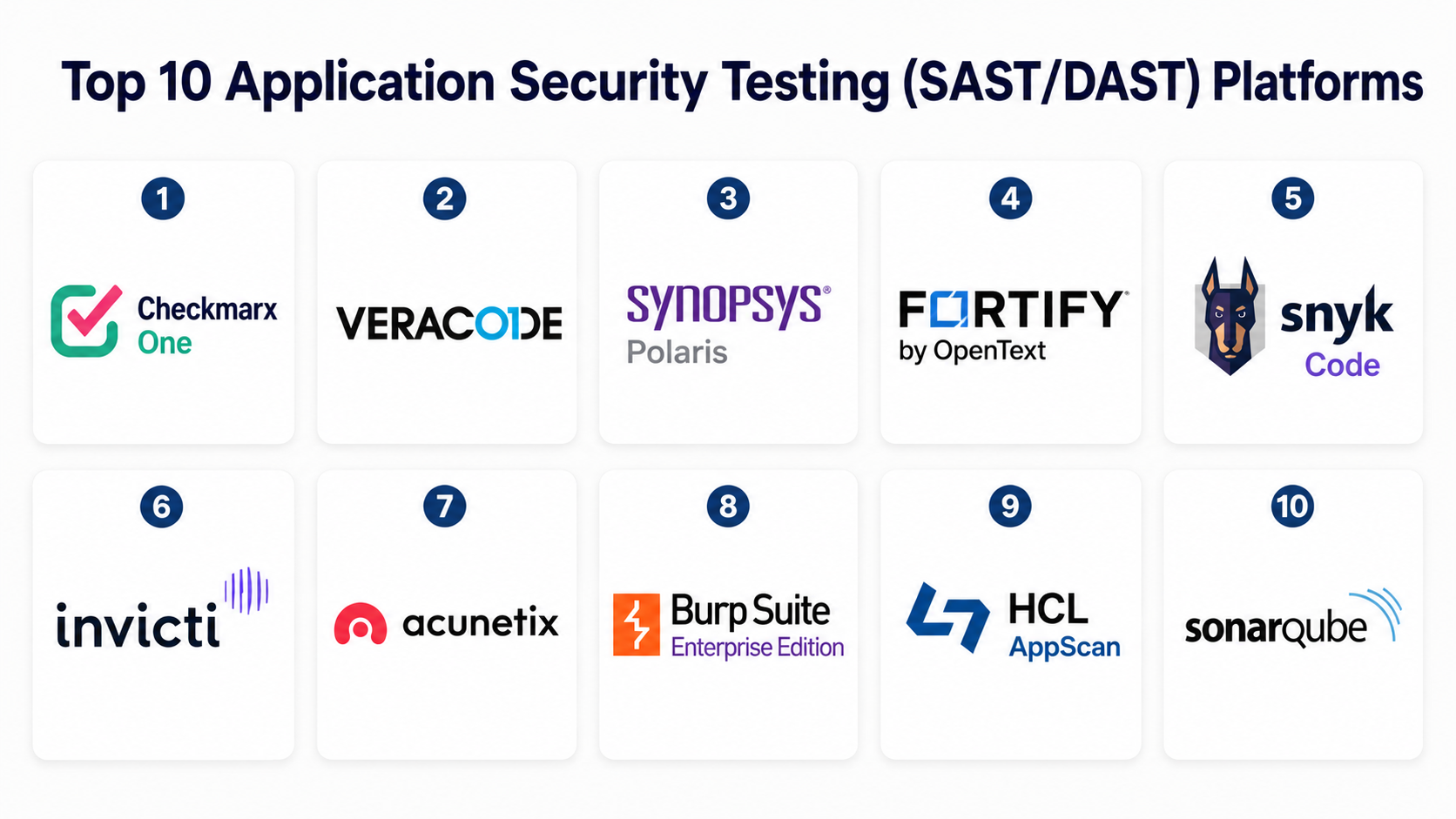
Introduction
Application Security Testing (SAST/DAST) Platforms help organizations identify security vulnerabilities in software applications during development and runtime testing phases. Static Application Security Testing (SAST) analyzes source code, binaries, or bytecode without executing the application, while Dynamic Application Security Testing (DAST) evaluates running applications by simulating real-world attack scenarios.
In application security testing has become a core requirement for modern software development because organizations increasingly deploy cloud-native applications, APIs, microservices, and continuous delivery pipelines. Security vulnerabilities introduced during development can lead to data breaches, ransomware incidents, API exploitation, and compliance failures. Modern SAST/DAST platforms now combine automation, AI-assisted prioritization, DevSecOps workflows, and software supply chain visibility to improve security throughout the software lifecycle.
Common real-world use cases include:
- Detecting vulnerabilities during software development
- Automating security testing inside CI/CD pipelines
- Securing APIs and web applications before release
- Supporting compliance audits and secure SDLC programs
- Reducing production security incidents through shift-left security
When evaluating SAST/DAST platforms, buyers should consider:
- Programming language and framework support
- False positive reduction capabilities
- CI/CD and DevOps integrations
- API and cloud-native application testing
- Runtime versus code-level visibility
- Compliance reporting capabilities
- Developer remediation workflows
- Scalability across repositories and teams
- AI-assisted prioritization and remediation
- Deployment flexibility and governance controls
Best for: DevSecOps teams, software engineering organizations, SaaS providers, financial institutions, healthcare organizations, security operations teams, and enterprises with secure SDLC requirements.
Not ideal for: Small static websites, extremely low-risk internal tools, or organizations with minimal custom software development.
Key Trends in Application Security Testing (SAST/DAST) Platforms
- AI-assisted vulnerability prioritization is reducing alert fatigue for developers.
- API security testing is becoming a core capability alongside traditional web application scanning.
- Shift-left DevSecOps adoption continues to expand across CI/CD environments.
- Cloud-native application testing support is rapidly improving.
- Runtime-aware application testing is helping reduce false positives.
- Software supply chain visibility and SBOM integration are becoming standard.
- Unified AppSec platforms combining SAST, DAST, SCA, and IaC scanning are growing rapidly.
- Developer-first remediation workflows are becoming a major differentiator.
- Kubernetes and container-aware testing capabilities are expanding.
- Compliance automation and governance reporting are increasingly integrated into platforms.
How We Selected These Tools (Methodology)
The tools in this list were selected using a balanced evaluation framework focused on security testing depth, enterprise adoption, developer usability, and ecosystem maturity.
Selection criteria included:
- Market adoption and industry reputation
- Breadth of SAST and DAST testing capabilities
- Programming language and framework coverage
- CI/CD and DevSecOps integration quality
- False positive management effectiveness
- API and cloud-native application testing support
- Governance and compliance reporting
- Scalability across enterprise environments
- Developer workflow optimization
- Support quality and ecosystem maturity
Application Security Testing (SAST/DAST) Platforms
#1 — Checkmarx One
Short description :
Checkmarx One is a comprehensive application security platform that combines SAST, DAST, software composition analysis, API security testing, and cloud-native security capabilities. It is widely used by enterprises implementing mature DevSecOps programs. The platform focuses heavily on developer integrations, centralized governance, and scalable application security testing across large engineering environments.
Key Features
- Static application security testing
- Dynamic application security testing
- API security testing
- Software composition analysis
- CI/CD integrations
- AI-assisted remediation guidance
- Compliance and governance reporting
Pros
- Broad unified AppSec platform capabilities
- Strong enterprise governance features
- Excellent language and framework support
Cons
- Enterprise pricing can be expensive
- Advanced configurations may require expertise
- Large deployments may need tuning
Platforms / Deployment
- Windows / Linux / Kubernetes
- Cloud / Self-hosted / Hybrid
Security & Compliance
- SSO/SAML
- RBAC
- MFA
- Audit logs
- Encryption support
- Compliance reporting capabilities
Integrations & Ecosystem
Checkmarx integrates deeply into DevSecOps and CI/CD ecosystems.
- GitHub
- GitLab
- Jenkins
- Azure DevOps
- Jira
- Kubernetes
Support & Community
Checkmarx provides enterprise onboarding, technical support, training programs, and detailed documentation.
#2 — Veracode
Short description :
Veracode is one of the most established application security testing platforms in the enterprise market. It offers SAST, DAST, software composition analysis, API security testing, and developer remediation tools. Veracode is commonly used by organizations with strong compliance and secure SDLC requirements.
Key Features
- Static code analysis
- Dynamic application testing
- Software composition analysis
- API security scanning
- Compliance reporting
- Risk prioritization
- Developer remediation guidance
Pros
- Mature enterprise AppSec platform
- Strong compliance reporting
- Broad testing coverage
Cons
- Premium pricing structure
- Scanning times may vary for large projects
- UI complexity for new users
Platforms / Deployment
- Web / Windows / Linux
- Cloud / Hybrid
Security & Compliance
- SSO/SAML
- MFA
- RBAC
- Audit logs
- SOC 2
- Compliance-focused controls
Integrations & Ecosystem
Veracode integrates into enterprise development and governance environments.
- GitHub
- Jenkins
- Azure DevOps
- Jira
- IDE plugins
- CI/CD systems
Support & Community
Veracode offers enterprise support, onboarding assistance, and secure development training resources.
#3 — Synopsys Polaris
Short description :
Synopsys Polaris is a cloud-based application security platform combining SAST, SCA, and dynamic testing capabilities. It focuses on scalable cloud-native application security workflows and enterprise governance. Polaris is commonly adopted by large engineering organizations managing complex software supply chains.
Key Features
- SAST capabilities
- DAST integrations
- Software composition analysis
- Cloud-native testing workflows
- Compliance reporting
- Risk prioritization
- DevSecOps integrations
Pros
- Strong enterprise scalability
- Good cloud-native support
- Mature software supply chain security features
Cons
- Enterprise operational complexity
- Pricing may not suit smaller teams
- Advanced workflows require expertise
Platforms / Deployment
- Windows / Linux / Kubernetes
- Cloud / Hybrid
Security & Compliance
- SSO/SAML
- RBAC
- Audit logging
- Compliance automation
- Encryption support
Integrations & Ecosystem
Synopsys Polaris integrates into enterprise DevSecOps ecosystems.
- GitHub
- Jenkins
- Jira
- Kubernetes
- CI/CD platforms
- IDE integrations
Support & Community
Synopsys provides enterprise support services, onboarding programs, and strong documentation resources.
#4 — Fortify by OpenText
Short description :
Fortify is a long-established application security testing platform offering SAST, DAST, mobile application testing, and software composition analysis. It is widely adopted by enterprises with large application portfolios and strict compliance requirements. Fortify supports both cloud and on-premises deployment models.
Key Features
- Static application testing
- Dynamic application scanning
- Mobile application security testing
- Software composition analysis
- CI/CD integrations
- Compliance reporting
- Centralized vulnerability management
Pros
- Strong enterprise security testing depth
- Flexible deployment models
- Broad application coverage
Cons
- Enterprise-focused operational complexity
- Scanning optimization may require tuning
- UI modernization varies by deployment
Platforms / Deployment
- Windows / Linux
- Cloud / Self-hosted / Hybrid
Security & Compliance
- SSO/SAML
- RBAC
- MFA
- Audit logs
- Compliance-oriented reporting
Integrations & Ecosystem
Fortify integrates into enterprise application security ecosystems.
- Jenkins
- GitHub
- Azure DevOps
- Jira
- IDEs
- CI/CD pipelines
Support & Community
Fortify provides enterprise support, onboarding assistance, and professional services.
#5 — Snyk Code
Short description :
Snyk Code is a developer-first SAST platform focused on real-time code analysis and remediation guidance. It emphasizes shift-left security workflows and developer productivity. Snyk Code is particularly popular among agile engineering teams and cloud-native application developers.
Key Features
- Real-time static code analysis
- AI-assisted remediation guidance
- IDE integrations
- CI/CD pipeline scanning
- Cloud-native workflow support
- Vulnerability prioritization
- Developer collaboration features
Pros
- Excellent developer usability
- Fast scanning workflows
- Strong DevSecOps integration
Cons
- Enterprise governance depth is lighter than some competitors
- Premium tiers required for advanced features
- DAST functionality is limited compared to broader platforms
Platforms / Deployment
- Windows / macOS / Linux
- Cloud / Hybrid
Security & Compliance
- SSO/SAML
- MFA
- RBAC
- SOC 2
- Encryption support
Integrations & Ecosystem
Snyk integrates deeply into developer and DevOps environments.
- GitHub
- GitLab
- Bitbucket
- Jenkins
- Kubernetes
- IDE plugins
Support & Community
Snyk provides strong documentation, active developer communities, and enterprise support programs.
#6 — Invicti
Short description :
Invicti is a dynamic application security testing platform focused on automated web application and API security scanning. It emphasizes accurate vulnerability validation and scalable web application testing workflows. Invicti is commonly used by organizations requiring continuous DAST automation across large web environments.
Key Features
- Automated DAST scanning
- API security testing
- Proof-based vulnerability validation
- CI/CD automation
- Risk prioritization
- Compliance reporting
- Web application discovery
Pros
- Strong DAST automation
- Good vulnerability validation accuracy
- Scalable web application testing
Cons
- SAST capabilities are limited
- Enterprise pricing structure
- Complex environments may require tuning
Platforms / Deployment
- Windows / Linux
- Cloud / Self-hosted
Security & Compliance
- SSO/SAML
- RBAC
- Audit logging
- Compliance reporting
- Encryption support
Integrations & Ecosystem
Invicti integrates into DevSecOps and security operations environments.
- Jenkins
- GitHub
- Jira
- Azure DevOps
- CI/CD systems
- SIEM platforms
Support & Community
Invicti provides onboarding support, training resources, and enterprise support tiers.
#7 — Acunetix
Short description :
Acunetix is a widely recognized DAST platform focused on web application vulnerability scanning and security testing automation. It supports web application, API, and network perimeter scanning workflows. Acunetix is commonly adopted by SMBs and mid-market organizations due to its balance of usability and security depth.
Key Features
- Dynamic web application scanning
- API vulnerability testing
- Automated security testing
- Compliance reporting
- CI/CD integrations
- Vulnerability management
- Scheduling and automation workflows
Pros
- Easy to deploy and operate
- Strong automated web scanning
- Good usability for smaller teams
Cons
- Limited SAST functionality
- Enterprise governance is lighter
- Advanced customization varies
Platforms / Deployment
- Windows / Linux
- Cloud / Self-hosted
Security & Compliance
- RBAC
- Audit support
- Compliance reporting
- Encryption support
Integrations & Ecosystem
Acunetix integrates into security and DevOps workflows.
- GitHub
- Jira
- Jenkins
- Azure DevOps
- CI/CD systems
Support & Community
Acunetix provides documentation, onboarding resources, and technical support programs.
#8 — Burp Suite Enterprise Edition
Short description :
Burp Suite Enterprise Edition is a scalable web application security testing platform built on the popular Burp Suite ecosystem. It combines automated DAST scanning with manual security testing capabilities. Burp Suite is widely respected among penetration testers, AppSec teams, and security researchers.
Key Features
- Automated DAST scanning
- Web vulnerability analysis
- API testing support
- CI/CD integration
- Scheduling automation
- Manual penetration testing workflows
- Reporting and issue tracking
Pros
- Strong security research reputation
- Excellent manual testing flexibility
- Good API testing capabilities
Cons
- SAST capabilities are limited
- Advanced features may require expertise
- Enterprise scaling may need planning
Platforms / Deployment
- Windows / macOS / Linux
- Self-hosted / Hybrid
Security & Compliance
- RBAC
- Audit logging
- Encryption support
- Compliance reporting varies
Integrations & Ecosystem
Burp Suite integrates into penetration testing and DevSecOps workflows.
- Jira
- Jenkins
- GitHub
- CI/CD pipelines
- API testing environments
Support & Community
Burp Suite has one of the largest security testing communities and extensive educational resources.
#9 — HCL AppScan
Short description :
HCL AppScan provides SAST, DAST, interactive application security testing, and API security capabilities for enterprise environments. It focuses heavily on governance, compliance automation, and secure software development lifecycle integration. AppScan is commonly adopted by regulated industries and large enterprises.
Key Features
- Static application security testing
- Dynamic application security testing
- Interactive application security testing
- API security analysis
- Compliance reporting
- Risk analytics
- DevSecOps integrations
Pros
- Broad AppSec testing capabilities
- Strong enterprise governance features
- Good compliance automation
Cons
- Enterprise deployment complexity
- UI modernization varies
- Operational overhead may be significant
Platforms / Deployment
- Windows / Linux
- Cloud / Self-hosted / Hybrid
Security & Compliance
- SSO/SAML
- MFA
- RBAC
- Audit logs
- Compliance-oriented reporting
Integrations & Ecosystem
AppScan integrates into enterprise security and development ecosystems.
- Jenkins
- GitHub
- Azure DevOps
- Jira
- SIEM systems
- Kubernetes
Support & Community
HCL provides enterprise support services, onboarding assistance, and documentation resources.
#10 — SonarQube
Short description :
SonarQube is widely known for code quality analysis but also includes significant static application security testing capabilities. It helps developers identify security vulnerabilities, code smells, and maintainability issues early in development workflows. SonarQube is especially popular among engineering teams adopting shift-left development practices.
Key Features
- Static code analysis
- Security vulnerability detection
- Code quality management
- CI/CD integration
- Developer workflow support
- Multi-language support
- Technical debt visibility
Pros
- Excellent developer adoption
- Strong code quality visibility
- Good CI/CD integration support
Cons
- DAST capabilities are limited
- Enterprise governance depth varies
- Advanced AppSec workflows may require additional tools
Platforms / Deployment
- Windows / macOS / Linux
- Cloud / Self-hosted
Security & Compliance
- SSO/SAML available in enterprise tiers
- RBAC
- Audit support
- Encryption support
Integrations & Ecosystem
SonarQube integrates deeply into developer and DevOps workflows.
- GitHub
- GitLab
- Jenkins
- Azure DevOps
- IDE plugins
- Kubernetes
Support & Community
SonarQube has a very large developer community, extensive documentation, and enterprise support options.
Comparison Table (Top 10)
| Tool Name | Best For | Platform(s) Supported | Deployment | Standout Feature | Public Rating |
|---|---|---|---|---|---|
| Checkmarx One | Enterprise unified AppSec | Windows, Linux, Kubernetes | Hybrid | Unified SAST/DAST/SCA platform | N/A |
| Veracode | Compliance-heavy enterprises | Web, Windows, Linux | Cloud / Hybrid | Mature enterprise governance | N/A |
| Synopsys Polaris | Large cloud-native environments | Windows, Linux, Kubernetes | Hybrid | Software supply chain visibility | N/A |
| Fortify | Large enterprise AppSec programs | Windows, Linux | Hybrid | Broad application coverage | N/A |
| Snyk Code | Developer-first SAST | Windows, macOS, Linux | Cloud / Hybrid | Real-time code analysis | N/A |
| Invicti | Automated DAST workflows | Windows, Linux | Cloud / Self-hosted | Proof-based scanning | N/A |
| Acunetix | SMB web security testing | Windows, Linux | Cloud / Self-hosted | Easy deployment | N/A |
| Burp Suite Enterprise | Penetration testing workflows | Windows, macOS, Linux | Hybrid | Manual and automated testing | N/A |
| HCL AppScan | Regulated enterprise environments | Windows, Linux | Hybrid | Broad AppSec coverage | N/A |
| SonarQube | Shift-left code security | Windows, macOS, Linux | Cloud / Self-hosted | Code quality and security visibility | N/A |
Evaluation & Application Security Testing (SAST/DAST) Platforms
| Tool Name | Core (25%) | Ease (15%) | Integrations (15%) | Security (10%) | Performance (10%) | Support (10%) | Value (15%) | Weighted Total (0–10) |
|---|---|---|---|---|---|---|---|---|
| Checkmarx One | 9 | 7 | 9 | 9 | 8 | 8 | 7 | 8.2 |
| Veracode | 9 | 7 | 8 | 9 | 8 | 8 | 6 | 7.9 |
| Synopsys Polaris | 8 | 7 | 8 | 9 | 8 | 8 | 6 | 7.7 |
| Fortify | 8 | 6 | 8 | 9 | 8 | 8 | 6 | 7.5 |
| Snyk Code | 8 | 9 | 9 | 8 | 8 | 8 | 8 | 8.3 |
| Invicti | 8 | 8 | 8 | 8 | 8 | 7 | 7 | 7.8 |
| Acunetix | 7 | 8 | 7 | 7 | 8 | 7 | 8 | 7.5 |
| Burp Suite Enterprise | 8 | 7 | 8 | 8 | 8 | 8 | 7 | 7.8 |
| HCL AppScan | 8 | 6 | 8 | 9 | 8 | 8 | 6 | 7.5 |
| SonarQube | 7 | 9 | 8 | 7 | 8 | 8 | 9 | 8.0 |
These scores are comparative and intended to help organizations evaluate trade-offs between security depth, usability, scalability, and operational complexity. Developer-first platforms often score highly on usability and integrations, while enterprise-focused tools typically provide stronger governance and compliance capabilities. Buyers should prioritize the criteria most aligned with their development workflows and security maturity.
Which Application Security Testing (SAST/DAST) Platforms
Solo / Freelancer
SonarQube Community Edition and Burp Suite are strong options for individual developers and smaller security teams needing affordable security testing workflows.
SMB
SMBs often benefit from Acunetix, Invicti, or Snyk Code due to easier onboarding, strong automation, and developer-friendly workflows.
Mid-Market
Mid-market organizations should evaluate Checkmarx One, Burp Suite Enterprise, and Veracode for broader security coverage and DevSecOps scalability.
Enterprise
Large enterprises typically require unified governance, compliance reporting, API security testing, and large-scale DevSecOps integrations. Checkmarx, Veracode, Synopsys Polaris, and Fortify are strong enterprise-oriented choices.
Budget vs Premium
Budget-conscious teams may prefer SonarQube or Burp Suite Community workflows, while premium platforms provide broader governance, analytics, and automation capabilities.
Feature Depth vs Ease of Use
Snyk Code emphasizes developer usability and fast workflows, while enterprise platforms like Fortify and Checkmarx provide deeper governance and broader security testing coverage.
Integrations & Scalability
Organizations operating mature DevSecOps pipelines should prioritize platforms with strong CI/CD, IDE, and cloud-native integrations.
Security & Compliance Needs
Highly regulated industries often require centralized reporting, audit visibility, policy enforcement, and compliance automation. Veracode, Fortify, and HCL AppScan are particularly strong choices.
Frequently Asked Questions (FAQs)
1. What is the difference between SAST and DAST?
SAST analyzes source code or binaries without executing the application, while DAST tests running applications by simulating external attacks against live environments.
2. Why are SAST and DAST both important?
SAST helps detect vulnerabilities early in development, while DAST identifies runtime and deployment-related issues that may not appear during static analysis.
3. Can these platforms integrate into CI/CD pipelines?
Yes. Most modern AppSec platforms integrate with GitHub Actions, Jenkins, GitLab CI, Azure DevOps, and other DevSecOps workflows.
4. What programming languages are commonly supported?
Most platforms support Java, JavaScript, Python, C#, Go, PHP, Ruby, Kotlin, Swift, and many other modern application frameworks.
5. What are false positives in application security testing?
False positives occur when a platform incorrectly flags secure code or behavior as vulnerable, increasing remediation workload for developers.
6. Are cloud-native applications supported?
Yes. Modern platforms increasingly support Kubernetes, containers, APIs, serverless applications, and microservices architectures.
7. What is shift-left security?
Shift-left security means integrating security testing earlier into the software development lifecycle to identify vulnerabilities before production deployment.
8. Can SAST/DAST platforms replace penetration testing?
No. Automated platforms complement but do not fully replace manual penetration testing and advanced security assessments.
9. Which industries benefit most from application security testing?
Finance, healthcare, SaaS, government, e-commerce, telecommunications, and software development organizations benefit heavily from AppSec testing platforms.
10. How difficult is implementation?
Implementation complexity varies depending on application scale, CI/CD maturity, governance requirements, and integration needs. Developer-first platforms are generally easier to deploy.
Conclusion
Application Security Testing (SAST/DAST) Platforms have become foundational components of modern secure software development practices. As organizations increasingly rely on APIs, cloud-native architectures, Kubernetes, and rapid software delivery pipelines, continuous security testing throughout the SDLC is now essential. Modern platforms combine static analysis, runtime testing, software composition analysis, API security, and DevSecOps automation into unified application security ecosystems.
