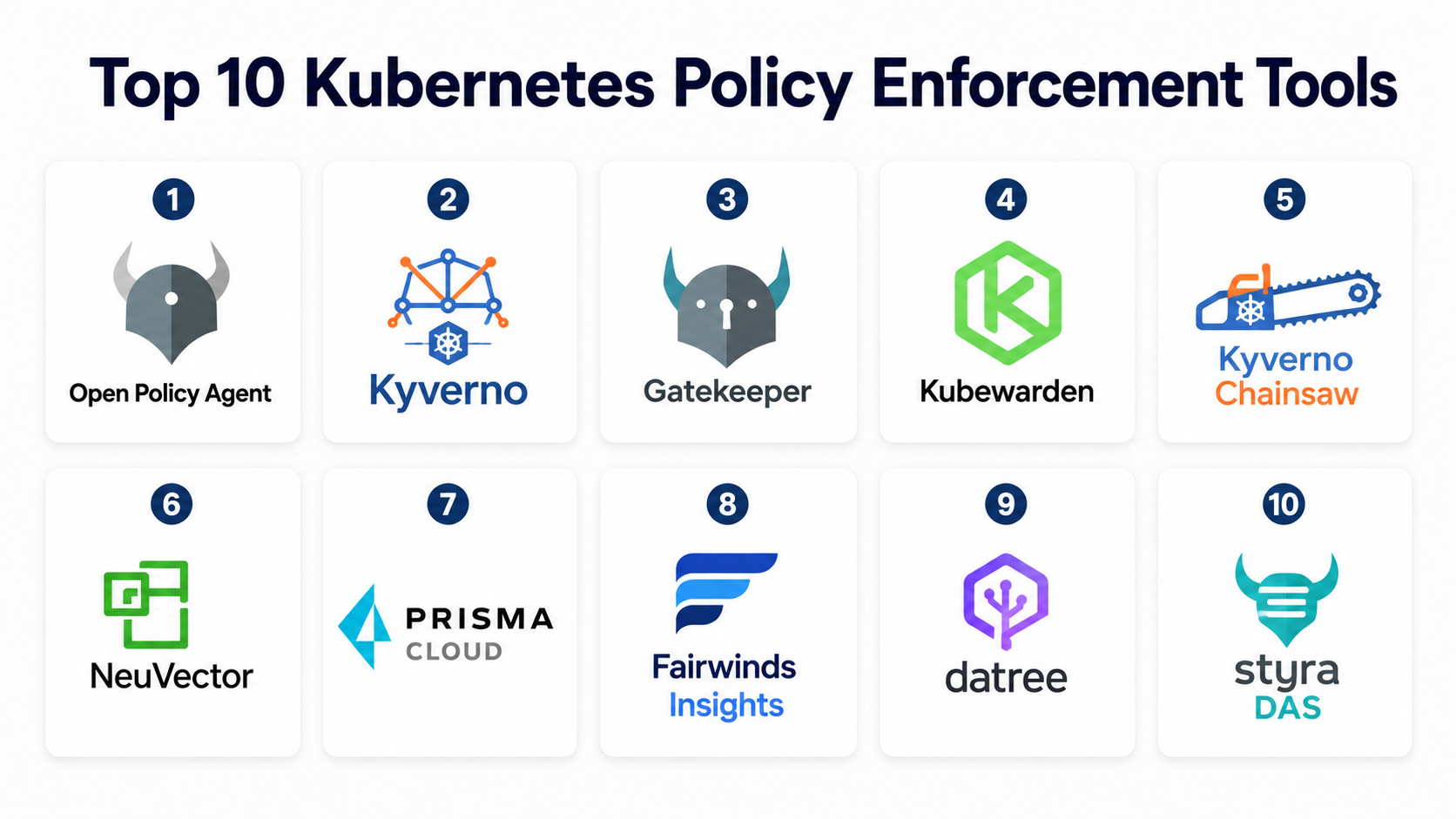
Introduction
Kubernetes Policy Enforcement Tools help organizations define, validate, and enforce security, compliance, and operational policies across Kubernetes clusters and cloud-native environments. These tools ensure workloads, configurations, containers, networking rules, and cluster resources comply with organizational standards before and during deployment.
In Kubernetes security has become a critical operational requirement because enterprises increasingly rely on containers, microservices, and multi-cluster cloud-native infrastructure. Misconfigured Kubernetes environments remain one of the leading causes of cloud security incidents, making automated policy enforcement essential for DevSecOps teams and platform engineers.
Common real-world use cases include:
- Blocking insecure container deployments
- Enforcing admission control policies
- Validating Kubernetes manifests before deployment
- Applying compliance controls for regulated industries
- Preventing privilege escalation and risky configurations
When evaluating Kubernetes Policy Enforcement Tools, buyers should consider:
- Kubernetes-native integration quality
- Policy-as-code support
- Runtime versus admission-time enforcement
- Multi-cluster scalability
- Compliance framework support
- CI/CD integration capabilities
- Ease of policy creation and management
- Observability and reporting features
- RBAC and governance controls
- Open-source ecosystem maturity
Best for: Platform engineering teams, DevSecOps organizations, Kubernetes administrators, cloud-native enterprises, managed Kubernetes providers, and security-focused engineering teams.
Not ideal for: Organizations not using Kubernetes extensively, small projects without governance requirements, or environments where basic Kubernetes RBAC is already sufficient.
Key Trends in Kubernetes Policy Enforcement Tools
- Policy-as-code adoption continues to grow rapidly across DevSecOps environments.
- AI-assisted policy recommendations are emerging for Kubernetes governance automation.
- Runtime-aware policy enforcement is becoming increasingly important.
- Multi-cluster governance is now a baseline enterprise requirement.
- Open Policy Agent (OPA) ecosystems continue to dominate policy frameworks.
- Supply chain security checks are being integrated directly into admission controllers.
- Compliance automation for CIS Kubernetes Benchmarks is increasingly common.
- GitOps and Infrastructure-as-Code integrations are becoming standard.
- Shift-left policy validation inside CI/CD pipelines is expanding rapidly.
- Kubernetes-native observability and audit reporting capabilities are improving significantly.
How We Selected These Tools (Methodology)
The tools in this list were selected using a balanced evaluation framework focused on Kubernetes-native functionality, enterprise adoption, and cloud-native ecosystem maturity.
Selection criteria included:
- Market adoption within Kubernetes ecosystems
- Policy enforcement depth and flexibility
- Kubernetes admission controller capabilities
- Runtime security support
- Multi-cluster scalability
- Open-source community strength
- Compliance and governance features
- CI/CD and GitOps integrations
- Ease of deployment and policy management
- Enterprise operational maturity
Kubernetes Policy Enforcement Tools
#1 — Open Policy Agent (OPA)
Short description :
Open Policy Agent is one of the most widely adopted policy-as-code frameworks in cloud-native environments. It allows organizations to define and enforce policies across Kubernetes, APIs, CI/CD pipelines, and cloud infrastructure using the Rego policy language. OPA is commonly used with Kubernetes admission controllers to validate workloads and configurations before deployment. It is highly flexible and deeply integrated into modern DevSecOps ecosystems.
Key Features
- Policy-as-code framework
- Rego policy language
- Kubernetes admission control
- Multi-platform policy enforcement
- API authorization support
- Flexible integration architecture
- Cloud-native extensibility
Pros
- Highly flexible and customizable
- Strong open-source community
- Broad ecosystem adoption
Cons
- Rego language has a learning curve
- Requires policy engineering expertise
- Advanced deployments may become complex
Platforms / Deployment
- Linux / Kubernetes
- Self-hosted / Cloud integrations
Security & Compliance
- RBAC support
- Audit logging support
- Encryption depends on deployment
- Compliance automation possible through integrations
Integrations & Ecosystem
OPA integrates deeply into Kubernetes, CI/CD, and cloud-native ecosystems.
- Kubernetes
- Envoy
- Terraform
- GitHub Actions
- Jenkins
- Istio
Support & Community
OPA has one of the strongest open-source communities in cloud-native security, with extensive documentation and enterprise adoption.
#2 — Kyverno
Short description :
Kyverno is a Kubernetes-native policy engine designed specifically for Kubernetes resource validation and policy enforcement. Unlike general-purpose policy frameworks, Kyverno uses Kubernetes-style YAML policies, making it accessible to platform and DevOps teams. It supports admission control, mutation, policy generation, and background scanning for Kubernetes workloads.
Key Features
- Kubernetes-native policy management
- YAML-based policy definitions
- Admission control enforcement
- Policy mutation capabilities
- Background configuration scanning
- Compliance reporting
- Policy generation automation
Pros
- Easier learning curve than Rego-based tools
- Native Kubernetes workflow alignment
- Strong policy automation capabilities
Cons
- Primarily Kubernetes-focused
- Advanced policies can become complex
- Large-scale deployments may require tuning
Platforms / Deployment
- Kubernetes / Linux
- Self-hosted / Cloud integrations
Security & Compliance
- RBAC support
- Audit logging
- Compliance reporting
- Policy validation controls
Integrations & Ecosystem
Kyverno integrates closely with Kubernetes-native operations and GitOps workflows.
- Kubernetes
- Helm
- Argo CD
- Flux
- GitHub Actions
- Prometheus
Support & Community
Kyverno has a rapidly growing open-source community and strong adoption among Kubernetes platform teams.
#3 — Gatekeeper
Short description :
Gatekeeper is a Kubernetes admission controller built on top of Open Policy Agent. It helps enforce governance policies across Kubernetes clusters using reusable policy templates and constraints. Gatekeeper is widely adopted for enterprise Kubernetes governance and compliance automation.
Key Features
- OPA-powered admission control
- Constraint templates
- Policy validation
- Kubernetes governance automation
- Audit capabilities
- Rego policy support
- Compliance-focused controls
Pros
- Strong Kubernetes governance model
- Flexible policy templating
- Enterprise-friendly architecture
Cons
- Rego learning curve
- Can become operationally complex
- Requires policy management expertise
Platforms / Deployment
- Kubernetes / Linux
- Self-hosted / Hybrid
Security & Compliance
- RBAC support
- Audit logging
- Compliance policy automation
- Admission enforcement controls
Integrations & Ecosystem
Gatekeeper integrates tightly into Kubernetes governance workflows.
- Kubernetes
- OPA
- Helm
- Argo CD
- CI/CD systems
- GitOps platforms
Support & Community
Gatekeeper benefits from strong CNCF ecosystem adoption and broad enterprise Kubernetes usage.
#4 — Kubewarden
Short description :
Kubewarden is a Kubernetes policy engine focused on WebAssembly-based policy execution. It allows organizations to write policies in multiple programming languages while improving portability and performance. Kubewarden is gaining attention among teams seeking flexible and modern Kubernetes policy enforcement approaches.
Key Features
- WebAssembly-based policy engine
- Multi-language policy support
- Admission control enforcement
- Kubernetes-native integrations
- Policy portability
- Secure sandboxed execution
- High-performance validation
Pros
- Flexible programming language support
- Strong performance model
- Modern architecture design
Cons
- Smaller ecosystem than OPA-based tools
- Fewer prebuilt policies
- Requires specialized expertise
Platforms / Deployment
- Kubernetes / Linux
- Self-hosted
Security & Compliance
- RBAC support
- Sandboxed policy execution
- Audit logging support
- Compliance policy support
Integrations & Ecosystem
Kubewarden integrates into Kubernetes-native environments and GitOps workflows.
- Kubernetes
- Helm
- Flux
- Argo CD
- CI/CD platforms
Support & Community
Kubewarden has a growing open-source community and increasing adoption in modern Kubernetes environments.
#5 — Kyverno Chainsaw
Short description :
Kyverno Chainsaw is a Kubernetes testing and validation framework associated with the Kyverno ecosystem. It focuses on validating policy behavior and Kubernetes configurations during CI/CD and operational workflows. It helps organizations improve policy reliability and Kubernetes governance testing.
Key Features
- Kubernetes policy testing
- Validation automation
- CI/CD integration
- YAML-driven workflows
- Kubernetes-native operations
- Governance validation
- Automated test orchestration
Pros
- Strong testing automation
- Native Kubernetes alignment
- Good DevOps workflow integration
Cons
- Narrower focus than full policy engines
- Smaller ecosystem
- Advanced testing may require expertise
Platforms / Deployment
- Kubernetes / Linux
- Self-hosted
Security & Compliance
- Policy validation controls
- Audit support
- RBAC through Kubernetes environments
Integrations & Ecosystem
Chainsaw integrates with Kubernetes testing and GitOps environments.
- Kubernetes
- Kyverno
- GitHub Actions
- Argo CD
- CI/CD systems
Support & Community
Community support is growing alongside Kyverno ecosystem adoption.
#6 — NeuVector
Short description :
NeuVector is a Kubernetes and container security platform that includes policy enforcement, runtime protection, network segmentation, and admission control features. It focuses heavily on zero-trust security models and runtime Kubernetes protection. NeuVector is widely adopted by organizations requiring both preventive and runtime controls.
Key Features
- Kubernetes admission control
- Runtime policy enforcement
- Zero-trust networking
- Container security monitoring
- Compliance validation
- Network segmentation
- Threat detection
Pros
- Strong runtime enforcement capabilities
- Excellent Kubernetes visibility
- Good compliance automation
Cons
- Advanced networking concepts may require expertise
- Enterprise deployment complexity
- Smaller ecosystem than OPA-based tools
Platforms / Deployment
- Kubernetes / Linux
- Cloud / Self-hosted / Hybrid
Security & Compliance
- RBAC
- Audit logs
- Compliance controls
- Encryption support
Integrations & Ecosystem
NeuVector integrates deeply into Kubernetes runtime security workflows.
- Kubernetes
- Rancher
- Docker
- CI/CD systems
- Cloud-native platforms
Support & Community
NeuVector provides enterprise support and strong Kubernetes-focused documentation.
#7 — Prisma Cloud
Short description :
Prisma Cloud provides Kubernetes policy enforcement as part of its broader cloud-native application protection platform. It combines posture management, compliance validation, runtime protection, and admission control into a unified cloud security platform. Prisma Cloud is especially popular in large enterprise multi-cloud environments.
Key Features
- Kubernetes posture management
- Admission control policies
- Runtime workload protection
- Compliance monitoring
- Multi-cloud governance
- Risk prioritization
- Cloud-native security analytics
Pros
- Comprehensive enterprise cloud security
- Strong runtime protection
- Excellent multi-cloud support
Cons
- Premium enterprise pricing
- Complex deployment for smaller teams
- Broad platform may require training
Platforms / Deployment
- Web / Linux / Kubernetes
- Cloud / Hybrid
Security & Compliance
- SSO/SAML
- MFA
- RBAC
- Audit logs
- Compliance automation
Integrations & Ecosystem
Prisma Cloud integrates with cloud-native and enterprise DevSecOps environments.
- AWS
- Azure
- Google Cloud
- Kubernetes
- Jenkins
- GitHub
Support & Community
Palo Alto Networks provides enterprise onboarding, documentation, and premium support tiers.
#8 — Fairwinds Insights
Short description :
Fairwinds Insights is a Kubernetes governance and optimization platform that includes policy enforcement and configuration validation features. It helps organizations improve Kubernetes security posture, compliance, and operational consistency. Fairwinds focuses strongly on Kubernetes best practices and governance automation.
Key Features
- Kubernetes configuration validation
- Policy enforcement automation
- Security posture management
- Cost optimization insights
- Compliance monitoring
- Governance dashboards
- Cluster health visibility
Pros
- Strong Kubernetes operational insights
- Easier governance workflows
- Good compliance visibility
Cons
- Narrower focus than full CNAPP platforms
- Advanced runtime controls are limited
- Smaller ecosystem presence
Platforms / Deployment
- Kubernetes / Linux
- Cloud / Hybrid
Security & Compliance
- RBAC
- Audit support
- Compliance visibility
- Governance reporting
Integrations & Ecosystem
Fairwinds integrates with Kubernetes governance and GitOps workflows.
- Kubernetes
- Helm
- Argo CD
- Flux
- Prometheus
- CI/CD systems
Support & Community
Fairwinds provides documentation, onboarding resources, and enterprise support programs.
#9 — Datree
Short description :
Datree is a Kubernetes policy enforcement and configuration validation platform focused on preventing misconfigurations before deployment. It integrates into developer workflows and CI/CD pipelines to validate manifests against organizational policies. Datree emphasizes shift-left Kubernetes governance and developer-friendly policy management.
Key Features
- Kubernetes manifest validation
- Policy-as-code workflows
- CI/CD integrations
- Misconfiguration prevention
- Governance enforcement
- Pre-deployment validation
- Developer workflow support
Pros
- Strong shift-left security model
- Easy CI/CD integration
- Developer-friendly workflows
Cons
- Primarily focused on pre-deployment validation
- Runtime controls are limited
- Enterprise governance depth varies
Platforms / Deployment
- Web / Linux / Kubernetes
- Cloud / Self-hosted
Security & Compliance
- RBAC support
- Policy governance controls
- Audit support varies by deployment
Integrations & Ecosystem
Datree integrates directly into Kubernetes development workflows.
- Kubernetes
- GitHub Actions
- GitLab CI
- Jenkins
- Helm
- Terraform
Support & Community
Datree offers onboarding resources, developer documentation, and growing Kubernetes community adoption.
#10 — Styra DAS
Short description :
Styra DAS is an enterprise policy management platform built around Open Policy Agent. It provides centralized policy lifecycle management, Kubernetes governance, and policy distribution across cloud-native environments. Styra DAS is commonly used by enterprises adopting large-scale policy-as-code strategies.
Key Features
- Centralized policy management
- OPA policy orchestration
- Kubernetes governance
- Policy lifecycle workflows
- Compliance automation
- Multi-cluster policy distribution
- Audit visibility
Pros
- Strong enterprise policy governance
- Excellent OPA ecosystem integration
- Scalable multi-cluster management
Cons
- Enterprise-focused pricing
- Rego learning curve
- Advanced operational complexity
Platforms / Deployment
- Web / Linux / Kubernetes
- Cloud / Hybrid
Security & Compliance
- SSO/SAML
- RBAC
- Audit logging
- Compliance controls
- Encryption support
Integrations & Ecosystem
Styra DAS integrates into enterprise cloud-native governance environments.
- Kubernetes
- OPA
- Terraform
- GitHub
- Jenkins
- CI/CD systems
Support & Community
Styra provides enterprise support, policy engineering guidance, and strong OPA ecosystem expertise.
Comparison Table (Top 10)
| Tool Name | Best For | Platform(s) Supported | Deployment | Standout Feature | Public Rating |
|---|---|---|---|---|---|
| Open Policy Agent | Flexible policy-as-code | Linux, Kubernetes | Self-hosted | Rego policy framework | N/A |
| Kyverno | Kubernetes-native governance | Kubernetes, Linux | Self-hosted | YAML-based policies | N/A |
| Gatekeeper | Enterprise admission control | Kubernetes, Linux | Hybrid | Constraint templates | N/A |
| Kubewarden | WebAssembly-based policies | Kubernetes, Linux | Self-hosted | Multi-language support | N/A |
| Kyverno Chainsaw | Kubernetes policy testing | Kubernetes, Linux | Self-hosted | Governance validation | N/A |
| NeuVector | Runtime Kubernetes protection | Kubernetes, Linux | Hybrid | Zero-trust runtime controls | N/A |
| Prisma Cloud | Enterprise cloud governance | Web, Linux, Kubernetes | Hybrid | Multi-cloud runtime security | N/A |
| Fairwinds Insights | Kubernetes posture governance | Kubernetes, Linux | Cloud / Hybrid | Operational visibility | N/A |
| Datree | Shift-left validation | Web, Linux, Kubernetes | Cloud / Self-hosted | Manifest validation | N/A |
| Styra DAS | Enterprise policy orchestration | Web, Linux, Kubernetes | Hybrid | Centralized OPA management | N/A |
Evaluation & Kubernetes Policy Enforcement Tools
| Tool Name | Core (25%) | Ease (15%) | Integrations (15%) | Security (10%) | Performance (10%) | Support (10%) | Value (15%) | Weighted Total (0–10) |
|---|---|---|---|---|---|---|---|---|
| Open Policy Agent | 10 | 6 | 10 | 9 | 9 | 8 | 9 | 8.8 |
| Kyverno | 9 | 9 | 8 | 8 | 8 | 8 | 9 | 8.6 |
| Gatekeeper | 9 | 7 | 9 | 9 | 8 | 8 | 8 | 8.3 |
| Kubewarden | 8 | 7 | 7 | 8 | 9 | 7 | 8 | 7.8 |
| Kyverno Chainsaw | 7 | 8 | 7 | 7 | 8 | 7 | 8 | 7.5 |
| NeuVector | 8 | 6 | 8 | 9 | 8 | 8 | 7 | 7.8 |
| Prisma Cloud | 9 | 6 | 9 | 10 | 9 | 8 | 6 | 8.2 |
| Fairwinds Insights | 7 | 8 | 7 | 7 | 8 | 7 | 8 | 7.5 |
| Datree | 8 | 8 | 8 | 7 | 8 | 7 | 8 | 7.9 |
| Styra DAS | 9 | 6 | 9 | 9 | 8 | 8 | 6 | 8.0 |
These scores are comparative and intended to help organizations evaluate trade-offs across flexibility, governance depth, usability, and operational scalability. Open-source frameworks often score highly on flexibility and value, while enterprise platforms typically provide stronger governance and compliance capabilities at higher operational and financial cost. Buyers should prioritize the categories most aligned with their Kubernetes maturity and security requirements.
Which Kubernetes Policy Enforcement Tools
Solo / Freelancer
Kyverno and Datree are excellent options for individual Kubernetes engineers and smaller DevOps teams because they offer relatively simple setup and developer-friendly policy management.
SMB
SMBs often benefit from Kyverno due to its Kubernetes-native YAML policies and easier operational model. Fairwinds Insights is also useful for organizations needing governance visibility without large enterprise complexity.
Mid-Market
Mid-market organizations should evaluate Gatekeeper, NeuVector, and Styra DAS for broader governance automation and scalable Kubernetes policy management.
Enterprise
Large enterprises typically require centralized governance, multi-cluster visibility, runtime enforcement, and compliance automation. Prisma Cloud, Styra DAS, and Open Policy Agent are particularly strong in these environments.
Budget vs Premium
Budget-conscious teams may prefer OPA, Kyverno, or Kubewarden because of their strong open-source ecosystems. Premium enterprise platforms like Prisma Cloud and Styra DAS provide broader governance and operational capabilities.
Feature Depth vs Ease of Use
Kyverno focuses heavily on usability through Kubernetes-native YAML policies, while OPA and Styra DAS provide deeper policy flexibility and governance capabilities with higher complexity.
Integrations & Scalability
Organizations operating large GitOps and multi-cluster Kubernetes environments should prioritize OPA, Gatekeeper, Styra DAS, or Prisma Cloud for broader ecosystem integrations.
Security & Compliance Needs
Highly regulated industries often require compliance automation, audit logging, runtime protection, and policy governance. Prisma Cloud, NeuVector, and Gatekeeper are particularly strong choices.
Frequently Asked Questions (FAQs)
1. What is a Kubernetes Policy Enforcement Tool?
A Kubernetes Policy Enforcement Tool validates and enforces rules across Kubernetes clusters to prevent insecure, non-compliant, or misconfigured workloads from being deployed.
2. Why are Kubernetes policies important?
Kubernetes environments are highly flexible, which increases the risk of misconfigurations. Policy enforcement helps maintain security, operational consistency, and compliance standards.
3. What is policy-as-code?
Policy-as-code allows organizations to define governance and security rules in machine-readable formats that can be version-controlled and automated through CI/CD pipelines.
4. What is admission control in Kubernetes?
Admission control validates or modifies Kubernetes resource requests before they are persisted in the cluster, helping enforce organizational policies.
5. What is the difference between OPA and Kyverno?
OPA is a general-purpose policy framework using the Rego language, while Kyverno is Kubernetes-native and uses YAML-based policy definitions for simpler Kubernetes workflows.
6. Can these tools integrate with CI/CD pipelines?
Yes. Most Kubernetes policy tools integrate with GitHub Actions, Jenkins, GitLab CI, Argo CD, Flux, and other GitOps or CI/CD platforms.
7. Are open-source policy tools sufficient for enterprises?
Many enterprises successfully use open-source tools like OPA and Kyverno, though some organizations prefer commercial platforms for centralized governance and enterprise support.
8. What are common Kubernetes policy mistakes?
Common mistakes include overly permissive RBAC policies, lack of admission controls, ignoring runtime enforcement, and failing to validate Infrastructure-as-Code templates.
9. Do Kubernetes policy tools support compliance automation?
Yes. Many platforms support CIS Kubernetes Benchmarks, governance reporting, audit visibility, and compliance-oriented policy enforcement.
10. Which industries benefit most from Kubernetes policy enforcement?
Finance, healthcare, SaaS, government, telecommunications, and large cloud-native enterprises benefit significantly from Kubernetes governance automation.
Conclusion
Kubernetes Policy Enforcement Tools have become foundational components of modern cloud-native security and governance strategies. As Kubernetes adoption continues to expand across enterprise infrastructure, organizations need automated policy validation, admission control, runtime governance, and compliance enforcement to reduce operational and security risks. Modern platforms now combine policy-as-code workflows, GitOps integrations, runtime visibility, and multi-cluster governance into scalable Kubernetes security ecosystems.
