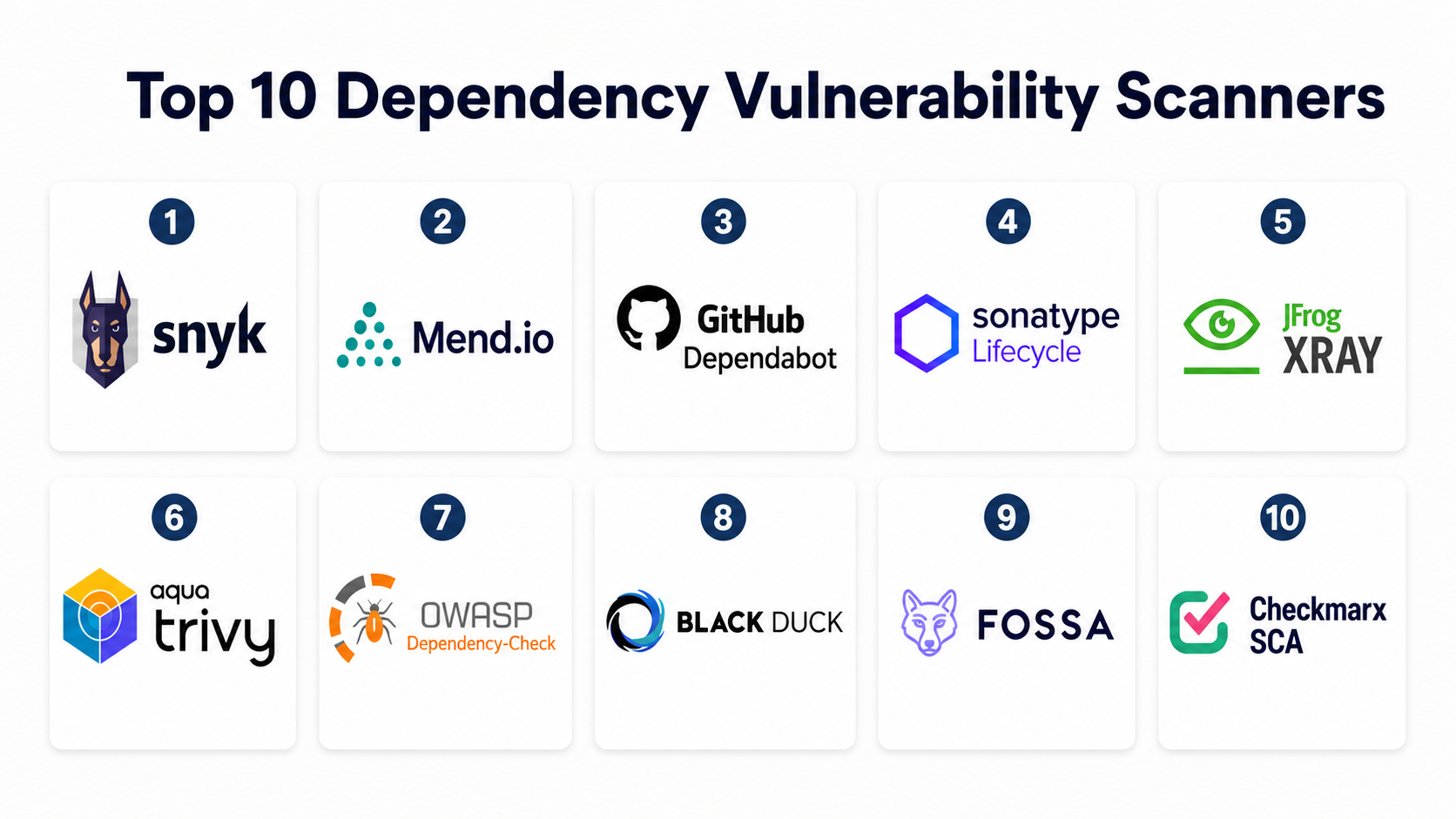
Introduction
Dependency Vulnerability Scanners are security tools that analyze software dependencies, libraries, packages, and open-source components for known vulnerabilities, licensing risks, and outdated versions. Modern applications rely heavily on third-party packages, making dependency security a critical part of software development and DevSecOps practices.
In dependency scanning matters more than ever because software supply chain attacks continue to grow in sophistication. Attackers increasingly target open-source ecosystems, package repositories, and transitive dependencies. Organizations are also under pressure to meet stricter compliance, governance, and software bill of materials (SBOM) requirements.
Common real-world use cases include:
- Detecting vulnerable open-source libraries in CI/CD pipelines
- Monitoring software supply chain risks across development teams
- Automating compliance checks for enterprise security programs
- Identifying malicious or abandoned packages before deployment
- Prioritizing remediation using exploit intelligence and risk scoring
When evaluating Dependency Vulnerability Scanners, buyers should consider:
- Vulnerability database quality and update frequency
- Language and package ecosystem coverage
- CI/CD and developer workflow integrations
- False positive reduction capabilities
- SBOM generation and analysis support
- License compliance management
- Cloud versus self-hosted deployment options
- Policy enforcement and governance controls
- Remediation automation and fix recommendations
- Scalability for large engineering environments
Best for: DevOps teams, security engineers, application security teams, software vendors, SaaS companies, regulated industries, enterprises managing large codebases, and organizations adopting DevSecOps practices.
Not ideal for: Very small projects with minimal dependencies, teams building entirely isolated internal software, or organizations already using comprehensive application security platforms where dependency scanning is included natively.
Key Trends in Dependency Vulnerability Scanners
- AI-assisted remediation recommendations are becoming standard, helping developers prioritize fixes with lower operational risk.
- SBOM generation and continuous SBOM monitoring are now expected for enterprise procurement and compliance workflows.
- Runtime-aware prioritization is reducing alert fatigue by focusing on actively used vulnerable components.
- Supply chain security frameworks such as SLSA and secure software attestations are influencing scanner capabilities.
- Container, Kubernetes, and Infrastructure-as-Code scanning are increasingly integrated into dependency analysis platforms.
- Developer-first workflows with IDE plugins and pull-request scanning are improving remediation speed.
- License compliance automation is becoming more important alongside vulnerability detection.
- Hybrid deployment models are growing as enterprises balance cloud convenience with data residency requirements.
- Risk-based vulnerability scoring now combines CVSS, exploitability, reachability, and runtime context.
- Multi-language and polyglot repository support are essential for modern microservices environments.
How We Selected These Tools (Methodology)
The tools in this list were selected using a balanced evaluation framework focused on technical capability, ecosystem maturity, and market adoption.
Selection criteria included:
- Broad industry adoption and developer mindshare
- Support for major package ecosystems and programming languages
- CI/CD, SCM, IDE, and cloud platform integrations
- Accuracy and freshness of vulnerability intelligence
- Enterprise governance and policy management capabilities
- SBOM support and software supply chain security features
- Deployment flexibility for cloud and self-hosted environments
- Developer usability and remediation workflows
- Community reputation and long-term ecosystem stability
- Suitability across startups, SMBs, mid-market, and enterprise organizations
Dependency Vulnerability Scanners
#1 — Snyk
Short description :
Snyk is one of the most recognized developer-first dependency vulnerability scanners in the market. It focuses on identifying and fixing vulnerabilities in open-source packages, containers, IaC configurations, and application code. Snyk is widely used by DevOps and engineering teams that want integrated security directly inside developer workflows. Its strong automation and remediation guidance make it especially attractive for fast-moving engineering organizations. The platform supports cloud-native development environments and large-scale enterprise deployments.
Key Features
- Open-source dependency vulnerability scanning
- Automated fix pull requests
- Container and Kubernetes scanning
- License compliance management
- IDE integrations for developers
- SBOM generation and reporting
- Policy enforcement and risk prioritization
Pros
- Strong developer experience and usability
- Excellent CI/CD and SCM integrations
- Fast remediation workflows with automated fixes
Cons
- Enterprise pricing can become expensive
- Large projects may generate noisy alerts
- Advanced governance features may require higher tiers
Platforms / Deployment
- Web / Windows / macOS / Linux
- Cloud / Self-hosted / Hybrid
Security & Compliance
- SSO/SAML
- MFA
- RBAC
- Audit logs
- SOC 2
- GDPR support
- Encryption in transit and at rest
Integrations & Ecosystem
Snyk integrates deeply into modern DevOps workflows and supports many developer platforms and package managers.
- GitHub
- GitLab
- Bitbucket
- Azure DevOps
- Jenkins
- Jira
Support & Community
Snyk has strong documentation, onboarding resources, training materials, and a large community presence. Enterprise customers typically receive dedicated support tiers and customer success programs.
#2 — Mend.io
Short description :
Mend.io, formerly WhiteSource, is an enterprise-focused dependency vulnerability and software composition analysis platform. It provides comprehensive open-source risk management capabilities across development pipelines. Mend is commonly adopted by enterprises with strict governance and compliance requirements. The platform emphasizes automated remediation, policy enforcement, and supply chain visibility. It supports large engineering organizations operating across multiple repositories and development teams.
Key Features
- Open-source vulnerability detection
- Automated remediation workflows
- License compliance analysis
- Policy and governance controls
- SBOM management
- Container security support
- Repository monitoring
Pros
- Strong enterprise governance capabilities
- Mature license compliance functionality
- Broad ecosystem and language support
Cons
- Interface can feel enterprise-heavy
- Setup complexity for smaller teams
- Premium features may increase cost significantly
Platforms / Deployment
- Web / Linux
- Cloud / Self-hosted / Hybrid
Security & Compliance
- SSO/SAML
- RBAC
- Audit logs
- SOC 2
- GDPR support
- Encryption capabilities
Integrations & Ecosystem
Mend.io integrates with major developer and enterprise security platforms.
- GitHub
- GitLab
- Azure DevOps
- Jira
- Jenkins
- Artifactory
Support & Community
Mend.io provides enterprise onboarding assistance, detailed documentation, and premium support programs. Community engagement is moderate compared to developer-first tools.
#3 — GitHub Dependabot
Short description :
GitHub Dependabot is a dependency vulnerability scanning and automated update tool integrated directly into GitHub repositories. It helps developers identify vulnerable dependencies and automatically generate update pull requests. Dependabot is widely used because of its native GitHub integration and accessibility. It is especially useful for teams already standardized on GitHub workflows. Smaller teams and startups often adopt it due to ease of use and integrated automation.
Key Features
- Automated dependency update pull requests
- Security advisories and alerts
- GitHub-native workflow integration
- Multi-language dependency support
- Dependency graph visualization
- Repository monitoring
- Security update automation
Pros
- Easy to enable and manage
- Native GitHub integration
- Strong automation for dependency updates
Cons
- Primarily optimized for GitHub ecosystems
- Limited advanced governance features
- Enterprise reporting is less comprehensive
Platforms / Deployment
- Web
- Cloud
Security & Compliance
- MFA
- Audit logs
- RBAC
- SSO/SAML available through GitHub Enterprise
- Encryption standards supported by GitHub
Integrations & Ecosystem
Dependabot fits naturally within GitHub development workflows and developer collaboration pipelines.
- GitHub Actions
- GitHub Advanced Security
- npm
- Maven
- PyPI
- Docker
Support & Community
Dependabot benefits from GitHub’s extensive documentation and large global developer community. Support quality varies by GitHub subscription tier.
#4 — Sonatype Lifecycle
Short description :
Sonatype Lifecycle is a software supply chain management and dependency vulnerability platform designed for enterprise environments. It focuses heavily on governance, policy management, and component intelligence. Sonatype is widely used by organizations managing large-scale open-source consumption across development pipelines. Its advanced risk intelligence and policy automation help security teams reduce supply chain exposure while supporting developer productivity.
Key Features
- Software composition analysis
- Open-source governance policies
- Vulnerability intelligence database
- Container and binary analysis
- Firewall protection for risky components
- SBOM support
- Automated policy enforcement
Pros
- Excellent enterprise policy controls
- Strong vulnerability intelligence
- Scalable for large organizations
Cons
- Learning curve for new users
- Enterprise-focused pricing
- Smaller teams may find it complex
Platforms / Deployment
- Web / Linux
- Cloud / Self-hosted / Hybrid
Security & Compliance
- SSO/SAML
- RBAC
- Audit logging
- Encryption support
- Compliance-oriented governance capabilities
Integrations & Ecosystem
Sonatype integrates into enterprise DevSecOps and artifact management ecosystems.
- Nexus Repository
- Jenkins
- GitLab
- GitHub
- Azure DevOps
- Jira
Support & Community
Sonatype offers enterprise-grade support, implementation guidance, and strong technical documentation. Community presence is solid within enterprise DevSecOps circles.
#5 — JFrog Xray
Short description :
JFrog Xray is a security and compliance scanning platform tightly integrated with the JFrog ecosystem. It provides vulnerability scanning for dependencies, containers, and binaries throughout the software lifecycle. Organizations using JFrog Artifactory often adopt Xray for centralized supply chain security visibility. The platform emphasizes traceability, impact analysis, and automated policy enforcement across repositories and pipelines.
Key Features
- Dependency and binary scanning
- Deep recursive dependency analysis
- Container security scanning
- License compliance checks
- Impact analysis and traceability
- Policy enforcement automation
- CI/CD security integration
Pros
- Excellent for JFrog-centric environments
- Strong artifact-level visibility
- Good enterprise scalability
Cons
- Best value requires JFrog ecosystem adoption
- Interface complexity for smaller teams
- Advanced configurations may require expertise
Platforms / Deployment
- Web / Linux
- Cloud / Self-hosted / Hybrid
Security & Compliance
- SSO/SAML
- MFA
- RBAC
- Audit logs
- Encryption support
- Compliance tooling available
Integrations & Ecosystem
JFrog Xray works closely with artifact repositories and DevOps pipelines.
- JFrog Artifactory
- Jenkins
- GitHub
- Kubernetes
- Docker
- Azure DevOps
Support & Community
JFrog provides enterprise support options, onboarding services, and extensive documentation. Community adoption is strong among DevOps and platform engineering teams.
#6 — Aqua Trivy
Short description :
Trivy is an open-source vulnerability scanner developed by Aqua Security. It scans dependencies, containers, Kubernetes configurations, and infrastructure artifacts for vulnerabilities and misconfigurations. Trivy is highly popular among cloud-native and Kubernetes-focused teams due to its lightweight design and open-source accessibility. It is commonly integrated into CI/CD pipelines and developer automation workflows.
Key Features
- Open-source vulnerability scanning
- Container image analysis
- Kubernetes security scanning
- SBOM generation
- IaC scanning support
- Lightweight CLI workflows
- Multi-language dependency coverage
Pros
- Free and open-source
- Fast and lightweight scanning
- Excellent cloud-native support
Cons
- Enterprise governance is limited without Aqua platform
- CLI-centric experience may challenge non-technical users
- Advanced reporting is less comprehensive
Platforms / Deployment
- Windows / macOS / Linux
- Self-hosted / Cloud integrations
Security & Compliance
- Encryption support varies by deployment
- RBAC varies by environment
- Compliance features depend on Aqua integrations
Integrations & Ecosystem
Trivy integrates well into Kubernetes and DevOps environments.
- GitHub Actions
- GitLab CI
- Jenkins
- Docker
- Kubernetes
- Terraform
Support & Community
Trivy has a large open-source community and strong GitHub activity. Commercial support is available through Aqua Security offerings.
#7 — OWASP Dependency-Check
Short description :
OWASP Dependency-Check is a widely used open-source software composition analysis tool that identifies publicly disclosed vulnerabilities in project dependencies. It is commonly used by security-conscious development teams and organizations seeking cost-effective dependency scanning. Dependency-Check integrates into build systems and CI/CD workflows, making it useful for automated security validation.
Key Features
- Open-source vulnerability analysis
- NVD database integration
- CI/CD automation support
- Build tool integrations
- Multi-language package scanning
- HTML and XML reporting
- Offline scanning capabilities
Pros
- Free and open-source
- Broad community adoption
- Flexible CI/CD integration
Cons
- Higher false positive rates possible
- UI and reporting are basic
- Limited enterprise governance features
Platforms / Deployment
- Windows / macOS / Linux
- Self-hosted
Security & Compliance
- Varies / N/A
- Compliance capabilities largely depend on deployment environment
Integrations & Ecosystem
Dependency-Check integrates with many build and automation tools.
- Maven
- Gradle
- Jenkins
- GitHub Actions
- Ant
- CI pipelines
Support & Community
OWASP Dependency-Check benefits from strong open-source community support and extensive online documentation.
#8 — Black Duck
Short description :
Black Duck by Synopsys is an enterprise-grade software composition analysis and dependency vulnerability management platform. It focuses on open-source governance, compliance, and supply chain risk reduction. Black Duck is commonly adopted by large enterprises operating in regulated industries with strict security and audit requirements. The platform supports extensive policy management and risk reporting capabilities.
Key Features
- Open-source vulnerability scanning
- License compliance management
- SBOM generation
- Policy enforcement
- Binary analysis support
- Risk reporting dashboards
- Container scanning
Pros
- Strong enterprise governance features
- Mature compliance tooling
- Good audit and reporting capabilities
Cons
- Can be expensive for smaller organizations
- Complex deployment and onboarding
- UI may feel heavy for developers
Platforms / Deployment
- Web / Linux
- Cloud / Self-hosted / Hybrid
Security & Compliance
- SSO/SAML
- RBAC
- Audit logs
- Encryption support
- Compliance-focused controls
Integrations & Ecosystem
Black Duck supports enterprise application security and DevSecOps workflows.
- Jira
- GitHub
- Jenkins
- Azure DevOps
- Kubernetes
- CI/CD pipelines
Support & Community
Synopsys provides enterprise support, onboarding, and professional services. Community engagement is smaller than open-source alternatives.
#9 — FOSSA
Short description :
FOSSA is a developer-focused software composition analysis and dependency vulnerability platform with strong license compliance capabilities. It helps organizations monitor open-source usage, automate policy management, and reduce legal and security risks. FOSSA is popular among engineering teams that want simplified workflows and accessible compliance tooling without excessive operational complexity.
Key Features
- Dependency vulnerability scanning
- License compliance automation
- Policy management
- SBOM generation
- Repository monitoring
- Developer workflow integrations
- Risk visibility dashboards
Pros
- Good balance of usability and governance
- Strong license management features
- Easier onboarding than many enterprise tools
Cons
- Advanced enterprise customization can be limited
- Smaller ecosystem than market leaders
- Some features may require premium plans
Platforms / Deployment
- Web / Linux
- Cloud / Hybrid
Security & Compliance
- SSO/SAML
- RBAC
- Encryption support
- Audit logging
- GDPR support
Integrations & Ecosystem
FOSSA integrates with common engineering and DevOps platforms.
- GitHub
- GitLab
- Bitbucket
- Slack
- Jira
- CI/CD systems
Support & Community
FOSSA provides helpful onboarding resources, documentation, and enterprise support. Community size is moderate but growing.
#10 — Checkmarx SCA
Short description :
Checkmarx SCA is a software composition analysis platform designed to help organizations identify vulnerabilities and risks in open-source dependencies. It is part of the broader Checkmarx application security ecosystem. The platform focuses on integrating security directly into software development pipelines while supporting enterprise governance and developer remediation workflows.
Key Features
- Open-source dependency analysis
- Automated vulnerability detection
- Risk prioritization
- CI/CD pipeline integration
- Policy management
- License compliance checks
- Developer remediation guidance
Pros
- Strong integration with broader AppSec workflows
- Good enterprise governance features
- Useful remediation insights
Cons
- Enterprise setup may require planning
- Smaller developer community than some competitors
- Premium pricing tiers for advanced functionality
Platforms / Deployment
- Web / Windows / Linux
- Cloud / Self-hosted / Hybrid
Security & Compliance
- SSO/SAML
- RBAC
- Audit logs
- Encryption support
- Compliance-oriented controls
Integrations & Ecosystem
Checkmarx integrates into enterprise application security environments.
- GitHub
- GitLab
- Jenkins
- Azure DevOps
- Jira
- CI/CD platforms
Support & Community
Checkmarx offers enterprise support, onboarding programs, and professional services. Documentation quality is generally strong.
Comparison Table (Top 10)
| Tool Name | Best For | Platform(s) Supported | Deployment | Standout Feature | Public Rating |
|---|---|---|---|---|---|
| Snyk | Developer-first DevSecOps teams | Web, Windows, macOS, Linux | Cloud / Hybrid | Automated fix pull requests | N/A |
| Mend.io | Enterprise governance | Web, Linux | Cloud / Hybrid | Policy enforcement | N/A |
| GitHub Dependabot | GitHub-centric teams | Web | Cloud | Native GitHub integration | N/A |
| Sonatype Lifecycle | Large enterprise supply chains | Web, Linux | Hybrid | Component intelligence | N/A |
| JFrog Xray | Artifact-centric DevOps teams | Web, Linux | Hybrid | Recursive dependency analysis | N/A |
| Aqua Trivy | Cloud-native and Kubernetes teams | Windows, macOS, Linux | Self-hosted | Lightweight open-source scanning | N/A |
| OWASP Dependency-Check | Budget-conscious security teams | Windows, macOS, Linux | Self-hosted | Open-source flexibility | N/A |
| Black Duck | Regulated enterprises | Web, Linux | Hybrid | Compliance governance | N/A |
| FOSSA | License compliance workflows | Web, Linux | Cloud / Hybrid | Simplified compliance automation | N/A |
| Checkmarx SCA | Enterprise AppSec programs | Web, Windows, Linux | Hybrid | Integrated AppSec ecosystem | N/A |
Evaluation & Dependency Vulnerability Scanners
| Tool Name | Core (25%) | Ease (15%) | Integrations (15%) | Security (10%) | Performance (10%) | Support (10%) | Value (15%) | Weighted Total (0–10) |
|---|---|---|---|---|---|---|---|---|
| Snyk | 9 | 9 | 9 | 8 | 8 | 8 | 7 | 8.4 |
| Mend.io | 9 | 7 | 8 | 9 | 8 | 8 | 6 | 7.9 |
| GitHub Dependabot | 7 | 10 | 7 | 7 | 8 | 8 | 9 | 8.0 |
| Sonatype Lifecycle | 9 | 7 | 8 | 9 | 9 | 8 | 6 | 8.1 |
| JFrog Xray | 8 | 7 | 9 | 8 | 8 | 8 | 7 | 7.9 |
| Aqua Trivy | 8 | 8 | 8 | 7 | 9 | 7 | 10 | 8.2 |
| OWASP Dependency-Check | 7 | 6 | 7 | 6 | 7 | 7 | 10 | 7.2 |
| Black Duck | 9 | 6 | 8 | 9 | 8 | 8 | 5 | 7.7 |
| FOSSA | 8 | 8 | 8 | 8 | 8 | 7 | 8 | 8.0 |
| Checkmarx SCA | 8 | 7 | 8 | 8 | 8 | 8 | 6 | 7.7 |
These scores are comparative rather than absolute. A higher score reflects stronger overall balance across usability, integrations, governance, and operational value. Enterprise-focused tools often score highly in governance and security but lower in value due to pricing complexity. Open-source tools may score strongly on value while lacking advanced reporting or governance capabilities. Buyers should prioritize the categories most aligned with their organizational needs.
Which Dependency Vulnerability Scanners
Solo / Freelancer
Solo developers and freelancers often prioritize affordability, simplicity, and low operational overhead. GitHub Dependabot and Aqua Trivy are strong options because they integrate easily into existing workflows without requiring large security teams. OWASP Dependency-Check is also attractive for cost-conscious users comfortable managing open-source tooling manually.
SMB
Small and medium-sized businesses benefit from tools that balance usability with automation. Snyk is particularly effective for SMBs because of its developer-first design and automated remediation workflows. FOSSA is also a good fit for teams needing license compliance without enterprise-level complexity.
Mid-Market
Mid-market organizations often require better governance, broader integrations, and scalability. Sonatype Lifecycle and JFrog Xray work well for organizations standardizing DevSecOps pipelines and artifact management. Mend.io is another strong choice for companies building mature software supply chain security programs.
Enterprise
Large enterprises typically require advanced governance, auditability, policy management, and hybrid deployment options. Black Duck, Mend.io, Sonatype Lifecycle, and Checkmarx SCA are strong enterprise-oriented solutions. These platforms support centralized visibility, large-scale policy enforcement, and compliance workflows across distributed engineering teams.
Budget vs Premium
Budget-conscious organizations may prefer Aqua Trivy or OWASP Dependency-Check due to strong open-source capabilities. Premium platforms like Black Duck and Mend.io provide deeper governance and reporting but require larger investments.
Feature Depth vs Ease of Use
Snyk and GitHub Dependabot emphasize developer usability and workflow simplicity. Black Duck and Sonatype Lifecycle provide deeper governance and policy controls but involve more operational complexity.
Integrations & Scalability
Organizations operating large CI/CD environments should prioritize integration-rich platforms like Snyk, JFrog Xray, Sonatype Lifecycle, or Mend.io. These tools scale more effectively across repositories, teams, and cloud-native environments.
Security & Compliance Needs
Highly regulated industries often require SBOM support, audit logs, policy enforcement, and compliance automation. Black Duck, Mend.io, Sonatype Lifecycle, and Checkmarx SCA are particularly strong in governance-heavy environments.
Frequently Asked Questions (FAQs)
1. What is a Dependency Vulnerability Scanner?
A Dependency Vulnerability Scanner identifies known security vulnerabilities in third-party libraries, packages, and open-source components used within software projects. These tools help organizations reduce software supply chain risks and improve application security posture.
2. Why are dependency vulnerabilities dangerous?
Attackers frequently exploit outdated or vulnerable open-source libraries because they are widely reused across applications. A single vulnerable dependency can expose sensitive systems, customer data, and production infrastructure.
3. How do these tools work?
Most scanners compare project dependencies against vulnerability databases such as NVD and proprietary threat intelligence feeds. Advanced platforms also analyze transitive dependencies, exploitability, and runtime usage patterns.
4. Are open-source scanners enough for enterprise security?
Open-source scanners can be highly effective, especially for smaller teams. However, enterprises often require advanced governance, reporting, compliance, and policy management capabilities available in commercial platforms.
5. What programming languages are typically supported?
Most modern tools support popular ecosystems including JavaScript, Python, Java, Go, Ruby, PHP, .NET, Rust, and container images. Coverage varies by vendor and package manager support.
6. What is SBOM support and why does it matter?
An SBOM, or Software Bill of Materials, provides an inventory of software components and dependencies. SBOMs help organizations improve transparency, comply with regulations, and respond faster to newly discovered vulnerabilities.
7. How are these tools typically priced?
Pricing models vary widely. Some tools use per-user pricing, while others charge based on repository count, scans, or enterprise licensing agreements. Open-source tools are usually free but may require internal operational support.
8. Can dependency scanners integrate into CI/CD pipelines?
Yes. Most modern platforms integrate directly into CI/CD pipelines, allowing vulnerabilities to be detected during build and deployment stages. This supports shift-left security practices.
9. What are common implementation mistakes?
Common mistakes include ignoring transitive dependencies, failing to prioritize remediation, generating excessive alert noise, and not integrating scanning into developer workflows early enough.
10. How difficult is it to switch between dependency scanning tools?
Migration complexity depends on workflow integrations, governance policies, and reporting dependencies. Organizations with mature DevSecOps pipelines may require careful migration planning and policy mapping.
11. Do dependency scanners replace penetration testing?
No. Dependency scanning focuses on known component vulnerabilities, while penetration testing evaluates broader application and infrastructure security weaknesses.
12. What industries benefit most from dependency vulnerability scanning?
Industries with strict compliance requirements or large software footprints benefit significantly, including finance, healthcare, SaaS, e-commerce, government, and technology providers.
Conclusion
Dependency Vulnerability Scanners have become essential tools for modern software development and software supply chain security. As organizations rely increasingly on open-source ecosystems, the ability to detect, prioritize, and remediate vulnerable dependencies is no longer optional. Modern platforms now combine vulnerability intelligence, SBOM management, CI/CD automation, compliance controls, and developer-friendly remediation workflows into unified DevSecOps solutions.
