Introduction
Policy as Code Tools are platforms that allow organizations to define, manage, and enforce security, compliance, and governance policies using machine-readable code instead of manual processes or static documentation. These policies can automatically evaluate infrastructure, applications, and cloud configurations to ensure they meet organizational standards.
In Policy as Code has become a critical layer in cloud-native security and platform engineering. As systems grow across multi-cloud, Kubernetes, and distributed environments, manual compliance checks are no longer scalable. Policy as Code introduces automation, consistency, and continuous governance across infrastructure and applications.
Common use cases include:
- Enforcing cloud security guardrails (IAM, networking, storage rules)
- Validating Infrastructure as Code (IaC) before deployment
- Kubernetes admission control and workload security
- Continuous compliance monitoring
- Preventing misconfigurations in production environments
- Enforcing data privacy and regulatory policies
- Securing multi-cloud environments
- Standardizing governance across DevOps pipelines
When evaluating Policy as Code tools, organizations should consider:
- Language flexibility (Rego, YAML, JSON, etc.)
- Integration with CI/CD pipelines
- Kubernetes admission control support
- Cloud provider integrations
- Real-time vs pre-deployment enforcement
- Policy scalability and performance
- Observability and audit logging
- Ease of writing and maintaining policies
- Multi-cloud and hybrid support
- Enterprise governance capabilities
Best for: DevSecOps teams, platform engineering teams, security engineers, and enterprises operating complex cloud-native environments.
Not ideal for: Small static applications with minimal infrastructure or teams without automation pipelines.
Key Trends in Policy as Code Tools
- Shift toward unified DevSecOps policy enforcement pipelines
- Kubernetes-native admission control becoming standard
- AI-assisted policy generation and optimization
- Real-time continuous compliance monitoring
- Integration with Infrastructure as Code pipelines
- Policy orchestration across multi-cloud environments
- Increasing use of Open Policy Agent (OPA) ecosystem
- Strong adoption of zero trust enforcement models
- Policy automation for data governance and privacy compliance
- Expansion into runtime security enforcement
How We Selected These Tools (Methodology)
The tools listed below were selected based on adoption in DevSecOps ecosystems, policy enforcement capabilities, scalability, integration flexibility, and enterprise readiness.
Selection criteria included:
- Policy enforcement accuracy and flexibility
- Integration with Kubernetes and cloud platforms
- CI/CD pipeline compatibility
- Support for Infrastructure as Code validation
- Real-time and admission control capabilities
- Security and compliance coverage
- Enterprise scalability and reliability
- Community and ecosystem maturity
- Observability and audit capabilities
- Ease of policy authoring and management
Policy as Code Tools
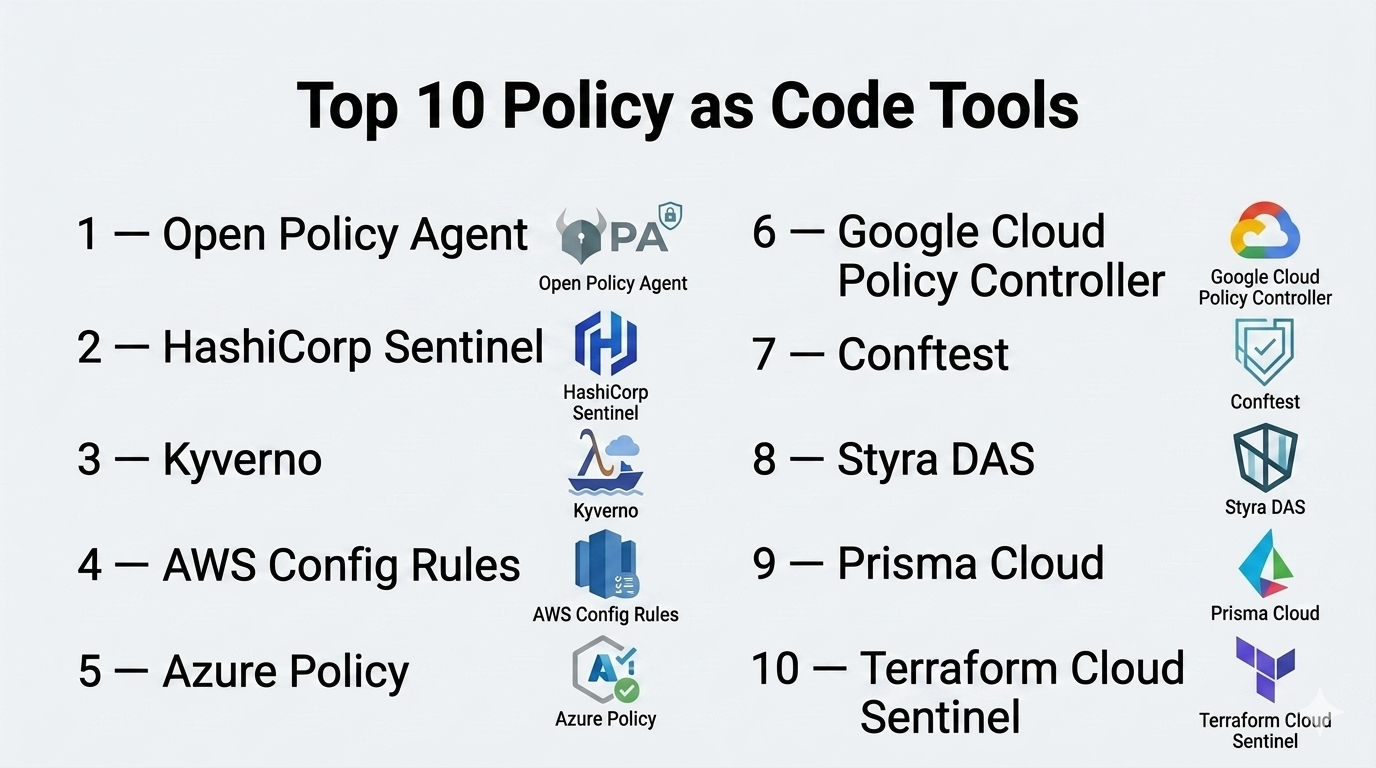
#1 — Open Policy Agent (OPA)
Short description :
Open Policy Agent (OPA) is the most widely adopted general-purpose Policy as Code engine that enables organizations to define fine-grained policies using a declarative language called Rego across cloud-native environments.
Key Features
- Declarative policy language (Rego)
- Kubernetes admission control integration
- CI/CD pipeline policy validation
- API authorization policies
- Infrastructure policy enforcement
- Lightweight policy engine
- Flexible runtime integration
Pros
- Extremely flexible policy engine
- Strong Kubernetes ecosystem adoption
- Highly extensible and scalable
Cons
- Steep learning curve (Rego language)
- Requires policy design expertise
- Debugging policies can be complex
Platforms / Deployment
- Cloud / Kubernetes / Self-hosted
Security & Compliance
- Fine-grained access control policies
- Audit logging support
- Integration with identity systems
- Policy decision logging
- Compliance enforcement capabilities
Integrations & Ecosystem
- Kubernetes
- CI/CD pipelines
- API gateways
- Service meshes
- Terraform/IaC pipelines
Support & Community
Very strong open-source and enterprise ecosystem.
#2 — HashiCorp Sentinel
Short description :
HashiCorp Sentinel is a Policy as Code framework designed to enforce governance rules within Terraform, Vault, and Consul workflows using a high-level policy language.
Key Features
- Policy enforcement for Terraform workflows
- Fine-grained governance rules
- Conditional logic-based policies
- Integration with HashiCorp ecosystem
- Pre-deployment policy validation
- Multi-level policy enforcement
- Reusable policy modules
Pros
- Deep integration with Terraform
- Strong enterprise governance model
- Easy alignment with infrastructure workflows
Cons
- Limited outside HashiCorp ecosystem
- Requires enterprise licensing for full features
- Less flexible than OPA
Platforms / Deployment
- Cloud / Self-hosted (HashiCorp stack)
Security & Compliance
- Policy enforcement at plan/apply stage
- Audit logging support
- Role-based access control
- Compliance validation workflows
- Secure infrastructure governance
Integrations & Ecosystem
- Terraform
- Vault
- Consul
- CI/CD pipelines
- Cloud providers
Support & Community
Strong enterprise support from HashiCorp.
#3 — Kyverno
Short description :
Kyverno is a Kubernetes-native Policy as Code engine designed specifically for validating, mutating, and generating Kubernetes resources using YAML-based policies.
Key Features
- Kubernetes-native policy enforcement
- YAML-based policy definitions
- Resource validation and mutation
- Policy generation for workloads
- Admission controller integration
- Kubernetes audit and reporting
- Image verification policies
Pros
- No need to learn new DSL (YAML-based)
- Deep Kubernetes integration
- Easy policy authoring
Cons
- Kubernetes-only scope
- Less flexible for non-Kubernetes systems
- Limited advanced logic compared to OPA
Platforms / Deployment
- Kubernetes / Cloud
Security & Compliance
- Admission control enforcement
- Audit logging
- Policy reporting
- Namespace-level isolation
- Image security verification
Integrations & Ecosystem
- Kubernetes
- Helm
- CI/CD pipelines
- GitOps tools
- Container registries
Support & Community
Strong CNCF-backed community.
#4 — AWS Config Rules
Short description :
AWS Config Rules is a native AWS service that evaluates AWS resource configurations against predefined or custom policies to ensure compliance and governance.
Key Features
- Real-time AWS resource evaluation
- Predefined compliance rules
- Custom rule creation using Lambda
- Continuous configuration monitoring
- Automated remediation actions
- Drift detection
- Compliance dashboards
Pros
- Deep AWS integration
- Easy compliance monitoring
- Strong automation support
Cons
- AWS-only ecosystem
- Limited flexibility outside AWS
- Can become costly at scale
Platforms / Deployment
- Cloud (AWS-only)
Security & Compliance
- IAM-based access control
- Audit logs via CloudTrail
- Encryption via AWS services
- Compliance reporting dashboards
- Automated remediation policies
Integrations & Ecosystem
- AWS services
- Lambda functions
- CI/CD pipelines
- Security Hub
- Monitoring tools
Support & Community
Strong AWS enterprise support.
#5 — Azure Policy
Short description :
Azure Policy is a Policy as Code service that enables organizations to create, assign, and manage policies across Azure resources to enforce compliance and governance rules.
Key Features
- Built-in compliance policy library
- Custom policy definitions
- Real-time policy enforcement
- Resource compliance tracking
- Remediation tasks
- Initiative grouping of policies
- Integration with Azure governance tools
Pros
- Deep Azure integration
- Strong enterprise governance capabilities
- Easy policy management at scale
Cons
- Azure-only ecosystem
- Complex policy definitions for advanced use cases
- Limited portability
Platforms / Deployment
- Cloud (Azure-only)
Security & Compliance
- Azure AD integration
- Audit logging
- Role-based access control
- Compliance dashboards
- Automated remediation
Integrations & Ecosystem
- Azure services
- Azure DevOps
- CI/CD pipelines
- Monitoring tools
- Security Center
Support & Community
Strong Microsoft enterprise support ecosystem.
#6 — Google Cloud Policy Controller
Short description :
Google Cloud Policy Controller is a Kubernetes-native policy enforcement tool built on OPA and Gatekeeper, designed for enforcing governance rules in GCP and hybrid Kubernetes environments.
Key Features
- Kubernetes admission control policies
- OPA/Gatekeeper-based engine
- Constraint templates
- Policy validation and enforcement
- Multi-cluster governance
- Audit logging
- Integration with GCP security tools
Pros
- Strong Kubernetes integration
- Built on mature OPA ecosystem
- Good multi-cluster support
Cons
- GCP-centric optimization
- Requires Kubernetes expertise
- Complex setup for beginners
Platforms / Deployment
- Cloud / Kubernetes
Security & Compliance
- IAM integration
- Audit logging
- Policy enforcement
- Namespace isolation
- Compliance monitoring
Integrations & Ecosystem
- Google Kubernetes Engine
- OPA ecosystem
- CI/CD pipelines
- GitOps tools
- Security monitoring tools
Support & Community
Strong Google Cloud enterprise support.
#7 — Conftest
Short description :
Conftest is a lightweight policy testing tool that uses OPA Rego policies to validate configuration files such as Terraform, Kubernetes manifests, and JSON/YAML configurations.
Key Features
- Policy testing for IaC files
- Rego-based policy engine
- CI/CD integration
- Fast local validation
- Kubernetes and Terraform support
- Developer-friendly CLI
- Policy unit testing
Pros
- Lightweight and fast
- Great for CI/CD pipelines
- Easy local validation
Cons
- Limited enterprise governance features
- Requires OPA knowledge
- Not a full policy management platform
Platforms / Deployment
- CLI / Cloud / Self-hosted
Security & Compliance
- Policy validation logs
- CI-based enforcement
- Integration with audit pipelines
- Secure configuration testing
- Compliance checks via pipelines
Integrations & Ecosystem
- Terraform
- Kubernetes
- CI/CD pipelines
- Git workflows
- OPA ecosystem
Support & Community
Strong open-source community.
#8 — Styra DAS
Short description :
Styra DAS is an enterprise policy management platform built on OPA that provides centralized policy authoring, deployment, and governance across cloud-native environments.
Key Features
- Centralized OPA policy management
- Visual policy authoring interface
- Multi-cluster policy enforcement
- Real-time compliance dashboards
- Policy lifecycle management
- Audit and reporting tools
- Role-based policy control
Pros
- Enterprise-grade governance layer
- Strong observability and dashboards
- Built on OPA reliability
Cons
- Enterprise-focused pricing
- Requires OPA foundation knowledge
- Complex for small teams
Platforms / Deployment
- Cloud / Hybrid
Security & Compliance
- RBAC support
- Audit logging
- Policy governance controls
- Compliance dashboards
- Secure policy distribution
Integrations & Ecosystem
- Kubernetes
- OPA engine
- CI/CD tools
- Cloud providers
- GitOps systems
Support & Community
Strong enterprise support model.
#9 — Prisma Cloud (Policy Engine)
Short description :
Prisma Cloud provides a unified cloud security platform that includes Policy as Code capabilities for enforcing compliance and security across multi-cloud environments.
Key Features
- Cloud security posture management policies
- IaC scanning and enforcement
- Runtime policy controls
- Multi-cloud governance
- Compliance frameworks mapping
- Identity and access policies
- Threat detection policies
Pros
- Broad multi-cloud coverage
- Strong enterprise security integration
- Unified policy and security platform
Cons
- Complex enterprise platform
- Premium pricing
- Requires onboarding effort
Platforms / Deployment
- Cloud / Hybrid
Security & Compliance
- Compliance mapping (SOC2, ISO, etc.)
- Audit logging
- Identity governance
- Policy enforcement engine
- Threat detection integration
Integrations & Ecosystem
- AWS, Azure, GCP
- Kubernetes
- CI/CD pipelines
- Security tools
- SIEM systems
Support & Community
Strong enterprise security support.
#10 — Terraform Cloud Sentinel (Managed Policy Layer)
Short description :
Terraform Cloud Sentinel provides Policy as Code enforcement within Terraform Cloud workflows, enabling governance checks before infrastructure is provisioned.
Key Features
- Pre-deployment policy enforcement
- Terraform plan validation
- Governance rule automation
- Policy-as-code workflows
- Reusable policy libraries
- Integration with Terraform Cloud
- Approval workflow integration
Pros
- Strong Terraform integration
- Easy governance for infrastructure teams
- Centralized policy enforcement
Cons
- Limited outside Terraform ecosystem
- Enterprise licensing required
- Less flexible than OPA
Platforms / Deployment
- Cloud / Terraform Cloud
Security & Compliance
- Access control via Terraform Cloud
- Audit logs
- Policy enforcement at apply stage
- Compliance workflows
- Secure infrastructure governance
Integrations & Ecosystem
- Terraform
- CI/CD pipelines
- Cloud providers
- Vault integration
- DevOps tooling
Support & Community
Strong HashiCorp enterprise support.
Comparison Table (Top 10)
| Tool Name | Best For | Platform(s) Supported | Deployment | Standout Feature | Public Rating |
|---|---|---|---|---|---|
| OPA | General policy engine | Cloud/K8s | Hybrid | Rego flexibility | N/A |
| Sentinel | Terraform governance | Terraform ecosystem | Cloud | Infra policy enforcement | N/A |
| Kyverno | Kubernetes policies | Kubernetes | Cloud | YAML-native policies | N/A |
| AWS Config | AWS governance | AWS | Cloud | Native AWS compliance | N/A |
| Azure Policy | Azure governance | Azure | Cloud | Enterprise compliance control | N/A |
| Policy Controller | GCP Kubernetes policies | GCP/K8s | Cloud | OPA-based enforcement | N/A |
| Conftest | IaC validation | Multi-platform | CLI | Fast CI policy testing | N/A |
| Styra DAS | Enterprise OPA governance | Multi-cloud | Hybrid | Policy lifecycle platform | N/A |
| Prisma Cloud | Cloud security policies | Multi-cloud | Hybrid | Unified security policies | N/A |
| Terraform Sentinel | Terraform governance | Terraform | Cloud | Pre-deploy enforcement | N/A |
Evaluation & Policy as Code Tools
| Tool Name | Core (25%) | Ease (15%) | Integrations (15%) | Security (10%) | Performance (10%) | Support (10%) | Value (15%) | Weighted Total |
|---|---|---|---|---|---|---|---|---|
| OPA | 10 | 7 | 10 | 10 | 9 | 9 | 9 | 9.2 |
| Sentinel | 9 | 8 | 9 | 10 | 9 | 9 | 8 | 8.8 |
| Kyverno | 9 | 9 | 9 | 9 | 9 | 9 | 9 | 9.0 |
| AWS Config | 9 | 9 | 9 | 10 | 9 | 9 | 9 | 9.1 |
| Azure Policy | 9 | 8 | 9 | 10 | 9 | 9 | 9 | 9.0 |
| Policy Controller | 9 | 8 | 9 | 9 | 9 | 9 | 8 | 8.8 |
| Conftest | 8 | 9 | 9 | 9 | 9 | 8 | 9 | 8.7 |
| Styra DAS | 9 | 7 | 9 | 10 | 9 | 9 | 8 | 8.8 |
| Prisma Cloud | 10 | 7 | 10 | 10 | 9 | 9 | 8 | 9.1 |
| Terraform Sentinel | 9 | 8 | 9 | 10 | 9 | 9 | 8 | 8.8 |
Which Policy as Code Tools
Solo / Freelancer
- Conftest
- Kyverno
- OPA
SMB
- Kyverno
- OPA
- AWS Config / Azure Policy
Mid-Market
- OPA
- Sentinel
- Conftest
Enterprise
- Prisma Cloud
- Styra DAS
- Sentinel
Budget vs Premium
- Budget-friendly: OPA, Kyverno, Conftest
- Balanced: Sentinel, AWS Config, Azure Policy
- Premium enterprise: Prisma Cloud, Styra DAS
Feature Depth vs Ease of Use
- Easiest: Kyverno, Azure Policy
- Most powerful engine: OPA
- Best enterprise governance: Styra DAS
Integrations & Scalability
- Best ecosystem: OPA
- Best cloud-native integration: AWS Config / Azure Policy
- Best Kubernetes enforcement: Kyverno
Security & Compliance Needs
Highly regulated environments should prioritize:
- Prisma Cloud
- OPA
- Sentinel
- Azure Policy / AWS Config
Frequently Asked Questions (FAQs)
1. What is Policy as Code?
It is the practice of defining and enforcing policies using machine-readable code.
2. Why is Policy as Code important?
It ensures consistent, automated, and scalable compliance enforcement.
3. Is Policy as Code only for cloud environments?
No, it can be used in Kubernetes, CI/CD, and on-prem systems.
4. What is OPA used for?
OPA is a general-purpose policy engine used across cloud-native systems.
5. What is the difference between IaC and Policy as Code?
IaC defines infrastructure, while Policy as Code enforces rules on it.
6. Is Policy as Code difficult to implement?
It requires initial setup and learning but becomes powerful at scale.
7. Can Policy as Code prevent security misconfigurations?
Yes, it can block unsafe deployments before they reach production.
8. What is Kubernetes admission control?
It is a mechanism that enforces policies before workloads are deployed.
9. Are these tools cloud-specific?
Some are (AWS Config, Azure Policy), while others are multi-cloud (OPA).
10. What is the future of Policy as Code?
It is moving toward AI-assisted governance and real-time autonomous compliance.
Conclusion
Policy as Code Tools are becoming essential for modern DevSecOps and cloud governance strategies. They provide automated, scalable, and consistent enforcement of security and compliance rules across infrastructure, applications, and Kubernetes environments. Open Policy Agent (OPA) remains the most flexible and widely adopted policy engine, while Kyverno simplifies Kubernetes-native enforcement. Cloud-native solutions like AWS Config and Azure Policy offer deep integration within their ecosystems, and enterprise platforms like Prisma Cloud and Styra DAS provide advanced governance capabilities.
