Introduction
Cloud Spend Governance Tools are platforms designed to help organizations monitor, control, and optimize cloud infrastructure costs across providers like AWS, Azure, and Google Cloud. In simple terms, they answer a critical business question: where cloud money is being spent and how efficiently it is being used.
As cloud adoption continues to expand in enterprises face increasingly complex billing models, multi-cloud environments, and decentralized engineering ownership. Without proper governance, cloud spending often becomes fragmented, unpredictable, and difficult to control.
Cloud Spend Governance Tools solve this by combining cost visibility, allocation accuracy, automation, forecasting, and policy enforcement into a unified system. These tools have become a core pillar of FinOps maturity, enabling collaboration between finance, engineering, and business teams.
Real-world use cases
- Tracking and reducing unused or overprovisioned cloud resources
- Allocating cloud costs to teams, products, or customers accurately
- Detecting sudden cost spikes or usage anomalies in real time
- Enforcing budget limits and governance policies automatically
- Forecasting monthly and yearly cloud expenditure for financial planning
Key evaluation criteria
Buyers typically assess these tools based on:
- Multi-cloud visibility (AWS, Azure, GCP support)
- Real-time vs delayed cost reporting
- Automation capabilities (alerts, scaling, shutdown rules)
- Tagging and cost allocation accuracy
- Integration with DevOps, CI/CD, and observability tools
- FinOps maturity support (basic to advanced governance)
- Security, RBAC, and compliance readiness
- Ease of onboarding and usability
- Forecasting and AI-driven insights
- Pricing transparency and ROI impact
Best for: Cloud architects, FinOps teams, DevOps engineers, CTOs, and SaaS companies with significant cloud usage.
Not ideal for: Very small businesses with minimal cloud spend or teams using only a single cloud account with predictable usage.
Key Trends in Cloud Spend Governance Tools
- Shift toward AI-driven cloud cost forecasting and anomaly detection
- Increased adoption of automated FinOps workflows instead of manual analysis
- Strong focus on real-time cost allocation at service, container, and workload level
- Expansion of Kubernetes-native cost governance capabilities
- Multi-cloud governance becoming the default enterprise requirement
- Integration of cloud cost data with business KPIs (unit economics)
- Tag enforcement automation to improve cost allocation accuracy
- Rise of self-service FinOps dashboards for engineering and product teams
- Shift from reporting tools to proactive governance and optimization platforms
- Deeper integration with DevOps pipelines and infrastructure-as-code workflows
How We Selected These Tools (Methodology)
- Evaluated global adoption and market presence in FinOps ecosystems
- Assessed feature depth across budgeting, forecasting, and allocation
- Prioritized multi-cloud and hybrid-cloud governance capabilities
- Considered Kubernetes and modern container cost visibility support
- Reviewed automation and policy enforcement capabilities
- Included tools suitable for enterprise, mid-market, and SMB segments
- Measured integration strength with cloud providers and DevOps tools
- Focused on usability for both finance and engineering teams
- Included both legacy enterprise platforms and modern FinOps-native tools
- Ensured balance between cost optimization and governance functionality
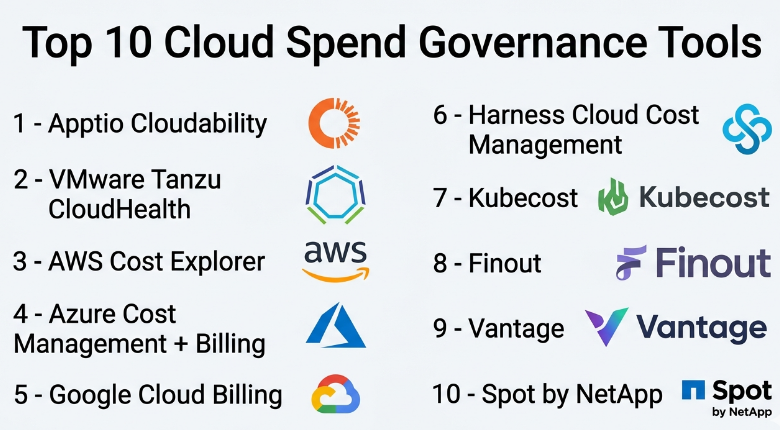
Top 10 Cloud Spend Governance Tools
#1 — Apptio Cloudability
Short description:
Apptio Cloudability is an enterprise-grade FinOps platform focused on cloud cost governance, allocation, and optimization. It is widely used in large organizations managing complex multi-cloud environments. It enables finance and engineering teams to collaborate on cloud cost accountability and unit economics tracking.
Key Features
- Multi-cloud cost visibility (AWS, Azure, GCP)
- Advanced cost allocation and tagging governance
- Budgeting, forecasting, and anomaly detection
- Unit economics tracking (cost per product/service)
- Kubernetes and container cost analytics
- Executive-level FinOps dashboards
Pros
- Strong enterprise financial governance capabilities
- Highly detailed cost allocation model
- Mature FinOps workflow support
Cons
- Complex onboarding for smaller teams
- Requires strong tagging discipline for best results
Platforms / Deployment
- Web / Cloud
Security & Compliance
- SSO/SAML, RBAC, audit logs (commonly supported)
- SOC 2: Not publicly stated
- ISO 27001: Not publicly stated
Integrations & Ecosystem
Supports integrations with:
- AWS, Azure, Google Cloud
- ServiceNow, Jira
- BI tools (Power BI, Tableau)
- Kubernetes environments
Includes APIs for custom reporting and data extraction.
Support & Community
Enterprise-grade support with structured onboarding and strong FinOps community adoption.
#2 — VMware Tanzu CloudHealth
Short description:
VMware Tanzu CloudHealth is a cloud financial management platform offering governance, optimization, and reporting across multi-cloud environments. It is commonly used in enterprise IT environments for policy-based cost control.
Key Features
- Multi-cloud cost reporting and visibility
- Policy-based governance rules
- Budget tracking and alerts
- Resource optimization recommendations
- Chargeback/showback reporting
- Custom dashboards and reporting
Pros
- Strong enterprise governance controls
- Reliable multi-cloud reporting
- Mature policy engine
Cons
- Complex user interface
- Slower evolution compared to newer tools
Platforms / Deployment
- Web / Cloud
Security & Compliance
- RBAC, SSO/SAML (commonly supported)
- SOC 2: Not publicly stated
Integrations & Ecosystem
- AWS, Azure, Google Cloud
- VMware ecosystem tools
- ITSM tools like ServiceNow
- API-based reporting integrations
Support & Community
Enterprise support model with structured documentation and onboarding.
#3 — AWS Cost Explorer
Short description:
AWS Cost Explorer is a native AWS tool that provides cost visibility, forecasting, and budgeting for AWS workloads. It is widely used by AWS-centric organizations.
Key Features
- AWS cost and usage visualization
- Forecasting based on historical usage
- Budget creation and alerts
- Cost allocation tags support
- Reserved instance tracking
- Savings plan recommendations
Pros
- Native AWS integration
- Simple setup and usability
- No additional cost within AWS ecosystem
Cons
- Limited to AWS only
- Lacks advanced governance features
Platforms / Deployment
- Web / Cloud
Security & Compliance
- AWS IAM-based security model
- SOC 2 / ISO: Not separately stated
Integrations & Ecosystem
- AWS services only
- Export to S3 and analytics tools
Support & Community
AWS documentation and community support.
#4 — Azure Cost Management + Billing
Short description:
Microsoft Azure Cost Management provides cost tracking, budgeting, and optimization tools for Azure environments.
Key Features
- Cost analysis dashboards
- Budget alerts and forecasting
- Resource-level cost allocation
- Optimization recommendations
- Export and reporting tools
- Limited multi-cloud visibility
Pros
- Deep Azure-native integration
- Strong budgeting features
- Easy for Microsoft ecosystem users
Cons
- Best suited for Azure-only environments
- Limited advanced FinOps automation
Platforms / Deployment
- Web / Cloud
Security & Compliance
- Azure IAM security model
- SOC 2 / ISO: Not publicly stated
Integrations & Ecosystem
- Azure services ecosystem
- Power BI integration
- Export APIs
Support & Community
Microsoft documentation and enterprise support.
#5 — Google Cloud Billing
Short description:
Google Cloud Billing provides cost tracking, forecasting, and budgeting tools for GCP users with strong analytics integration.
Key Features
- Service-level cost breakdown
- Budget alerts and notifications
- Usage forecasting
- BigQuery export support
- Label-based cost allocation
- Optimization recommendations
Pros
- Strong analytics integration
- Easy-to-use interface
- Good forecasting capabilities
Cons
- Limited outside GCP
- Basic governance features
Platforms / Deployment
- Web / Cloud
Security & Compliance
- Google Cloud IAM model
- SOC 2 / ISO: Not publicly stated
Integrations & Ecosystem
- GCP services
- BigQuery and Looker
- API-based exports
Support & Community
Google Cloud documentation and support plans.
#6 — Harness Cloud Cost Management
Short description:
Harness CCM is a FinOps-native platform focused on real-time cost optimization and DevOps-driven cloud governance.
Key Features
- Kubernetes cost optimization
- Real-time anomaly detection
- Automated governance policies
- Continuous optimization recommendations
- Multi-cloud support
- Engineering-focused dashboards
Pros
- Strong DevOps alignment
- Real-time optimization capabilities
- Excellent Kubernetes support
Cons
- Requires DevOps maturity
- Not finance-first design
Platforms / Deployment
- Web / Cloud
Security & Compliance
- RBAC and SSO commonly supported
- SOC 2: Not publicly stated
Integrations & Ecosystem
- Kubernetes, CI/CD pipelines
- AWS, Azure, GCP
- DevOps tooling ecosystem
Support & Community
Strong DevOps-focused support and documentation.
#7 — Kubecost
Short description:
Kubecost is a Kubernetes-native cost governance tool providing deep visibility into container-level cloud spending.
Key Features
- Kubernetes cost allocation per namespace/workload
- Real-time cost monitoring
- Resource optimization insights
- Multi-cluster tracking
- Budget alerts
- Open-source core model
Pros
- Deep Kubernetes visibility
- Developer-friendly
- Open-source flexibility
Cons
- Limited non-Kubernetes coverage
- Requires technical expertise
Platforms / Deployment
- Web / Self-hosted / Hybrid
Security & Compliance
- RBAC support varies by deployment
- SOC 2: Not publicly stated
Integrations & Ecosystem
- Kubernetes clusters
- Prometheus, Grafana
- Cloud provider APIs
Support & Community
Strong open-source community and enterprise support options.
#8 — Finout
Short description:
Finout is a cloud cost observability platform designed to unify multi-cloud financial data into business-level insights.
Key Features
- Multi-cloud cost aggregation
- Business unit cost allocation
- Real-time dashboards
- Anomaly detection
- Engineering cost observability
- Custom metrics tracking
Pros
- Strong visualization and UX
- Fast onboarding
- Good cross-team collaboration
Cons
- Newer platform in the market
- Some enterprise features still evolving
Platforms / Deployment
- Web / Cloud
Security & Compliance
- SSO/RBAC commonly supported
- SOC 2: Not publicly stated
Integrations & Ecosystem
- AWS, Azure, GCP
- BI tools
- APIs for data access
Support & Community
Growing FinOps adoption and responsive support.
#9 — Vantage
Short description:
Vantage is a simplified cloud cost management platform designed for fast onboarding and clear visibility.
Key Features
- Unified multi-cloud dashboard
- Budget tracking and alerts
- Cost breakdown by service/team
- Forecasting tools
- Tag-based allocation
- API reporting
Pros
- Very easy to use
- Quick setup
- Clean UI
Cons
- Limited enterprise governance
- Fewer automation features
Platforms / Deployment
- Web / Cloud
Security & Compliance
- SSO/RBAC commonly supported
- SOC 2: Not publicly stated
Integrations & Ecosystem
- AWS, Azure, GCP
- Slack notifications
- API integrations
Support & Community
Strong onboarding and documentation.
#10 — Spot by NetApp
Short description:
Spot by NetApp focuses on automated cloud cost optimization through intelligent workload scaling and infrastructure efficiency.
Key Features
- Automated workload optimization
- Spot instance management
- Kubernetes optimization
- Predictive scaling
- Infrastructure cost efficiency tools
- Multi-cloud support
Pros
- Strong automation capabilities
- Excellent compute optimization
- Scales well in large environments
Cons
- Less financial reporting depth
- Requires infrastructure maturity
Platforms / Deployment
- Web / Cloud
Security & Compliance
- RBAC/IAM integration commonly supported
- SOC 2: Not publicly stated
Integrations & Ecosystem
- AWS, Azure, GCP
- Kubernetes ecosystems
- CI/CD pipelines
Support & Community
Enterprise-level support via NetApp ecosystem.
Comparison Table (Top 10)
| Tool Name | Best For | Platform(s) | Deployment | Standout Feature | Public Rating |
|---|---|---|---|---|---|
| Apptio Cloudability | Enterprise FinOps | Web | Cloud | Cost allocation depth | N/A |
| CloudHealth | Enterprise governance | Web | Cloud | Policy engine | N/A |
| AWS Cost Explorer | AWS users | Web | Cloud | Native reporting | N/A |
| Azure Cost Mgmt | Azure users | Web | Cloud | Budgeting tools | N/A |
| Google Billing | GCP users | Web | Cloud | BigQuery integration | N/A |
| Harness CCM | DevOps teams | Web | Cloud | Real-time optimization | N/A |
| Kubecost | Kubernetes teams | Web | Hybrid | Pod-level costing | N/A |
| Finout | FinOps teams | Web | Cloud | Cost observability | N/A |
| Vantage | SMB/startups | Web | Cloud | Simplicity | N/A |
| Spot by NetApp | Optimization teams | Web | Cloud | Automated scaling | N/A |
Evaluation & Scoring (Cloud Spend Governance Tools)
| Tool | Core (25%) | Ease (15%) | Integrations (15%) | Security (10%) | Performance (10%) | Support (10%) | Value (15%) | Total |
|---|---|---|---|---|---|---|---|---|
| Apptio Cloudability | 9 | 6 | 9 | 8 | 8 | 9 | 7 | 8.2 |
| CloudHealth | 8 | 6 | 8 | 8 | 7 | 8 | 7 | 7.6 |
| AWS Cost Explorer | 6 | 9 | 7 | 8 | 8 | 8 | 10 | 7.8 |
| Azure Cost Mgmt | 6 | 9 | 7 | 8 | 8 | 8 | 10 | 7.8 |
| Google Billing | 6 | 9 | 7 | 8 | 8 | 8 | 10 | 7.8 |
| Harness CCM | 8 | 7 | 8 | 8 | 8 | 8 | 7 | 7.9 |
| Kubecost | 8 | 7 | 8 | 7 | 8 | 8 | 8 | 7.8 |
| Finout | 8 | 8 | 8 | 8 | 8 | 8 | 8 | 8.0 |
| Vantage | 7 | 9 | 7 | 8 | 7 | 7 | 9 | 7.6 |
| Spot by NetApp | 8 | 7 | 8 | 8 | 9 | 8 | 8 | 8.0 |
Interpretation:
- Scores are comparative, not absolute benchmarks
- Enterprise tools score higher in governance depth
- Native tools score higher in ease and simplicity
- DevOps tools excel in automation but may lack finance depth
- Use scores to shortlist, not to make final decisions
Which Cloud Spend Governance Tools Should You Choose?
Solo / Freelancer
Best: AWS Cost Explorer, Vantage
Focus on simplicity and visibility.
SMB
Best: Finout, Vantage, Google Cloud Billing
Focus on budgeting and basic allocation.
Mid-Market
Best: Harness CCM, Kubecost, Finout
Focus on automation and engineering alignment.
Enterprise
Best: Apptio Cloudability, CloudHealth, Spot by NetApp
Focus on governance and chargeback models.
Budget vs Premium
- Budget: Native cloud tools
- Premium: Apptio, CloudHealth, Harness
Feature Depth vs Ease of Use
- Depth: Apptio, Kubecost, Harness
- Ease: Vantage, AWS/Azure/GCP tools
Integrations & Scalability
- Strongest: Apptio, Harness, Spot
- Balanced: Finout, Kubecost
Security & Compliance
- Strong enterprise governance: Apptio, CloudHealth
- Cloud-native baseline security: AWS, Azure, GCP tools
Frequently Asked Questions (FAQs)
1. What are Cloud Spend Governance Tools?
They are platforms that help organizations track and control cloud costs across providers. They ensure spending is visible, allocated correctly, and optimized.
2. Why are they important?
They prevent cloud waste, improve financial accountability, and help organizations forecast infrastructure spending accurately.
3. Do they support multi-cloud environments?
Yes, most modern tools support AWS, Azure, and Google Cloud simultaneously.
4. Are these tools expensive?
Pricing varies widely from free native tools to enterprise platforms with custom pricing.
5. Do they require technical skills?
Basic tools are simple, but advanced platforms may require DevOps or FinOps expertise.
6. Can they reduce cloud bills?
Yes, by identifying waste, optimizing resources, and enforcing governance policies.
7. Do they support Kubernetes?
Many advanced tools like Kubecost and Harness CCM provide Kubernetes-level cost tracking.
8. How long does setup take?
From a few hours (native tools) to several weeks (enterprise platforms).
9. What is the biggest implementation challenge?
Poor tagging and inconsistent cost allocation across teams.
10. Can organizations switch tools later?
Yes, but migration requires careful data mapping and integration adjustments.
Conclusion
Cloud Spend Governance Tools have become essential for modern cloud-driven organizations where infrastructure spending can grow rapidly and unpredictably. These platforms bring structure, visibility, and control to cloud financial operations, enabling better collaboration between engineering and finance teams. However, the “best” tool depends heavily on organizational size, cloud maturity, and governance requirements. Native cloud tools are ideal for simplicity, while enterprise platforms deliver deeper financial control and FinOps maturity.
