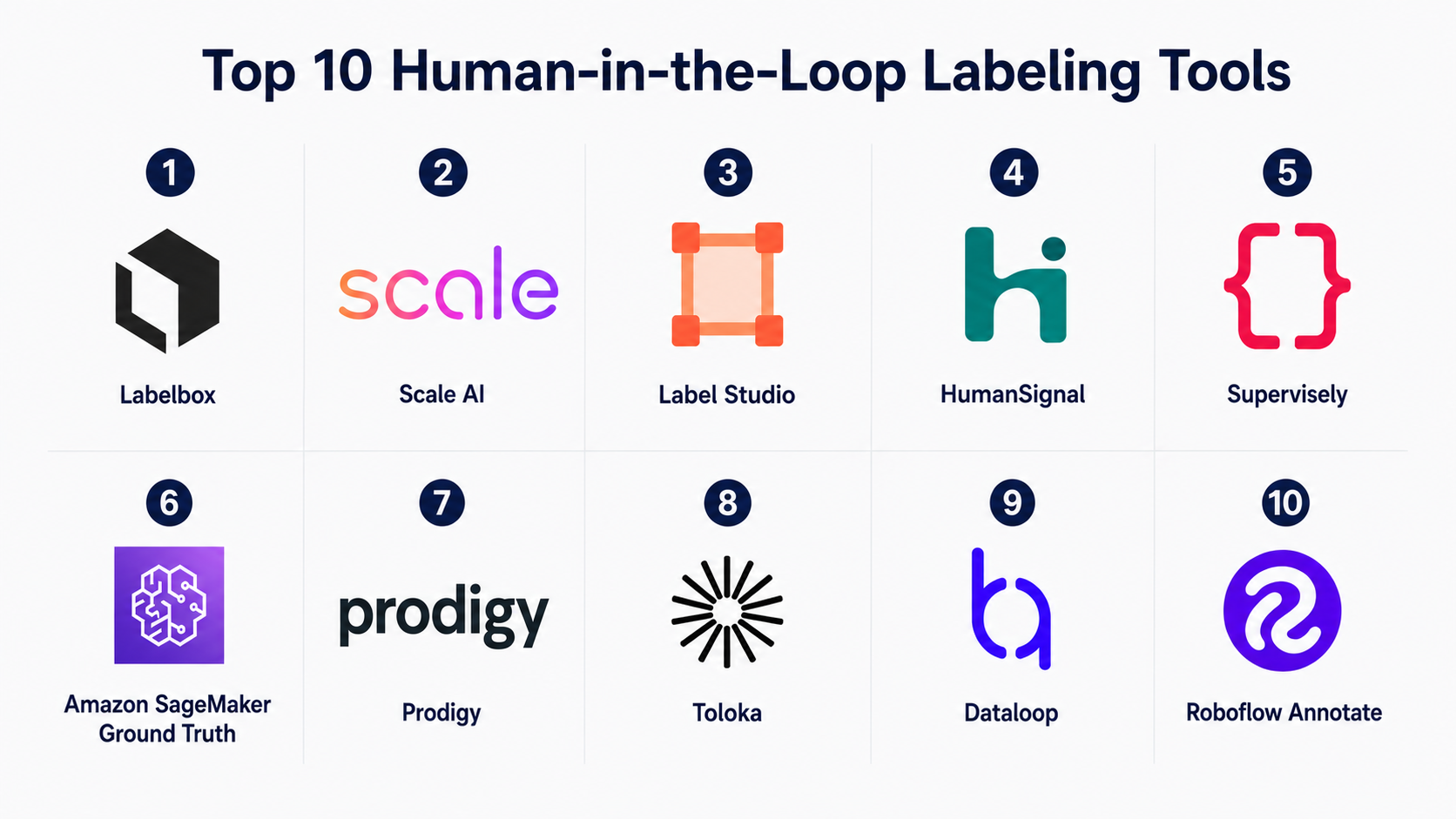
Introduction
Human-in-the-Loop (HITL) Labeling Tools are platforms that combine human expertise with machine learning automation to improve data annotation quality, model accuracy, and AI reliability. These tools enable humans to review, validate, correct, and optimize AI-generated labels, predictions, and outputs during training and operational workflows.
In HITL systems are becoming critical because generative AI, autonomous systems, Retrieval-Augmented Generation (RAG), computer vision, and enterprise AI applications require continuous feedback loops to reduce hallucinations, improve model trustworthiness, and maintain data quality. AI-assisted labeling alone is often insufficient for high-risk or domain-specific tasks such as healthcare, finance, legal analysis, cybersecurity, and autonomous navigation.
Common real-world use cases include:
- AI training data validation
- LLM fine-tuning workflows
- Computer vision quality assurance
- Healthcare imaging review
- Human feedback for RAG systems
When evaluating Human-in-the-Loop Labeling Tools, buyers should consider:
- AI-assisted annotation capabilities
- Human review workflows
- Quality assurance systems
- Workforce management features
- Active learning support
- Automation and orchestration
- Collaboration workflows
- Security and compliance controls
- Multimodal annotation support
- Integration ecosystem
Best for: AI engineering teams, ML operations teams, enterprise AI platforms, healthcare AI providers, autonomous systems developers, and organizations requiring high-quality AI training workflows.
Not ideal for: Small projects using fully automated AI services with minimal customization or lightweight datasets requiring little manual validation.
Key Trends in Human-in-the-Loop Labeling Tools
- AI-assisted labeling is reducing repetitive manual annotation tasks.
- Human review remains essential for hallucination reduction and model accuracy.
- LLM fine-tuning workflows are driving demand for scalable HITL systems.
- Active learning is improving annotation efficiency and cost optimization.
- Multimodal AI datasets are increasing workflow complexity.
- Real-time collaborative review pipelines are becoming standard.
- AI governance and auditability are gaining importance in regulated industries.
- Synthetic data generation is supplementing human labeling operations.
- Domain-specialized annotation for healthcare and legal AI is expanding.
- Reinforcement Learning from Human Feedback (RLHF) workflows are growing rapidly.
How We Selected These Tools (Methodology)
The platforms in this list were selected based on enterprise adoption, AI workflow relevance, HITL capabilities, scalability, and annotation ecosystem maturity.
Selection criteria included:
- Human review and validation workflows
- AI-assisted labeling capabilities
- Annotation automation support
- Enterprise adoption and scalability
- Quality assurance systems
- Multimodal annotation support
- Integration ecosystem maturity
- Security and governance tooling
- Documentation and community support
- Innovation in AI feedback workflows
The final list includes enterprise annotation platforms, open-source HITL frameworks, AI operations systems, and specialized human feedback infrastructure.
Human-in-the-Loop Labeling Tools
#1 — Labelbox
Short description :
Labelbox is a leading enterprise AI data platform offering advanced human-in-the-loop workflows for annotation, model validation, and AI quality assurance. It supports multimodal labeling, human review pipelines, AI-assisted automation, and collaborative data operations for enterprise AI teams.
Key Features
- AI-assisted labeling
- Human review workflows
- Multimodal annotation
- Quality assurance pipelines
- Dataset versioning
- Workflow orchestration
- Active learning support
Pros
- Strong enterprise workflow support
- Excellent collaboration tooling
- Scalable AI-assisted annotation
Cons
- Enterprise pricing can be expensive
- Advanced workflows require onboarding
- Complex deployments for large operations
Platforms / Deployment
- Web
- Cloud
Security & Compliance
- SSO/SAML
- RBAC
- Encryption
- Audit logs
- SOC 2
Integrations & Ecosystem
Labelbox integrates with AI infrastructure and cloud-native ML ecosystems.
- AWS
- Azure
- Google Cloud
- MLflow
- Python SDKs
Support & Community
Labelbox provides enterprise onboarding, technical support, and strong workflow documentation.
#2 — Scale AI
Short description :
Scale AI provides enterprise-scale human-in-the-loop data operations infrastructure for machine learning and generative AI applications. The platform combines managed workforce operations, AI-assisted labeling, and human review pipelines for large-scale AI training workflows.
Key Features
- Managed annotation workforce
- Human review systems
- RLHF workflow support
- AI-assisted automation
- Dataset quality monitoring
- Large-scale operations
- Multimodal labeling
Pros
- Excellent scalability
- Strong managed operations
- Good enterprise AI workflow support
Cons
- Premium enterprise pricing
- Less flexible for smaller teams
- Managed service approach may limit customization
Platforms / Deployment
- Web
- Cloud
Security & Compliance
- SSO/SAML
- Encryption
- RBAC
- Audit logging
- SOC 2
Integrations & Ecosystem
Scale AI integrates with enterprise AI infrastructure and data platforms.
- OpenAI APIs
- Databricks
- AWS
- Snowflake
- APIs
Support & Community
Scale AI provides enterprise-grade operational support and onboarding services.
#3 — Label Studio
Short description :
Label Studio is an open-source annotation platform supporting human-in-the-loop workflows for text, image, audio, and multimodal datasets. It is widely adopted among AI startups and ML engineering teams due to its flexibility and extensibility.
Key Features
- Multimodal annotation
- Human review workflows
- Custom labeling interfaces
- ML-assisted annotation
- Open-source deployment
- Active learning support
- Flexible APIs
Pros
- Highly customizable
- Strong open-source ecosystem
- Good multimodal support
Cons
- Enterprise governance requires customization
- Scaling workflows requires engineering effort
- UI complexity for non-technical users
Platforms / Deployment
- Linux / Windows / macOS
- Cloud / Self-hosted / Hybrid
Security & Compliance
- RBAC
- Encryption
- Access controls
Integrations & Ecosystem
Label Studio integrates with AI orchestration and machine learning systems.
- Hugging Face
- OpenAI APIs
- Kubernetes
- MLflow
- Python
Support & Community
Label Studio has active open-source communities and strong developer adoption.
#4 — HumanSignal
Short description :
HumanSignal focuses on human feedback workflows, annotation pipelines, and AI data operations for enterprise machine learning systems. It emphasizes scalable human-in-the-loop collaboration and AI quality optimization.
Key Features
- Human feedback workflows
- Annotation management
- AI-assisted labeling
- Workforce coordination
- Active learning support
- Data quality monitoring
- Workflow automation
Pros
- Strong HITL workflow focus
- Good enterprise collaboration support
- Flexible annotation architecture
Cons
- Smaller ecosystem than larger competitors
- Enterprise deployments may require customization
- Advanced governance features still evolving
Platforms / Deployment
- Web
- Cloud / Hybrid
Security & Compliance
- RBAC
- Encryption
- Audit logs
Integrations & Ecosystem
HumanSignal integrates with machine learning workflows and AI infrastructure.
- Kubernetes
- APIs
- Python
- ML pipelines
- Cloud storage
Support & Community
HumanSignal has growing AI engineering communities and enterprise adoption.
#5 — Supervisely
Short description :
Supervisely is a collaborative AI data operations platform supporting computer vision annotation, human review workflows, and AI-assisted labeling pipelines. It is widely used in robotics, autonomous systems, and industrial AI applications.
Key Features
- Human review pipelines
- Computer vision workflows
- Team collaboration
- AI-assisted annotation
- Dataset management
- Workflow automation
- Video annotation support
Pros
- Strong collaborative capabilities
- Good automation workflows
- Flexible deployment support
Cons
- Primarily computer vision-focused
- Enterprise scaling can become complex
- Advanced features require training
Platforms / Deployment
- Windows / Linux
- Cloud / Self-hosted / Hybrid
Security & Compliance
- RBAC
- Encryption
- Audit logs
Integrations & Ecosystem
Supervisely integrates with computer vision and ML tooling.
- TensorFlow
- PyTorch
- Docker
- APIs
- Kubernetes
Support & Community
Supervisely has active AI developer communities and enterprise workflow support.
#6 — Amazon SageMaker Ground Truth
Short description :
Amazon SageMaker Ground Truth is AWS’s managed data labeling platform supporting human-in-the-loop review workflows, automated labeling, and scalable AI dataset operations.
Key Features
- Human review systems
- Managed workforce support
- Automated labeling
- Active learning workflows
- AWS-native integrations
- Multimodal labeling
- Quality control pipelines
Pros
- Strong AWS ecosystem integration
- Scalable infrastructure
- Good automation support
Cons
- AWS-centric architecture
- Complex pricing structure
- Less portable outside AWS environments
Platforms / Deployment
- Web
- Cloud
Security & Compliance
- RBAC
- Encryption
- Audit logs
- SSO/SAML
- SOC 2
Integrations & Ecosystem
Ground Truth integrates deeply with AWS AI and analytics services.
- SageMaker
- S3
- Lambda
- AWS IAM
- AWS AI services
Support & Community
AWS provides enterprise documentation, onboarding, and technical support resources.
#7 — Prodigy
Short description :
Prodigy is a lightweight annotation and human feedback platform focused primarily on NLP, conversational AI, and LLM fine-tuning workflows. It is commonly used for RLHF and active learning tasks.
Key Features
- NLP annotation
- Human feedback loops
- Active learning support
- Lightweight deployment
- Text classification
- Named entity recognition
- LLM fine-tuning workflows
Pros
- Excellent NLP usability
- Lightweight architecture
- Strong active learning capabilities
Cons
- Limited multimodal support
- Smaller enterprise ecosystem
- Mostly developer-focused
Platforms / Deployment
- Linux / Windows / macOS
- Self-hosted
Security & Compliance
- Access controls
- Varies / N/A
Integrations & Ecosystem
Prodigy integrates with NLP and language model ecosystems.
- spaCy
- Hugging Face
- OpenAI APIs
- Python
- NLP pipelines
Support & Community
Prodigy has active NLP developer communities and strong technical documentation.
#8 — Toloka
Short description :
Toloka is a crowd-powered human-in-the-loop data labeling platform supporting AI training, search evaluation, and generative AI feedback workflows. It combines distributed workforce operations with scalable annotation infrastructure.
Key Features
- Crowd workforce management
- Human feedback pipelines
- Search relevance evaluation
- AI-assisted workflows
- Multimodal annotation
- Quality assurance tooling
- RLHF support
Pros
- Strong workforce scalability
- Good AI feedback workflows
- Flexible labeling operations
Cons
- Workforce consistency management required
- Enterprise governance varies by deployment
- Complex workflows may require oversight
Platforms / Deployment
- Web
- Cloud
Security & Compliance
- RBAC
- Encryption
- Audit logging
Integrations & Ecosystem
Toloka integrates with AI infrastructure and evaluation systems.
- APIs
- Cloud storage
- Python SDKs
- ML workflows
- Search systems
Support & Community
Toloka provides operational support and growing AI ecosystem adoption.
#9 — Dataloop
Short description :
Dataloop is an AI data operations platform supporting annotation, human review, orchestration, and AI lifecycle management. It emphasizes collaborative AI workflows and automated pipeline management.
Key Features
- Human validation workflows
- AI-assisted annotation
- Workflow orchestration
- Data pipeline automation
- Dataset management
- Quality assurance systems
- Multimodal support
Pros
- Strong AI workflow orchestration
- Good automation capabilities
- Flexible deployment support
Cons
- Enterprise complexity for smaller teams
- Advanced workflows require expertise
- Smaller ecosystem than major vendors
Platforms / Deployment
- Web
- Cloud / Hybrid
Security & Compliance
- SSO/SAML
- RBAC
- Encryption
- Audit logs
Integrations & Ecosystem
Dataloop integrates with cloud-native AI and ML infrastructure.
- AWS
- Azure
- APIs
- Kubernetes
- ML pipelines
Support & Community
Dataloop provides enterprise onboarding and workflow consultation services.
#10 — Roboflow Annotate
Short description :
Roboflow Annotate is a computer vision-focused annotation platform supporting AI-assisted labeling and human review workflows for image datasets and vision model training.
Key Features
- Human image review
- Bounding box annotation
- AI-assisted labeling
- Dataset versioning
- Team collaboration
- Computer vision workflows
- Quality control tooling
Pros
- Easy-to-use interface
- Strong computer vision workflows
- Good startup-friendly usability
Cons
- Primarily vision-focused
- Limited enterprise governance tooling
- Less suitable for multimodal AI systems
Platforms / Deployment
- Web
- Cloud
Security & Compliance
- RBAC
- Encryption
Integrations & Ecosystem
Roboflow integrates with computer vision and AI training workflows.
- YOLO
- TensorFlow
- PyTorch
- APIs
- Cloud storage
Support & Community
Roboflow has strong educational resources and active computer vision communities.
Comparison Table (Top 10)
| Tool Name | Best For | Platform(s) Supported | Deployment | Standout Feature | Public Rating |
|---|---|---|---|---|---|
| Labelbox | Enterprise AI labeling | Web | Cloud | Multimodal HITL workflows | N/A |
| Scale AI | Large-scale AI operations | Web | Cloud | Managed workforce infrastructure | N/A |
| Label Studio | Open-source HITL workflows | Windows, Linux, macOS | Hybrid | Customizable annotation pipelines | N/A |
| HumanSignal | Human feedback operations | Web | Hybrid | AI feedback orchestration | N/A |
| Supervisely | Computer vision collaboration | Windows, Linux | Hybrid | Collaborative vision workflows | N/A |
| SageMaker Ground Truth | AWS-native HITL labeling | Web | Cloud | Managed AI labeling pipelines | N/A |
| Prodigy | NLP and RLHF workflows | Windows, Linux, macOS | Self-hosted | Active learning for NLP | N/A |
| Toloka | Crowd-powered annotation | Web | Cloud | Distributed human workforce | N/A |
| Dataloop | AI workflow orchestration | Web | Hybrid | AI lifecycle management | N/A |
| Roboflow Annotate | Computer vision startups | Web | Cloud | Simplified vision annotation | N/A |
Evaluation & Human-in-the-Loop Labeling Tools
| Tool Name | Core (25%) | Ease (15%) | Integrations (15%) | Security (10%) | Performance (10%) | Support (10%) | Value (15%) | Weighted Total |
|---|---|---|---|---|---|---|---|---|
| Labelbox | 9 | 8 | 9 | 9 | 8 | 8 | 7 | 8.4 |
| Scale AI | 9 | 8 | 8 | 9 | 9 | 9 | 6 | 8.3 |
| Label Studio | 8 | 7 | 8 | 6 | 7 | 7 | 9 | 7.8 |
| HumanSignal | 8 | 7 | 7 | 7 | 7 | 7 | 8 | 7.4 |
| Supervisely | 8 | 7 | 8 | 7 | 8 | 7 | 8 | 7.7 |
| SageMaker Ground Truth | 8 | 7 | 9 | 9 | 9 | 8 | 7 | 8.1 |
| Prodigy | 7 | 8 | 7 | 5 | 7 | 7 | 9 | 7.3 |
| Toloka | 8 | 7 | 7 | 7 | 8 | 7 | 8 | 7.5 |
| Dataloop | 8 | 7 | 8 | 8 | 8 | 7 | 7 | 7.7 |
| Roboflow Annotate | 7 | 9 | 7 | 6 | 7 | 7 | 8 | 7.4 |
These scores are comparative rather than absolute. Some platforms prioritize enterprise AI operations and governance, while others focus on lightweight developer workflows or computer vision specialization. Buyers should evaluate HITL platforms based on annotation scale, AI model requirements, collaboration needs, and operational complexity.
Which Human-in-the-Loop Labeling Tools
Solo / Freelancer
Independent AI developers and researchers may prefer:
- Prodigy
- Label Studio
- Roboflow Annotate
These tools provide lightweight workflows and manageable operational complexity.
SMB
Small and medium-sized businesses should prioritize usability and flexible deployment.
Recommended options:
- Supervisely
- Label Studio
- Roboflow Annotate
Mid-Market
Mid-sized organizations often require scalable collaboration and workflow automation.
Recommended options:
- Labelbox
- Dataloop
- SageMaker Ground Truth
- HumanSignal
Enterprise
Large enterprises with governance and large-scale AI operations should prioritize scalability and operational controls.
Recommended options:
- Labelbox
- Scale AI
- SageMaker Ground Truth
- Toloka
Budget vs Premium
- Budget-friendly: Label Studio, Prodigy
- Premium enterprise: Scale AI, Labelbox
- Balanced value: Supervisely, Dataloop
Feature Depth vs Ease of Use
- Deepest enterprise workflows: Labelbox, Scale AI
- Best usability: Roboflow Annotate
- Best NLP workflows: Prodigy
Integrations & Scalability
- Best AWS ecosystem integration: SageMaker Ground Truth
- Best enterprise AI integration: Labelbox
- Best open-source flexibility: Label Studio
Security & Compliance Needs
Organizations with governance and compliance priorities should consider:
- Labelbox
- Scale AI
- SageMaker Ground Truth
- Dataloop
Frequently Asked Questions (FAQs)
1. What are Human-in-the-Loop labeling tools?
These are platforms that combine AI automation with human review workflows to improve dataset quality and AI reliability.
2. Why is HITL important for generative AI?
Human review helps reduce hallucinations, improve model alignment, and validate AI-generated outputs.
3. What is RLHF?
RLHF stands for Reinforcement Learning from Human Feedback, where humans guide model behavior through feedback and ranking workflows.
4. Which industries use HITL labeling tools most?
Industries include healthcare, autonomous vehicles, cybersecurity, finance, retail, robotics, and enterprise AI.
5. What is active learning in HITL systems?
Active learning prioritizes uncertain or valuable data samples for human review to improve labeling efficiency.
6. Can HITL platforms support multimodal AI workflows?
Yes. Many modern platforms support image, text, audio, video, and multimodal annotation workflows.
7. Are open-source HITL tools enterprise-ready?
Several open-source platforms can support enterprise workloads when paired with governance and infrastructure tooling.
8. What should buyers prioritize when selecting HITL platforms?
Buyers should evaluate automation support, quality assurance systems, scalability, collaboration workflows, and integration capabilities.
9. How do HITL systems improve AI model quality?
They help identify incorrect labels, validate outputs, reduce bias, and continuously refine model training data.
10. Are managed labeling services better than self-managed platforms?
Managed services simplify operations and scaling, while self-managed platforms provide more flexibility and customization control.
Conclusion
Human-in-the-Loop Labeling Tools are becoming foundational infrastructure for trustworthy AI systems, generative AI workflows, autonomous systems, and enterprise machine learning operations. As AI models become more complex and organizations deploy Retrieval-Augmented Generation (RAG), multimodal AI, and LLM fine-tuning pipelines, human feedback workflows remain essential for maintaining quality, reducing hallucinations, and improving operational reliability.Labelbox and Scale AI continue leading enterprise-scale HITL operations, while Label Studio and Prodigy remain strong open-source and developer-focused options.
