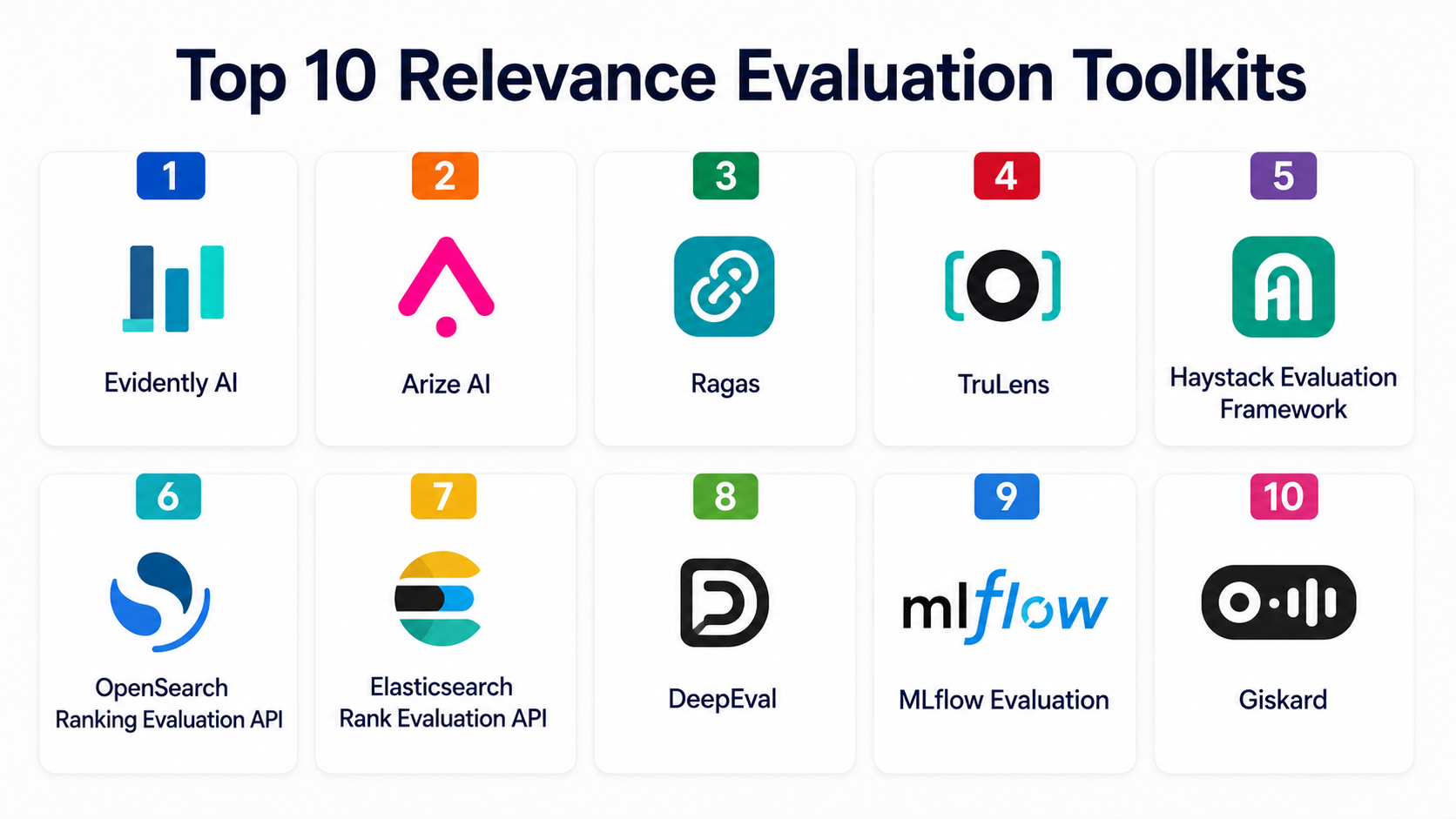
Introduction
Relevance Evaluation Toolkits are platforms and frameworks used to measure, benchmark, optimize, and validate the quality of search, recommendation, retrieval, ranking, and AI-generated results. These tools help organizations evaluate whether search engines, semantic retrieval systems, Retrieval-Augmented Generation (RAG) pipelines, recommendation engines, and AI assistants are returning accurate, useful, and contextually relevant responses.
In relevance evaluation has become increasingly critical because organizations are deploying generative AI, semantic search, vector retrieval systems, enterprise AI copilots, and multimodal search platforms at scale. Poor retrieval quality directly impacts user trust, AI accuracy, operational efficiency, and customer experience.
Common real-world use cases include:
- Search relevance benchmarking
- RAG evaluation and optimization
- AI answer quality validation
- Recommendation engine tuning
- Enterprise search analytics
When evaluating Relevance Evaluation Toolkits, buyers should consider:
- Support for semantic and vector retrieval evaluation
- AI and RAG benchmarking capabilities
- Ranking quality metrics
- Human feedback integration
- Experimentation and A/B testing support
- Scalability for enterprise datasets
- Integration ecosystem
- Explainability and observability
- Automation and workflow orchestration
- Security and governance features
Best for: Search engineering teams, AI platform teams, data scientists, recommendation engine developers, enterprise search teams, and organizations deploying AI retrieval systems.
Not ideal for: Small applications with basic keyword-only search or organizations without complex retrieval and ranking workflows.
Key Trends in Relevance Evaluation Toolkits
- RAG evaluation frameworks are rapidly becoming enterprise priorities.
- LLM-as-a-judge approaches are increasingly used for automated evaluation.
- Hybrid retrieval evaluation combining keyword and vector relevance is expanding.
- AI observability platforms are integrating retrieval quality monitoring.
- Synthetic dataset generation is improving benchmarking coverage.
- Human-in-the-loop relevance tuning remains important for enterprise search.
- Real-time relevance monitoring is becoming standard in production AI systems.
- Multimodal retrieval evaluation for text, image, and audio systems is growing.
- Open-source relevance tooling is gaining enterprise adoption.
- Explainability and auditability are becoming critical for regulated industries.
How We Selected These Tools (Methodology)
The platforms in this list were selected based on AI relevance capabilities, enterprise adoption, ecosystem maturity, scalability, and usefulness for modern retrieval evaluation workflows.
Selection criteria included:
- Search and AI evaluation capabilities
- Enterprise and developer adoption
- Support for RAG and semantic retrieval
- Experimentation and analytics tooling
- Scalability and automation support
- Integration ecosystem maturity
- Observability and explainability features
- Security and governance capabilities
- Documentation and community strength
- Innovation in AI evaluation methodologies
The final list includes open-source evaluation frameworks, enterprise experimentation platforms, AI observability systems, and retrieval benchmarking toolkits.
Relevance Evaluation Toolkits
#1 — Evidently AI
Short description :
Evidently AI is an open-source and enterprise-focused AI evaluation and observability platform designed for monitoring machine learning models, data quality, and retrieval system relevance. It is increasingly used for RAG evaluation, search benchmarking, and AI system observability. The platform supports automated reporting, drift detection, ranking evaluation, and production monitoring for AI-driven systems.
Key Features
- AI observability dashboards
- RAG evaluation support
- Ranking quality metrics
- Data drift detection
- Automated reporting
- Monitoring workflows
- Open-source deployment options
Pros
- Strong AI observability capabilities
- Good RAG evaluation workflows
- Flexible deployment options
Cons
- Advanced customization may require expertise
- Enterprise features can increase complexity
- Some workflows still evolving rapidly
Platforms / Deployment
- Linux / Windows / macOS
- Cloud / Self-hosted / Hybrid
Security & Compliance
- RBAC
- Encryption
- Audit logging
Integrations & Ecosystem
Evidently AI integrates with ML workflows, analytics systems, and AI infrastructure tooling.
- MLflow
- Python
- Kubernetes
- OpenAI APIs
- LangChain
Support & Community
Evidently AI has strong open-source momentum and active AI engineering communities.
#2 — Arize AI
Short description :
Arize AI is an AI observability and evaluation platform focused on monitoring machine learning, LLM, retrieval, and recommendation systems. It provides advanced evaluation workflows for RAG pipelines, semantic retrieval systems, and AI ranking models.
Key Features
- AI observability platform
- RAG evaluation tooling
- Embedding visualization
- Ranking performance analytics
- Drift monitoring
- Explainability workflows
- Production monitoring
Pros
- Strong enterprise AI observability
- Excellent visualization capabilities
- Good retrieval analytics support
Cons
- Enterprise-focused pricing
- Advanced features may require onboarding
- Less lightweight for smaller teams
Platforms / Deployment
- Web
- Cloud / Hybrid
Security & Compliance
- RBAC
- Encryption
- Audit logs
- SOC 2
Integrations & Ecosystem
Arize AI integrates with ML systems, vector databases, and AI frameworks.
- OpenAI
- Pinecone
- Databricks
- LangChain
- Kubernetes
Support & Community
Arize AI provides enterprise onboarding, technical support, and strong documentation.
#3 — Ragas
Short description :
Ragas is an open-source framework specifically designed for evaluating Retrieval-Augmented Generation (RAG) systems. It provides automated metrics for retrieval relevance, answer correctness, faithfulness, and contextual alignment in generative AI applications.
Key Features
- RAG evaluation metrics
- LLM-based scoring
- Retrieval quality evaluation
- Faithfulness measurement
- Context relevance scoring
- Open-source architecture
- Python-native workflows
Pros
- Purpose-built for RAG systems
- Lightweight implementation
- Strong AI developer adoption
Cons
- Focused mainly on RAG workloads
- Limited enterprise governance tooling
- Rapidly evolving ecosystem
Platforms / Deployment
- Windows / Linux / macOS
- Self-hosted
Security & Compliance
- Varies / N/A
Integrations & Ecosystem
Ragas integrates with AI orchestration frameworks and LLM workflows.
- LangChain
- LlamaIndex
- OpenAI APIs
- Python
- Hugging Face
Support & Community
Ragas has rapidly growing open-source communities in the AI engineering ecosystem.
#4 — TruLens
Short description :
TruLens is an open-source evaluation and observability framework for LLM applications and retrieval systems. It helps teams measure response quality, retrieval effectiveness, and hallucination risk in AI systems.
Key Features
- LLM evaluation tooling
- Retrieval monitoring
- Hallucination detection
- Feedback instrumentation
- Explainability workflows
- Open-source framework
- RAG optimization support
Pros
- Strong LLM evaluation focus
- Flexible instrumentation support
- Developer-friendly architecture
Cons
- Requires engineering expertise
- Enterprise workflows still maturing
- Smaller ecosystem than larger observability platforms
Platforms / Deployment
- Linux / Windows / macOS
- Self-hosted / Hybrid
Security & Compliance
- Varies / N/A
Integrations & Ecosystem
TruLens integrates with AI orchestration and retrieval systems.
- LangChain
- LlamaIndex
- OpenAI
- Python
- Hugging Face
Support & Community
TruLens has active AI developer communities and growing open-source adoption.
#5 — Haystack Evaluation Framework
Short description :
Haystack is an open-source NLP and retrieval framework that includes evaluation tooling for search relevance, semantic retrieval, and RAG architectures. It is commonly used in enterprise AI search and question-answering systems.
Key Features
- Semantic retrieval evaluation
- QA benchmarking
- Pipeline evaluation workflows
- Hybrid retrieval testing
- Open-source framework
- NLP integrations
- Vector search support
Pros
- Strong semantic search ecosystem
- Flexible retrieval workflows
- Good developer community
Cons
- Requires engineering expertise
- Enterprise governance tooling limited
- Scaling complex pipelines may require customization
Platforms / Deployment
- Linux / Windows / macOS
- Cloud / Self-hosted / Hybrid
Security & Compliance
- Encryption
- RBAC
Integrations & Ecosystem
Haystack integrates with vector databases, AI frameworks, and cloud infrastructure.
- Elasticsearch
- OpenSearch
- Pinecone
- Hugging Face
- OpenAI APIs
Support & Community
Haystack has active NLP and AI developer communities.
#6 — OpenSearch Ranking Evaluation API
Short description :
OpenSearch Ranking Evaluation API provides built-in tooling for evaluating search relevance and ranking quality within OpenSearch environments. It supports query benchmarking and relevance scoring workflows for enterprise search systems.
Key Features
- Ranking evaluation APIs
- Query relevance testing
- Search benchmarking
- Hybrid retrieval evaluation
- Open-source architecture
- Distributed search analytics
- Real-time evaluation support
Pros
- Native OpenSearch integration
- Good search benchmarking support
- Open-source flexibility
Cons
- Primarily OpenSearch-focused
- Limited advanced AI evaluation tooling
- Smaller ecosystem than Elastic
Platforms / Deployment
- Linux / Windows
- Cloud / Self-hosted / Hybrid
Security & Compliance
- RBAC
- Encryption
- Audit logs
Integrations & Ecosystem
OpenSearch evaluation tooling integrates with search infrastructure and analytics systems.
- OpenSearch
- Kafka
- AWS
- Python SDKs
Support & Community
OpenSearch benefits from active open-source communities and enterprise cloud support.
#7 — Elasticsearch Rank Evaluation API
Short description :
Elasticsearch Rank Evaluation API provides relevance benchmarking and ranking quality measurement capabilities for Elasticsearch environments. It supports enterprise search optimization, query analysis, and semantic retrieval tuning.
Key Features
- Ranking quality evaluation
- Query benchmarking
- Search analytics
- Hybrid search testing
- Distributed evaluation support
- API-driven workflows
- Enterprise scalability
Pros
- Strong enterprise search ecosystem
- Mature ranking evaluation capabilities
- Good scalability support
Cons
- Elasticsearch-focused workflows
- Advanced tuning may require expertise
- Premium enterprise features may increase costs
Platforms / Deployment
- Windows / Linux / macOS
- Cloud / Self-hosted / Hybrid
Security & Compliance
- RBAC
- Encryption
- Audit logs
- SSO/SAML
Integrations & Ecosystem
Elasticsearch evaluation tooling integrates with analytics, observability, and AI systems.
- Kibana
- OpenAI APIs
- Kafka
- AWS
- Azure
Support & Community
Elasticsearch has one of the largest enterprise search communities globally.
#8 — DeepEval
Short description :
DeepEval is an open-source evaluation framework designed for testing and benchmarking LLM applications, RAG systems, and retrieval workflows. It focuses on automated evaluation pipelines and AI quality assurance.
Key Features
- LLM benchmarking
- RAG evaluation
- Automated test workflows
- Hallucination scoring
- AI quality assurance
- Open-source architecture
- CI/CD compatibility
Pros
- Good AI testing workflows
- Strong developer usability
- Lightweight implementation
Cons
- Smaller ecosystem
- Enterprise governance features limited
- Rapidly evolving feature set
Platforms / Deployment
- Linux / Windows / macOS
- Self-hosted
Security & Compliance
- Varies / N/A
Integrations & Ecosystem
DeepEval integrates with AI development and orchestration frameworks.
- LangChain
- OpenAI APIs
- Python
- Hugging Face
- CI/CD systems
Support & Community
DeepEval has growing AI developer communities and active open-source development.
#9 — MLflow Evaluation
Short description :
MLflow Evaluation provides experiment tracking and model evaluation capabilities increasingly used for retrieval quality benchmarking and AI workflow validation. It is commonly deployed in enterprise ML operations environments.
Key Features
- Experiment tracking
- Model evaluation
- AI workflow monitoring
- Benchmarking support
- Metrics management
- Scalable ML workflows
- Open-source deployment
Pros
- Mature ML ecosystem
- Strong experiment tracking
- Enterprise ML workflow support
Cons
- Not retrieval-specific by default
- Requires customization for RAG
- Complex enterprise environments
Platforms / Deployment
- Linux / Windows / macOS
- Cloud / Self-hosted / Hybrid
Security & Compliance
- RBAC
- Encryption
- Audit logs
Integrations & Ecosystem
MLflow integrates with machine learning and analytics platforms.
- Databricks
- Kubernetes
- Python
- Spark
- TensorFlow
Support & Community
MLflow has large enterprise ML and data science communities.
#10 — Giskard
Short description :
Giskard is an AI quality assurance and testing platform designed for validating machine learning and LLM systems. It supports hallucination detection, retrieval evaluation, AI testing workflows, and explainability analysis.
Key Features
- AI testing workflows
- Hallucination detection
- Retrieval evaluation
- Explainability tooling
- Bias and risk analysis
- Open-source support
- Automated testing pipelines
Pros
- Strong AI testing focus
- Good explainability workflows
- Growing enterprise AI adoption
Cons
- Smaller ecosystem than major observability platforms
- Advanced governance still evolving
- Some enterprise workflows require customization
Platforms / Deployment
- Linux / Windows / macOS
- Cloud / Self-hosted / Hybrid
Security & Compliance
- RBAC
- Encryption
- Audit logging
Integrations & Ecosystem
Giskard integrates with ML pipelines and AI orchestration systems.
- Hugging Face
- OpenAI APIs
- Python
- MLflow
- LangChain
Support & Community
Giskard has active AI quality assurance communities and growing enterprise interest.
Comparison Table (Top 10)
| Tool Name | Best For | Platform(s) Supported | Deployment | Standout Feature | Public Rating |
|---|---|---|---|---|---|
| Evidently AI | AI observability and RAG evaluation | Windows, Linux, macOS | Hybrid | AI monitoring dashboards | N/A |
| Arize AI | Enterprise AI observability | Web | Hybrid | Embedding analytics visualization | N/A |
| Ragas | RAG benchmarking | Windows, Linux, macOS | Self-hosted | Retrieval quality scoring | N/A |
| TruLens | LLM observability | Windows, Linux, macOS | Hybrid | Hallucination monitoring | N/A |
| Haystack Evaluation Framework | Semantic retrieval evaluation | Windows, Linux, macOS | Hybrid | NLP retrieval workflows | N/A |
| OpenSearch Ranking Evaluation API | OpenSearch relevance testing | Windows, Linux | Hybrid | Native search benchmarking | N/A |
| Elasticsearch Rank Evaluation API | Enterprise search evaluation | Windows, Linux, macOS | Hybrid | Query relevance scoring | N/A |
| DeepEval | AI testing automation | Windows, Linux, macOS | Self-hosted | Automated AI benchmarking | N/A |
| MLflow Evaluation | ML workflow validation | Windows, Linux, macOS | Hybrid | Experiment tracking | N/A |
| Giskard | AI quality assurance | Windows, Linux, macOS | Hybrid | AI risk testing | N/A |
Evaluation & Relevance Evaluation Toolkits
| Tool Name | Core (25%) | Ease (15%) | Integrations (15%) | Security (10%) | Performance (10%) | Support (10%) | Value (15%) | Weighted Total |
|---|---|---|---|---|---|---|---|---|
| Evidently AI | 9 | 8 | 8 | 8 | 8 | 8 | 9 | 8.4 |
| Arize AI | 9 | 8 | 9 | 9 | 9 | 8 | 6 | 8.4 |
| Ragas | 8 | 8 | 7 | 5 | 7 | 7 | 10 | 7.7 |
| TruLens | 8 | 7 | 7 | 5 | 7 | 7 | 9 | 7.4 |
| Haystack Evaluation Framework | 8 | 7 | 8 | 6 | 8 | 8 | 8 | 7.8 |
| OpenSearch Ranking Evaluation API | 7 | 7 | 7 | 8 | 8 | 7 | 9 | 7.6 |
| Elasticsearch Rank Evaluation API | 8 | 7 | 9 | 9 | 9 | 9 | 7 | 8.3 |
| DeepEval | 8 | 8 | 7 | 5 | 7 | 7 | 9 | 7.6 |
| MLflow Evaluation | 8 | 6 | 9 | 8 | 8 | 9 | 8 | 8.0 |
| Giskard | 8 | 7 | 7 | 7 | 7 | 7 | 8 | 7.5 |
These scores are comparative rather than absolute. Some toolkits focus heavily on AI observability and enterprise governance, while others prioritize lightweight RAG benchmarking or open-source experimentation. Buyers should evaluate platforms based on AI maturity, operational complexity, compliance needs, and integration requirements.
Which Relevance Evaluation Toolkits
Solo / Freelancer
Independent AI developers and researchers may prefer:
- Ragas
- DeepEval
- TruLens
These tools provide lightweight evaluation workflows and strong developer flexibility.
SMB
Small and medium-sized businesses should prioritize usability and manageable operational complexity.
Recommended options:
- Evidently AI
- Haystack Evaluation Framework
- Giskard
Mid-Market
Mid-sized organizations often require scalable evaluation workflows and AI monitoring.
Recommended options:
- Evidently AI
- MLflow Evaluation
- Elasticsearch Rank Evaluation API
Enterprise
Large enterprises with complex AI governance requirements should prioritize observability, scalability, and compliance.
Recommended options:
- Arize AI
- Evidently AI
- Elasticsearch Rank Evaluation API
- MLflow Evaluation
Budget vs Premium
- Budget-friendly: Ragas, DeepEval, TruLens
- Premium enterprise: Arize AI
- Balanced value: Evidently AI, Haystack
Feature Depth vs Ease of Use
- Deepest enterprise observability: Arize AI
- Best usability: Evidently AI
- Best open-source flexibility: Ragas
Integrations & Scalability
- Best ML ecosystem: MLflow
- Best enterprise search ecosystem: Elasticsearch Rank Evaluation API
- Best AI observability ecosystem: Arize AI
Security & Compliance Needs
Organizations with governance and compliance priorities should consider:
- Arize AI
- Elasticsearch Rank Evaluation API
- MLflow Evaluation
- Evidently AI
Frequently Asked Questions (FAQs)
1. What is a relevance evaluation toolkit?
A relevance evaluation toolkit measures how accurately search engines, retrieval systems, and AI applications return useful and contextually relevant results.
2. Why is relevance evaluation important for AI systems?
Poor retrieval quality can reduce AI accuracy, increase hallucinations, and negatively impact customer trust and operational efficiency.
3. What is RAG evaluation?
RAG evaluation measures the effectiveness of Retrieval-Augmented Generation systems by analyzing retrieval quality, answer correctness, and contextual relevance.
4. What metrics are commonly used in relevance evaluation?
Common metrics include precision, recall, NDCG, MRR, contextual relevance, faithfulness, answer similarity, and retrieval accuracy.
5. What does “LLM-as-a-judge” mean?
LLM-as-a-judge uses large language models to automatically evaluate AI-generated responses and retrieval quality.
6. Are open-source relevance evaluation tools enterprise-ready?
Several open-source frameworks are increasingly enterprise-ready, especially when combined with observability and governance tooling.
7. Which industries use relevance evaluation toolkits most?
Industries include SaaS, e-commerce, finance, healthcare, cybersecurity, media, and enterprise knowledge management.
8. Can relevance evaluation be automated?
Yes. Many modern platforms support automated benchmarking, continuous monitoring, synthetic testing, and CI/CD evaluation workflows.
9. What should buyers prioritize when evaluating relevance toolkits?
Buyers should evaluate AI monitoring capabilities, scalability, explainability, integration support, governance controls, and workflow automation.
10. How do relevance toolkits help reduce hallucinations?
These platforms analyze retrieval quality, contextual grounding, and factual consistency to identify weak retrieval and unsupported AI responses.
Conclusion
Relevance Evaluation Toolkits are becoming essential infrastructure for AI retrieval systems, semantic search platforms, enterprise knowledge discovery, and Retrieval-Augmented Generation (RAG) architectures. As organizations increasingly depend on AI-generated answers and semantic retrieval, evaluation quality directly impacts user trust, operational reliability, and AI system effectiveness.Arize AI and Evidently AI lead in enterprise AI observability and monitoring, while Ragas and DeepEval provide lightweight open-source evaluation workflows for RAG systems.
