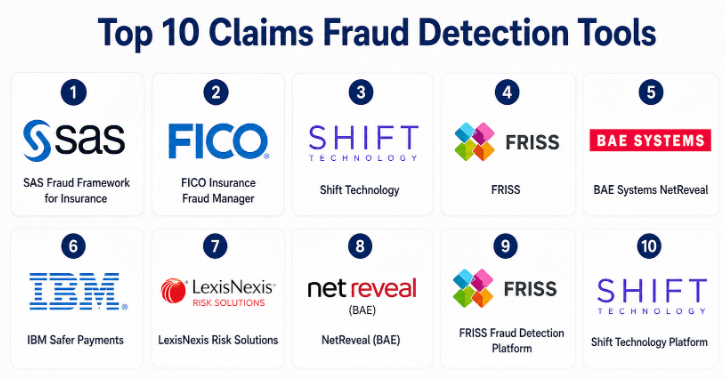
Introduction
Claims Fraud Detection Tools help insurance companies, brokers, and claims teams identify, investigate, and prevent fraudulent claims. In simple terms, these tools analyze claims data, detect suspicious patterns, and flag high-risk claims to reduce financial losses.
Fraudulent claims affect insurers’ profitability and operational efficiency. Modern fraud detection platforms leverage AI, machine learning, and predictive analytics to spot anomalies, prioritize investigations, and automate alerts.
Common use cases include auto insurance fraud detection, health claim monitoring, workers’ compensation fraud prevention, identifying duplicate or exaggerated claims, risk scoring, and regulatory compliance reporting.
When evaluating these tools, insurers should consider detection accuracy, AI and ML capabilities, integration with claims and policy systems, workflow automation, reporting, scalability, real-time analytics, regulatory compliance, ease of use, and vendor support.
Best for: Insurance companies, claims departments, fraud investigation units, risk management teams, and agencies handling high volumes of claims.
Not ideal for: Very small agencies with low claim volumes, organizations without significant fraud risk, or teams managing claims entirely manually.
Key Trends in Claims Fraud Detection Tools
- AI and machine learning are central to detecting complex fraud patterns.
- Predictive analytics is increasingly used to identify high-risk claims before payout.
- Integration with policy and claims management systems streamlines workflows.
- Real-time alerts and dashboards enable faster fraud response.
- Behavioral and anomaly detection improves accuracy across auto, health, and property claims.
- Cloud deployment allows scalability and faster data analysis.
- Collaboration and case management support fraud investigation teams.
- Regulatory compliance and audit reporting are embedded in modern tools.
- Text, image, and document analysis flag inconsistencies in submissions.
- Cross-carrier data sharing helps detect broader fraud patterns.
How We Selected These Tools
- Focused on platforms recognized in insurance fraud detection, analytics, and claims monitoring.
- Prioritized tools with AI, machine learning, and predictive analytics capabilities.
- Evaluated integration potential with claims and policy administration systems.
- Assessed workflow support for case management and fraud investigations.
- Considered scalability for high-volume claims operations.
- Emphasized usability for claims analysts, investigators, and risk teams.
- Avoided guessing public ratings, pricing, or certifications.
- Used N/A, Varies / N/A, or Not publicly stated for uncertain details.
#1 — SAS Fraud Framework for Insurance
Short description: SAS Fraud Framework for Insurance provides advanced analytics and AI-driven detection for auto, health, and property claims. It helps insurers identify suspicious claims, prioritize investigations, and reduce losses. Ideal for enterprise insurers managing high volumes of claims.
Key Features
- AI and machine learning detection
- Anomaly and pattern recognition
- Real-time alerts
- Case management support
- Predictive analytics
- Risk scoring dashboards
- Regulatory reporting
Pros
- Scalable for large insurers
- Strong analytics capabilities
- Integrates with claims systems
Cons
- Complex implementation
- High enterprise cost
- Requires skilled analysts
Platforms / Deployment
Web / Windows / Varies / N/A
Cloud / On-premises / Hybrid
Security & Compliance
SSO, encryption, audit logs. Certifications: Not publicly stated.
Integrations & Ecosystem
- Claims management systems
- Policy administration
- Investigation tools
- Reporting dashboards
Support & Community
Vendor-led onboarding, documentation, analytics support. Community strong among enterprise insurers.
#2 — FICO Insurance Fraud Manager
Short description: FICO Insurance Fraud Manager combines AI, rules-based detection, and predictive analytics to detect fraud across auto, property, and health claims. It supports triage, scoring, and investigations. Suitable for mid-to-large insurers requiring automated fraud detection.
Key Features
- Predictive scoring and AI detection
- Rules-based fraud detection
- Case management workflows
- Real-time alerts
- Claim scoring dashboards
- Integration with claims systems
- Reporting and analytics
Pros
- Combines AI and rule-based methods
- Multi-line insurance support
- Improves triage efficiency
Cons
- Implementation complexity for smaller insurers
- High licensing costs
- Requires trained staff to interpret alerts
Platforms / Deployment
Web / Varies / N/A
Cloud / On-premises
Security & Compliance
Encryption, access control, audit logging. Certifications: Not publicly stated.
Integrations & Ecosystem
- Claims processing systems
- Policy administration systems
- Analytics dashboards
- Investigation tools
Support & Community
Vendor-led support, training, and documentation. Community active among insurance analysts.
#3 — Shift Technology
Short description: Shift Technology offers AI-driven fraud detection for health, auto, and property claims. It identifies anomalies, predicts risk, and assists investigators in prioritizing claims. Ideal for insurers seeking rapid deployment and AI-based insights.
Key Features
- AI and ML fraud detection
- Automated case prioritization
- Anomaly detection
- Real-time risk scoring
- Investigation support
- Reporting dashboards
- Alerts and workflow integration
Pros
- Rapid AI model deployment
- Supports multiple insurance lines
- Reduces manual investigation load
Cons
- Requires quality data for accuracy
- Less customizable for complex rules
- Dependent on integration quality
Platforms / Deployment
Web / Varies / N/A
Cloud
Security & Compliance
User permissions, encryption, audit logs. Certifications: Not publicly stated.
Integrations & Ecosystem
- Claims management platforms
- Policy administration
- Investigation workflows
- Reporting dashboards
Support & Community
Vendor-led implementation, documentation, and training. Community focused on AI-driven fraud detection.
#4 — FRISS
Short description: FRISS provides cloud-based fraud detection for property and casualty, as well as health insurers. It leverages AI and predictive modeling to score claims and flag suspicious activity. Suitable for mid-to-large insurers seeking automated detection.
Key Features
- AI-driven claim scoring
- Automated alerts and prioritization
- Case management support
- Anomaly detection
- Integration with claims systems
- Analytics dashboards
- Regulatory compliance reporting
Pros
- Cloud-based and scalable
- Reduces manual workload
- Quick deployment
Cons
- Performance depends on data quality
- Customization may require vendor assistance
- Enterprise-level customization limited
Platforms / Deployment
Web / Varies / N/A
Cloud
Security & Compliance
Encryption, access controls, audit logs. Certifications: Not publicly stated.
Integrations & Ecosystem
- Claims systems
- Policy administration
- Case management
- Analytics dashboards
Support & Community
Vendor-led support, training, documentation. Community active among insurers using FRISS.
#5 — BAE Systems NetReveal
Short description: NetReveal detects organized and complex fraud using predictive analytics and network analysis. Suitable for enterprise insurers managing multi-line claims and complex fraud schemes.
Key Features
- Predictive analytics
- Network analysis
- Multi-line insurance support
- Case management workflows
- Risk scoring
- Real-time alerts
- Investigation dashboards
Pros
- Effective for organized fraud patterns
- Multi-line support
- Enterprise-scale analytics
Cons
- Complex implementation
- High cost for small insurers
- Requires skilled analysts
Platforms / Deployment
Web / Varies / N/A
Cloud / On-premises / Hybrid
Security & Compliance
Access control, encryption, audit logs. Certifications: Not publicly stated.
Integrations & Ecosystem
- Claims processing
- Policy administration
- Investigation workflows
- Reporting dashboards
Support & Community
Vendor-led support, documentation, training. Enterprise-focused community.
#6 — IBM Safer Payments
Short description: IBM Safer Payments detects fraudulent claims in real-time using AI and rules-based systems. Ideal for enterprise insurers seeking multi-line fraud monitoring and real-time intervention.
Key Features
- Real-time monitoring
- AI and rules-based detection
- Anomaly detection
- Case management support
- Integration with claims systems
- Dashboards and reporting
- Multi-line insurance support
Pros
- Real-time intervention
- Scalable for large insurers
- Multi-line support
Cons
- High complexity
- Requires skilled staff
- Less suitable for small agencies
Platforms / Deployment
Web / Varies / N/A
Cloud / On-prem / Hybrid
Security & Compliance
Encryption, audit logs, role-based access. Certifications: Not publicly stated.
Integrations & Ecosystem
- Claims management
- Policy administration
- Case investigation
- Reporting dashboards
Support & Community
IBM support, onboarding, documentation, and training. Community focused on enterprise insurance.
#7 — LexisNexis Risk Solutions
Short description: LexisNexis uses analytics and historical claims data to detect fraud across P&C, auto, and health insurance lines. Suitable for insurers requiring analytics-driven prioritization.
Key Features
- Predictive analytics
- Historical claims pattern analysis
- Risk scoring
- Alerts for suspicious claims
- Integration with claims systems
- Reporting dashboards
- External data enrichment
Pros
- Established analytics expertise
- Multi-line support
- Enhances investigation prioritization
Cons
- Requires quality data
- Integration may need IT support
- Advanced analytics may require training
Platforms / Deployment
Web / Varies / N/A
Cloud
Security & Compliance
User permissions, encryption, audit logs. Certifications: Not publicly stated.
Integrations & Ecosystem
- Claims processing systems
- Policy databases
- Investigation workflows
- Reporting dashboards
Support & Community
Vendor support, training, documentation. Community strong among insurance analytics teams.
#8 — NetReveal (BAE)
Short description: NetReveal provides enterprise-level fraud detection using AI and predictive modeling, suitable for multi-line insurers with complex fraud networks.
Key Features
- Predictive and network analytics
- Case management
- Alerts and dashboards
- Multi-line insurance support
- Risk scoring
Pros
- Enterprise analytics
- Detects complex fraud
- Supports multiple insurance lines
Cons
- Complex implementation
- High cost
- Requires skilled analysts
Platforms / Deployment
Web / Varies / N/A
Cloud / On-prem / Hybrid
Security & Compliance
Role-based access, encryption, audit logs. Certifications: Not publicly stated.
Integrations & Ecosystem
- Claims systems
- Policy administration
- Investigation workflows
- Reporting dashboards
Support & Community
Vendor-led support, documentation, and training. Community enterprise-focused.
#9 — FRISS Fraud Detection Platform
Short description: Cloud-based fraud detection for P&C and health insurance. Uses AI and predictive modeling to score claims and automate prioritization.
Key Features
- AI claim scoring
- Automated prioritization
- Case management
- Alerts and dashboards
- Integration with claims systems
Pros
- Cloud-based
- Reduces manual workload
- Quick deployment
Cons
- Data quality dependent
- Customization may need support
- Enterprise-level features limited
Platforms / Deployment
Web / Varies / N/A
Cloud
Security & Compliance
Encryption, access controls, audit logs. Certifications: Not publicly stated.
Integrations & Ecosystem
- Claims systems
- Policy databases
- Investigation workflows
- Reporting dashboards
Support & Community
Vendor-led support, documentation, and training. Community active among insurers.
#10 — Shift Technology Platform
Short description: AI-powered detection platform for claims across auto, health, and property. Automates anomaly detection, risk scoring, and prioritization.
Key Features
- AI and ML detection
- Anomaly identification
- Automated case prioritization
- Risk scoring dashboards
- Investigation support
Pros
- Fast AI deployment
- Multi-line insurance support
- Reduces manual review workload
Cons
- Dependent on data quality
- Requires integration
- Customization may be limited
Platforms / Deployment
Web / Varies / N/A
Cloud
Security & Compliance
Encryption, access controls, audit logs. Certifications: Not publicly stated.
Integrations & Ecosystem
- Claims systems
- Policy administration
- Case management workflows
- Reporting dashboards
Support & Community
Vendor support, documentation, training. Community focused on AI-based fraud detection.
Comparison Table
| Tool Name | Best For | Platform(s) Supported | Deployment | Standout Feature | Public Rating |
|---|---|---|---|---|---|
| SAS Fraud Framework | Enterprise insurers | Web / Windows / Varies | Cloud / On-prem / Hybrid | AI-driven claims detection | N/A |
| FICO Insurance Fraud Manager | Mid-large insurers | Web / Varies | Cloud / On-prem | Predictive scoring + AI | N/A |
| Shift Technology | Multi-line insurers | Web / Varies | Cloud | AI anomaly detection | N/A |
| FRISS | P&C & health insurers | Web / Varies | Cloud | Automated fraud scoring | N/A |
| BAE Systems NetReveal | Enterprise & complex fraud | Web / Varies | Cloud / On-prem / Hybrid | Network analytics | N/A |
| IBM Safer Payments | Enterprise insurers | Web / Varies | Cloud / On-prem / Hybrid | Real-time fraud prevention | N/A |
| LexisNexis Risk Solutions | Auto, health, P&C | Web / Varies | Cloud | Data-driven pattern detection | N/A |
| NetReveal (BAE) | Enterprise insurers | Web / Varies | Cloud / On-prem / Hybrid | Multi-line analytics | N/A |
| FRISS Fraud Detection | Mid-large insurers | Web / Varies | Cloud | Cloud-based AI detection | N/A |
| Shift Technology Platform | Multi-line insurers | Web / Varies | Cloud | Automated AI claims scoring | N/A |
Evaluation & Claims Fraud Detection Tools
| Tool Name | Core (25%) | Ease (15%) | Integrations (15%) | Security (10%) | Performance (10%) | Support (10%) | Value (15%) | Weighted Total |
|---|---|---|---|---|---|---|---|---|
| SAS Fraud Framework | 9 | 7 | 8 | 8 | 9 | 8 | 7 | 8.0 |
| FICO Insurance Fraud Manager | 8 | 8 | 8 | 7 | 8 | 8 | 7 | 7.75 |
| Shift Technology | 8 | 8 | 8 | 7 | 8 | 8 | 7 | 7.75 |
| FRISS | 8 | 8 | 7 | 7 | 8 | 8 | 7 | 7.65 |
| BAE Systems NetReveal | 9 | 7 | 8 | 8 | 9 | 8 | 7 | 8.0 |
| IBM Safer Payments | 9 | 7 | 8 | 8 | 9 | 8 | 7 | 8.0 |
| LexisNexis Risk Solutions | 8 | 8 | 7 | 7 | 8 | 8 | 7 | 7.65 |
| NetReveal (BAE) | 9 | 7 | 8 | 8 | 9 | 8 | 7 | 8.0 |
| FRISS Fraud Detection | 8 | 8 | 7 | 7 | 8 | 8 | 7 | 7.65 |
| Shift Technology Platform | 8 | 8 | 8 | 7 | 8 | 8 | 7 | 7.75 |
Interpretation: Enterprise tools excel in analytics and integration, while AI-focused platforms provide rapid detection. Scores are comparative and should be considered relative to insurer size and claim volume.
Which Claims Fraud Detection Tool Should You Choose?
Solo / Freelancer
Independent analysts may use FRISS or Shift Technology for advisory purposes.
SMB
Small-to-mid insurers benefit from FRISS or LexisNexis for automated detection without enterprise complexity.
Mid-Market
Shift Technology, FRISS, or IBM Safer Payments provide AI-assisted detection and integration with claims systems.
Enterprise
Large insurers should consider SAS Fraud Framework, BAE Systems NetReveal, or IBM Safer Payments for scalable, multi-line monitoring.
Budget vs Premium
Budget-conscious insurers may choose FRISS. Premium buyers needing enterprise-scale analytics and multi-line coverage may select SAS, BAE NetReveal, or IBM Safer Payments.
Feature Depth vs Ease of Use
Feature-rich platforms detect complex fraud but require skilled analysts. Simpler platforms are easier to adopt but detect more obvious fraud patterns.
Integrations & Scalability
Tools should integrate with claims systems, policy databases, investigation workflows, and reporting platforms. Scalability is critical for high-volume operations.
Security & Compliance Needs
Encryption, audit logs, role-based access, and secure handling of sensitive claims data are essential. Regulatory compliance must be considered.
Frequently Asked Questions
1. What is a Claims Fraud Detection Tool?
Software that analyzes claims data, flags suspicious activity, and prioritizes investigations to reduce fraudulent payouts.
2. Why are these tools important for insurers?
They minimize losses, improve efficiency, ensure compliance, and protect legitimate clients.
3. How much do these tools cost?
Pricing varies based on claims volume, lines of insurance, deployment model, and AI capabilities.
4. Can these tools detect fraud across multiple insurance lines?
Yes, most support property, casualty, auto, health, and life insurance claims.
5. Is AI accurate in detecting fraudulent claims?
AI improves detection by identifying patterns and anomalies but should be supplemented with human review.
6. How do these tools integrate with claims systems?
They connect to claims databases to automate scoring, alerts, and case prioritization.
7. Can these tools reduce manual investigation workload?
Yes, automated prioritization allows investigators to focus on high-risk cases.
8. Are cloud-based tools secure?
Most include encryption, access control, and audit logs. Agencies should review vendor security policies.
9. How long does implementation take?
Implementation depends on insurer size, integrations, and claims volume; it can range from weeks to months.
10. What are alternatives to these tools?
Manual reviews, spreadsheets, and traditional investigation teams, though less scalable and slower.
Conclusion
Claims Fraud Detection Tools are essential for insurers to identify, investigate, and prevent fraudulent claims efficiently. Enterprise insurers benefit from SAS Fraud Framework, BAE Systems NetReveal, or IBM Safer Payments for large-scale operations, while mid-sized insurers may use Shift Technology, FRISS, or LexisNexis for AI-assisted detection. Small agencies can start with FRISS or cloud-based solutions.
