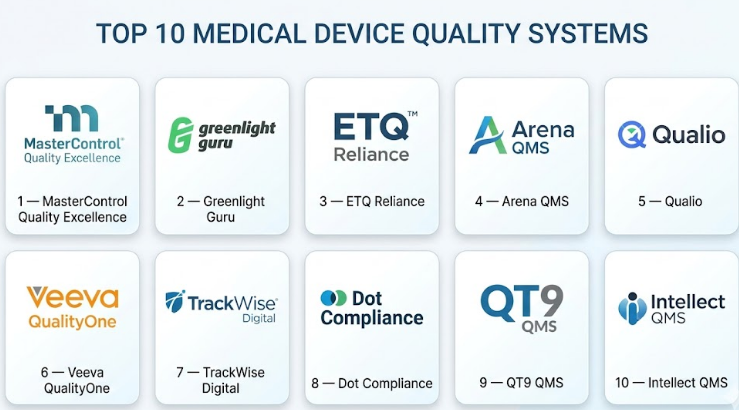
Introduction
Medical Device Quality Systems are software platforms that help medical device companies manage quality, compliance, documentation, audits, corrective actions, supplier quality, training, risk, complaints, and product lifecycle records. In simple words, these tools help companies prove that their medical devices are designed, manufactured, tested, released, and monitored according to required quality standards.
These systems matter because medical device companies work in a highly regulated environment where poor documentation, weak change control, missed training, supplier issues, or complaint handling mistakes can create serious business and patient safety risks. A good quality system helps teams stay audit-ready, reduce manual work, manage quality events faster, and maintain consistent records across design, manufacturing, post-market, and supplier processes.
Common use cases include document control, CAPA, nonconformance management, complaint handling, audit management, supplier quality, training records, change control, risk management, and electronic quality records.
Buyers should evaluate regulatory fit, ease of use, document control, CAPA depth, audit readiness, supplier quality, training management, validation support, integrations, reporting, security, scalability, and implementation effort.
Best for: Medical device manufacturers, diagnostics companies, life sciences quality teams, regulatory affairs teams, compliance leaders, manufacturing teams, supplier quality teams, and companies preparing for audits.
Not ideal for: Very small teams with simple documentation needs, early-stage companies not yet operating under formal quality requirements, or businesses that only need basic task tracking instead of a full quality management system.
Key Trends in Medical Device Quality Systems
- Cloud-based quality systems are becoming more common because teams need easier access across locations, suppliers, and remote quality operations.
- Integrated quality workflows are replacing disconnected spreadsheets, especially for CAPA, audit management, document control, and training records.
- Risk-based quality management is becoming more important, helping teams connect quality events with product risk and patient safety impact.
- AI-assisted quality workflows are emerging, especially for document review, deviation categorization, complaint trends, and audit preparation.
- Supplier quality visibility is becoming a bigger focus because medical device companies rely on complex global supplier networks.
- Electronic records and audit trails are now major buying criteria, especially for regulated environments that need strong traceability.
- Integration with ERP, PLM, MES, CRM, and complaint systems is becoming more important for end-to-end quality visibility.
- Validation support is a key differentiator, because regulated companies often need documentation to support software validation.
- Mobile-friendly access is growing, especially for audits, inspections, manufacturing quality checks, and field service feedback.
- Scalable quality platforms are preferred, because companies want one system that can support early growth, commercial operations, and global compliance maturity.
How We Selected These Tools
- We selected tools that are widely recognized for quality management in medical devices, life sciences, healthcare manufacturing, and regulated industries.
- We considered feature completeness across document control, CAPA, audits, supplier quality, training, complaints, risk, and change control.
- We prioritized platforms that support regulated quality workflows and audit-ready documentation.
- We included enterprise-grade platforms as well as flexible cloud-based systems suitable for growing companies.
- We considered usability, implementation complexity, integration potential, and fit across company sizes.
- We looked at ecosystem strength, customer fit, validation support, and ability to support medical device quality processes.
- We avoided guessing public ratings, certifications, or security details where information is uncertain.
- We used N/A, Varies / N/A, and Not publicly stated where details are not confidently known.
#1 — MasterControl Quality Excellence
Short description: MasterControl Quality Excellence is a quality management platform widely used by life sciences and regulated companies, including medical device manufacturers. It helps teams manage document control, CAPA, audits, training, change control, supplier quality, and quality events in a structured system. The platform is suitable for companies that need strong compliance workflows, audit readiness, and controlled documentation. It is a strong fit for mid-market and enterprise medical device organizations with mature quality requirements.
Key Features
- Document control and approval workflows.
- CAPA management.
- Audit management.
- Training management.
- Supplier quality workflows.
- Change control support.
- Quality event tracking and reporting.
Pros
- Strong fit for regulated medical device companies.
- Good depth across quality and compliance workflows.
- Useful for audit-ready documentation and controlled processes.
Cons
- May be costly for very small teams.
- Implementation can require planning and process mapping.
- Advanced configuration may need experienced support.
Platforms / Deployment
Web
Cloud / Varies / N/A
Security & Compliance
Security features may include role-based access, audit trails, electronic signatures, and controlled records. Specific certifications: Not publicly stated.
Integrations & Ecosystem
MasterControl can support quality processes across document control, training, suppliers, and quality events.
- ERP integration options.
- PLM integration options.
- Training record workflows.
- Supplier quality workflows.
- Reporting and analytics.
- API or configured integrations may vary.
Support & Community
MasterControl generally provides enterprise-style onboarding, customer support, training resources, and implementation assistance. Public community strength is limited, but vendor-led support and regulated industry experience are strong.
#2 — Greenlight Guru
Short description: Greenlight Guru is a quality management system designed specifically for medical device companies. It supports design controls, risk management, document control, CAPA, audits, training, and product development quality workflows. The platform is especially useful for startups, growing medical device companies, and teams that want a quality system aligned with medical device product development. It is a practical choice for companies that need both quality management and design control support in one system.
Key Features
- Medical device-focused QMS workflows.
- Design controls.
- Risk management.
- Document control.
- CAPA management.
- Training records.
- Audit and quality event support.
Pros
- Built specifically for medical device companies.
- Good fit for startups and growing device manufacturers.
- Supports both product development and quality workflows.
Cons
- May not fit non-device industries as broadly.
- Enterprise customization may be limited compared with larger platforms.
- Integration needs should be validated before purchase.
Platforms / Deployment
Web
Cloud
Security & Compliance
Security details may include controlled access and audit-related records. Specific certifications: Not publicly stated.
Integrations & Ecosystem
Greenlight Guru is designed around medical device quality and product development workflows.
- Design control workflows.
- Risk management connections.
- Document control.
- Training records.
- Quality event tracking.
- Integration options may vary.
Support & Community
Greenlight Guru provides vendor-led onboarding, training resources, documentation, and customer support. Its community and educational ecosystem are strong in the medical device startup and quality space.
#3 — ETQ Reliance
Short description: ETQ Reliance is an enterprise quality management system used across regulated and complex industries, including medical devices, life sciences, manufacturing, and healthcare-related operations. It supports quality processes such as CAPA, audits, document control, supplier quality, nonconformance, complaints, change management, and risk. The platform is useful for organizations that need configurable enterprise quality workflows across multiple locations and departments. It is best suited for mid-market and enterprise companies with complex quality needs.
Key Features
- CAPA management.
- Document control.
- Audit management.
- Supplier quality management.
- Nonconformance tracking.
- Complaint handling.
- Configurable quality workflows.
Pros
- Strong enterprise quality management capabilities.
- Highly configurable for different quality processes.
- Suitable for multi-site quality operations.
Cons
- May require implementation expertise.
- Can be more than small teams need.
- Configuration decisions should be carefully governed.
Platforms / Deployment
Web
Cloud / Varies / N/A
Security & Compliance
Security capabilities may include role-based access, audit trails, workflow controls, and enterprise user management. Specific certifications: Not publicly stated.
Integrations & Ecosystem
ETQ Reliance can integrate with enterprise systems and support broad quality workflows.
- ERP integration options.
- Supplier management workflows.
- Complaint and nonconformance tracking.
- Document management workflows.
- Reporting and dashboards.
- API and configured integration options may vary.
Support & Community
ETQ generally provides enterprise support, implementation assistance, documentation, and customer success services. Public community strength is limited, but enterprise quality ecosystem presence is strong.
#4 — Arena QMS
Short description: Arena QMS is a cloud-based quality management system often used by product companies, including medical device and electronics manufacturers. It connects quality processes with product lifecycle management workflows, making it useful for companies that need quality and product development data in one environment. Arena QMS supports document control, change management, CAPA, training, supplier quality, and quality records. It is a strong option for companies that want QMS and product information to work closely together.
Key Features
- Document control.
- CAPA management.
- Change management.
- Supplier quality workflows.
- Training management.
- Product record connectivity.
- Quality process tracking.
Pros
- Good connection between QMS and product lifecycle data.
- Useful for product-driven medical device companies.
- Cloud-based access supports distributed teams.
Cons
- Best value comes when product data management is also important.
- May not fit teams needing only simple QMS features.
- Integration and configuration scope should be reviewed.
Platforms / Deployment
Web
Cloud
Security & Compliance
Security details may include access control, audit trails, and controlled workflows. Specific certifications: Not publicly stated.
Integrations & Ecosystem
Arena QMS is useful when product lifecycle and quality processes must stay connected.
- PLM connectivity.
- ERP integration options.
- Supplier quality workflows.
- Change control processes.
- Document and training workflows.
- Reporting and dashboards.
Support & Community
Arena provides vendor-led support, onboarding, documentation, and customer success resources. Community strength is mainly customer and partner-driven.
#5 — Qualio
Short description: Qualio is a cloud-based quality management system used by life sciences companies, including medical device, biotech, and pharmaceutical teams. It helps manage controlled documents, training, CAPA, suppliers, audits, change control, and quality events. Qualio is often a good fit for growing companies that want a modern QMS without the complexity of older enterprise systems. It is practical for teams that need an easier way to move from manual quality processes to a structured digital system.
Key Features
- Document control.
- Training management.
- CAPA workflows.
- Supplier management.
- Audit management.
- Change control.
- Quality event tracking.
Pros
- Easy-to-use cloud QMS for life sciences teams.
- Good fit for growing medical device companies.
- Helps replace spreadsheets and manual documentation.
Cons
- May not offer the same enterprise depth as larger systems.
- Advanced integrations should be validated.
- Complex global organizations may need more configuration.
Platforms / Deployment
Web
Cloud
Security & Compliance
Security details may include access control and audit trails. Specific certifications: Not publicly stated.
Integrations & Ecosystem
Qualio supports core quality processes and can connect with common business workflows depending on customer needs.
- Document workflows.
- Training records.
- Supplier quality processes.
- Audit tracking.
- Quality event management.
- Integration options may vary.
Support & Community
Qualio provides onboarding, documentation, customer support, and quality-focused guidance. Community strength is strongest among growing life sciences companies and quality teams.
#6 — Veeva QualityOne
Short description: Veeva QualityOne is a quality management platform built for regulated industries and enterprise quality teams. It supports document control, quality events, audits, training, supplier quality, and operational quality workflows. For medical device companies, it can support structured quality processes across teams, sites, suppliers, and manufacturing operations. It is best suited for mid-market and enterprise organizations that need a scalable quality platform with strong process control.
Key Features
- Document control.
- Quality event management.
- CAPA workflows.
- Audit management.
- Training management.
- Supplier quality.
- Enterprise quality reporting.
Pros
- Strong fit for regulated enterprise quality teams.
- Scalable for multi-site quality operations.
- Useful for connecting quality workflows across departments.
Cons
- May be too broad for very small medical device teams.
- Implementation scope can vary based on configuration.
- Pricing and package details should be confirmed directly.
Platforms / Deployment
Web
Cloud
Security & Compliance
Security and compliance capabilities may include controlled access, audit trails, and enterprise quality records. Specific certifications: Not publicly stated.
Integrations & Ecosystem
Veeva QualityOne can support enterprise quality workflows and connect with broader business systems.
- Document control workflows.
- Training workflows.
- Supplier quality processes.
- Audit and quality event tracking.
- Enterprise reporting.
- Integration options may vary.
Support & Community
Veeva provides enterprise support, documentation, training resources, and implementation assistance. Community strength is stronger within regulated industry customers and partner networks.
#7 — TrackWise Digital
Short description: TrackWise Digital is an enterprise quality management system used by regulated companies, including life sciences and medical device organizations. It supports quality events, CAPA, change control, audits, complaints, supplier quality, and compliance workflows. The platform is suitable for organizations that need strong process control, traceability, and scalable quality operations. It is best for companies with complex quality processes and enterprise compliance needs.
Key Features
- Quality event management.
- CAPA workflows.
- Change control.
- Audit management.
- Complaint handling.
- Supplier quality management.
- Enterprise reporting.
Pros
- Strong fit for regulated enterprise quality management.
- Supports complex quality workflows.
- Useful for organizations with mature quality systems.
Cons
- May be complex for small teams.
- Implementation can require strong quality process knowledge.
- Configuration and change management need careful planning.
Platforms / Deployment
Web
Cloud / Varies / N/A
Security & Compliance
Security capabilities may include controlled workflows, audit trails, role-based access, and enterprise user management. Specific certifications: Not publicly stated.
Integrations & Ecosystem
TrackWise Digital can support broad enterprise quality operations and connect with business systems.
- ERP integration options.
- Complaint management workflows.
- Supplier quality processes.
- Audit and CAPA tracking.
- Reporting dashboards.
- API or configured integrations may vary.
Support & Community
Support is generally enterprise-focused, with implementation partners, documentation, customer support, and training services. Public community strength is limited.
#8 — Dot Compliance
Short description: Dot Compliance is a cloud-based quality and compliance platform for life sciences companies, including medical device, biotech, and pharma organizations. It supports document control, training, CAPA, audits, quality events, supplier management, and compliance workflows. The platform is suitable for companies that want a modern QMS with life sciences-focused functionality. It is useful for teams that need structured quality processes without building everything manually.
Key Features
- Document control.
- Training management.
- CAPA workflows.
- Audit management.
- Supplier quality.
- Quality event tracking.
- Compliance process management.
Pros
- Life sciences-focused quality platform.
- Good for structured quality and compliance workflows.
- Cloud-based access supports distributed teams.
Cons
- Advanced needs may require configuration.
- Integration depth should be validated.
- Vendor-specific implementation support may be needed.
Platforms / Deployment
Web
Cloud
Security & Compliance
Security details may include controlled access and audit trails. Specific certifications: Not publicly stated.
Integrations & Ecosystem
Dot Compliance supports life sciences quality workflows and can connect with business systems depending on implementation needs.
- Document management.
- Training workflows.
- Quality event tracking.
- Supplier quality workflows.
- Audit management.
- Integration options may vary.
Support & Community
Dot Compliance provides vendor-led support, onboarding, documentation, and implementation guidance. Public community strength is limited, but vendor support is focused on regulated life sciences needs.
#9 — QT9 QMS
Short description: QT9 QMS is a quality management system used by manufacturing, medical device, life sciences, and regulated industry teams. It supports core quality processes such as document control, CAPA, audits, training, complaints, nonconformance, supplier quality, and maintenance-related quality workflows. The platform can be useful for companies that want a practical QMS with broad module coverage. It is suitable for small to mid-sized teams as well as growing regulated organizations.
Key Features
- Document control.
- CAPA management.
- Audit management.
- Training management.
- Complaint tracking.
- Supplier quality.
- Nonconformance management.
Pros
- Broad QMS module coverage.
- Practical for small and mid-sized teams.
- Useful for companies moving away from manual quality tracking.
Cons
- Enterprise depth should be evaluated for large global teams.
- Integration scope may vary.
- User experience and configuration fit should be checked during demo.
Platforms / Deployment
Web / Varies / N/A
Cloud / Varies / N/A
Security & Compliance
Security details vary by package and deployment. Specific certifications: Not publicly stated.
Integrations & Ecosystem
QT9 QMS supports common quality workflows and may connect with other operational systems depending on customer needs.
- Document control workflows.
- CAPA tracking.
- Complaint management.
- Supplier quality tracking.
- Audit workflows.
- Reporting tools.
Support & Community
QT9 provides customer support, onboarding assistance, and documentation. Public community strength is limited, but vendor-led support is available.
#10 — Intellect QMS
Short description: Intellect QMS is a configurable quality management platform used by regulated and process-driven organizations. It supports quality workflows such as document control, CAPA, audits, nonconformance, complaints, supplier quality, training, and change management. The platform is useful for teams that want flexibility to design quality workflows around their own processes. It can fit medical device companies that need configurable quality control without relying only on rigid templates.
Key Features
- Configurable quality workflows.
- Document control.
- CAPA management.
- Audit management.
- Nonconformance tracking.
- Complaint management.
- Supplier quality workflows.
Pros
- Flexible and configurable.
- Useful for process-driven quality teams.
- Supports broad quality management workflows.
Cons
- Configuration requires clear process planning.
- Medical device-specific depth should be validated.
- Implementation quality depends on workflow design.
Platforms / Deployment
Web
Cloud / Varies / N/A
Security & Compliance
Security details may include access control and workflow auditability. Specific certifications: Not publicly stated.
Integrations & Ecosystem
Intellect QMS can support configurable quality workflows and connect with business systems based on implementation needs.
- ERP integration options.
- Document control workflows.
- CAPA and audit workflows.
- Complaint tracking.
- Supplier quality processes.
- Reporting and dashboards.
Support & Community
Intellect provides vendor-led support, onboarding, implementation guidance, and documentation. Public community activity is limited, but flexibility can be useful for teams with defined quality processes.
Comparison Table
| Tool Name | Best For | Platform(s) Supported | Deployment | Standout Feature | Public Rating |
|---|---|---|---|---|---|
| MasterControl Quality Excellence | Enterprise medical device quality management | Web | Cloud / Varies | Strong regulated quality workflow depth | N/A |
| Greenlight Guru | Medical device startups and growing teams | Web | Cloud | Medical device-focused QMS and design controls | N/A |
| ETQ Reliance | Enterprise quality operations | Web | Cloud / Varies | Configurable enterprise quality workflows | N/A |
| Arena QMS | Product-driven medical device companies | Web | Cloud | QMS and product lifecycle connection | N/A |
| Qualio | Growing life sciences teams | Web | Cloud | Modern cloud QMS for life sciences | N/A |
| Veeva QualityOne | Enterprise regulated quality teams | Web | Cloud | Scalable quality operations platform | N/A |
| TrackWise Digital | Complex regulated quality processes | Web | Cloud / Varies | Enterprise CAPA and quality event management | N/A |
| Dot Compliance | Life sciences quality and compliance teams | Web | Cloud | Cloud-based life sciences QMS workflows | N/A |
| QT9 QMS | Small to mid-sized regulated teams | Web / Varies | Cloud / Varies | Broad practical QMS module coverage | N/A |
| Intellect QMS | Configurable quality workflows | Web | Cloud / Varies | Flexible workflow design | N/A |
Evaluation & Medical Device Quality Systems
| Tool Name | Core (25%) | Ease (15%) | Integrations (15%) | Security (10%) | Performance (10%) | Support (10%) | Value (15%) | Weighted Total |
|---|---|---|---|---|---|---|---|---|
| MasterControl Quality Excellence | 9 | 7 | 8 | 8 | 8 | 8 | 7 | 7.95 |
| Greenlight Guru | 8 | 8 | 7 | 7 | 8 | 8 | 8 | 7.75 |
| ETQ Reliance | 9 | 7 | 8 | 8 | 8 | 8 | 7 | 7.95 |
| Arena QMS | 8 | 8 | 8 | 7 | 8 | 8 | 8 | 7.90 |
| Qualio | 8 | 8 | 7 | 7 | 8 | 8 | 8 | 7.75 |
| Veeva QualityOne | 9 | 7 | 8 | 8 | 8 | 8 | 7 | 7.95 |
| TrackWise Digital | 9 | 6 | 8 | 8 | 8 | 8 | 7 | 7.80 |
| Dot Compliance | 8 | 8 | 7 | 7 | 8 | 7 | 8 | 7.65 |
| QT9 QMS | 7 | 8 | 7 | 7 | 7 | 7 | 8 | 7.25 |
| Intellect QMS | 8 | 7 | 7 | 7 | 7 | 7 | 8 | 7.40 |
These scores are comparative and should be used as a starting point. A tool with a slightly lower total may still be the best fit if it matches your company size, compliance maturity, budget, and implementation needs. Enterprise tools usually score higher on workflow depth and scalability, while modern cloud tools may score better on ease of use and faster adoption. Always validate the shortlist with demos, process mapping, security review, and pilot testing.
Which Medical Device Quality System Should You Choose?
Solo / Freelancer
Solo consultants, independent quality advisors, or very small teams usually do not need a heavy enterprise QMS. They should focus on systems that are easy to understand, quick to implement, and practical for document control, CAPA, and basic audit readiness. Qualio, Greenlight Guru, QT9 QMS, or Dot Compliance may be easier to evaluate for smaller quality environments.
SMB
Small and mid-sized medical device companies should choose a system that supports document control, design controls, CAPA, training, audits, and supplier quality without creating too much administrative burden. Greenlight Guru is especially practical for medical device-focused teams. Qualio, Dot Compliance, QT9 QMS, and Arena QMS can also be strong options depending on process maturity.
Mid-Market
Mid-market companies usually need stronger integrations, workflow control, reporting, supplier management, and cross-functional quality visibility. MasterControl, ETQ Reliance, Arena QMS, Qualio, Veeva QualityOne, and TrackWise Digital can be good options depending on whether the company prioritizes enterprise depth, usability, or product lifecycle connection.
Enterprise
Enterprise medical device companies should focus on scalability, multi-site control, validation support, audit trails, supplier quality, complaint handling, change control, and integration with ERP, PLM, MES, and CRM systems. MasterControl, ETQ Reliance, Veeva QualityOne, TrackWise Digital, and Arena QMS are stronger enterprise choices.
Budget vs Premium
Budget-focused teams should avoid buying more system than they can implement. A simpler cloud QMS may be better than a large enterprise tool if the team is still building quality maturity. Premium buyers should focus on workflow depth, validation support, integrations, reporting, supplier quality, and long-term scalability.
Feature Depth vs Ease of Use
Enterprise platforms like MasterControl, ETQ Reliance, Veeva QualityOne, and TrackWise Digital offer deeper quality workflows but may require more planning and configuration. Greenlight Guru, Qualio, Dot Compliance, QT9 QMS, and Intellect QMS may be easier for smaller or growing teams, depending on the required process depth.
Integrations & Scalability
Medical device quality systems should not work in isolation. Buyers should check integration with ERP, PLM, MES, CRM, supplier systems, complaint handling tools, training platforms, and reporting tools. Scalability also matters because a company may start with document control but later need complaints, post-market surveillance support, supplier quality, and advanced analytics.
Security & Compliance Needs
Medical device companies should carefully review access control, audit trails, electronic signatures, role-based permissions, data retention, backup, validation documentation, and user activity records. Security and compliance should be reviewed before contract signing, not after implementation begins.
Frequently Asked Questions
1. What is a Medical Device Quality System?
A Medical Device Quality System is software that helps medical device companies manage quality processes such as document control, CAPA, audits, complaints, training, supplier quality, and change control. It helps keep records organized, controlled, and audit-ready.
2. Why do medical device companies need a QMS?
Medical device companies need a QMS because they operate in a regulated environment where quality records must be accurate, controlled, and traceable. A good QMS helps reduce compliance risk, improve product quality, and support audit readiness.
3. What is the difference between QMS and document control?
Document control is one part of a QMS. A full QMS may also include CAPA, audits, training, complaints, supplier quality, nonconformance, risk management, and change control.
4. How much does Medical Device QMS software cost?
Pricing varies based on users, modules, company size, validation needs, support level, and implementation scope. Many vendors use subscription pricing, while enterprise platforms may require custom quotes.
5. How long does QMS implementation take?
Implementation time depends on company size, number of processes, document volume, integrations, validation requirements, and team readiness. Simple cloud systems may be faster, while enterprise systems require more planning and configuration.
6. What common mistakes should buyers avoid?
Common mistakes include choosing a tool without mapping quality processes, ignoring validation needs, skipping user training, failing to involve quality and regulatory teams, and underestimating document cleanup before migration.
7. Can QMS software support audits?
Yes, most QMS platforms support audits through document control, audit plans, findings, CAPA links, evidence tracking, and reporting. Buyers should confirm whether the audit module matches internal audit, supplier audit, and external audit needs.
8. What security features should buyers check?
Buyers should check role-based access, audit trails, electronic signatures, password policies, MFA, encryption, backup, data retention, and user activity logs. Security details should be confirmed with the vendor before selection.
9. Can QMS software integrate with ERP and PLM systems?
Many QMS tools can integrate with ERP, PLM, MES, CRM, and training systems, but integration depth varies. Buyers should validate APIs, middleware needs, data flows, and implementation effort during the selection process.
10. Is cloud QMS safe for medical device companies?
Cloud QMS can be suitable for medical device companies when security, access control, validation support, backup, and compliance documentation are properly reviewed. The decision should be based on risk, vendor controls, and company requirements.
Conclusion
Medical Device Quality Systems are essential for companies that need reliable control over documentation, CAPA, audits, training, complaints, supplier quality, and compliance workflows. The best system depends on company size, product risk, regulatory maturity, budget, integration needs, and quality team structure. Greenlight Guru is strong for medical device-focused teams, while MasterControl, ETQ Reliance, Veeva QualityOne, and TrackWise Digital are better suited for mature enterprise environments. Qualio, Dot Compliance, QT9 QMS, Arena QMS, and Intellect QMS can be practical options for growing companies or teams that need a balance of usability and quality depth.
