Introduction
Food Supply Chain Traceability Tools help companies track food products from farm to processing, packaging, storage, transport, retail, and final delivery. These tools make it easier to know where a product came from, where it moved, who handled it, and whether it met safety and quality requirements.
For food manufacturers, distributors, retailers, exporters, restaurants, and logistics teams, traceability is very important because even one safety issue can affect brand trust, customer health, and business reputation. A good traceability platform helps teams manage recalls faster, reduce waste, improve supplier accountability, monitor quality, and meet food safety expectations.
These tools are useful for fresh produce, dairy, meat, seafood, packaged food, frozen items, ingredients, beverages, and ready-to-eat products.
Best for: food manufacturers, processors, distributors, retailers, exporters, cold chain logistics teams, quality teams, and compliance managers.
Not ideal for: very small businesses that only manage a few local suppliers and can handle records manually, or companies that do not need batch-level, lot-level, or supplier-level tracking.
Key Trends in Food Supply Chain Traceability Tools
- More food companies are moving from paper records to digital traceability systems.
- Real-time tracking is becoming important for perishable and high-risk food products.
- QR code-based product history is becoming more common for customer transparency.
- Blockchain-based traceability is being used in some food networks for tamper-resistant records.
- Supplier compliance tracking is becoming a major requirement for food brands.
- Integration with ERP, WMS, TMS, and quality management systems is now more important.
- Recall management is becoming faster with lot-level and batch-level visibility.
- Sustainability tracking is becoming part of traceability, especially for ethical sourcing.
- Mobile apps are helping warehouse, farm, and logistics teams capture data faster.
- Food safety audits are easier when documentation is centralized and searchable.
How We Selected These Tools
The following tools were selected based on practical food supply chain needs, market recognition, feature depth, traceability capabilities, and business fit.
- Ability to track products across suppliers, batches, lots, and shipments.
- Support for food safety, recall management, and compliance workflows.
- Practical usability for food manufacturers, retailers, distributors, and logistics teams.
- Integration options with ERP, inventory, warehouse, and quality systems.
- Visibility across the complete food supply chain.
- Support for reporting, audit records, and supplier documentation.
- Scalability for small, mid-sized, and enterprise food businesses.
- Availability of mobile, cloud, or hybrid deployment models.
- Strength of analytics, dashboards, and exception management.
- Fit for different food categories such as produce, dairy, meat, seafood, and packaged goods.
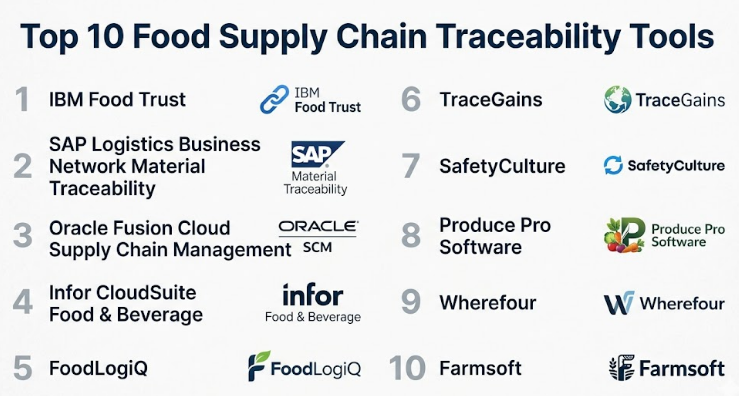
Top 10 Food Supply Chain Traceability Tools
1. IBM Food Trust
Short description:
IBM Food Trust is a food traceability platform designed to improve transparency across complex food supply chains. It uses blockchain-based recordkeeping to help participants share product movement, origin, and quality data. The platform is useful for retailers, food producers, suppliers, and distributors that need trusted traceability records. It helps businesses improve visibility, manage recalls, and build confidence in food sourcing. IBM Food Trust is best suited for larger supply chain networks where multiple partners need to share data securely.
Key Features
- Blockchain-based food traceability.
- Product origin and movement tracking.
- Supplier and partner data sharing.
- Recall support and traceability records.
- Suitable for multi-party food supply chains.
- Visibility into product journey and sourcing.
- Useful for retailers, growers, processors, and distributors.
Pros
- Strong fit for complex food networks.
- Helps improve trust between supply chain partners.
- Useful for product origin and recall visibility.
Cons
- May be too advanced for small businesses.
- Setup can require partner participation.
- Pricing and implementation details may vary.
Platforms / Deployment
Cloud-based platform
Web access available where applicable
Security & Compliance
Not publicly stated in full detail. Buyers should directly confirm encryption, access controls, audit logs, role-based permissions, SSO/SAML, and relevant compliance requirements.
Integrations & Ecosystem
IBM Food Trust works best when multiple supply chain partners participate in the same traceability network.
- ERP integration possibilities.
- Supplier data sharing.
- Retail and distributor workflows.
- Product origin records.
- Recall support workflows.
- API options should be confirmed directly.
Support & Community
Support is likely enterprise-focused. Buyers should confirm onboarding, training, partner enablement, technical support, and implementation services before purchase.
2. SAP Logistics Business Network Material Traceability
Short description:
SAP Logistics Business Network Material Traceability helps businesses trace materials and products across supply chains. It is useful for food companies already using SAP systems and looking for traceability across suppliers, batches, production, and distribution. The platform helps improve transparency, compliance readiness, and recall response. It is best suited for mid-market and enterprise companies with structured supply chain operations. Food manufacturers and retailers using SAP can benefit from its ecosystem alignment.
Key Features
- Material and product traceability.
- Batch and lot-level tracking.
- Supplier collaboration support.
- Recall and quality investigation workflows.
- Strong fit with SAP ecosystem.
- Supply chain network visibility.
- Useful for enterprise food operations.
Pros
- Good option for businesses already using SAP.
- Strong enterprise process alignment.
- Useful for batch-level traceability and compliance.
Cons
- May be complex for smaller teams.
- Best value comes when SAP ecosystem is already in place.
- Implementation may require technical and process planning.
Platforms / Deployment
Cloud-based platform
Web access available where applicable
Security & Compliance
Not publicly stated in full detail. Buyers should confirm SSO/SAML, MFA, encryption, audit logs, RBAC, data retention, and compliance documentation.
Integrations & Ecosystem
This tool fits strongly into SAP-based enterprise environments.
- SAP ERP ecosystem.
- Supplier collaboration workflows.
- Quality and compliance systems.
- Logistics and production data.
- Material traceability records.
- Enterprise reporting workflows.
Support & Community
SAP has a large enterprise support ecosystem. Buyers should confirm support plans, implementation partner availability, onboarding effort, and training requirements.
3. Oracle Fusion Cloud Supply Chain Management
Short description:
Oracle Fusion Cloud Supply Chain Management provides broad supply chain capabilities that can support food traceability through inventory, manufacturing, logistics, quality, and supplier data. It is not only a traceability tool but a wider enterprise supply chain platform. Food businesses can use it to connect procurement, production, inventory, and distribution workflows. It is best for larger companies that need traceability as part of a complete supply chain management system. Oracle is suitable for organizations with complex operations and strong governance needs.
Key Features
- Inventory and supply chain visibility.
- Manufacturing and quality management workflows.
- Supplier and procurement tracking.
- Lot and batch tracking capabilities.
- Enterprise reporting and analytics.
- Integration across finance, procurement, and operations.
- Suitable for large and complex food businesses.
Pros
- Strong enterprise supply chain platform.
- Good for companies needing more than traceability alone.
- Useful for connecting traceability with business operations.
Cons
- May be expensive or complex for small businesses.
- Requires proper configuration for food traceability workflows.
- Implementation can take planning and expert support.
Platforms / Deployment
Cloud-based platform
Web access available where applicable
Security & Compliance
Not publicly stated in full detail here. Buyers should confirm encryption, access controls, MFA, SSO/SAML, audit logs, RBAC, and required compliance documentation directly.
Integrations & Ecosystem
Oracle works well in enterprise ecosystems where traceability must connect with financial, operational, supplier, and logistics data.
- ERP and procurement workflows.
- Inventory and warehouse systems.
- Manufacturing operations.
- Quality management.
- Supplier management.
- Analytics and reporting tools.
Support & Community
Oracle has enterprise support, implementation partners, and documentation resources. Buyers should validate support tier, onboarding scope, and training needs.
4. Infor CloudSuite Food & Beverage
Short description:
Infor CloudSuite Food & Beverage is designed for food and beverage manufacturers that need industry-specific ERP and traceability capabilities. It helps manage ingredients, recipes, production, inventory, compliance, and product movement. The platform is useful for food companies that need lot tracking, quality control, and recall support. It is best suited for mid-sized and enterprise food manufacturers. Infor is a strong option when traceability must be connected with production planning and operational control.
Key Features
- Food and beverage ERP capabilities.
- Ingredient and recipe management.
- Lot and batch traceability.
- Quality control workflows.
- Recall support and reporting.
- Inventory and production visibility.
- Industry-focused food manufacturing features.
Pros
- Strong fit for food and beverage manufacturing.
- Helps connect traceability with production and quality.
- Useful for companies needing industry-specific workflows.
Cons
- May require ERP-level implementation effort.
- Not ideal for very small food businesses.
- Pricing and configuration details vary.
Platforms / Deployment
Cloud-based platform
Web access available where applicable
Security & Compliance
Not publicly stated in full detail. Buyers should validate access controls, audit logs, encryption, MFA, SSO/SAML, RBAC, and compliance-related documentation.
Integrations & Ecosystem
Infor is useful where traceability is part of a full manufacturing and supply chain process.
- ERP workflows.
- Manufacturing systems.
- Quality management.
- Inventory control.
- Supplier and procurement workflows.
- Reporting and analytics.
Support & Community
Support is business and enterprise focused. Buyers should confirm onboarding, implementation partner support, training, and long-term technical assistance.
5. FoodLogiQ
Short description:
FoodLogiQ is a food safety, supplier management, and traceability platform built for food companies that need better control over supply chain records. It helps businesses manage supplier documentation, product traceability, audits, incidents, and recalls. The platform is useful for restaurants, retailers, food brands, and manufacturers. FoodLogiQ is especially practical for organizations that need supplier compliance and traceability in one place. It is a strong option for teams that want better food safety visibility without building everything manually.
Key Features
- Supplier management and documentation.
- Product traceability workflows.
- Recall and incident management.
- Audit and compliance support.
- Food safety record management.
- Supply chain transparency tools.
- Useful for retailers, brands, and food service companies.
Pros
- Strong focus on food industry needs.
- Good for supplier compliance and traceability.
- Helpful for food safety and recall readiness.
Cons
- Advanced needs may require configuration.
- Some features may depend on selected modules.
- Buyers should confirm integration depth.
Platforms / Deployment
Cloud-based platform
Web access available where applicable
Security & Compliance
Not publicly stated in full detail. Buyers should confirm MFA, SSO/SAML, encryption, audit logs, RBAC, and compliance documentation directly.
Integrations & Ecosystem
FoodLogiQ fits food safety and supplier compliance ecosystems well.
- Supplier documentation workflows.
- Food safety records.
- Recall processes.
- Audit management.
- Product traceability records.
- Data export and integration options should be confirmed.
Support & Community
Support is likely focused on food safety teams and enterprise customers. Buyers should confirm onboarding, training, support levels, and implementation guidance.
6. TraceGains
Short description:
TraceGains is a networked supply chain platform used by food, beverage, and consumer goods companies for supplier compliance, ingredient data, product development, and quality management. It helps businesses manage supplier documents, specifications, approvals, and traceability-related workflows. TraceGains is useful when food companies need better control over supplier information and quality records. It is best for brands and manufacturers with many suppliers and complex documentation needs. The platform is especially valuable where compliance and ingredient transparency are important.
Key Features
- Supplier compliance management.
- Ingredient and specification data.
- Quality and documentation workflows.
- Network-based supplier collaboration.
- Audit and approval support.
- Product development data support.
- Useful for food and beverage brands.
Pros
- Strong supplier documentation capabilities.
- Good for ingredient and compliance visibility.
- Useful for brands managing many suppliers.
Cons
- More focused on supplier and quality data than physical shipment tracking.
- May require process alignment for best results.
- Pricing and modules may vary.
Platforms / Deployment
Cloud-based platform
Web access available where applicable
Security & Compliance
Not publicly stated in full detail. Buyers should validate encryption, access controls, audit logs, SSO/SAML, MFA, RBAC, and compliance support.
Integrations & Ecosystem
TraceGains works well where supplier data and quality records must be connected across teams.
- Supplier portals.
- Specification management.
- Quality management workflows.
- Documentation records.
- Product development workflows.
- ERP and data integrations should be confirmed.
Support & Community
Support is likely business-focused with onboarding and customer success resources. Buyers should confirm support tiers, training, and supplier onboarding help.
7. SafetyCulture
Short description:
SafetyCulture is an operations, inspection, and checklist platform that can support food safety and traceability workflows. It is not a dedicated food traceability system only, but it is widely used for inspections, audits, corrective actions, and operational records. Food businesses can use it for hygiene checks, storage inspections, delivery checks, temperature logs, and supplier audits. It is best for teams that want simple mobile-first operational visibility. SafetyCulture is practical for restaurants, warehouses, food service teams, and distributed retail operations.
Key Features
- Mobile inspection checklists.
- Food safety audit workflows.
- Corrective action tracking.
- Temperature and storage checks.
- Team task management.
- Reporting dashboards.
- Useful for distributed operations.
Pros
- Easy to use for frontline teams.
- Strong mobile checklist and inspection experience.
- Useful for food safety operations and audits.
Cons
- Not a full traceability platform by itself.
- Batch and lot tracking may require additional systems.
- Best suited for operational checks, not complete supply chain mapping.
Platforms / Deployment
Web / iOS / Android
Cloud-based deployment
Security & Compliance
Not publicly stated in full detail here. Buyers should confirm MFA, SSO/SAML, encryption, audit logs, RBAC, and compliance-related documentation directly.
Integrations & Ecosystem
SafetyCulture fits well with operational workflows where teams need inspection, audit, and corrective action records.
- Mobile inspection workflows.
- Food safety checklists.
- Task and issue management.
- Reporting dashboards.
- Integrations through APIs or connectors should be confirmed.
- Useful alongside ERP or traceability tools.
Support & Community
SafetyCulture has documentation, onboarding resources, and support options. Buyers should confirm available support tiers and enterprise assistance.
8. Produce Pro Software
Short description:
Produce Pro Software is designed for fresh produce businesses, including distributors, wholesalers, processors, and food service suppliers. It supports produce-specific operations such as inventory, sales, purchasing, warehouse management, accounting, and traceability. The platform is useful for businesses that need lot tracking and operational control in fresh produce supply chains. It is best for companies that handle perishable produce and need industry-focused workflows. Produce Pro is especially relevant for produce distributors that need both business management and traceability.
Key Features
- Produce-focused ERP capabilities.
- Inventory and lot tracking.
- Purchasing and sales management.
- Warehouse management workflows.
- Traceability and recall support.
- Accounting and business operations support.
- Useful for fresh produce distributors.
Pros
- Strong fit for the produce industry.
- Combines business operations with traceability.
- Useful for companies managing perishable inventory.
Cons
- Less suitable for non-produce food sectors.
- May require industry-specific onboarding.
- Deployment and pricing details should be confirmed.
Platforms / Deployment
Varies / N/A
Deployment details should be confirmed directly
Security & Compliance
Not publicly stated. Buyers should confirm access controls, encryption, audit logs, MFA, SSO/SAML, RBAC, and compliance needs.
Integrations & Ecosystem
Produce Pro works well for produce businesses that want operational and traceability data in one system.
- Inventory workflows.
- Warehouse operations.
- Purchasing and sales records.
- Recall and lot tracking.
- Accounting workflows.
- Integration options should be confirmed directly.
Support & Community
Support is likely industry-focused. Buyers should confirm training, onboarding, implementation assistance, and support levels.
9. Wherefour
Short description:
Wherefour is an ERP and traceability platform designed for food and beverage manufacturers. It helps manage inventory, production, recipes, batches, purchasing, sales, quality, and traceability. The platform is useful for small and mid-sized food manufacturers that need a practical system without heavy enterprise complexity. Wherefour supports batch-level tracking and recall readiness. It is a good fit for growing food brands that want simpler operational control with traceability built in.
Key Features
- Food and beverage ERP features.
- Batch and lot traceability.
- Recipe and production management.
- Inventory control.
- Recall support.
- Purchasing and sales workflows.
- Quality and production records.
Pros
- Good fit for small and mid-sized food manufacturers.
- Easier than many large ERP systems.
- Useful for batch tracking and recall preparation.
Cons
- May not fit very large enterprise operations.
- Advanced integrations should be validated.
- Some complex workflows may need configuration.
Platforms / Deployment
Cloud-based platform
Web access available where applicable
Security & Compliance
Not publicly stated in full detail. Buyers should confirm encryption, MFA, RBAC, audit logs, SSO/SAML, and compliance requirements.
Integrations & Ecosystem
Wherefour supports food manufacturing workflows where production, inventory, and traceability need to work together.
- Inventory records.
- Batch production workflows.
- Recipe management.
- Recall tracking.
- Purchasing and sales records.
- Integration options should be confirmed.
Support & Community
Support is likely suitable for SMB and mid-market food manufacturers. Buyers should confirm onboarding, training resources, and response times.
10. Farmsoft
Short description:
Farmsoft is a traceability and management platform focused on fresh produce packing, processing, inventory, and supply chain operations. It helps companies manage receiving, packing, labeling, quality control, inventory, dispatch, and recall traceability. Farmsoft is useful for packhouses, fresh produce suppliers, farms, exporters, and food processors. It is best suited for businesses that need produce traceability from farm intake to customer delivery. The platform is practical for companies that want operational traceability with fresh produce workflows.
Key Features
- Fresh produce traceability.
- Packing and processing workflows.
- Inventory and dispatch management.
- Labeling and barcode support.
- Quality control records.
- Recall traceability.
- Supplier and grower records.
Pros
- Strong focus on fresh produce operations.
- Useful for packhouses and exporters.
- Helps connect quality, inventory, and traceability.
Cons
- Best suited for produce-focused businesses.
- May not fit all packaged food or manufacturing needs.
- Buyers should confirm deployment and integration details.
Platforms / Deployment
Web-based platform where applicable
Cloud / Varies depending on setup
Security & Compliance
Not publicly stated. Buyers should validate encryption, audit logs, MFA, SSO/SAML, RBAC, and compliance documentation.
Integrations & Ecosystem
Farmsoft fits produce supply chain workflows from farm intake to packing and dispatch.
- Grower and supplier records.
- Barcode and labeling workflows.
- Inventory and dispatch systems.
- Quality control processes.
- Recall traceability.
- Integration options should be confirmed directly.
Support & Community
Support is likely product-focused and industry-specific. Buyers should confirm onboarding, documentation, training, and support levels.
Comparison Table
| Tool Name | Best For | Platform(s) Supported | Deployment | Standout Feature | Public Rating |
|---|---|---|---|---|---|
| IBM Food Trust | Large food supply chain networks | Web | Cloud | Blockchain-based traceability | N/A |
| SAP Logistics Business Network Material Traceability | SAP-based enterprises | Web | Cloud | Material and batch traceability | N/A |
| Oracle Fusion Cloud Supply Chain Management | Large enterprise food operations | Web | Cloud | End-to-end supply chain visibility | N/A |
| Infor CloudSuite Food & Beverage | Food and beverage manufacturers | Web | Cloud | Industry-focused ERP and traceability | N/A |
| FoodLogiQ | Supplier compliance and food safety teams | Web | Cloud | Supplier and recall management | N/A |
| TraceGains | Food brands with many suppliers | Web | Cloud | Supplier documentation network | N/A |
| SafetyCulture | Food safety inspections and audits | Web / iOS / Android | Cloud | Mobile-first inspection workflows | N/A |
| Produce Pro Software | Fresh produce distributors | Varies / N/A | Varies / N/A | Produce-specific ERP workflows | N/A |
| Wherefour | Small and mid-sized food manufacturers | Web | Cloud | Batch-level food ERP traceability | N/A |
| Farmsoft | Fresh produce packhouses and exporters | Web | Cloud / Varies | Produce packing and recall traceability | N/A |
Evaluation & Scoring Table
| Tool Name | Core (25%) | Ease (15%) | Integrations (15%) | Security (10%) | Performance (10%) | Support (10%) | Value (15%) | Weighted Total |
|---|---|---|---|---|---|---|---|---|
| IBM Food Trust | 9 | 7 | 8 | 7 | 8 | 8 | 7 | 7.85 |
| SAP Logistics Business Network Material Traceability | 9 | 7 | 9 | 7 | 8 | 8 | 7 | 8.00 |
| Oracle Fusion Cloud Supply Chain Management | 9 | 7 | 9 | 7 | 8 | 8 | 7 | 8.00 |
| Infor CloudSuite Food & Beverage | 9 | 7 | 8 | 7 | 8 | 8 | 8 | 8.00 |
| FoodLogiQ | 8 | 8 | 7 | 7 | 8 | 8 | 8 | 7.80 |
| TraceGains | 8 | 8 | 7 | 7 | 8 | 8 | 8 | 7.80 |
| SafetyCulture | 7 | 9 | 7 | 7 | 8 | 8 | 9 | 7.85 |
| Produce Pro Software | 8 | 7 | 7 | 6 | 8 | 7 | 8 | 7.35 |
| Wherefour | 8 | 8 | 7 | 6 | 8 | 7 | 8 | 7.50 |
| Farmsoft | 8 | 7 | 7 | 6 | 8 | 7 | 8 | 7.35 |
The scoring is comparative and should be used as a shortlisting guide, not as a final buying decision. A large enterprise may value integration and scalability more, while a small food manufacturer may value ease of use and price. Security scores are conservative where public details are not fully stated. Always validate integrations, compliance, support, and total cost before final selection.
Which Food Supply Chain Traceability Tool Should You Choose?
Solo / Freelancer
Solo operators and very small food businesses usually do not need a heavy enterprise traceability platform. If the need is simple inspection, checklist, or food safety record management, SafetyCulture may be enough. If batch tracking is needed for small production, Wherefour can be a practical option.
SMB
Small and mid-sized food businesses should focus on usability, cost, batch tracking, recall readiness, and simple reporting. Wherefour, FoodLogiQ, SafetyCulture, and Farmsoft can be useful depending on the type of food business. Produce businesses may prefer Farmsoft or Produce Pro Software.
Mid-Market
Mid-market food companies often need better supplier management, compliance records, inventory traceability, and integrations. FoodLogiQ, TraceGains, Infor CloudSuite Food & Beverage, and Wherefour can be strong options. The right choice depends on whether the company needs supplier compliance, production traceability, or operational ERP features.
Enterprise
Enterprise buyers should focus on scalability, multi-site operations, supplier networks, ERP integration, audit readiness, and recall speed. IBM Food Trust, SAP Logistics Business Network Material Traceability, Oracle Fusion Cloud Supply Chain Management, and Infor CloudSuite Food & Beverage are more suitable for larger organizations.
Budget vs Premium
Budget-conscious buyers should avoid overbuying large enterprise platforms if they only need basic traceability. SafetyCulture, Wherefour, and Farmsoft may be more practical for focused use cases. Premium buyers with complex supply chains should look at IBM, SAP, Oracle, Infor, TraceGains, or FoodLogiQ.
Feature Depth vs Ease of Use
If ease of use matters most, SafetyCulture, Wherefour, and FoodLogiQ may be easier to adopt. If feature depth matters more, SAP, Oracle, Infor, IBM Food Trust, and TraceGains offer stronger enterprise capabilities but may require more planning.
Integrations & Scalability
Companies planning long-term growth should choose tools that can connect with ERP, warehouse, inventory, supplier, quality, and reporting systems. SAP, Oracle, Infor, TraceGains, and FoodLogiQ are stronger options for scalable integration needs.
Security & Compliance Needs
Food companies handling high-risk products should carefully check audit trails, access controls, user permissions, data retention, and compliance support. Do not assume security features are included unless the vendor clearly confirms them.
Frequently Asked Questions
1. What are Food Supply Chain Traceability Tools?
Food Supply Chain Traceability Tools help businesses track food products from source to final delivery. They record supplier details, batch numbers, lot movement, quality checks, storage, processing, and shipment history.
2. Why is food traceability important?
Food traceability helps companies respond faster during recalls, reduce safety risks, improve supplier accountability, and protect customer trust. It also supports better quality control and audit readiness.
3. Which businesses need food traceability software?
Food manufacturers, distributors, retailers, exporters, restaurants, packhouses, logistics providers, and food brands can benefit from traceability software. It is especially useful for businesses handling perishable or regulated products.
4. Are these tools only for large companies?
No. Large companies may need advanced platforms, but small and mid-sized businesses can also use traceability tools for batch tracking, supplier records, inspections, and recall preparation.
5. What is the difference between traceability and inventory management?
Inventory management shows what stock is available and where it is stored. Traceability goes deeper by showing origin, batch history, movement, supplier details, quality records, and recall-related information.
6. Can traceability tools help with food recalls?
Yes. A good traceability tool can help identify affected batches, suppliers, customers, shipment routes, and storage locations faster. This reduces confusion and helps teams act quickly.
7. Do these tools integrate with ERP systems?
Many food traceability tools support ERP or business system integrations, but the depth varies. Buyers should confirm integration with inventory, warehouse, quality, finance, and logistics systems before purchase.
8. What are common mistakes while selecting traceability software?
Common mistakes include choosing based only on price, ignoring integrations, not checking reporting needs, failing to train staff, and not validating whether the tool supports batch or lot-level tracking.
9. Is blockchain necessary for food traceability?
Blockchain is useful for some multi-party supply chains, but it is not always necessary. Many companies can achieve strong traceability with cloud-based ERP, supplier management, and batch tracking tools.
10. How should a company start with food traceability software?
Start by mapping your suppliers, products, batch records, movement points, and recall risks. Then shortlist tools, run a pilot with one product line, test reporting, and validate staff usability.
Conclusion
Food Supply Chain Traceability Tools are becoming essential for companies that want better control over food safety, product quality, supplier accountability, and recall readiness. The best tool depends on business size, food category, supply chain complexity, compliance needs, and existing systems. A fresh produce packhouse may need a very different platform than a global food manufacturer or a restaurant chain. Enterprise buyers may prefer SAP, Oracle, IBM Food Trust, or Infor, while smaller teams may find Wherefour, SafetyCulture, Farmsoft, or FoodLogiQ more practical. Before choosing any platform, shortlist two or three tools, check whether they support your exact traceability workflow, test integrations, review security controls, and run a pilot with real product data
