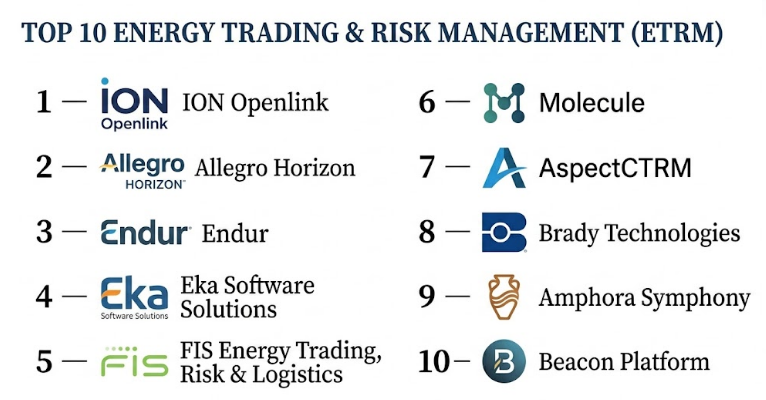
Introduction
Energy Trading & Risk Management, commonly called ETRM, refers to software platforms that help energy companies manage trading, contracts, positions, risk, logistics, settlements, and compliance. In simple English, an ETRM platform helps energy businesses know what they bought, what they sold, where the energy is moving, what risks they are carrying, and how much money they may gain or lose.
ETRM platforms are used across power, gas, oil, LNG, renewables, coal, refined products, carbon, and environmental commodities. These tools are especially important because energy markets are complex, volatile, highly regulated, and dependent on real-time data. A small mistake in contracts, nominations, pricing, or risk exposure can create serious financial and operational problems.
Common use cases include:
- Energy trade capture and deal lifecycle management
- Market price, credit, liquidity, and operational risk tracking
- Power, gas, oil, and renewable energy portfolio management
- Contract, nomination, scheduling, and settlement workflows
- Regulatory reporting and audit support
- Forecasting, valuation, and exposure management
- Integration with exchanges, pricing feeds, ERP, accounting, and logistics systems
Buyers should evaluate:
- Commodity coverage
- Trade capture and contract management
- Position and exposure tracking
- Risk analytics and valuation
- Scheduling, nominations, and logistics support
- Settlement and invoicing workflows
- Regulatory and compliance capabilities
- Integrations with market data, ERP, accounting, and trading systems
- Scalability and performance
- Security, audit trails, and role-based access
- Vendor implementation experience
- Support for cloud, hosted, or on-premise deployment
Best for: Energy trading firms, utilities, oil and gas companies, power producers, renewable energy firms, commodity traders, LNG businesses, risk teams, middle-office teams, back-office teams, finance teams, and energy portfolio managers.
Not ideal for: Very small companies with only basic contract tracking, teams that only need simple spreadsheet-based reporting, or businesses that do not actively trade, hedge, schedule, or settle energy products.
Key Energy Trading & Risk Management ETRM Platform Trends
- Cloud-based ETRM adoption is growing because companies want faster deployment, easier upgrades, and lower infrastructure burden.
- Renewables and environmental commodities support is becoming more important as energy portfolios include power purchase agreements, carbon credits, renewable certificates, and green contracts.
- Real-time risk visibility is now essential because market volatility can change exposure quickly.
- Advanced analytics and AI-assisted insights are helping teams improve forecasting, anomaly detection, pricing analysis, and scenario planning.
- Integration with market data feeds is critical for accurate valuation, mark-to-market reporting, and risk calculations.
- Regulatory reporting and auditability remain core requirements for energy trading organizations.
- Multi-commodity support is important for companies trading across power, gas, oil, LNG, carbon, and related products.
- Middle-office automation is becoming a key differentiator because manual risk checks and spreadsheet reconciliation are slow and risky.
- API-first architecture is gaining importance as firms connect ETRM with ERP, accounting, logistics, BI, data lakes, and trading platforms.
- Cybersecurity and access control are becoming stronger priorities because trading data, pricing, positions, and contracts are highly sensitive.
How We Selected These Tools
The platforms below were selected using a practical buyer-focused evaluation approach:
- Recognized presence in energy trading, commodity trading, ETRM, CTRM, risk management, or energy portfolio management.
- Ability to support front-office, middle-office, and back-office energy workflows.
- Coverage across energy commodities such as power, gas, oil, LNG, renewables, carbon, and environmental products.
- Strength of trade capture, position management, risk analytics, settlement, and accounting workflows.
- Suitability for different buyer types, including utilities, producers, trading houses, oil and gas companies, and renewable energy businesses.
- Scalability for multi-entity, multi-region, and multi-commodity operations.
- Integration capability with market data, ERP, accounting, scheduling, exchanges, and reporting systems.
- Security posture, auditability, and governance capabilities where confidently known.
- Vendor maturity, implementation support, documentation, and professional services ecosystem.
- Balance between large enterprise platforms, cloud-native platforms, specialist energy tools, and flexible commodity trading platforms.
Top 10 Energy Trading & Risk Management ETRM Platforms
#1 — ION Openlink
Short description :
ION Openlink is a well-known trading and risk management platform used by energy, commodity, and financial trading organizations. It supports complex deal capture, valuation, risk, scheduling, settlement, and accounting workflows. The platform is suitable for large energy companies, trading houses, and organizations with multi-commodity portfolios. It is especially useful where trading operations require strong front-to-back-office control. Openlink is best for companies that need deep trading and risk functionality across complex business environments.
Key Features
- Multi-commodity trading and risk management
- Trade capture and lifecycle management
- Position and exposure tracking
- Valuation and mark-to-market workflows
- Scheduling, logistics, settlement, and accounting support
- Risk analytics and reporting
- Enterprise integration and workflow support
Pros
- Strong fit for large and complex trading organizations.
- Broad front, middle, and back-office functionality.
- Suitable for multi-commodity and multi-region energy portfolios.
Cons
- Implementation can be complex and resource-intensive.
- May be too advanced for smaller trading teams.
- Customization and upgrades may require specialist support.
Platforms / Deployment
Web / Desktop options may vary
Cloud / Hosted / On-premise / Hybrid options may vary
Security & Compliance
Enterprise access controls, audit trails, user permissions, and workflow governance are expected. Specific certifications such as SOC 2, ISO 27001, GDPR, or other compliance details should be verified directly with the vendor. Not publicly stated here.
Integrations & Ecosystem
ION Openlink is designed for complex trading environments where ETRM must connect with many business and market systems.
- Market data feeds
- ERP and accounting systems
- Scheduling and logistics systems
- Risk and reporting tools
- Data warehouse and BI systems
- Exchange and broker workflows
Support & Community
Enterprise support, implementation services, documentation, and partner ecosystem support are typically available. Community strength is strongest among large commodity and energy trading organizations.
#2 — Allegro Horizon
Short description :
Allegro Horizon is an ETRM and commodity trading platform used by energy companies, utilities, refiners, marketers, and trading firms. It supports trade capture, risk, credit, logistics, settlements, and financial management across energy and commodity products. The platform is suitable for organizations that need strong operational and financial control across the full trade lifecycle. Allegro is often used by companies with physical and financial commodity trading needs. It is best for mid-market and enterprise buyers managing energy trading operations at scale.
Key Features
- Energy and commodity trade capture
- Position, exposure, and risk management
- Credit risk and counterparty tracking
- Contract management and settlements
- Logistics and scheduling support
- Financial and accounting workflows
- Reporting and analytics
Pros
- Strong coverage for energy and commodity trading.
- Useful for physical and financial trading workflows.
- Good fit for utilities, marketers, and commodity trading businesses.
Cons
- Implementation may require process redesign.
- Configuration can be complex for smaller teams.
- Pricing and package details are usually not simple publicly.
Platforms / Deployment
Web / Desktop options may vary
Cloud / Hosted / On-premise / Hybrid options may vary
Security & Compliance
Enterprise controls such as access permissions, audit trails, and workflow governance may be available. Specific certifications are Not publicly stated here.
Integrations & Ecosystem
Allegro Horizon works well where ETRM must connect trading, risk, logistics, finance, and accounting workflows.
- ERP and accounting systems
- Market data providers
- Scheduling and logistics tools
- Credit and risk workflows
- BI and reporting systems
- External trading and broker systems
Support & Community
Vendor support, professional services, implementation partners, and documentation are available. Community strength is strong among energy trading and commodity management teams.
#3 — Endur
Short description :
Endur is an enterprise trading and risk management platform used by energy and commodity trading organizations. It supports front-office trade capture, middle-office risk control, and back-office settlement and accounting workflows. Endur is suitable for companies with complex portfolios across power, gas, oil, LNG, and other commodities. It is especially useful for organizations needing deep valuation, risk analytics, and enterprise-scale trade lifecycle management. Endur is best for large trading organizations that require high configurability and strong risk control.
Key Features
- Multi-commodity trade lifecycle management
- Advanced valuation and risk analytics
- Position and exposure management
- Deal capture and contract workflows
- Settlement, invoicing, and accounting support
- Market data and curve management
- Enterprise reporting and controls
Pros
- Strong for complex trading and risk environments.
- Deep functionality across front, middle, and back office.
- Suitable for large energy and commodity portfolios.
Cons
- Can be complex to implement and maintain.
- Requires skilled users and technical support.
- May be too heavy for smaller trading organizations.
Platforms / Deployment
Web / Desktop options may vary
Cloud / Hosted / On-premise / Hybrid options may vary
Security & Compliance
Enterprise access controls, workflow governance, and audit trails may be available. Specific certifications and compliance details should be verified directly. Not publicly stated here.
Integrations & Ecosystem
Endur is useful when trading operations need integration across pricing, analytics, operations, finance, and risk systems.
- Market data and pricing feeds
- ERP and accounting platforms
- Risk engines and analytics systems
- Scheduling and logistics tools
- Data warehouses and BI tools
- Exchange and broker connectivity
Support & Community
Enterprise support, consulting, implementation services, and specialist ecosystem support are available. Community strength is strongest among advanced trading and risk management teams.
#4 — Eka Software Solutions
Short description :
Eka Software Solutions provides cloud-based commodity management and trading software for energy, agriculture, metals, and other commodity businesses. For energy trading teams, Eka can support trade capture, risk management, procurement, logistics, inventory, and financial workflows. It is suitable for companies looking for a modern commodity management platform with flexible cloud deployment. Eka is especially useful for organizations that want to connect trading, supply chain, and risk management. It is best for mid-market and enterprise commodity businesses that need practical digital transformation.
Key Features
- Commodity trading and risk management
- Trade capture and contract management
- Procurement, inventory, and logistics workflows
- Position and exposure tracking
- Risk and margin visibility
- Cloud-based platform approach
- Reporting and analytics
Pros
- Flexible for commodity businesses beyond only energy.
- Cloud-oriented approach can support faster modernization.
- Useful for trading, supply chain, and finance alignment.
Cons
- Energy-specific depth should be validated by use case.
- Advanced trading needs may require configuration.
- Exact module scope can vary by implementation.
Platforms / Deployment
Web
Cloud
Security & Compliance
Enterprise cloud security controls may be available. Specific certifications are Not publicly stated here and should be verified with the vendor.
Integrations & Ecosystem
Eka is useful when commodity trading data must connect with procurement, logistics, inventory, risk, and finance systems.
- ERP and accounting workflows
- Market data and pricing inputs
- Logistics and inventory systems
- Procurement platforms
- Reporting and analytics tools
- APIs and business system integrations
Support & Community
Vendor support, onboarding, implementation guidance, and documentation are available. Community strength is strongest among commodity trading and supply chain organizations.
#5 — FIS Energy Trading, Risk & Logistics
Short description :
FIS Energy Trading, Risk & Logistics solutions support energy companies in managing trading, risk, logistics, and settlement workflows. The platform is relevant for power, gas, oil, and commodity market participants that need trade lifecycle control. It helps organizations manage positions, exposures, operations, and financial outcomes. FIS is best suited for companies that need established financial technology and risk management capabilities connected with energy trading workflows. It can support organizations that require robust controls across trading and operations.
Key Features
- Energy trade and contract management
- Position and exposure tracking
- Risk management and analytics
- Logistics and scheduling support
- Settlement and accounting workflows
- Reporting and operational visibility
- Integration with financial and market systems
Pros
- Strong financial technology background.
- Useful for energy trading and risk control.
- Good fit for organizations needing trading, logistics, and finance alignment.
Cons
- Implementation and configuration may require specialist support.
- Smaller organizations may find it more than they need.
- Detailed module and pricing information may require vendor discussion.
Platforms / Deployment
Web / Desktop options may vary
Cloud / Hosted / On-premise options may vary
Security & Compliance
Enterprise security controls are expected. Specific certifications and compliance details should be verified directly with the vendor. Not publicly stated here.
Integrations & Ecosystem
FIS solutions are useful when trading and risk workflows must connect with finance, accounting, market, and operational systems.
- Market data feeds
- ERP and finance systems
- Risk and reporting systems
- Scheduling and logistics workflows
- Accounting and settlement processes
- Business intelligence tools
Support & Community
Enterprise support, documentation, onboarding, and professional services are typically available. Community strength is strongest among financial services, trading, and energy market participants.
#6 — Molecule
Short description :
Molecule is a cloud-based ETRM platform designed for energy and commodity trading teams that want modern trade capture, position management, risk analytics, and reporting. It is especially attractive for companies that want a flexible, web-based platform without heavy legacy infrastructure. Molecule supports trading workflows across commodities and helps teams manage exposure, valuation, and reporting. It is a good fit for growing trading firms, renewable energy businesses, and mid-market energy companies. Molecule is best for teams that want usability and cloud-native flexibility.
Key Features
- Cloud-based trade capture
- Position and exposure management
- Risk analytics and valuation
- Dashboards and reporting
- Commodity portfolio support
- Workflow automation
- API and integration capabilities
Pros
- Modern cloud-based user experience.
- Suitable for growing trading teams.
- Easier to adopt than some heavy legacy platforms.
Cons
- Very complex enterprise scenarios should be validated carefully.
- Advanced commodity-specific needs may require configuration.
- Buyers should confirm coverage for their exact products and markets.
Platforms / Deployment
Web
Cloud
Security & Compliance
Cloud security controls, permissions, and audit-related features may be available. Specific certifications are Not publicly stated here.
Integrations & Ecosystem
Molecule works well when ETRM needs to connect with pricing feeds, accounting tools, data platforms, and reporting systems.
- Market data feeds
- Accounting and ERP systems
- APIs and data exports
- Reporting and analytics workflows
- Trading and risk data pipelines
Support & Community
Vendor support, onboarding, documentation, and customer success resources are available. Community strength is strongest among modern energy trading and cloud ETRM users.
#7 — AspectCTRM
Short description :
AspectCTRM is a cloud-based commodity trading and risk management platform used by trading firms and commodity businesses. It supports trade capture, position management, risk, logistics, inventory, and settlements. The platform is suitable for organizations that want a web-based CTRM or ETRM-style solution without heavy on-premise infrastructure. It is useful for energy and commodity traders who need practical trade lifecycle visibility. AspectCTRM is best for small to mid-sized trading firms and companies looking for faster cloud deployment.
Key Features
- Cloud-based trade capture
- Commodity and energy trading workflows
- Position and exposure tracking
- Risk management and reporting
- Inventory and logistics workflows
- Settlement and invoicing support
- Dashboard and analytics capabilities
Pros
- Cloud-based and accessible.
- Practical for small and mid-sized commodity trading firms.
- Useful for trade lifecycle visibility without heavy infrastructure.
Cons
- May not match the deepest enterprise platforms for complex global operations.
- Advanced customization should be validated.
- Commodity coverage may vary by implementation.
Platforms / Deployment
Web
Cloud
Security & Compliance
Cloud access controls and user permissions may be available. Specific certifications are Not publicly stated here.
Integrations & Ecosystem
AspectCTRM is useful when trading teams need a cloud platform connected with pricing, reporting, finance, and operational systems.
- Market pricing data
- ERP and accounting exports
- Inventory and logistics workflows
- Reporting tools
- APIs and data integration options
Support & Community
Vendor support, onboarding, documentation, and implementation guidance are available. Community strength is strongest among cloud CTRM and commodity trading users.
#8 — Brady Technologies
Short description :
Brady Technologies provides trading, risk, and logistics software for energy and commodity markets. Its solutions are relevant for power, gas, metals, recycling, and other commodity businesses. For ETRM users, Brady can support trade management, risk, scheduling, logistics, settlements, and operational workflows. It is especially useful for European energy markets and commodity businesses needing strong operational control. Brady is best for companies that require specialized energy and commodity workflows rather than generic financial trading software.
Key Features
- Energy and commodity trade management
- Position and risk tracking
- Scheduling and logistics support
- Settlement and invoicing workflows
- Market data and pricing support
- Reporting and compliance workflows
- Commodity-specific operational tools
Pros
- Strong commodity and energy market focus.
- Useful for operational trading workflows.
- Good fit for specialized energy and commodity businesses.
Cons
- Product scope may vary depending on market and module.
- Implementation may require domain expertise.
- Buyers should validate specific commodity coverage.
Platforms / Deployment
Web / Desktop options may vary
Cloud / Hosted / On-premise options may vary
Security & Compliance
Enterprise access controls and audit workflows may be available. Specific certifications are Not publicly stated here.
Integrations & Ecosystem
Brady solutions are useful when trading systems must connect with energy market operations, logistics, settlement, and reporting processes.
- Market data systems
- Scheduling and logistics systems
- ERP and accounting workflows
- Reporting and compliance systems
- Commodity market processes
Support & Community
Vendor support, implementation services, documentation, and domain guidance are available. Community strength is strongest among energy and commodity trading professionals.
#9 — Amphora Symphony
Short description :
Amphora Symphony is a commodity trading and risk management platform used by energy, oil, gas, metals, and commodity trading organizations. It supports trade capture, operations, risk, logistics, contracts, and settlement workflows. The platform is useful for trading firms that need a flexible system for physical and financial commodity transactions. Amphora is especially relevant for organizations managing complex deal structures and operational processes. It is best for trading teams that need strong commodity lifecycle management.
Key Features
- Commodity trade capture and management
- Position and risk tracking
- Contract and deal lifecycle support
- Logistics and operations workflows
- Settlement and invoicing support
- Reporting and analytics
- Support for physical and financial commodity trading
Pros
- Strong commodity trading focus.
- Useful for physical trading and operational workflows.
- Suitable for energy, oil, gas, and related commodity businesses.
Cons
- Implementation may require domain and workflow expertise.
- Exact commodity coverage should be validated.
- May be more advanced than small teams need.
Platforms / Deployment
Web / Desktop options may vary
Cloud / Hosted / On-premise options may vary
Security & Compliance
Enterprise security controls and user permissions may be available. Specific certifications are Not publicly stated here.
Integrations & Ecosystem
Amphora Symphony is useful when trading data must connect with operations, logistics, finance, and risk systems.
- Market data feeds
- Logistics and scheduling systems
- ERP and accounting systems
- Risk and reporting tools
- Data export and integration workflows
Support & Community
Vendor support, implementation assistance, training, and documentation are available. Community strength is strongest among commodity trading and physical energy trading users.
#10 — Beacon Platform
Short description :
Beacon Platform is a cloud-native platform for financial markets, analytics, and risk management. While it is not a traditional ETRM-only system, it is relevant for energy and commodity trading teams that need advanced analytics, risk modeling, pricing, and development flexibility. Beacon is useful for organizations with quantitative teams that want to build or customize trading and risk workflows. It can support energy trading use cases where analytics and flexibility are more important than a prebuilt operational ETRM workflow. Beacon is best for sophisticated teams with strong technical and quantitative capabilities.
Key Features
- Cloud-native analytics and risk platform
- Pricing, valuation, and risk modeling support
- Custom application development capabilities
- Data integration and analytics workflows
- Suitable for quantitative trading teams
- Flexible reporting and modeling environment
- Support for complex financial and commodity analytics
Pros
- Strong for advanced analytics and custom risk workflows.
- Cloud-native and flexible for technical teams.
- Useful when prebuilt ETRM systems are not enough for modeling needs.
Cons
- Not a full traditional ETRM out of the box.
- Requires technical and quantitative expertise.
- Operational workflows such as scheduling and settlements may need separate systems.
Platforms / Deployment
Web
Cloud
Security & Compliance
Enterprise cloud security controls may be available. Specific certifications are Not publicly stated here.
Integrations & Ecosystem
Beacon is useful when analytics, pricing models, and risk workflows need to connect with trading data and enterprise systems.
- Market data sources
- Trading and risk data
- Analytics libraries and models
- APIs and data pipelines
- BI and reporting tools
- Custom trading applications
Support & Community
Vendor support, technical documentation, onboarding, and implementation guidance are available. Community strength is strongest among quantitative, risk, and financial engineering teams.
Comparison Table
| Tool Name | Best For | Platform(s) Supported | Deployment | Standout Feature | Public Rating |
|---|---|---|---|---|---|
| ION Openlink | Large energy and commodity trading organizations | Web / Desktop options vary | Cloud / Hosted / On-premise / Hybrid | Deep enterprise trading and risk management | N/A |
| Allegro Horizon | Utilities, marketers, and commodity trading firms | Web / Desktop options vary | Cloud / Hosted / On-premise / Hybrid | Strong physical and financial commodity workflows | N/A |
| Endur | Complex enterprise energy trading portfolios | Web / Desktop options vary | Cloud / Hosted / On-premise / Hybrid | Advanced valuation and multi-commodity risk analytics | N/A |
| Eka Software Solutions | Cloud commodity management and trading teams | Web | Cloud | Trading, supply chain, and risk workflows together | N/A |
| FIS Energy Trading, Risk & Logistics | Energy firms needing finance-linked risk control | Web / Desktop options vary | Cloud / Hosted / On-premise options vary | Trading, risk, logistics, and financial workflow alignment | N/A |
| Molecule | Modern cloud ETRM for growing trading teams | Web | Cloud | Cloud-native trade capture and risk visibility | N/A |
| AspectCTRM | Small and mid-sized cloud commodity traders | Web | Cloud | Faster cloud-based CTRM deployment | N/A |
| Brady Technologies | Specialized energy and commodity market operations | Web / Desktop options vary | Cloud / Hosted / On-premise options vary | Commodity-specific trading and logistics workflows | N/A |
| Amphora Symphony | Physical commodity and energy trading firms | Web / Desktop options vary | Cloud / Hosted / On-premise options vary | Physical trading lifecycle and operational support | N/A |
| Beacon Platform | Quantitative trading and custom risk analytics teams | Web | Cloud | Flexible cloud-native analytics and risk modeling | N/A |
Evaluation & Energy Trading Risk Management Platforms
| Tool Name | Core (25%) | Ease (15%) | Integrations (15%) | Security (10%) | Performance (10%) | Support (10%) | Value (15%) | Weighted Total (0–10) |
|---|---|---|---|---|---|---|---|---|
| ION Openlink | 9 | 6 | 9 | 8 | 9 | 8 | 7 | 8.10 |
| Allegro Horizon | 9 | 7 | 8 | 8 | 8 | 8 | 7 | 8.00 |
| Endur | 9 | 6 | 9 | 8 | 9 | 8 | 7 | 8.10 |
| Eka Software Solutions | 8 | 8 | 8 | 7 | 8 | 8 | 8 | 7.90 |
| FIS Energy Trading, Risk & Logistics | 8 | 7 | 8 | 8 | 8 | 8 | 7 | 7.75 |
| Molecule | 8 | 9 | 8 | 7 | 8 | 8 | 8 | 8.05 |
| AspectCTRM | 7 | 8 | 7 | 7 | 7 | 7 | 8 | 7.25 |
| Brady Technologies | 8 | 7 | 7 | 7 | 8 | 8 | 7 | 7.50 |
| Amphora Symphony | 8 | 7 | 7 | 7 | 8 | 8 | 7 | 7.50 |
| Beacon Platform | 7 | 7 | 9 | 8 | 9 | 8 | 7 | 7.85 |
These scores are comparative and should be used as a shortlisting guide, not as a final buying decision. A platform with a high enterprise score may be too complex for a smaller trading firm. A cloud-native platform may be easier to adopt but may need validation for deep physical scheduling, settlement, or regional market requirements. Buyers should test real trades, pricing curves, risk reports, settlement workflows, and integrations before choosing.
Which Energy Trading & Risk Management ETRM Platform Should You Choose?
Solo / Freelancer
Solo consultants and independent energy advisors usually do not need a full enterprise ETRM unless they are supporting a client implementation. For advisory, modeling, or risk analysis work, Beacon Platform may be useful if advanced analytics are required.
Freelancers working with clients should understand platforms such as ION Openlink, Endur, Allegro Horizon, Molecule, and AspectCTRM, because clients may already use these systems internally.
SMB
Small and mid-sized trading firms usually need practical trade capture, position visibility, and risk reporting without heavy infrastructure. Molecule and AspectCTRM are strong options for cloud-based ETRM or CTRM workflows.
SMBs should avoid overbuying. A large enterprise platform can be powerful, but it may create unnecessary cost and implementation effort if the trading operation is still simple.
Mid-Market
Mid-market energy firms often need better trade lifecycle control, valuation, settlements, market data integration, and reporting. Allegro Horizon, Eka Software Solutions, Molecule, Brady Technologies, and Amphora Symphony can be good candidates depending on commodity coverage.
A mid-market utility may prefer a platform with strong scheduling and settlements. A commodity trading firm may prioritize physical logistics and risk. A renewable energy trader may need flexibility around power, certificates, and environmental products.
Enterprise
Large enterprises should prioritize scalability, multi-commodity support, global operations, role-based security, audit trails, valuation depth, integration flexibility, and support for front-to-back-office workflows. ION Openlink, Endur, Allegro Horizon, FIS Energy Trading, Risk & Logistics, and Amphora Symphony are strong enterprise candidates.
Enterprise buyers should validate deployment options, custom workflows, performance at scale, regional market support, integration with ERP and accounting, and upgrade strategy.
Budget vs Premium
Budget-conscious buyers may prefer Molecule or AspectCTRM if cloud deployment and faster implementation are priorities. These platforms can be practical for growing trading organizations that need structure without very heavy implementation.
Premium buyers with complex trading operations may need ION Openlink, Endur, Allegro Horizon, or FIS. Premium platforms usually offer deeper functionality but require stronger internal project ownership and implementation planning.
Feature Depth vs Ease of Use
For feature depth, ION Openlink, Endur, Allegro Horizon, and FIS are stronger because they support complex trade lifecycle, risk, valuation, and back-office workflows.
For ease of use and modern cloud adoption, Molecule, AspectCTRM, and Eka Software Solutions may feel more approachable depending on the use case.
Integrations & Scalability
Integration needs should be tested carefully. ETRM platforms often need to connect with market data feeds, ERP, accounting, settlement systems, scheduling tools, exchanges, data lakes, and BI platforms.
For large integration-heavy environments, ION Openlink, Endur, Allegro Horizon, and FIS may be stronger. For API-driven modern workflows, Molecule, Beacon Platform, and Eka Software Solutions may be attractive depending on architecture.
Security & Compliance Needs
Energy trading data is sensitive because it includes positions, pricing, contracts, counterparties, risk exposure, and financial outcomes. Buyers should ask vendors about SSO, MFA, RBAC, audit logs, encryption, data residency, backup controls, segregation of duties, and approval workflows.
For regulated trading environments, buyers should also validate reporting controls, change history, evidence tracking, and compliance workflows.
Frequently Asked Questions
1. What is an ETRM platform?
An ETRM platform is software used to manage energy trading and risk workflows. It helps companies capture trades, manage positions, track risk, handle contracts, schedule energy movement, settle invoices, and report trading performance.
2. What is the difference between ETRM and CTRM?
ETRM focuses specifically on energy products such as power, gas, oil, LNG, renewables, and carbon. CTRM is broader and can include agriculture, metals, soft commodities, chemicals, and energy products.
3. Who uses ETRM software?
ETRM software is used by utilities, energy traders, oil and gas companies, power producers, LNG businesses, renewable energy firms, risk teams, finance teams, schedulers, and commodity trading organizations.
4. How much does ETRM software cost?
Pricing varies widely based on users, modules, commodities, deployment model, integrations, implementation services, and support level. Enterprise ETRM platforms usually use custom pricing, while cloud-native platforms may be more flexible.
5. Can energy trading be managed in spreadsheets?
Very small operations may start with spreadsheets, but spreadsheets become risky as trade volume, market volatility, counterparties, and settlement complexity increase. ETRM platforms provide better controls, automation, audit trails, and risk visibility.
6. What is the biggest mistake buyers make?
The biggest mistake is choosing a platform before mapping real trading workflows. Buyers should document trade capture, market data, risk reports, settlements, scheduling, accounting, and compliance needs before selecting software.
7. Can ETRM platforms support renewable energy trading?
Yes, many platforms can support renewable power, certificates, environmental commodities, and related contracts, but buyers must validate exact product coverage. Renewable trading workflows can differ from traditional power or fuel trading.
8. Do ETRM platforms integrate with ERP and accounting systems?
Yes, many ETRM platforms integrate with ERP, accounting, finance, settlement, market data, logistics, and reporting systems. Integration testing is one of the most important parts of vendor evaluation.
9. Which ETRM platform is best for small trading firms?
Small trading firms may consider cloud-based platforms such as Molecule or AspectCTRM, depending on commodity coverage and workflow needs. The best choice is usually the one that supports core trades, risk, and settlements without heavy complexity.
10. Which ETRM platform is best for enterprises?
Enterprises may evaluate ION Openlink, Endur, Allegro Horizon, FIS Energy Trading Risk & Logistics, or Amphora Symphony. The best choice depends on commodity coverage, trading complexity, deployment preference, integrations, and internal support capability.
Conclusion
Energy Trading & Risk Management platforms are critical for organizations that buy, sell, hedge, schedule, and settle energy products. The right ETRM platform helps teams reduce spreadsheet risk, improve trade visibility, manage market exposure, support settlements, and maintain stronger operational control. However, the best platform depends heavily on company size, commodity coverage, trading complexity, deployment preference, integration needs, and internal expertise.
