Introduction
Healthcare Electronic Health Record (EHR) Systems are digital platforms that store, manage, and share patient medical data in a secure and structured way. Instead of paper files, hospitals and clinics use EHRs to track patient history, prescriptions, lab results, and clinical workflows in real time.
In today’s healthcare landscape EHR systems are no longer optional—they are central to patient care, compliance, and operational efficiency. With rising patient expectations, telemedicine growth, and stricter regulations, healthcare providers rely heavily on modern EHR platforms.
Real-world use cases:
- Managing patient records across multiple hospitals or clinics
- Enabling telemedicine and remote consultations
- Automating billing, insurance claims, and coding
- Supporting clinical decision-making with AI insights
- Improving care coordination between departments
What buyers should evaluate:
- Ease of use for clinicians
- Interoperability (FHIR, HL7 support)
- Security and compliance (HIPAA, GDPR)
- Scalability across locations
- Customization and workflows
- Integration with labs, imaging, and billing
- AI and automation capabilities
- Deployment flexibility (cloud vs on-premise)
- Cost structure and long-term ROI
Best for: Hospitals, clinics, diagnostic centers, telehealth providers, and healthcare networks of all sizes that need structured patient data management and compliance-ready workflows.
Not ideal for: Very small practices with minimal patient volume or organizations that only need basic appointment scheduling—lighter practice management tools may be sufficient.
Key Trends in Healthcare EHR Systems
- AI-powered clinical decision support improving diagnosis and treatment suggestions
- Cloud-first deployments replacing legacy on-premise systems
- FHIR-based interoperability becoming standard for data exchange
- Patient-centric portals enabling self-service access and engagement
- Voice-enabled documentation reducing clinician workload
- Integrated telehealth modules within EHR platforms
- Automation of billing and coding using AI and NLP
- Stronger compliance frameworks with built-in audit tracking
- Mobile-first access for doctors and healthcare staff
- Predictive analytics for population health management
How We Selected These Tools (Methodology)
- Evaluated market adoption and industry presence
- Assessed feature completeness across clinical workflows
- Reviewed performance and reliability signals
- Considered security and compliance readiness
- Analyzed integration capabilities and ecosystem strength
- Looked at fit across SMB to enterprise healthcare providers
- Prioritized innovation (AI, automation, telehealth integration)
- Balanced usability vs depth of features
- Included global and regionally dominant platforms
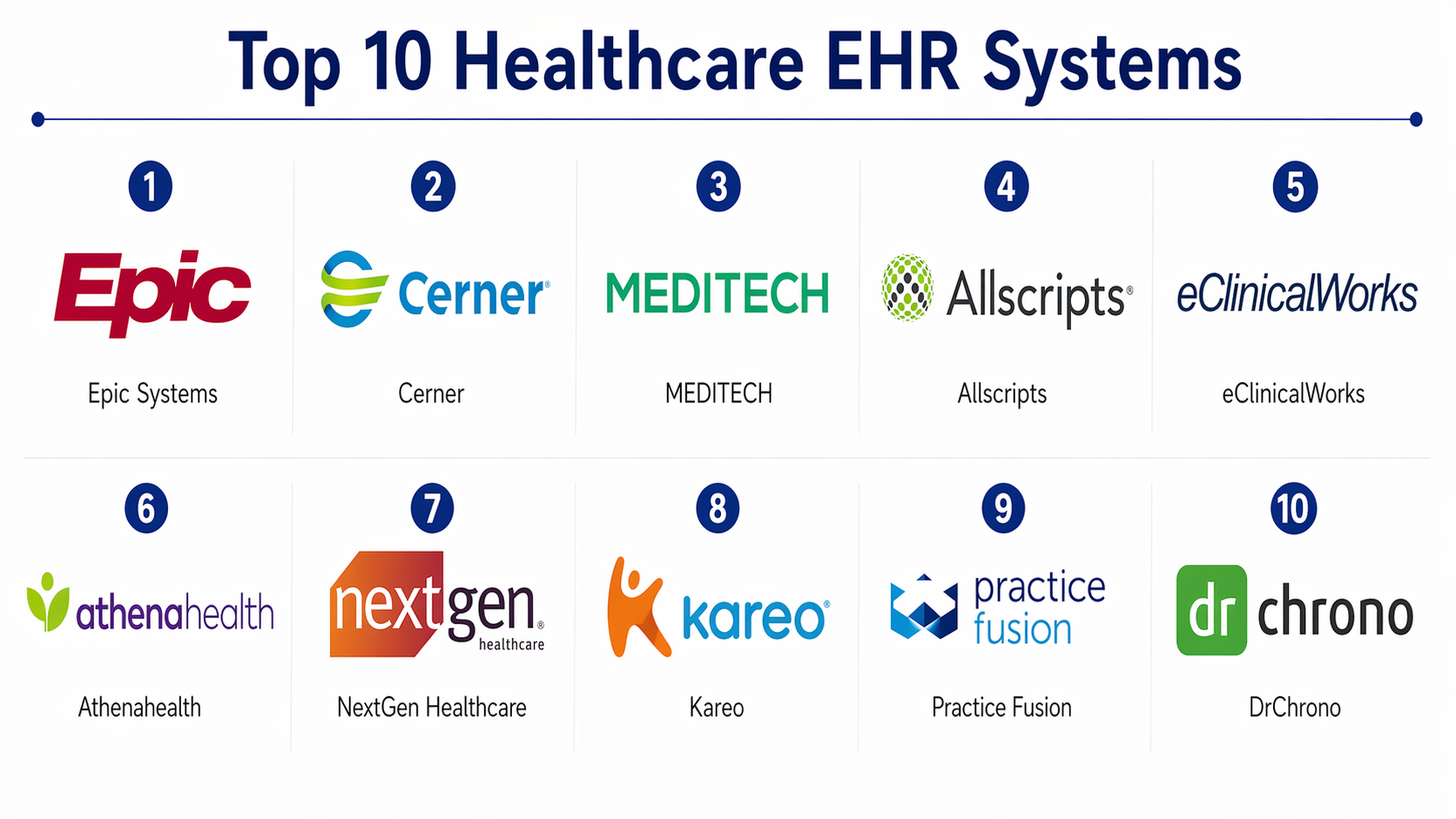
Top 10 Healthcare EHR Systems
#1 — Epic Systems
Short description :
Epic is one of the most widely used enterprise-grade EHR systems globally. It is designed for large hospitals and healthcare networks that need comprehensive clinical, administrative, and financial workflows. Epic offers deep integration across departments and strong interoperability. It is known for its scalability and advanced analytics capabilities.
Key Features
- Comprehensive patient record management
- Integrated billing and revenue cycle management
- Advanced analytics and reporting
- Interoperability via FHIR and HL7
- Patient portal and engagement tools
- Telehealth integration
Pros
- Highly scalable for large organizations
- Strong ecosystem and integration support
Cons
- Complex implementation
- High cost for smaller organizations
Platforms / Deployment
Web / Windows / iOS / Android
Cloud / Self-hosted / Hybrid
Security & Compliance
HIPAA-ready, encryption, RBAC, audit logs
Integrations & Ecosystem
Epic integrates with labs, imaging systems, insurance providers, and third-party healthcare tools.
- HL7 and FHIR APIs
- Pharmacy systems
- Telehealth platforms
- Revenue cycle tools
Support & Community
Strong enterprise support with structured onboarding and dedicated account teams.
#2 — Cerner (Oracle Health)
Short description :
Cerner, now part of Oracle Health, provides a scalable EHR platform for hospitals and health systems. It focuses on interoperability and data-driven healthcare. Cerner is widely used across global healthcare organizations.
Key Features
- Clinical and administrative workflows
- Population health analytics
- Real-time patient monitoring
- Interoperability tools
- AI-driven insights
Pros
- Strong interoperability
- Enterprise-grade analytics
Cons
- Learning curve for new users
- Implementation complexity
Platforms / Deployment
Web / Mobile
Cloud / Hybrid
Security & Compliance
HIPAA-ready, encryption, audit logs
Integrations & Ecosystem
- Oracle ecosystem
- Lab systems
- Insurance platforms
- APIs for third-party tools
Support & Community
Enterprise support with structured documentation.
#3 — MEDITECH
Short description :
MEDITECH is a long-standing EHR provider known for its affordability and reliability. It serves hospitals and mid-sized healthcare providers with a focus on usability and core clinical workflows.
Key Features
- Patient record management
- Clinical decision support
- Billing and financial modules
- Reporting tools
- Interoperability support
Pros
- Cost-effective for mid-market
- Stable and reliable
Cons
- Limited UI modernization
- Fewer advanced AI features
Platforms / Deployment
Web / Windows
Cloud / Self-hosted
Security & Compliance
HIPAA-ready
Integrations & Ecosystem
- Lab integrations
- Billing systems
- API support
Support & Community
Moderate support and long-term customer base.
#4 — Allscripts (Veradigm)
Short description :
Allscripts offers flexible EHR solutions for hospitals and physician practices. It emphasizes open architecture and interoperability, allowing integration with various third-party systems.
Key Features
- Open architecture platform
- Clinical documentation tools
- ePrescribing
- Population health analytics
- Interoperability tools
Pros
- Flexible integrations
- Customizable workflows
Cons
- Interface complexity
- Variable performance
Platforms / Deployment
Web / Mobile
Cloud / Hybrid
Security & Compliance
HIPAA-ready
Integrations & Ecosystem
- Third-party apps
- APIs
- Health data networks
Support & Community
Varies by deployment and region.
#5 — eClinicalWorks
Short description :
eClinicalWorks is a popular cloud-based EHR solution for small to mid-sized practices. It offers integrated telehealth, patient engagement, and billing features.
Key Features
- Cloud-based EHR
- Telehealth integration
- Patient portal
- Billing and coding
- AI-powered documentation
Pros
- Affordable for SMBs
- Easy cloud deployment
Cons
- Customization limitations
- Performance concerns reported
Platforms / Deployment
Web / iOS / Android
Cloud
Security & Compliance
HIPAA-ready
Integrations & Ecosystem
- Labs and pharmacies
- Billing tools
- APIs
Support & Community
Moderate support with large SMB user base.
#6 — Athenahealth
Short description :
Athenahealth provides a cloud-native EHR platform focused on usability and revenue cycle management. It is widely used by ambulatory care providers.
Key Features
- Cloud-based EHR
- Revenue cycle management
- Patient engagement tools
- Analytics and reporting
- Interoperability
Pros
- User-friendly interface
- Strong billing features
Cons
- Limited enterprise customization
- Dependency on cloud infrastructure
Platforms / Deployment
Web / Mobile
Cloud
Security & Compliance
HIPAA-ready
Integrations & Ecosystem
- Partner ecosystem
- APIs
- Telehealth tools
Support & Community
Strong customer support and onboarding.
#7 — NextGen Healthcare
Short description :
NextGen Healthcare focuses on ambulatory practices and specialty care providers. It offers configurable workflows tailored to different medical specialties.
Key Features
- Specialty-specific workflows
- Patient engagement
- Practice management tools
- Analytics
- Telehealth
Pros
- Highly customizable
- Good for specialty clinics
Cons
- Complex configuration
- UI can feel outdated
Platforms / Deployment
Web / Mobile
Cloud / Hybrid
Security & Compliance
HIPAA-ready
Integrations & Ecosystem
- Labs
- Billing tools
- APIs
Support & Community
Moderate support with strong niche adoption.
#8 — Kareo
Short description :
Kareo is designed for small practices and independent providers. It combines EHR with practice management and billing tools in a simple interface.
Key Features
- Practice management
- Billing automation
- Patient records
- Scheduling
- Reporting
Pros
- Easy to use
- Affordable
Cons
- Limited scalability
- Fewer advanced features
Platforms / Deployment
Web
Cloud
Security & Compliance
HIPAA-ready
Integrations & Ecosystem
- Billing systems
- Labs
- APIs
Support & Community
Basic support with SMB focus.
#9 — Practice Fusion
Short description :
Practice Fusion is a cloud-based EHR designed for small clinics. It focuses on simplicity, affordability, and quick deployment.
Key Features
- Cloud EHR
- ePrescribing
- Patient records
- Scheduling
- Reporting
Pros
- Simple setup
- Cost-effective
Cons
- Limited advanced features
- Smaller ecosystem
Platforms / Deployment
Web
Cloud
Security & Compliance
HIPAA-ready
Integrations & Ecosystem
- Labs
- Pharmacies
- APIs
Support & Community
Basic support.
#10 — DrChrono
Short description :
DrChrono is a mobile-first EHR platform tailored for small to mid-sized practices. It offers flexibility and strong mobile capabilities.
Key Features
- Mobile EHR
- Scheduling
- Billing
- Patient portal
- Telehealth
Pros
- Strong mobile experience
- Flexible workflows
Cons
- Limited enterprise capabilities
- Pricing varies
Platforms / Deployment
Web / iOS / Android
Cloud
Security & Compliance
HIPAA-ready
Integrations & Ecosystem
- APIs
- Billing tools
- Labs
Support & Community
Moderate support with growing user base.
Comparison Table (Top 10)
| Tool Name | Best For | Platform(s) Supported | Deployment | Standout Feature | Public Rating |
|---|---|---|---|---|---|
| Epic Systems | Enterprise hospitals | Web, Mobile | Hybrid | Full ecosystem integration | N/A |
| Cerner | Large health systems | Web, Mobile | Cloud/Hybrid | Interoperability | N/A |
| MEDITECH | Mid-market hospitals | Web | Cloud/Self | Cost efficiency | N/A |
| Allscripts | Flexible deployments | Web, Mobile | Hybrid | Open architecture | N/A |
| eClinicalWorks | SMB practices | Web, Mobile | Cloud | Telehealth integration | N/A |
| Athenahealth | Ambulatory care | Web, Mobile | Cloud | Revenue cycle tools | N/A |
| NextGen Healthcare | Specialty clinics | Web, Mobile | Hybrid | Specialty workflows | N/A |
| Kareo | Small practices | Web | Cloud | Simplicity | N/A |
| Practice Fusion | Small clinics | Web | Cloud | Quick deployment | N/A |
| DrChrono | Mobile-first practices | Web, Mobile | Cloud | Mobile usability | N/A |
Evaluation & Healthcare EHR Systems
| Tool Name | Core | Ease | Integrations | Security | Performance | Support | Value | Weighted Total |
|---|---|---|---|---|---|---|---|---|
| Epic Systems | 10 | 7 | 9 | 9 | 9 | 9 | 6 | 8.6 |
| Cerner | 9 | 7 | 9 | 9 | 8 | 8 | 7 | 8.3 |
| MEDITECH | 7 | 7 | 7 | 8 | 8 | 7 | 8 | 7.5 |
| Allscripts | 8 | 6 | 8 | 8 | 7 | 7 | 7 | 7.4 |
| eClinicalWorks | 7 | 8 | 7 | 8 | 7 | 7 | 8 | 7.5 |
| Athenahealth | 8 | 9 | 8 | 8 | 8 | 8 | 7 | 8.2 |
| NextGen | 8 | 7 | 7 | 8 | 7 | 7 | 7 | 7.4 |
| Kareo | 6 | 9 | 6 | 7 | 7 | 6 | 9 | 7.3 |
| Practice Fusion | 6 | 9 | 6 | 7 | 6 | 6 | 9 | 7.1 |
| DrChrono | 7 | 8 | 7 | 8 | 7 | 7 | 8 | 7.6 |
How to interpret:
- Scores are comparative, not absolute
- Enterprise tools score higher in features but lower in ease/value
- SMB tools score higher in ease/value but lower in depth
- Choose based on fit, not highest score
Which Healthcare EHR Systems
Solo / Freelancer
Choose Kareo, Practice Fusion, or DrChrono for simplicity and affordability.
SMB
Best options: eClinicalWorks, Athenahealth for balanced features and usability.
Mid-Market
Consider MEDITECH, NextGen for scalability without enterprise complexity.
Enterprise
Top choices: Epic Systems, Cerner for full ecosystem support.
Budget vs Premium
- Budget: Kareo, Practice Fusion
- Premium: Epic, Cerner
Feature Depth vs Ease of Use
- Deep features: Epic, Cerner
- Easy to use: Athenahealth, Kareo
Integrations & Scalability
- Strong integrations: Epic, Cerner
- Moderate: Athenahealth, Allscripts
Security & Compliance Needs
- High compliance: Epic, Cerner
- Standard compliance: SMB tools
Frequently Asked Questions (FAQs)
1. What is the cost of an EHR system?
Pricing varies widely depending on size, features, and deployment. Small systems may be subscription-based, while enterprise solutions involve large upfront and ongoing costs.
2. How long does implementation take?
Implementation can range from weeks for small clinics to several months for large hospitals.
3. Are EHR systems secure?
Most modern EHR systems include encryption, access controls, and compliance frameworks, but proper configuration is essential.
4. Can EHR systems integrate with other tools?
Yes, most systems support APIs and integrations with labs, billing systems, and telehealth platforms.
5. What is interoperability in EHR?
Interoperability allows systems to exchange patient data using standards like FHIR and HL7.
6. Is cloud better than on-premise?
Cloud offers flexibility and scalability, while on-premise gives more control. Choice depends on organizational needs.
7. What are common mistakes when choosing EHR?
Ignoring usability, underestimating implementation complexity, and overlooking integration needs.
8. Can small clinics use EHR systems?
Yes, many solutions are designed specifically for small practices.
9. How do you switch EHR systems?
Switching involves data migration, training, and process adjustments. Planning is critical.
10. Are there alternatives to EHR systems?
Basic practice management tools exist, but they lack full clinical record capabilities.
Conclusion
Healthcare EHR systems have evolved into mission-critical platforms that go far beyond digital record keeping. From enabling better patient care to ensuring regulatory compliance and operational efficiency, the right EHR system can significantly impact a healthcare organization’s success. However, there is no single “best” solution—each platform is designed with a specific type of user in mind. Large hospitals benefit from robust enterprise systems like Epic and Cerner, while smaller practices may find better value in lightweight, cloud-based tools like Kareo or Practice Fusion.
