Introduction
Sanctions screening tools are software platforms used by organizations to check individuals, businesses, and transactions against global sanctions lists, watchlists, and regulatory databases. These tools help ensure that companies do not engage with sanctioned entities, which could result in heavy penalties, legal risks, or reputational damage.
In today’s global digital economy, especially with increasing cross-border payments, fintech growth, and stricter regulatory frameworks, sanctions screening has become a critical compliance function. Financial institutions, payment providers, crypto exchanges, and even large enterprises must continuously monitor transactions and customers against evolving sanctions lists.
Real-world use cases include:
- Screening new customers during onboarding (KYC processes)
- Monitoring transactions in real time for suspicious activity
- Vendor and partner due diligence checks
- AML (Anti-Money Laundering) compliance workflows
- Continuous monitoring of existing customer databases
What buyers should evaluate:
- Coverage of global sanctions lists
- Real-time vs batch screening capabilities
- AI/ML accuracy and false positive reduction
- Integration with core systems (payments, CRM, ERP)
- Scalability and performance
- Audit trails and reporting features
- Security and compliance standards
- Deployment flexibility (cloud vs on-premise)
- Cost and pricing transparency
Best for: Compliance teams, fintech startups, banks, payment processors, crypto platforms, and enterprises dealing with international transactions.
Not ideal for: Small local businesses with no cross-border exposure or regulatory obligations; manual checks or basic tools may suffice for them.
Key Trends in Sanctions Screening Tools
- AI-driven false positive reduction improving efficiency for compliance teams
- Real-time transaction monitoring becoming standard for fintech and banking platforms
- API-first architecture enabling seamless integration with modern tech stacks
- Continuous monitoring models replacing one-time screening
- Cloud-native deployments dominating due to scalability and ease of updates
- Regulatory expansion globally increasing demand for multi-jurisdiction coverage
- Integration with AML/KYC platforms for unified compliance workflows
- Explainable AI models to support audit and regulatory transparency
- Automation of case management workflows reducing manual investigation effort
- Data enrichment capabilities improving identity matching accuracy
How We Selected These Tools (Methodology)
- Strong market adoption and enterprise usage across banking and fintech sectors
- Comprehensive feature coverage for sanctions, AML, and compliance workflows
- Proven performance and reliability signals in high-volume environments
- Availability of security and compliance controls where publicly known
- Robust integration ecosystems and APIs
- Fit across multiple segments (SMB to enterprise)
- Balance of legacy enterprise vendors and modern API-first platforms
- Feedback signals from industry usage and analyst coverage (without citing sources)
- Ability to handle global regulatory requirements
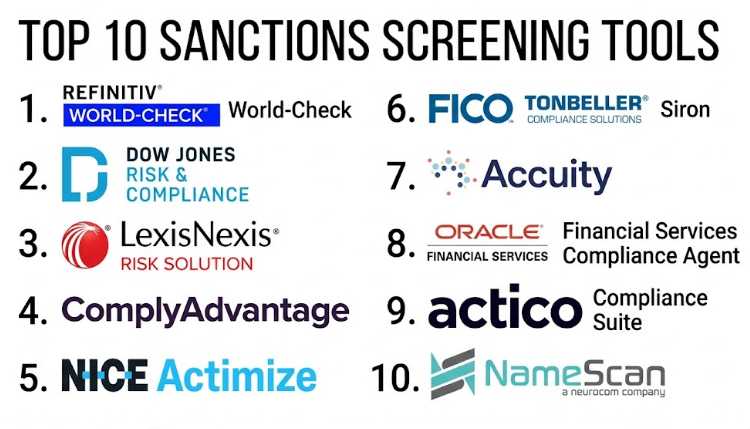
Top 10 Sanctions Screening Tools
#1 — Refinitiv World-Check
Short description:
A widely used sanctions and risk intelligence database used by financial institutions globally. It provides detailed profiles of individuals and entities linked to financial crime risks. Ideal for large enterprises and banks requiring deep data coverage and high accuracy.
Key Features
- Extensive global sanctions and watchlist database
- Risk intelligence profiles and adverse media screening
- Continuous monitoring capabilities
- Integration with AML and KYC workflows
- Advanced matching algorithms
- Audit-ready reporting
Pros
- Highly trusted data source
- Strong global coverage
Cons
- Can be expensive
- Complex setup for smaller teams
Platforms / Deployment
Cloud / Hybrid
Security & Compliance
Not publicly stated
Integrations & Ecosystem
Strong integration with enterprise compliance systems
- APIs for onboarding workflows
- CRM and banking system integration
- AML platforms compatibility
Support & Community
Enterprise-grade support with structured onboarding; documentation is extensive
#2 — Dow Jones Risk & Compliance
Short description:
Provides sanctions screening along with adverse media and risk intelligence. Known for combining news data with compliance tools for enhanced decision-making.
Key Features
- Sanctions and watchlist screening
- Adverse media monitoring
- Entity resolution capabilities
- Real-time updates
- Workflow management tools
Pros
- Strong data quality
- Media-driven insights
Cons
- Higher cost
- May require training
Platforms / Deployment
Cloud
Security & Compliance
Not publicly stated
Integrations & Ecosystem
- APIs for compliance workflows
- Integration with onboarding systems
- Data feeds for enterprise tools
Support & Community
Professional support with onboarding assistance
#3 — LexisNexis Risk Solution
Short description:
A comprehensive compliance platform offering sanctions screening, identity verification, and fraud prevention. Suitable for financial institutions and regulated industries.
Key Features
- Global sanctions list coverage
- Identity verification tools
- Transaction monitoring
- Risk scoring models
- Workflow automation
Pros
- All-in-one compliance platform
- Scalable for enterprise
Cons
- Complex pricing
- Implementation effort
Platforms / Deployment
Cloud / Hybrid
Security & Compliance
Not publicly stated
Integrations & Ecosystem
- APIs and SDKs
- Banking and fintech integrations
- Data enrichment services
Support & Community
Strong enterprise support and documentation
#4 — ComplyAdvantage
Short description:
A modern, AI-driven compliance platform focused on reducing false positives and improving screening efficiency. Popular among fintech companies.
Key Features
- AI-powered sanctions screening
- Real-time transaction monitoring
- Risk scoring
- Continuous monitoring
- API-first platform
Pros
- Easy integration
- Strong AI capabilities
Cons
- Less legacy data depth
- Premium pricing for advanced features
Platforms / Deployment
Cloud
Security & Compliance
Not publicly stated
Integrations & Ecosystem
- REST APIs
- Integration with payment systems
- Fintech ecosystem compatibility
Support & Community
Good documentation and developer-friendly support
#5 — NICE Actimize
Short description:
An enterprise-grade financial crime and compliance solution offering sanctions screening and AML capabilities for large banks and institutions.
Key Features
- Real-time screening
- AML and fraud detection integration
- Advanced analytics
- Case management
- Risk scoring
Pros
- Strong enterprise capabilities
- High scalability
Cons
- Expensive
- Complex deployment
Platforms / Deployment
Cloud / On-premise
Security & Compliance
Not publicly stated
Integrations & Ecosystem
- Integration with core banking systems
- AML and fraud platforms
- Enterprise APIs
Support & Community
Enterprise-level support with dedicated teams
#6 — FICO TONBELLER Siron
Short description:
A compliance and financial crime prevention platform offering sanctions screening and transaction monitoring for banks.
Key Features
- Sanctions screening
- AML monitoring
- Case management
- Risk scoring
- Audit trails
Pros
- Trusted in banking sector
- Strong compliance focus
Cons
- Older interface
- Limited flexibility
Platforms / Deployment
Hybrid
Security & Compliance
Not publicly stated
Integrations & Ecosystem
- Banking system integration
- Data feeds
- Compliance tools
Support & Community
Standard enterprise support
#7 — Accuity (Firco Compliance Link)
Short description:
A widely used tool for payment screening and sanctions compliance, especially in SWIFT environments.
Key Features
- Real-time payment screening
- Sanctions filtering
- SWIFT integration
- Risk scoring
- Alerts and reporting
Pros
- Strong payment screening
- Reliable performance
Cons
- Limited UI flexibility
- Requires tuning
Platforms / Deployment
Cloud / On-premise
Security & Compliance
Not publicly stated
Integrations & Ecosystem
- SWIFT systems
- Payment gateways
- Banking platforms
Support & Community
Enterprise support with financial sector focus
#8 — Oracle Financial Services Compliance Agent
Short description:
Part of Oracle’s financial crime suite, offering sanctions screening and compliance capabilities for large organizations.
Key Features
- Sanctions screening
- Transaction monitoring
- Case management
- Analytics
- Regulatory reporting
Pros
- Strong enterprise ecosystem
- Integrated with Oracle systems
Cons
- Complex setup
- High cost
Platforms / Deployment
Cloud / On-premise
Security & Compliance
Not publicly stated
Integrations & Ecosystem
- Oracle ecosystem
- Enterprise applications
- Data platforms
Support & Community
Strong enterprise support
#9 — Actico Compliance Suite
Short description:
A flexible compliance platform offering sanctions screening and risk management features, suitable for mid-market to enterprise.
Key Features
- Sanctions screening
- Risk scoring
- Workflow automation
- Case management
- Data integration
Pros
- Flexible architecture
- Good automation features
Cons
- Smaller ecosystem
- Less brand recognition
Platforms / Deployment
Cloud / Hybrid
Security & Compliance
Not publicly stated
Integrations & Ecosystem
- APIs
- Banking integrations
- Workflow tools
Support & Community
Moderate support availability
#10 — NameScan
Short description:
A lightweight sanctions screening tool suitable for SMBs and fintech startups needing quick deployment.
Key Features
- Sanctions list screening
- Batch and real-time checks
- API integration
- Alerts and reporting
- Simple dashboard
Pros
- Easy to use
- Affordable
Cons
- Limited advanced features
- Smaller data coverage
Platforms / Deployment
Cloud
Security & Compliance
Not publicly stated
Integrations & Ecosystem
- API access
- CRM integration
- Payment system integration
Support & Community
Basic support with documentation
Comparison Table (Top 10)
| Tool Name | Best For | Platform(s) Supported | Deployment | Standout Feature | Public Rating |
|---|---|---|---|---|---|
| Refinitiv World-Check | Large banks | Web | Cloud/Hybrid | Risk intelligence database | N/A |
| Dow Jones Risk & Compliance | Enterprises | Web | Cloud | Adverse media integration | N/A |
| LexisNexis Risk Solutions | Financial institutions | Web | Cloud/Hybrid | Identity + sanctions combo | N/A |
| ComplyAdvantage | Fintech | Web/API | Cloud | AI-driven screening | N/A |
| NICE Actimize | Enterprises | Web | Hybrid | AML integration | N/A |
| FICO TONBELLER | Banks | Web | Hybrid | AML + sanctions | N/A |
| Accuity Firco | Payments | Web | Hybrid | SWIFT integration | N/A |
| Oracle Compliance Agent | Enterprises | Web | Hybrid | Oracle ecosystem | N/A |
| Actico Compliance Suite | Mid-market | Web | Hybrid | Workflow automation | N/A |
| NameScan | SMBs | Web/API | Cloud | Simplicity | N/A |
Evaluation & Sanctions Screening Tools
| Tool Name | Core (25%) | Ease (15%) | Integrations (15%) | Security (10%) | Performance (10%) | Support (10%) | Value (15%) | Weighted Total |
|---|---|---|---|---|---|---|---|---|
| Refinitiv World-Check | 9 | 6 | 8 | 7 | 9 | 8 | 6 | 7.75 |
| Dow Jones | 9 | 7 | 8 | 7 | 8 | 8 | 6 | 7.70 |
| LexisNexis | 9 | 7 | 9 | 7 | 9 | 8 | 6 | 7.95 |
| ComplyAdvantage | 8 | 9 | 9 | 7 | 8 | 7 | 7 | 8.00 |
| NICE Actimize | 9 | 6 | 8 | 8 | 9 | 8 | 5 | 7.65 |
| FICO TONBELLER | 8 | 6 | 7 | 7 | 8 | 7 | 6 | 7.10 |
| Accuity | 9 | 7 | 8 | 7 | 9 | 8 | 6 | 7.75 |
| Oracle | 9 | 6 | 9 | 8 | 9 | 8 | 5 | 7.80 |
| Actico | 8 | 7 | 7 | 7 | 8 | 7 | 7 | 7.40 |
| NameScan | 6 | 9 | 7 | 6 | 7 | 6 | 9 | 7.20 |
How to interpret scores:
- Scores are relative comparisons, not absolute benchmarks
- Higher weighted totals indicate balanced performance across criteria
- Enterprise tools score higher on features but lower on ease/value
- SMB tools score higher on usability and pricing
- Choose based on your business size and compliance complexity
Which Sanctions Screening Tools
Solo / Freelancer
- NameScan is sufficient
- Lightweight tools reduce cost and complexity
SMB
- ComplyAdvantage or Actico
- Focus on ease of use and API integration
Mid-Market
- Actico or LexisNexis
- Balanced features and scalability
Enterprise
- Refinitiv, NICE Actimize, Oracle
- Deep data coverage and compliance features
Budget vs Premium
- Budget: NameScan
- Premium: Refinitiv, LexisNexis
Feature Depth vs Ease of Use
- Depth: NICE Actimize, Oracle
- Ease: ComplyAdvantage
Integrations & Scalability
- Best: ComplyAdvantage, LexisNexis
- Enterprise-grade: Oracle, NICE
Security & Compliance Needs
- Enterprise: Refinitiv, LexisNexis
- SMB: ComplyAdvantage
Frequently Asked Questions (FAQs)
1. What is a sanctions screening tool?
It checks individuals or entities against global watchlists to ensure compliance with regulations.
2. How do these tools work?
They match customer or transaction data against sanctions lists using algorithms.
3. Are these tools mandatory?
For regulated industries like banking, yes. Others may use them as risk mitigation.
4. What causes false positives?
Name similarities, incomplete data, and strict matching rules.
5. Can AI reduce false positives?
Yes, modern tools use AI to improve matching accuracy.
6. How long does implementation take?
Varies from days (API tools) to months (enterprise systems).
7. Are cloud solutions secure?
Most are, but security features depend on the provider.
8. Do these tools support real-time screening?
Yes, many modern tools provide real-time capabilities.
9. Can small businesses use them?
Yes, lightweight solutions like NameScan are designed for SMBs.
10. What are alternatives?
Manual checks or basic databases, but they are not scalable.
Conclusion
Sanctions screening tools are no longer optional for organizations operating in regulated or global markets. As compliance requirements grow stricter and financial crime becomes more sophisticated, choosing the right tool can significantly impact risk management, operational efficiency, and regulatory compliance. Enterprise solutions like Refinitiv, LexisNexis, and NICE Actimize offer deep capabilities and global coverage, while modern platforms like ComplyAdvantage provide agility and AI-driven efficiency. Ultimately, the “best” tool depends on your business size, risk exposure, and technical requirements. The most practical next step is to shortlist two or three tools that align with your needs, run pilot tests, and validate integrations, performance, and compliance fit before making a final decision.
