Introduction
RegTech Monitoring Tools are specialized software platforms designed to help organizations monitor, detect, and manage regulatory compliance risks in real time. In simple terms, these tools ensure that companies follow laws, regulations, and internal policies while continuously scanning transactions, communications, and operational data for suspicious or non-compliant activity.
As regulatory environments become more complex and dynamic, especially across financial services, healthcare, and global enterprises, RegTech tools are no longer optional. Organizations must deal with increasing compliance requirements, cross-border regulations, and rising penalties for non-compliance. Modern RegTech monitoring platforms use automation, AI, and data analytics to reduce manual effort and improve accuracy.
Real-world use cases:
- Monitoring financial transactions for AML (Anti-Money Laundering)
- Detecting insider trading or market abuse
- Tracking employee communications for compliance violations
- Real-time fraud detection in banking and fintech
- Ensuring regulatory reporting accuracy
What buyers should evaluate:
- Real-time monitoring capabilities
- AI/ML detection accuracy
- Regulatory coverage (AML, KYC, GDPR, etc.)
- Integration with existing systems
- Scalability for large data volumes
- Alert management and workflow automation
- Audit trail and reporting features
- Deployment flexibility
- Security and data privacy controls
Best for: Banks, fintech companies, insurance firms, trading firms, and enterprises operating in highly regulated industries.
Not ideal for: Small businesses with minimal regulatory exposure or companies that only need basic compliance tracking—simpler tools or manual processes may be sufficient.
Key Trends in RegTech Monitoring Tools
- AI-powered anomaly detection: Machine learning models are identifying suspicious behavior with higher accuracy.
- Real-time compliance monitoring: Shift from batch processing to continuous monitoring.
- Cloud-native platforms: Increasing adoption for scalability and global compliance coverage.
- Regulatory automation: Automated reporting and compliance workflows reducing manual effort.
- Cross-border compliance support: Tools adapting to multi-region regulatory frameworks.
- Explainable AI: Growing demand for transparent decision-making in compliance alerts.
- Data integration expansion: Integration with CRM, ERP, and trading platforms.
- Risk scoring engines: Advanced scoring systems for prioritizing compliance risks.
- Privacy-first architecture: Strong focus on data protection and GDPR-like regulations.
How We Selected These Tools (Methodology)
- Evaluated market adoption and industry presence in RegTech.
- Assessed feature completeness including monitoring, analytics, and reporting.
- Reviewed AI/ML capabilities for anomaly detection.
- Considered integration capabilities with financial and enterprise systems.
- Evaluated security posture and compliance readiness.
- Looked at deployment flexibility (cloud vs on-premise).
- Assessed scalability and performance for large datasets.
- Considered customer fit across industries and organization sizes.
- Prioritized tools with proven reliability and innovation.
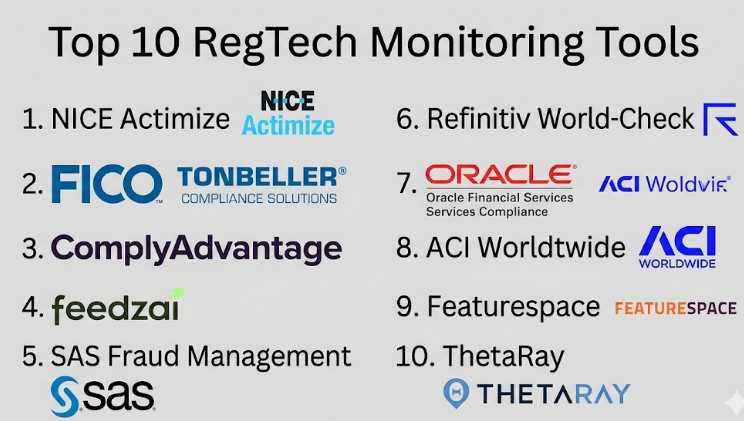
Top 10 RegTech Monitoring Tools
#1 — NICE Actimize
Short description :
A leading RegTech platform focused on financial crime prevention, including AML, fraud detection, and compliance monitoring. It is widely used by large financial institutions to monitor transactions and customer behavior in real time.
Key Features
- Real-time transaction monitoring
- AI-based fraud detection
- AML and KYC compliance tools
- Risk scoring models
- Case management workflows
Pros
- Strong AI capabilities
- Comprehensive compliance coverage
Cons
- Complex implementation
- High cost for smaller firms
Platforms / Deployment
Web
Cloud / Hybrid
Security & Compliance
RBAC, audit logs, encryption; other certifications Not publicly stated
Integrations & Ecosystem
Strong ecosystem with banking systems and data providers.
- Core banking integrations
- APIs
- Data analytics tools
Support & Community
Enterprise-grade support with structured onboarding.
#2 — FICO TONBELLER
Short description:
A compliance and monitoring solution specializing in AML and fraud prevention with strong analytics capabilities.
Key Features
- AML transaction monitoring
- Fraud detection analytics
- Risk scoring
- Regulatory reporting
- Case management
Pros
- Strong analytics engine
- Reliable for AML
Cons
- UI complexity
- Customization effort required
Platforms / Deployment
Web
Cloud / Hybrid
Security & Compliance
Not publicly stated
Integrations & Ecosystem
- APIs
- Financial systems integration
- Data feeds
Support & Community
Strong enterprise support; moderate documentation.
#3 — ComplyAdvantage
Short description:
A modern RegTech platform offering real-time AML monitoring and risk intelligence powered by machine learning.
Key Features
- Real-time risk screening
- AML monitoring
- Sanctions and watchlist screening
- API-first design
- AI-based detection
Pros
- Easy integration
- Modern UI
Cons
- Limited legacy system compatibility
- Pricing varies
Platforms / Deployment
Web
Cloud
Security & Compliance
Encryption, MFA; other details Not publicly stated
Integrations & Ecosystem
API-driven platform for fintech ecosystems.
- REST APIs
- CRM integrations
- Payment systems
Support & Community
Good support; strong developer documentation.
#4 — Feedzai
Short description:
An AI-driven financial risk and fraud monitoring platform designed for banks and payment providers.
Key Features
- Real-time fraud detection
- Behavioral analytics
- Machine learning models
- Transaction monitoring
- Risk scoring
Pros
- Strong AI capabilities
- Real-time insights
Cons
- Requires data maturity
- Enterprise-focused pricing
Platforms / Deployment
Web
Cloud
Security & Compliance
Not publicly stated
Integrations & Ecosystem
- APIs
- Payment systems
- Banking platforms
Support & Community
Enterprise-level support; onboarding assistance.
#5 — SAS Fraud Management
Short description:
A powerful analytics-driven fraud and compliance monitoring solution used by large enterprises.
Key Features
- Advanced analytics
- Fraud detection
- Real-time alerts
- Risk scoring
- Case management
Pros
- Strong analytics
- Scalable
Cons
- High complexity
- Requires expertise
Platforms / Deployment
Web
Cloud / On-premise
Security & Compliance
Not publicly stated
Integrations & Ecosystem
- Data platforms
- APIs
- Enterprise systems
Support & Community
Strong enterprise support; extensive documentation.
#6 — Refinitiv World-Check
Short description:
A widely used risk intelligence database and monitoring tool for compliance and due diligence.
Key Features
- Risk intelligence database
- Sanctions screening
- PEP monitoring
- Adverse media tracking
- Compliance reporting
Pros
- Extensive data coverage
- Trusted globally
Cons
- Data-heavy system
- Cost considerations
Platforms / Deployment
Web
Cloud
Security & Compliance
Not publicly stated
Integrations & Ecosystem
- APIs
- Financial systems
- Data platforms
Support & Community
Reliable support; widely adopted.
#7 — Oracle Financial Services Compliance
Short description:
A comprehensive compliance monitoring solution with strong analytics and reporting capabilities.
Key Features
- AML monitoring
- Regulatory reporting
- Risk analytics
- Case management
- Data integration
Pros
- Strong enterprise features
- Scalable
Cons
- Complex deployment
- Higher cost
Platforms / Deployment
Web
Cloud / Hybrid
Security & Compliance
Not publicly stated
Integrations & Ecosystem
- Oracle ecosystem
- APIs
- Enterprise systems
Support & Community
Strong enterprise support.
#8 — ACI Worldwide
Short description:
A payment and compliance monitoring platform focused on real-time fraud detection and transaction monitoring.
Key Features
- Real-time payment monitoring
- Fraud detection
- Risk scoring
- Compliance tools
- Analytics
Pros
- Strong payment focus
- Real-time processing
Cons
- Limited outside payments
- Integration effort
Platforms / Deployment
Web
Cloud
Security & Compliance
Not publicly stated
Integrations & Ecosystem
- Payment systems
- APIs
- Banking platforms
Support & Community
Good enterprise support.
#9 — Featurespace
Short description:
An AI-driven fraud and anomaly detection platform known for adaptive behavioral analytics.
Key Features
- Adaptive AI models
- Fraud detection
- Behavioral analytics
- Real-time monitoring
- Risk scoring
Pros
- Advanced AI detection
- High accuracy
Cons
- Requires data setup
- Enterprise focus
Platforms / Deployment
Web
Cloud
Security & Compliance
Not publicly stated
Integrations & Ecosystem
- APIs
- Banking systems
- Data feeds
Support & Community
Strong support; growing ecosystem.
#10 — ThetaRay
Short description:
A transaction monitoring platform focused on detecting financial crime using AI and big data analytics.
Key Features
- Transaction monitoring
- AML compliance
- AI-based anomaly detection
- Risk scoring
- Reporting tools
Pros
- Strong AML capabilities
- AI-driven insights
Cons
- Limited customization
- Pricing varies
Platforms / Deployment
Web
Cloud
Security & Compliance
Not publicly stated
Integrations & Ecosystem
- APIs
- Financial systems
- Data platforms
Support & Community
Good enterprise support.
Comparison Table (Top 10)
| Tool Name | Best For | Platform(s) Supported | Deployment | Standout Feature | Public Rating |
|---|---|---|---|---|---|
| NICE Actimize | Large banks | Web | Hybrid | AI fraud detection | N/A |
| FICO TONBELLER | AML monitoring | Web | Hybrid | Risk analytics | N/A |
| ComplyAdvantage | Fintech | Web | Cloud | API-first AML | N/A |
| Feedzai | Fraud detection | Web | Cloud | AI analytics | N/A |
| SAS Fraud Management | Enterprises | Web | Hybrid | Advanced analytics | N/A |
| Refinitiv World-Check | Risk intelligence | Web | Cloud | Data coverage | N/A |
| Oracle Compliance | Large enterprises | Web | Hybrid | Compliance suite | N/A |
| ACI Worldwide | Payments | Web | Cloud | Real-time monitoring | N/A |
| Featurespace | AI fraud detection | Web | Cloud | Behavioral AI | N/A |
| ThetaRay | AML monitoring | Web | Cloud | Big data analytics | N/A |
Evaluation & Execution Management Systems (EMS)
| Tool Name | Core (25%) | Ease (15%) | Integrations (15%) | Security (10%) | Performance (10%) | Support (10%) | Value (15%) | Weighted Total |
|---|---|---|---|---|---|---|---|---|
| NICE Actimize | 9 | 7 | 9 | 8 | 9 | 8 | 6 | 8.1 |
| FICO TONBELLER | 8 | 6 | 8 | 7 | 8 | 7 | 7 | 7.5 |
| ComplyAdvantage | 8 | 8 | 9 | 7 | 8 | 7 | 8 | 8.0 |
| Feedzai | 9 | 7 | 8 | 7 | 9 | 7 | 7 | 8.0 |
| SAS Fraud Management | 9 | 6 | 8 | 8 | 8 | 8 | 6 | 7.8 |
| Refinitiv World-Check | 8 | 7 | 7 | 7 | 8 | 7 | 7 | 7.5 |
| Oracle Compliance | 9 | 6 | 8 | 8 | 8 | 8 | 6 | 7.9 |
| ACI Worldwide | 8 | 7 | 7 | 7 | 8 | 7 | 7 | 7.4 |
| Featurespace | 9 | 7 | 7 | 7 | 9 | 7 | 7 | 7.9 |
| ThetaRay | 8 | 7 | 7 | 7 | 8 | 7 | 7 | 7.5 |
How to interpret scores:
These scores are comparative and reflect how well each tool performs across key criteria. A higher score indicates stronger overall capability, but the best tool depends on your specific compliance needs, data maturity, and budget. Enterprise tools typically score higher in features, while newer platforms may excel in ease of use and flexibility.
Which RegTech Monitoring Tools
Solo / Freelancer
Typically not required; lightweight compliance tracking tools are sufficient.
SMB
ComplyAdvantage or ThetaRay offers a balance of cost and capability.
Mid-Market
Feedzai and Featurespace provide strong AI-driven monitoring.
Enterprise
NICE Actimize, SAS, and Oracle are leading choices.
Budget vs Premium
- Budget: ComplyAdvantage, ThetaRay
- Premium: NICE Actimize, SAS
Feature Depth vs Ease of Use
- Feature-rich: SAS, Oracle
- Easy to use: ComplyAdvantage
Integrations & Scalability
- Best: NICE Actimize, Feedzai
- Moderate: ACI, ThetaRay
Security & Compliance Needs
- High compliance: NICE Actimize, Oracle
- Moderate: Others
Frequently Asked Questions (FAQs)
1. What are RegTech monitoring tools?
They are software platforms that monitor compliance, detect risks, and ensure adherence to regulations in real time.
2. Who needs RegTech tools?
Banks, fintech firms, insurance companies, and any organization operating under strict regulatory frameworks.
3. Are these tools expensive?
Costs vary widely depending on features and scale; enterprise solutions tend to be costly.
4. How long does implementation take?
It can take weeks to months depending on system complexity and integrations.
5. Do RegTech tools use AI?
Yes, many modern tools use AI for anomaly detection and predictive risk analysis.
6. Can they integrate with existing systems?
Most tools provide APIs and integrations with banking and enterprise systems.
7. Are they secure?
They typically include encryption and access controls; certifications vary.
8. What regulations do they support?
Commonly AML, KYC, GDPR, and financial compliance frameworks.
9. Can small businesses use them?
Yes, but simpler solutions may be more suitable.
10. What are alternatives?
Manual compliance processes or basic monitoring tools.
Conclusion
RegTech Monitoring Tools have become essential for organizations navigating complex and evolving regulatory landscapes. From detecting fraud to ensuring compliance with global standards, these platforms provide real-time visibility, automation, and risk mitigation capabilities that manual processes simply cannot match. However, choosing the right tool depends heavily on your organization’s size, regulatory exposure, data maturity, and integration needs. Enterprise firms may prioritize deep analytics and scalability, while smaller organizations may focus on ease of use and cost efficiency. The most practical next step is to shortlist two or three tools that align with your requirements, run pilot implementations, and validate their performance, integrations, and compliance capabilities before making a final decision.
