Introduction
A Trade Surveillance System is software used by financial institutions to monitor trading activity and detect suspicious behavior such as market manipulation, insider trading, or regulatory violations. In simple terms, it acts like a watchdog for trading activity, analyzing patterns, alerts, and anomalies across markets.
In today’s regulatory-heavy environment, especially with increasing scrutiny from global regulators, trade surveillance systems have become critical. Modern platforms now use AI, machine learning, and real-time analytics to identify complex patterns that manual processes would miss. With growing volumes of trades and fragmented markets, automation is no longer optional.
Real-world use cases:
- Detecting insider trading patterns across equity markets
- Monitoring spoofing, layering, and market manipulation
- Ensuring compliance with regulatory frameworks
- Identifying suspicious trading across multiple asset classes
- Supporting internal audits and investigations
What buyers should evaluate:
- Real-time monitoring vs batch processing
- AI/ML capabilities for anomaly detection
- Regulatory coverage across regions
- Alert accuracy and false-positive reduction
- Integration with OMS, EMS, and data feeds
- Scalability for high trade volumes
- Reporting and audit trail capabilities
- User interface for compliance teams
- Deployment flexibility (cloud/on-prem)
Best for: Banks, hedge funds, broker-dealers, exchanges, and compliance teams handling large volumes of trading activity.
Not ideal for: Small trading firms or retail investors with minimal regulatory exposure—basic compliance tools may be sufficient.
Key Trends in Trade Surveillance Systems
- AI-driven anomaly detection replacing rule-based monitoring
- Real-time surveillance becoming standard over batch processing
- Cloud-based surveillance platforms gaining adoption
- Cross-asset surveillance (equities, FX, crypto, derivatives)
- Behavioral analytics for trader profiling
- Integration with communication surveillance (emails, chats)
- RegTech automation reducing manual compliance workload
- Explainable AI models for regulatory transparency
- Global regulatory harmonization support
- Scalable big data architectures for handling massive trade volumes
How We Selected These Tools (Methodology)
- Evaluated industry adoption among banks and hedge funds
- Reviewed coverage of regulatory requirements globally
- Assessed AI/ML capabilities and detection accuracy
- Considered performance and scalability under high volumes
- Analyzed integration capabilities with trading systems
- Included enterprise and mid-market solutions
- Reviewed ease of use for compliance teams
- Balanced legacy leaders with modern RegTech platforms
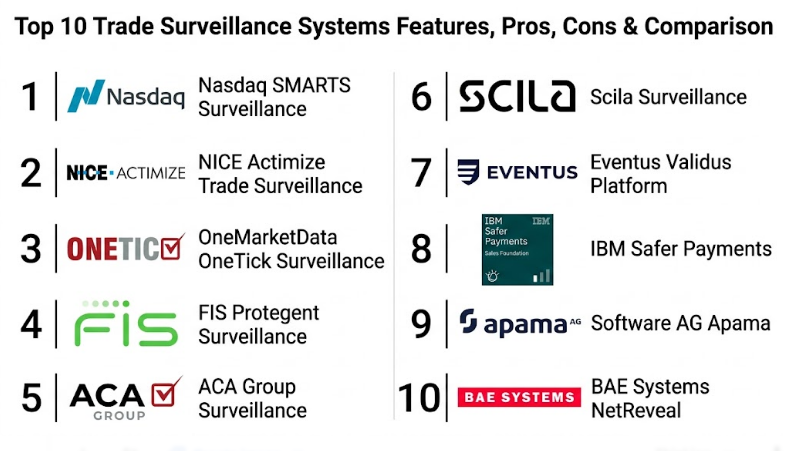
Top 10 Trade Surveillance Systems
#1 — Nasdaq SMARTS Surveillance
Short description :
Nasdaq SMARTS is a leading trade surveillance platform used by exchanges, regulators, and financial institutions. It offers advanced monitoring across multiple asset classes and markets. The platform uses sophisticated analytics to detect market abuse patterns. It is known for its reliability and global adoption. Best suited for large institutions and exchanges.
Key Features
- Real-time surveillance
- Multi-asset monitoring
- Market abuse detection algorithms
- Advanced alerting system
- Cross-market analysis
- Regulatory reporting
Pros
- Widely trusted globally
- Strong analytics capabilities
Cons
- Complex implementation
- High cost
Platforms / Deployment
Cloud / Hybrid
Security & Compliance
MFA, audit logs, RBAC; certifications Not publicly stated
Integrations & Ecosystem
Strong integration with trading systems and market data platforms
- Exchanges
- OMS/EMS
- Data providers
- APIs
Support & Community
Enterprise-grade support with global presence
#2 — NICE Actimize Trade Surveillance
Short description :
NICE Actimize provides AI-driven trade surveillance solutions focused on detecting market abuse and compliance risks. It is widely used by banks and financial institutions. The platform offers flexible deployment and strong analytics capabilities.
Key Features
- AI-based anomaly detection
- Behavioral analytics
- Cross-asset surveillance
- Case management tools
- Regulatory compliance automation
Pros
- Strong AI capabilities
- Good compliance coverage
Cons
- Complex configuration
- Resource-intensive
Platforms / Deployment
Cloud / Hybrid
Security & Compliance
Encryption, RBAC; certifications Not publicly stated
Integrations & Ecosystem
- Data feeds
- Trading systems
- APIs
Support & Community
Strong enterprise support
#3 — OneMarketData OneTick Surveillance
Short description :
OneTick Surveillance offers high-performance analytics for trade monitoring. It is designed for firms needing real-time and historical data analysis. Known for scalability and performance.
Key Features
- Real-time and historical analysis
- Big data processing
- Customizable alerts
- Cross-asset monitoring
- High-performance analytics
Pros
- Strong performance
- Flexible analytics
Cons
- Requires technical expertise
- Complex setup
Platforms / Deployment
Cloud / Hybrid
Security & Compliance
Not publicly stated
Integrations & Ecosystem
- Market data feeds
- APIs
- Trading systems
Support & Community
Technical support available
#4 — FIS Protegent Surveillance
Short description :
FIS Protegent focuses on trade surveillance and compliance for financial institutions. It provides pre-built scenarios for detecting market abuse. Suitable for mid to large firms.
Key Features
- Pre-configured detection scenarios
- Real-time alerts
- Compliance reporting
- Multi-asset support
- Risk monitoring
Pros
- Ready-to-use scenarios
- Good compliance tools
Cons
- Limited customization
- UI could be improved
Platforms / Deployment
Hybrid
Security & Compliance
Not publicly stated
Integrations & Ecosystem
- Trading systems
- Data feeds
- APIs
Support & Community
Moderate support
#5 — ACA Group Surveillance (ACA ComplianceAlpha)
Short description :
ACA ComplianceAlpha is a cloud-based trade surveillance platform focusing on regulatory compliance and risk management. It is suitable for hedge funds and asset managers.
Key Features
- Cloud-based surveillance
- AI-driven alerts
- Compliance workflows
- Risk analytics
- Reporting tools
Pros
- Easy deployment
- Good for mid-sized firms
Cons
- Limited advanced analytics
- Smaller ecosystem
Platforms / Deployment
Cloud
Security & Compliance
MFA, encryption; certifications Not publicly stated
Integrations & Ecosystem
- APIs
- Trading platforms
- Data providers
Support & Community
Good onboarding support
#6 — Scila Surveillance
Short description :
Scila provides trade surveillance solutions focusing on exchanges and market operators. It offers flexible monitoring and analytics tools.
Key Features
- Market surveillance
- Real-time monitoring
- Alert management
- Analytics tools
- Compliance reporting
Pros
- Flexible platform
- Good analytics
Cons
- Limited global presence
- Smaller ecosystem
Platforms / Deployment
Cloud / Hybrid
Security & Compliance
Not publicly stated
Integrations & Ecosystem
- Exchanges
- APIs
- Data feeds
Support & Community
Moderate support
#7 — Eventus Validus Platform
Short description :
Eventus Validus is a modern trade surveillance platform designed for multi-asset monitoring, including crypto markets. It provides scalable and flexible deployment.
Key Features
- Multi-asset surveillance
- Crypto market monitoring
- Real-time alerts
- Compliance workflows
- Analytics dashboards
Pros
- Modern architecture
- Supports digital assets
Cons
- Limited legacy integrations
- Growing ecosystem
Platforms / Deployment
Cloud
Security & Compliance
Not publicly stated
Integrations & Ecosystem
- APIs
- Data feeds
- Trading systems
Support & Community
Growing support ecosystem
#8 — IBM Safer Payments (Trade Surveillance Capabilities)
Short description :
IBM Safer Payments is primarily a fraud detection platform but also supports trade surveillance use cases. It uses AI to detect anomalies.
Key Features
- AI anomaly detection
- Real-time monitoring
- Risk scoring
- Analytics tools
- Fraud detection integration
Pros
- Strong AI models
- Scalable architecture
Cons
- Not purely OMS-focused
- Requires customization
Platforms / Deployment
Cloud / Hybrid
Security & Compliance
Enterprise-grade security; certifications Not publicly stated
Integrations & Ecosystem
- Banking systems
- APIs
- Data platforms
Support & Community
Strong enterprise support
#9 — Software AG Apama (Market Surveillance)
Short description :
Apama is a streaming analytics platform used for real-time trade surveillance. It is known for event-driven architecture and low latency.
Key Features
- Real-time streaming analytics
- Event-driven monitoring
- Custom rule creation
- Low-latency processing
- Integration tools
Pros
- High performance
- Flexible rule engine
Cons
- Requires technical expertise
- Complex setup
Platforms / Deployment
Cloud / Hybrid
Security & Compliance
Not publicly stated
Integrations & Ecosystem
- APIs
- Data streams
- Trading systems
Support & Community
Technical support available
#10 — BAE Systems NetReveal
Short description :
NetReveal provides financial crime and trade surveillance solutions. It uses advanced analytics and AI for detection.
Key Features
- AI-based detection
- Behavioral analytics
- Risk scoring
- Case management
- Compliance reporting
Pros
- Strong analytics
- Good compliance tools
Cons
- Complex implementation
- High cost
Platforms / Deployment
Cloud / Hybrid
Security & Compliance
Not publicly stated
Integrations & Ecosystem
- Financial systems
- APIs
- Data feeds
Support & Community
Enterprise support available
Comparison Table (Top 10
| Tool Name | Best For | Platform(s) Supported | Deployment | Standout Feature | Public Rating |
|---|---|---|---|---|---|
| Nasdaq SMARTS | Exchanges | Web | Hybrid | Market analytics | N/A |
| NICE Actimize | Banks | Web | Hybrid | AI detection | N/A |
| OneTick Surveillance | Data-heavy firms | Web | Hybrid | Big data analytics | N/A |
| FIS Protegent | Mid-large firms | Web | Hybrid | Pre-built scenarios | N/A |
| ACA ComplianceAlpha | Hedge funds | Web | Cloud | Ease of use | N/A |
| Scila | Exchanges | Web | Hybrid | Flexible monitoring | N/A |
| Eventus Validus | Crypto + multi-asset | Web | Cloud | Digital asset support | N/A |
| IBM Safer Payments | Large banks | Web | Hybrid | AI risk scoring | N/A |
| Apama | Real-time systems | Web | Hybrid | Streaming analytics | N/A |
| NetReveal | Financial crime detection | Web | Hybrid | Behavioral analytics | N/A |
Evaluation & Trade Surveillance Systems
| Tool Name | Core | Ease | Integrations | Security | Performance | Support | Value | Weighted Total |
|---|---|---|---|---|---|---|---|---|
| Nasdaq SMARTS | 9 | 7 | 9 | 8 | 9 | 9 | 6 | 8.3 |
| NICE Actimize | 9 | 7 | 8 | 8 | 8 | 9 | 6 | 8.1 |
| OneTick Surveillance | 8 | 6 | 8 | 7 | 9 | 7 | 7 | 7.8 |
| FIS Protegent | 8 | 7 | 7 | 7 | 8 | 7 | 7 | 7.5 |
| ACA ComplianceAlpha | 7 | 8 | 7 | 7 | 7 | 8 | 8 | 7.6 |
| Scila | 7 | 7 | 6 | 6 | 7 | 7 | 7 | 6.9 |
| Eventus Validus | 8 | 8 | 7 | 6 | 8 | 7 | 7 | 7.5 |
| IBM Safer Payments | 8 | 7 | 8 | 8 | 8 | 8 | 6 | 7.8 |
| Apama | 8 | 6 | 8 | 7 | 9 | 7 | 7 | 7.7 |
| NetReveal | 8 | 6 | 7 | 8 | 8 | 8 | 6 | 7.6 |
How to interpret scores:
These scores are comparative benchmarks across trade surveillance tools. A higher score indicates a better balance of features, performance, and usability. However, selection should depend on regulatory requirements, trading volume, and integration needs rather than score alone.
Which Trade Surveillance Systems
Solo / Freelancer
Not required. Basic monitoring tools are sufficient.
SMB
ACA ComplianceAlpha or Eventus Validus offer easier onboarding.
Mid-Market
FIS Protegent or OneTick provide a balance of performance and cost.
Enterprise
Nasdaq SMARTS, NICE Actimize, and NetReveal are strong choices.
Budget vs Premium
- Budget: ACA, Scila
- Premium: Nasdaq SMARTS, NICE Actimize
Feature Depth vs Ease of Use
- Deep features: NICE Actimize, SMARTS
- Easy use: ACA ComplianceAlpha
Integrations & Scalability
- Strong integrations: OneTick, SMARTS
- Scalable: IBM, Apama
Security & Compliance Needs
- High compliance: NICE Actimize, NetReveal
- Moderate: ACA, Scila
Frequently Asked Questions (FAQs)
1. What is a trade surveillance system?
It monitors trading activity to detect suspicious patterns and ensure compliance with regulations.
2. How much do these systems cost?
Pricing varies widely depending on scale, features, and deployment model.
3. Are these systems real-time?
Most modern platforms support real-time monitoring, though some still use batch processing.
4. Can they detect insider trading?
Yes, they use analytics and AI to identify patterns associated with insider trading.
5. Do they support multiple asset classes?
Yes, most platforms support equities, derivatives, FX, and increasingly crypto assets.
6. Are they required by regulators?
Yes, many jurisdictions require trade surveillance for compliance.
7. How difficult is implementation?
Implementation can be complex, especially for enterprise systems.
8. Can small firms use them?
Some cloud-based solutions are suitable for smaller firms.
9. What are common mistakes?
Ignoring integration needs and underestimating configuration complexity.
10. How to choose the right tool?
Evaluate based on scale, compliance needs, and integration capabilities.
Conclusion
Trade surveillance systems are now essential for maintaining trust, compliance, and operational integrity in financial markets. As trading becomes more complex and global regulations tighten, these platforms provide the visibility and intelligence needed to detect and prevent market abuse. While enterprise solutions like Nasdaq SMARTS and NICE Actimize lead in depth and coverage, newer cloud platforms such as Eventus Validus and ACA ComplianceAlpha offer flexibility and faster deployment. The best solution depends on your firm’s size, regulatory exposure, and technical capabilities. A smart approach is to shortlist a few platforms, run controlled evaluations, and validate how effectively they integrate with your trading systems and compliance workflows before making a final decision.
