Introduction
Payment Orchestration Platforms are software systems that help businesses manage multiple payment providers (gateways, processors, acquirers) from one centralized layer. Instead of integrating with different payment services individually, companies use orchestration to route, optimize, and control transactions efficiently.
In today’s digital economy, where global payments, fraud risks, and customer expectations are evolving quickly, orchestration platforms have become critical. Businesses need higher authorization rates, better cost control, and seamless user experiences—especially across regions and payment methods.
Real-world use cases include:
- E-commerce companies optimizing checkout success rates
- SaaS platforms handling global subscriptions and billing
- Marketplaces managing multi-vendor payments
- Fintech startups routing transactions across providers
- Enterprises reducing payment processing costs
Key evaluation criteria:
- Multi-gateway support and routing logic
- Smart transaction routing and failover
- Fraud detection and risk management
- Integration flexibility (APIs, SDKs)
- Global payment method coverage
- Reporting and analytics
- Compliance and security features
- Scalability and performance
- Pricing transparency
Best for: Large e-commerce businesses, fintech companies, SaaS platforms, and global enterprises handling high transaction volumes and multiple payment providers.
Not ideal for: Small businesses with a single payment gateway or low transaction volume where complexity outweighs benefits.
Key Trends in Payment Orchestration Platforms
- AI-driven routing: Platforms now use machine learning to select the best payment route in real time.
- Multi-acquirer strategies: Businesses are reducing dependency on single providers.
- Embedded payments: Orchestration is being integrated into broader fintech and SaaS ecosystems.
- Advanced fraud detection: AI-powered fraud prevention is becoming standard.
- No-code/low-code workflows: Easier configuration of payment flows without engineering effort.
- Regulatory compliance automation: Built-in compliance for PSD2, GDPR, and regional laws.
- Real-time analytics: Instant visibility into transaction success and failures.
- Cloud-native architectures: High scalability and reliability.
- Cross-border optimization: Better handling of international transactions and currencies.
How We Selected These Tools (Methodology)
- Evaluated global adoption and market presence
- Reviewed feature completeness and orchestration capabilities
- Assessed reliability and transaction success optimization
- Considered security and compliance signals
- Analyzed integration flexibility and developer experience
- Looked at ecosystem partnerships (gateways, PSPs)
- Compared scalability for SMB to enterprise use
- Reviewed customer fit across industries
- Focused on innovation and AI capabilities
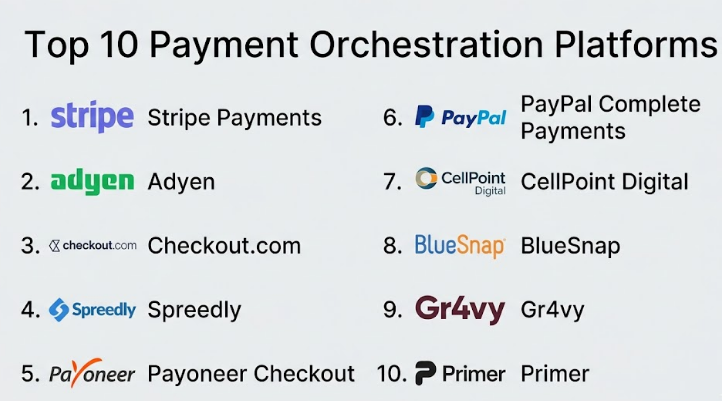
Top 10 Payment Orchestration Platforms
#1 — Stripe Payments (Orchestration Layer)
Short description:
Stripe provides a powerful payment infrastructure with orchestration-like capabilities through routing, billing, and global payment support. It is widely used by developers and businesses for its flexibility and ease of integration.
Key Features
- Global payment acceptance
- Smart routing and retries
- Subscription billing engine
- Fraud detection (Radar)
- Extensive API ecosystem
- Multi-currency support
Pros
- Developer-friendly APIs
- Strong global reach
Cons
- Limited pure orchestration features compared to specialized tools
- Pricing can scale quickly
Platforms / Deployment
Cloud
Security & Compliance
SOC 2, PCI DSS, encryption, MFA, RBAC
Integrations & Ecosystem
Strong ecosystem with SaaS, CRM, ERP, and marketplaces.
- Shopify
- Salesforce
- QuickBooks
- Custom APIs
Support & Community
Excellent documentation and large developer community.
#2 — Adyen
Short description:
Adyen is an enterprise-grade payment platform offering unified commerce and orchestration capabilities with global reach and strong analytics.
Key Features
- Unified commerce platform
- Smart routing engine
- Global acquiring network
- Fraud prevention tools
- Real-time analytics
Pros
- Enterprise scalability
- Strong global coverage
Cons
- Complex onboarding
- Higher cost for SMBs
Platforms / Deployment
Cloud
Security & Compliance
PCI DSS, GDPR, encryption, RBAC
Integrations & Ecosystem
Enterprise integrations across retail and fintech.
- SAP
- Salesforce
- POS systems
Support & Community
Enterprise-grade support; documentation is solid.
#3 — Checkout.com
Short description:
Checkout.com provides a flexible payment infrastructure with orchestration capabilities focused on high-growth digital businesses.
Key Features
- Smart payment routing
- Global payment methods
- Fraud detection tools
- Real-time reporting
- API-first architecture
Pros
- High performance
- Strong analytics
Cons
- Limited SMB focus
- Pricing not transparent
Platforms / Deployment
Cloud
Security & Compliance
PCI DSS, GDPR, encryption
Integrations & Ecosystem
API-driven integrations with fintech and SaaS platforms.
- Payment gateways
- Fraud tools
- CRM systems
Support & Community
Good enterprise support; moderate community presence.
#4 — Spreedly
Short description:
Spreedly is a specialized payment orchestration platform that connects multiple gateways and enables secure tokenization.
Key Features
- Gateway-agnostic orchestration
- Tokenization vault
- Smart routing
- PCI compliance tools
- Global gateway support
Pros
- Strong orchestration focus
- Flexible integrations
Cons
- Requires technical setup
- Limited UI tools
Platforms / Deployment
Cloud
Security & Compliance
PCI DSS, tokenization, encryption
Integrations & Ecosystem
Supports 100+ gateways.
- PayPal
- Stripe
- Braintree
Support & Community
Strong documentation; niche community.
#5 — Payoneer Checkout (Orchestration capabilities)
Short description:
Payoneer offers payment solutions with orchestration-like features for cross-border businesses.
Key Features
- Cross-border payments
- Multi-currency support
- Payment routing
- Compliance management
- Vendor payouts
Pros
- Strong global reach
- Good for marketplaces
Cons
- Limited advanced orchestration
- UI can be complex
Platforms / Deployment
Cloud
Security & Compliance
Not publicly stated
Integrations & Ecosystem
Integrates with marketplaces and ERP systems.
- Amazon
- eBay
- Shopify
Support & Community
Moderate support; documentation varies.
#6 — PayPal Complete Payments
Short description:
PayPal offers orchestration capabilities through its global payment infrastructure and routing features.
Key Features
- Global payment acceptance
- Fraud detection
- Smart routing
- Wallet integration
- Subscription management
Pros
- Widely trusted brand
- Easy setup
Cons
- Limited customization
- Higher fees
Platforms / Deployment
Cloud
Security & Compliance
PCI DSS, encryption, MFA
Integrations & Ecosystem
Broad ecosystem across e-commerce platforms.
- WooCommerce
- Magento
- Shopify
Support & Community
Strong community and support.
#7 — CellPoint Digital
Short description:
CellPoint Digital is a dedicated payment orchestration platform focused on airlines and large enterprises.
Key Features
- Multi-provider orchestration
- Payment optimization
- Fraud management
- Analytics dashboard
- Airline-focused solutions
Pros
- Industry-specific optimization
- Strong orchestration engine
Cons
- Niche focus
- Complex implementation
Platforms / Deployment
Cloud
Security & Compliance
Not publicly stated
Integrations & Ecosystem
Supports airline and enterprise integrations.
- Booking systems
- Payment gateways
Support & Community
Enterprise support model.
#8 — BlueSnap
Short description:
BlueSnap combines payment processing with orchestration features, offering global payments and fraud tools.
Key Features
- Global payment acceptance
- Smart routing
- Subscription billing
- Fraud prevention
- Reporting tools
Pros
- All-in-one platform
- Good global reach
Cons
- Limited advanced orchestration
- UI complexity
Platforms / Deployment
Cloud
Security & Compliance
PCI DSS, GDPR
Integrations & Ecosystem
Integrates with CRM and e-commerce tools.
- Salesforce
- Shopify
Support & Community
Good support; smaller community.
#9 — Gr4vy
Short description:
Gr4vy is a modern cloud-native payment orchestration platform offering decentralized payment infrastructure.
Key Features
- Cloud-native orchestration
- Payment routing
- Tokenization
- Multi-region deployment
- API-first design
Pros
- Flexible architecture
- Strong developer experience
Cons
- Newer platform
- Limited enterprise adoption
Platforms / Deployment
Cloud / Hybrid
Security & Compliance
Not publicly stated
Integrations & Ecosystem
API-based integrations.
- Payment gateways
- Fraud tools
Support & Community
Growing community; good documentation.
#10 — Primer
Short description:
Primer is a no-code payment orchestration platform enabling businesses to connect and manage multiple payment providers easily.
Key Features
- No-code workflows
- Multi-gateway orchestration
- Fraud tools integration
- Real-time analytics
- Payment routing
Pros
- Easy to use
- Fast deployment
Cons
- Limited customization for complex needs
- Newer platform
Platforms / Deployment
Cloud
Security & Compliance
Not publicly stated
Integrations & Ecosystem
Wide integrations with payment providers.
- Stripe
- Adyen
- PayPal
Support & Community
Good onboarding; growing ecosystem.
Comparison Table (Top 10)
| Tool Name | Best For | Platform(s) Supported | Deployment | Standout Feature | Public Rating |
|---|---|---|---|---|---|
| Stripe | Developers, SaaS | Web | Cloud | API ecosystem | N/A |
| Adyen | Enterprises | Web | Cloud | Global acquiring | N/A |
| Checkout.com | High-growth startups | Web | Cloud | Smart routing | N/A |
| Spreedly | Orchestration specialists | Web | Cloud | Tokenization vault | N/A |
| Payoneer | Marketplaces | Web | Cloud | Cross-border payments | N/A |
| PayPal | SMBs | Web | Cloud | Global wallet | N/A |
| CellPoint Digital | Airlines | Web | Cloud | Industry focus | N/A |
| BlueSnap | SMB to mid-market | Web | Cloud | All-in-one platform | N/A |
| Gr4vy | Developers | Web | Cloud/Hybrid | Cloud-native infra | N/A |
| Primer | SMB, startups | Web | Cloud | No-code orchestration | N/A |
Evaluation & Payment Orchestration Platforms
| Tool Name | Core | Ease | Integrations | Security | Performance | Support | Value | Weighted Total |
|---|---|---|---|---|---|---|---|---|
| Stripe | 9 | 9 | 10 | 9 | 9 | 9 | 8 | 9.0 |
| Adyen | 10 | 7 | 9 | 9 | 9 | 8 | 7 | 8.6 |
| Checkout.com | 9 | 8 | 9 | 8 | 9 | 8 | 7 | 8.5 |
| Spreedly | 9 | 7 | 10 | 9 | 8 | 7 | 7 | 8.3 |
| Payoneer | 7 | 7 | 8 | 7 | 7 | 7 | 8 | 7.4 |
| PayPal | 8 | 9 | 8 | 9 | 8 | 9 | 7 | 8.3 |
| CellPoint | 9 | 6 | 8 | 7 | 8 | 7 | 6 | 7.7 |
| BlueSnap | 8 | 7 | 8 | 8 | 8 | 7 | 7 | 7.8 |
| Gr4vy | 8 | 8 | 9 | 7 | 8 | 7 | 7 | 7.9 |
| Primer | 8 | 9 | 8 | 7 | 8 | 7 | 8 | 8.0 |
How to interpret:
Scores are comparative and based on feature balance, usability, and market positioning. A higher score indicates better overall fit across multiple criteria, not a universal winner.
Which Payment Orchestration Platforms
Solo / Freelancer
Simple tools like PayPal or Stripe are enough. Full orchestration is rarely needed.
SMB
Primer or BlueSnap provide easier setup and decent orchestration features.
Mid-Market
Checkout.com and Spreedly offer strong routing and scalability.
Enterprise
Adyen and CellPoint Digital are ideal for complex, global operations.
Budget vs Premium
- Budget: PayPal, Stripe
- Premium: Adyen, Checkout.com
Feature Depth vs Ease of Use
- Deep features: Spreedly, Adyen
- Ease of use: Primer, Stripe
Integrations & Scalability
Choose platforms with strong API ecosystems like Stripe or Gr4vy.
Security & Compliance Needs
Enterprises should prioritize PCI DSS-compliant platforms with strong fraud detection.
Frequently Asked Questions (FAQs)
1. What is a payment orchestration platform?
It is a system that manages multiple payment providers through a single interface, improving efficiency and success rates.
2. How does it improve payment success rates?
By routing transactions dynamically to the best-performing provider.
3. Is it expensive?
Pricing varies; enterprise solutions are costlier, while SMB tools are more affordable.
4. Do I need technical expertise?
Some platforms require developer support, while others offer no-code options.
5. Can I switch providers easily?
Yes, orchestration platforms simplify switching between gateways.
6. Is it secure?
Most platforms follow PCI DSS and encryption standards.
7. What industries benefit most?
E-commerce, SaaS, fintech, and marketplaces.
8. How long does implementation take?
From days to months depending on complexity.
9. Are there alternatives?
Yes, direct gateway integrations or all-in-one payment platforms.
10. Can it handle global payments?
Yes, most platforms support multi-currency and cross-border payments.
Conclusion
Payment orchestration platforms have become a critical layer in modern digital commerce. They help businesses improve transaction success rates, reduce costs, and manage multiple payment providers efficiently. However, the “best” platform depends heavily on your business size, technical capability, and global requirements. Smaller businesses may benefit from simpler tools, while enterprises need advanced orchestration with deep customization. The smartest approach is to shortlist two or three platforms, run pilot integrations, and evaluate performance, cost, and ease of use before making a final decision.
