Introduction
Experiment Tracking Tools are platforms that help data scientists and machine learning teams log, monitor, compare, and reproduce experiments. These tools capture key details such as model parameters, datasets, metrics, code versions, and outputs—ensuring that experiments are organized and reproducible instead of scattered across notebooks and spreadsheets.
In the current AI-first environment, experiment tracking has become essential. Teams are running hundreds or thousands of experiments across different models, hyperparameters, and datasets. Without structured tracking, it becomes nearly impossible to understand what worked, what failed, and why. These tools enable faster iteration, better collaboration, and reliable production deployment.
Real-world use cases
- Hyperparameter tuning for deep learning models
- A/B testing of ML models in production
- Tracking NLP model performance across datasets
- Comparing feature engineering strategies
- Monitoring model drift experiments
What buyers should evaluate
- Experiment logging capabilities (metrics, parameters, artifacts)
- Visualization and comparison tools
- Collaboration features and team workflows
- Integration with ML frameworks
- Version control and reproducibility
- Scalability for large experiments
- Deployment flexibility (cloud vs self-hosted)
- Security and access control
- Cost and pricing model
- Ease of onboarding
Best for: Data scientists, ML engineers, AI teams, research labs, and organizations building scalable ML workflows.
Not ideal for: Small teams doing simple analytics or single-model workflows where manual tracking (e.g., spreadsheets) is sufficient.
Key Trends in Experiment Tracking Tools
- AI-assisted experiment analysis to suggest optimal configurations
- Tighter integration with MLOps platforms and CI/CD pipelines
- Unified ML lifecycle platforms combining tracking, deployment, and monitoring
- Real-time experiment dashboards for faster insights
- Collaboration-first design with shared workspaces and versioning
- Cloud-native adoption with managed experiment tracking services
- Open-source ecosystem growth for flexibility and cost control
- Improved reproducibility standards with metadata tracking
- Security and governance enhancements for enterprise adoption
- Integration with data versioning tools for end-to-end traceability
How We Selected These Tools (Methodology)
- Evaluated industry adoption and developer mindshare
- Assessed experiment tracking depth and usability
- Reviewed performance with large-scale ML workloads
- Considered security and compliance capabilities
- Analyzed integration with ML frameworks and data tools
- Evaluated deployment flexibility (cloud, hybrid, on-prem)
- Reviewed community support and documentation quality
- Considered fit for different organization sizes
- Assessed innovation in AI and automation features
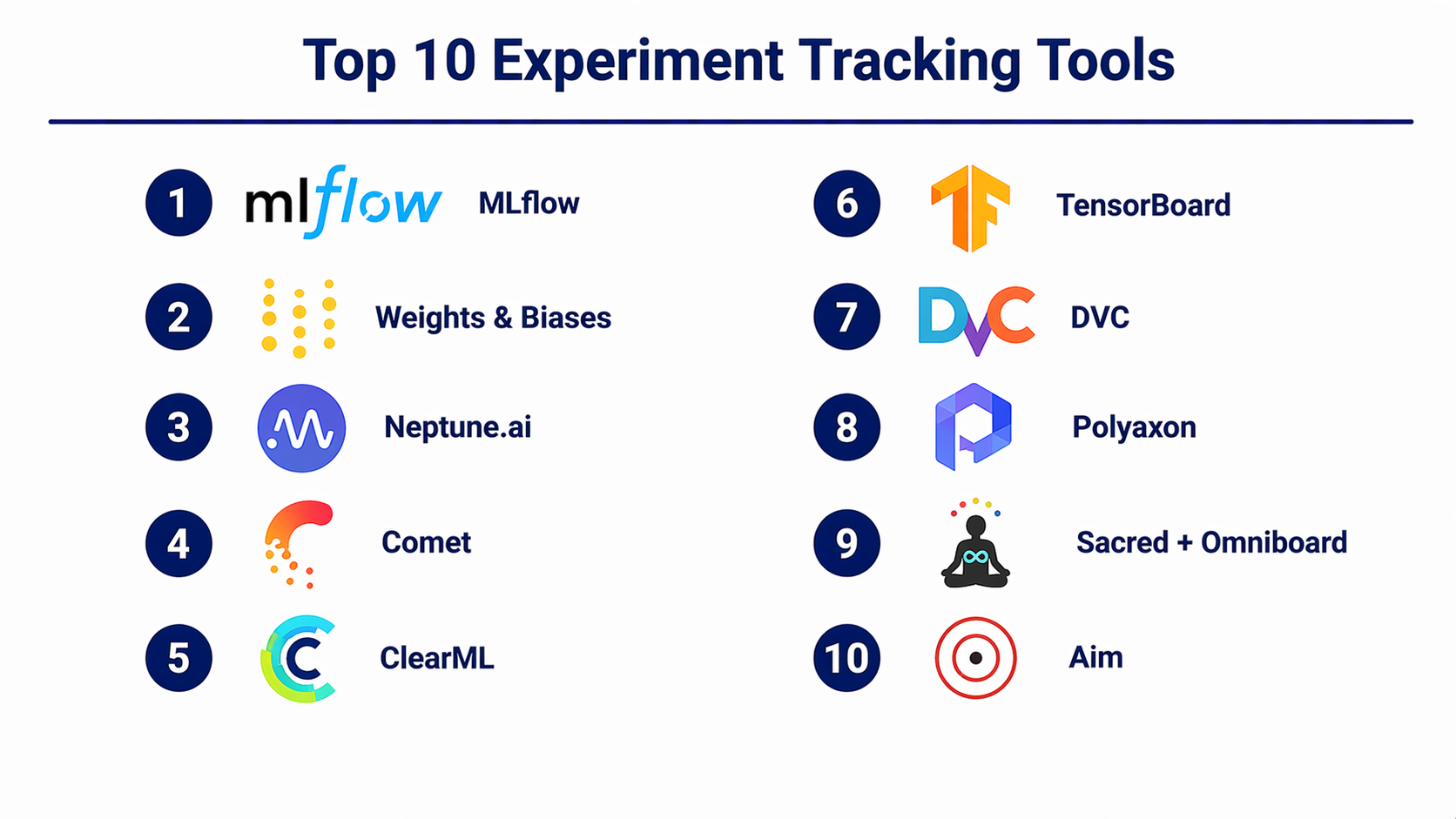
Top 10 Experiment Tracking Tools
#1 — MLflow
Short description (2–3 lines): A widely adopted open-source platform for managing the ML lifecycle, including experiment tracking, model packaging, and deployment.
Key Features
- Experiment logging (parameters, metrics, artifacts)
- Model registry
- REST API support
- UI dashboard for experiments
- Multi-language support
- Integration with multiple ML frameworks
Pros
- Strong open-source ecosystem
- Flexible and widely supported
Cons
- Requires setup for production use
- UI can feel basic
Platforms / Deployment
Cloud / Self-hosted
Security & Compliance
Not publicly stated
Integrations & Ecosystem
Highly extensible and integrates with major ML tools.
- TensorFlow
- PyTorch
- Spark
- Databricks
Support & Community
Very strong community support and extensive documentation.
#2 — Weights & Biases (W&B)
Short description (2–3 lines): A popular experiment tracking platform with advanced visualization and collaboration features for ML teams.
Key Features
- Real-time experiment tracking
- Interactive dashboards
- Hyperparameter sweeps
- Artifact versioning
- Team collaboration tools
- Automated reports
Pros
- Excellent visualization tools
- Easy to use
Cons
- Pricing can scale quickly
- Requires internet connectivity for cloud features
Platforms / Deployment
Cloud / Hybrid
Security & Compliance
SSO, RBAC (others not publicly stated)
Integrations & Ecosystem
Integrates seamlessly with ML workflows.
- PyTorch
- TensorFlow
- Hugging Face
Support & Community
Strong documentation and enterprise support.
#3 — Neptune.ai
Short description (2–3 lines): A metadata store for experiments designed for tracking complex ML workflows and large-scale experiments.
Key Features
- Experiment metadata tracking
- Model versioning
- Collaboration tools
- Custom dashboards
- API-based logging
- Large dataset handling
Pros
- Flexible metadata tracking
- Good scalability
Cons
- Learning curve
- Limited offline capabilities
Platforms / Deployment
Cloud
Security & Compliance
Not publicly stated
Integrations & Ecosystem
Supports a wide range of ML tools.
- PyTorch
- TensorFlow
- Scikit-learn
Support & Community
Growing community and support.
#4 — Comet
Short description (2–3 lines): An experiment tracking and model management platform designed for deep learning and production ML teams.
Key Features
- Experiment tracking
- Model registry
- Visualization tools
- Hyperparameter optimization
- Collaboration features
- API integrations
Pros
- Strong visualization capabilities
- Good model management
Cons
- Pricing complexity
- UI can be overwhelming
Platforms / Deployment
Cloud / Hybrid
Security & Compliance
SSO, encryption (others not publicly stated)
Integrations & Ecosystem
Integrates with ML pipelines.
- Keras
- PyTorch
- TensorFlow
Support & Community
Commercial support with documentation.
#5 — ClearML
Short description (2–3 lines): An open-source MLOps platform with experiment tracking, pipeline orchestration, and automation features.
Key Features
- Experiment tracking
- Pipeline automation
- Dataset versioning
- Model management
- Resource orchestration
- Open-source flexibility
Pros
- End-to-end ML platform
- Cost-effective
Cons
- Setup complexity
- UI improvements needed
Platforms / Deployment
Cloud / Self-hosted
Security & Compliance
Not publicly stated
Integrations & Ecosystem
Supports various ML tools and frameworks.
- PyTorch
- TensorFlow
- Kubernetes
Support & Community
Active community with growing adoption.
#6 — TensorBoard
Short description (2–3 lines): Visualization and experiment tracking tool primarily used with TensorFlow, but extensible to other frameworks.
Key Features
- Metrics visualization
- Graph visualization
- Embedding visualization
- Performance tracking
- Real-time updates
- Plugin support
Pros
- Free and widely used
- Strong visualization
Cons
- Limited to visualization
- Not a full experiment tracking platform
Platforms / Deployment
Web / Local
Security & Compliance
Not publicly stated
Integrations & Ecosystem
Primarily integrates with TensorFlow ecosystem.
- TensorFlow
- PyTorch (via plugins)
Support & Community
Strong open-source community.
#7 — DVC (Data Version Control)
Short description (2–3 lines): A data and experiment versioning tool that integrates with Git for reproducible ML workflows.
Key Features
- Data versioning
- Experiment tracking
- Pipeline management
- Reproducibility
- Git integration
- CLI-based workflows
Pros
- Strong reproducibility
- Works well with Git
Cons
- CLI-heavy
- Limited UI
Platforms / Deployment
Self-hosted
Security & Compliance
Not publicly stated
Integrations & Ecosystem
Works with version control systems.
- Git
- CI/CD tools
Support & Community
Strong open-source support.
#8 — Polyaxon
Short description (2–3 lines): A platform for managing ML experiments, pipelines, and deployments in Kubernetes environments.
Key Features
- Experiment tracking
- Pipeline orchestration
- Resource management
- Kubernetes-native
- Model lifecycle support
- Visualization dashboards
Pros
- Scalable architecture
- Kubernetes integration
Cons
- Complex setup
- Requires Kubernetes knowledge
Platforms / Deployment
Cloud / Self-hosted
Security & Compliance
RBAC (others not publicly stated)
Integrations & Ecosystem
Designed for cloud-native ML.
- Kubernetes
- Docker
Support & Community
Moderate community support.
#9 — Sacred + Omniboard
Short description (2–3 lines): Lightweight experiment tracking framework combined with a visualization dashboard.
Key Features
- Experiment configuration tracking
- Logging system
- Lightweight architecture
- Extensible design
- Visualization dashboard
- Open-source
Pros
- Simple and lightweight
- Highly customizable
Cons
- Limited enterprise features
- Smaller ecosystem
Platforms / Deployment
Self-hosted
Security & Compliance
Not publicly stated
Integrations & Ecosystem
Flexible integration via Python.
- Python frameworks
- Custom scripts
Support & Community
Small but dedicated community.
#10 — Aim
Short description (2–3 lines): An open-source experiment tracking tool focused on performance and scalability.
Key Features
- Fast experiment tracking
- Scalable storage
- Visualization dashboards
- Query system
- Lightweight integration
- CLI and UI
Pros
- High performance
- Easy integration
Cons
- Limited enterprise features
- Smaller ecosystem
Platforms / Deployment
Cloud / Self-hosted
Security & Compliance
Not publicly stated
Integrations & Ecosystem
Works with ML pipelines and frameworks.
- PyTorch
- TensorFlow
Support & Community
Growing open-source community.
Comparison Table (Top 10)
| Tool Name | Best For | Platform(s) Supported | Deployment | Standout Feature | Public Rating |
|---|---|---|---|---|---|
| MLflow | Developers | Web, Linux | Hybrid | Open-source flexibility | N/A |
| W&B | Teams | Web | Cloud | Visualization dashboards | N/A |
| Neptune.ai | Enterprises | Web | Cloud | Metadata tracking | N/A |
| Comet | ML teams | Web | Hybrid | Visualization tools | N/A |
| ClearML | Full ML workflows | Web | Hybrid | Pipeline automation | N/A |
| TensorBoard | TensorFlow users | Web | Local | Visualization | N/A |
| DVC | Dev teams | CLI | Self-hosted | Git integration | N/A |
| Polyaxon | Cloud-native teams | Web | Hybrid | Kubernetes-native | N/A |
| Sacred | Lightweight use | Local | Self-hosted | Simplicity | N/A |
| Aim | Open-source users | Web | Hybrid | High performance | N/A |
Evaluation & Scoring of Experiment Tracking Tools
| Tool Name | Core (25%) | Ease (15%) | Integrations (15%) | Security (10%) | Performance (10%) | Support (10%) | Value (15%) | Weighted Total |
|---|---|---|---|---|---|---|---|---|
| MLflow | 9 | 7 | 9 | 6 | 8 | 9 | 9 | 8.3 |
| W&B | 9 | 9 | 8 | 8 | 9 | 9 | 7 | 8.6 |
| Neptune | 8 | 7 | 8 | 7 | 8 | 8 | 7 | 7.8 |
| Comet | 8 | 8 | 8 | 7 | 8 | 8 | 7 | 7.9 |
| ClearML | 9 | 7 | 8 | 6 | 8 | 7 | 9 | 8.0 |
| TensorBoard | 7 | 8 | 6 | 5 | 7 | 9 | 10 | 7.5 |
| DVC | 8 | 6 | 7 | 6 | 7 | 8 | 9 | 7.6 |
| Polyaxon | 8 | 6 | 7 | 7 | 8 | 7 | 7 | 7.4 |
| Sacred | 6 | 7 | 6 | 5 | 6 | 6 | 8 | 6.5 |
| Aim | 7 | 8 | 7 | 5 | 9 | 7 | 8 | 7.6 |
How to interpret:
These scores compare tools across key dimensions relevant to ML teams. Higher scores indicate stronger overall capabilities, but the right choice depends on your team size, infrastructure, and use case.
Which Experiment Tracking Tools for You?
Solo / Freelancer
Aim, DVC, or MLflow are ideal due to simplicity and cost-effectiveness.
SMB
ClearML and Comet provide a good balance of features and usability.
Mid-Market
Neptune and W&B offer strong collaboration and scalability.
Enterprise
W&B, Tecton-style platforms, and MLflow with enterprise support are preferred.
Budget vs Premium
- Budget: MLflow, DVC, Aim
- Premium: W&B, Comet
Feature Depth vs Ease of Use
- Deep features: ClearML, MLflow
- Easy use: W&B
Integrations & Scalability
- Best integrations: MLflow, W&B
- Highly scalable: Neptune
Security & Compliance Needs
- Enterprise security: W&B, Comet
Frequently Asked Questions (FAQs)
What are experiment tracking tools?
They track ML experiments, including parameters, metrics, and results for reproducibility.
Why are they important?
They help teams understand which experiments work and ensure consistency.
Are they expensive?
Some are free (open-source), while others use subscription pricing.
Can I use them with any ML framework?
Most tools support major frameworks like TensorFlow and PyTorch.
How long does implementation take?
Basic setup can take hours; full integration may take weeks.
Do they support collaboration?
Yes, most modern tools offer team collaboration features.
Are they secure?
Enterprise tools offer security features; details vary.
Can I switch tools later?
Yes, but migration requires effort.
What mistakes should I avoid?
Not logging enough metadata and ignoring reproducibility.
What are alternatives?
Manual tracking, spreadsheets, or simple logging systems.
Conclusion
Experiment tracking tools are no longer optional for serious machine learning workflows—they are a foundational requirement for building reliable, scalable, and reproducible AI systems. As experimentation becomes more complex, these tools help teams move faster while maintaining clarity and control over their work. There is no single “best” tool. Open-source solutions like MLflow and DVC provide flexibility and cost advantages, while platforms like Weights & Biases and Comet offer advanced collaboration and visualization for larger teams. Your choice should depend on your team’s size, infrastructure, and maturity level in MLOps.
