Introduction
Feature Store Platforms are specialized systems used in machine learning pipelines to store, manage, and serve features—the structured inputs used to train and run models. Instead of repeatedly engineering features across teams, a feature store centralizes them, making ML workflows more consistent, scalable, and production-ready.
In the current AI-driven landscape, feature stores have become critical. As organizations move from experimentation to production ML systems, challenges like feature consistency, data drift, and real-time inference become more complex. Feature stores solve these by bridging the gap between data engineering and machine learning operations.
Real-world use cases
- Fraud detection in fintech (real-time transaction features)
- Recommendation systems (user behavior tracking)
- Predictive maintenance (IoT sensor features)
- Personalization engines (customer segmentation)
- Demand forecasting (time-series features)
What buyers should evaluate
- Feature versioning and lineage
- Online vs offline feature serving
- Real-time data support
- Integration with ML pipelines
- Governance and access control
- Scalability and latency
- Monitoring and observability
- Ease of deployment
- Cost efficiency
Best for: ML engineers, data scientists, platform teams, and enterprises building production-grade AI systems.
Not ideal for: Small teams doing basic analytics or one-off ML experiments where simple pipelines or notebooks are sufficient.
Key Trends in Feature Store Platforms
- Real-time feature serving is becoming standard for low-latency applications
- Tighter MLOps integration with pipelines, model monitoring, and orchestration tools
- AI-assisted feature engineering using automation and suggestions
- Data governance focus with lineage tracking and compliance-ready architectures
- Hybrid architectures combining batch and streaming data processing
- Cloud-native dominance with managed feature store services
- Open-source growth (developer-first tools gaining traction)
- Cross-team collaboration features for data and ML teams
- Embedded monitoring and drift detection
- Cost optimization models evolving with usage-based pricing
How We Selected These Tools (Methodology)
- Evaluated market adoption and industry recognition
- Assessed feature completeness across ML lifecycle
- Considered performance and reliability indicators
- Reviewed security posture and governance capabilities
- Analyzed integration ecosystem with ML/data tools
- Checked deployment flexibility (cloud, hybrid, on-prem)
- Considered developer experience and usability
- Evaluated community strength and enterprise support
- Looked at fit across SMB to enterprise use cases
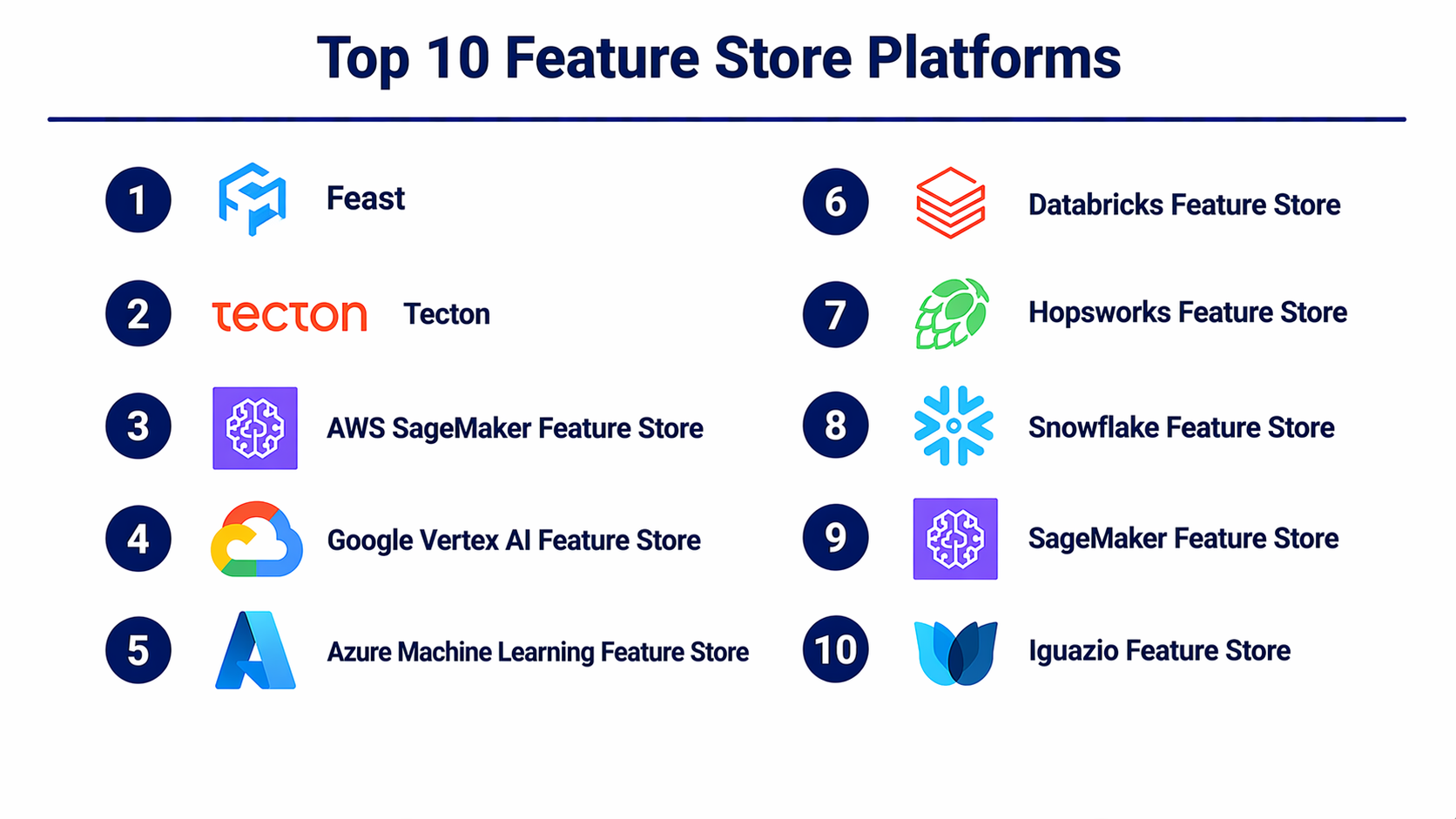
Top 10 Feature Store Platforms
#1 — Feast
Short description: An open-source feature store designed for data scientists and ML engineers looking for flexibility and control.
Key Features
- Offline and online feature store support
- Feature versioning and reproducibility
- Integration with batch and streaming pipelines
- Lightweight architecture
- Python SDK
- Pluggable storage backends
Pros
- Strong open-source ecosystem
- Highly customizable
Cons
- Requires setup and maintenance
- Limited enterprise UI features
Platforms / Deployment
Cloud / Self-hosted
Security & Compliance
Not publicly stated
Integrations & Ecosystem
Works with major data tools and ML frameworks.
- Spark
- Kafka
- BigQuery
- AWS services
Support & Community
Strong open-source community; enterprise support varies.
#2 — Tecton
Short description: A fully managed feature platform focused on real-time ML use cases for enterprises.
Key Features
- Real-time feature pipelines
- Automated feature engineering workflows
- Feature monitoring
- Data validation
- Online and offline serving
- Workflow orchestration
Pros
- Enterprise-grade reliability
- Strong real-time capabilities
Cons
- Higher cost
- Complex onboarding
Platforms / Deployment
Cloud
Security & Compliance
SSO, RBAC (others not publicly stated)
Integrations & Ecosystem
Deep integration with cloud and ML systems.
- Snowflake
- Databricks
- Kafka
Support & Community
Enterprise-level support with onboarding assistance.
#3 — AWS SageMaker Feature Store
Short description: A managed feature store integrated within the AWS ecosystem.
Key Features
- Fully managed infrastructure
- Real-time and batch feature storage
- Feature lineage tracking
- Built-in security controls
- Seamless integration with ML workflows
Pros
- Tight AWS integration
- Scalable and reliable
Cons
- Vendor lock-in
- Learning curve for AWS beginners
Platforms / Deployment
Cloud
Security & Compliance
Encryption, IAM, audit logs
Integrations & Ecosystem
Native AWS ecosystem support.
- S3
- Lambda
- SageMaker pipelines
Support & Community
Strong documentation and enterprise support.
#4 — Google Vertex AI Feature Store
Short description: A scalable feature management solution within Google’s AI platform.
Key Features
- Real-time feature serving
- Data validation
- Feature monitoring
- Auto scaling
- Integration with ML pipelines
Pros
- Strong performance
- Managed service
Cons
- Limited flexibility outside GCP
- Pricing complexity
Platforms / Deployment
Cloud
Security & Compliance
IAM, encryption
Integrations & Ecosystem
GCP-native integrations.
- BigQuery
- Dataflow
Support & Community
Strong enterprise support.
#5 — Azure Machine Learning Feature Store
Short description: Microsoft’s feature store offering integrated with Azure ML services.
Key Features
- Feature lifecycle management
- Real-time and batch support
- Built-in governance
- Pipeline integration
- Version control
Pros
- Strong enterprise ecosystem
- Integrated governance
Cons
- Azure dependency
- Setup complexity
Platforms / Deployment
Cloud
Security & Compliance
RBAC, encryption
Integrations & Ecosystem
- Azure Data Factory
- Synapse
- ML pipelines
Support & Community
Enterprise support with documentation.
#6 — Databricks Feature Store
Short description: Feature store built into Databricks Lakehouse platform.
Key Features
- Unified data + ML platform
- Delta Lake integration
- Feature sharing
- Real-time inference
- ML lifecycle integration
Pros
- Strong data integration
- High scalability
Cons
- Requires Databricks ecosystem
- Cost considerations
Platforms / Deployment
Cloud
Security & Compliance
RBAC, audit logs
Integrations & Ecosystem
- Spark
- MLflow
- Delta Lake
Support & Community
Strong enterprise support.
#7 — Hopsworks Feature Store
Short description: A feature store designed for both batch and real-time ML pipelines.
Key Features
- Feature registry
- Real-time serving
- Data validation
- Metadata tracking
- Model serving integration
Pros
- Full-stack ML platform
- Strong research backing
Cons
- Learning curve
- Smaller ecosystem
Platforms / Deployment
Cloud / Self-hosted
Security & Compliance
Not publicly stated
Integrations & Ecosystem
- Kafka
- Spark
- Python SDK
Support & Community
Growing community and enterprise support.
#8 — Snowflake Feature Store
Short description: A feature store integrated with Snowflake’s data cloud.
Key Features
- SQL-based feature engineering
- Native data integration
- Feature sharing
- Governance controls
- Scalability
Pros
- Strong data integration
- Easy adoption for SQL users
Cons
- Limited ML-native features
- Vendor dependency
Platforms / Deployment
Cloud
Security & Compliance
Encryption, RBAC
Integrations & Ecosystem
- Snowflake ecosystem
- BI tools
Support & Community
Enterprise support available.
#9 — SageMaker Feature Store (Open-source alternatives integration)
Short description: Hybrid approach using AWS with open-source extensions.
Key Features
- Flexible pipelines
- Hybrid deployment
- Feature reuse
- Custom integrations
Pros
- Flexible architecture
- Customizable
Cons
- Complex setup
- Maintenance overhead
Platforms / Deployment
Hybrid
Security & Compliance
Varies / N/A
Integrations & Ecosystem
- Open-source tools
- AWS services
Support & Community
Varies depending on setup.
#10 — Iguazio Feature Store
Short description: Real-time feature store focused on production ML environments.
Key Features
- Real-time data ingestion
- Feature pipelines
- Low-latency serving
- Model monitoring
- Automation tools
Pros
- Strong real-time capabilities
- Production-ready
Cons
- Enterprise-focused pricing
- Limited community visibility
Platforms / Deployment
Cloud / Hybrid
Security & Compliance
Not publicly stated
Integrations & Ecosystem
- Kubernetes
- ML pipelines
Support & Community
Enterprise support model.
Comparison Table (Top 10)
| Tool Name | Best For | Platform(s) Supported | Deployment | Standout Feature | Public Rating |
|---|---|---|---|---|---|
| Feast | Developers | Linux, Cloud | Self-hosted | Open-source flexibility | N/A |
| Tecton | Enterprise | Web | Cloud | Real-time pipelines | N/A |
| AWS SageMaker Feature Store | AWS users | Web | Cloud | Native AWS integration | N/A |
| Google Vertex AI Feature Store | GCP users | Web | Cloud | Auto scaling | N/A |
| Azure ML Feature Store | Azure users | Web | Cloud | Governance tools | N/A |
| Databricks Feature Store | Data teams | Web | Cloud | Lakehouse integration | N/A |
| Hopsworks | Research/ML teams | Web | Hybrid | Metadata tracking | N/A |
| Snowflake Feature Store | SQL teams | Web | Cloud | SQL-first features | N/A |
| Hybrid SageMaker FS | Advanced users | Hybrid | Hybrid | Custom pipelines | N/A |
| Iguazio | Real-time ML | Web | Hybrid | Low latency serving | N/A |
Evaluation & Scoring of Feature Store Platforms
| Tool Name | Core (25%) | Ease (15%) | Integrations (15%) | Security (10%) | Performance (10%) | Support (10%) | Value (15%) | Weighted Total |
|---|---|---|---|---|---|---|---|---|
| Feast | 8 | 6 | 8 | 6 | 7 | 7 | 9 | 7.5 |
| Tecton | 9 | 7 | 9 | 8 | 9 | 9 | 6 | 8.3 |
| AWS SageMaker | 9 | 7 | 9 | 9 | 9 | 9 | 7 | 8.6 |
| Vertex AI | 9 | 7 | 8 | 8 | 9 | 9 | 7 | 8.4 |
| Azure ML | 8 | 7 | 8 | 8 | 8 | 9 | 7 | 8.0 |
| Databricks | 9 | 7 | 9 | 8 | 9 | 9 | 6 | 8.4 |
| Hopsworks | 8 | 6 | 7 | 6 | 7 | 7 | 8 | 7.3 |
| Snowflake | 7 | 8 | 8 | 8 | 8 | 8 | 7 | 7.8 |
| Hybrid FS | 8 | 5 | 8 | 6 | 7 | 6 | 8 | 7.0 |
| Iguazio | 8 | 6 | 7 | 7 | 9 | 8 | 6 | 7.6 |
How to interpret:
Scores are relative comparisons based on feature strength, usability, and ecosystem. A higher score does not mean universally better—it depends on your environment, scale, and use case.
Which Feature Store Platforms for You?
Solo / Freelancer
Feast is ideal due to flexibility and no vendor lock-in.
SMB
Snowflake or Databricks offers a balance of usability and scalability.
Mid-Market
Azure ML or Vertex AI provides strong integration and governance.
Enterprise
Tecton and AWS SageMaker are best for large-scale production ML.
Budget vs Premium
- Budget: Feast
- Premium: Tecton, Iguazio
Feature Depth vs Ease of Use
- Deep features: Tecton, Databricks
- Easy setup: Snowflake
Integrations & Scalability
- Best integrations: AWS, Databricks
- Scalable: Vertex AI
Security & Compliance Needs
- Strong security: AWS, Azure
Frequently Asked Questions (FAQs)
What is a feature store?
A system that manages and serves ML features consistently across training and inference.
Do I need a feature store?
Only if you are scaling ML workflows or deploying models in production.
Are feature stores expensive?
Costs vary widely depending on cloud usage and scale.
Can I build my own feature store?
Yes, but it requires significant engineering effort.
What is online vs offline feature store?
Online is for real-time serving; offline is for training datasets.
How long does implementation take?
From weeks to months depending on complexity.
Are they secure?
Most enterprise platforms offer strong security; details vary.
Can I switch feature stores later?
Yes, but migration can be complex.
What are common mistakes?
Ignoring governance and not planning for scaling.
What alternatives exist?
Simple data pipelines or ML platforms without feature stores.
Conclusion
Feature store platforms have become a foundational component in modern machine learning infrastructure. They solve real-world challenges around feature consistency, scalability, and operational efficiency. However, the “best” platform depends heavily on your context—your cloud environment, team size, real-time needs, and budget constraints. For organizations already invested in cloud ecosystems, native solutions like AWS, Azure, or Google offer tight integration and ease of scaling. On the other hand, open-source tools like Feast provide flexibility and control for teams that want customization without vendor lock-in.
