Introduction
MLOps platforms are tools that help teams build, deploy, monitor, and manage machine learning models in production. Think of MLOps as DevOps for machine learning—it brings structure, automation, and reliability to ML workflows that would otherwise be complex and error-prone.
As organizations scale AI adoption, MLOps has become critical. In today’s environment, models are not just built once—they must be continuously trained, monitored, and improved. Without MLOps, teams struggle with model drift, deployment delays, and lack of governance.
Real-world use cases:
- Fraud detection models that need continuous retraining
- Recommendation engines in e-commerce
- Predictive maintenance in industrial systems
- Real-time personalization in marketing platforms
- Risk scoring in banking and insurance
What buyers should evaluate:
- End-to-end ML lifecycle coverage
- Ease of deployment and CI/CD integration
- Model monitoring and observability
- Data versioning and lineage tracking
- Integration with cloud and data platforms
- Scalability and performance
- Security and compliance controls
- Collaboration features for teams
- Cost and pricing flexibility
Best for: ML engineers, data scientists, DevOps teams, enterprises scaling AI, and startups building production-grade ML systems.
Not ideal for: Small projects or one-off models where manual deployment is sufficient, or teams without ongoing ML workloads.
Key Trends in MLOps Platforms
- Rapid adoption of AI-powered pipeline automation
- Integration with generative AI and LLM workflows
- Strong focus on model monitoring and observability
- Rise of feature stores as core components
- Expansion of multi-cloud and hybrid deployments
- Increasing demand for data governance and lineage tracking
- Growth of open-source MLOps ecosystems
- Emphasis on real-time inference and edge ML
- Adoption of GitOps-style workflows for ML pipelines
- Pricing models shifting toward usage-based billing
How We Selected These Tools (Methodology)
- High adoption across enterprises and startups
- Comprehensive coverage of ML lifecycle
- Proven reliability and performance in production
- Security and compliance readiness
- Strong integrations with modern data stacks
- Flexibility for both developers and business users
- Balanced mix of open-source and enterprise tools
- Community support and documentation quality
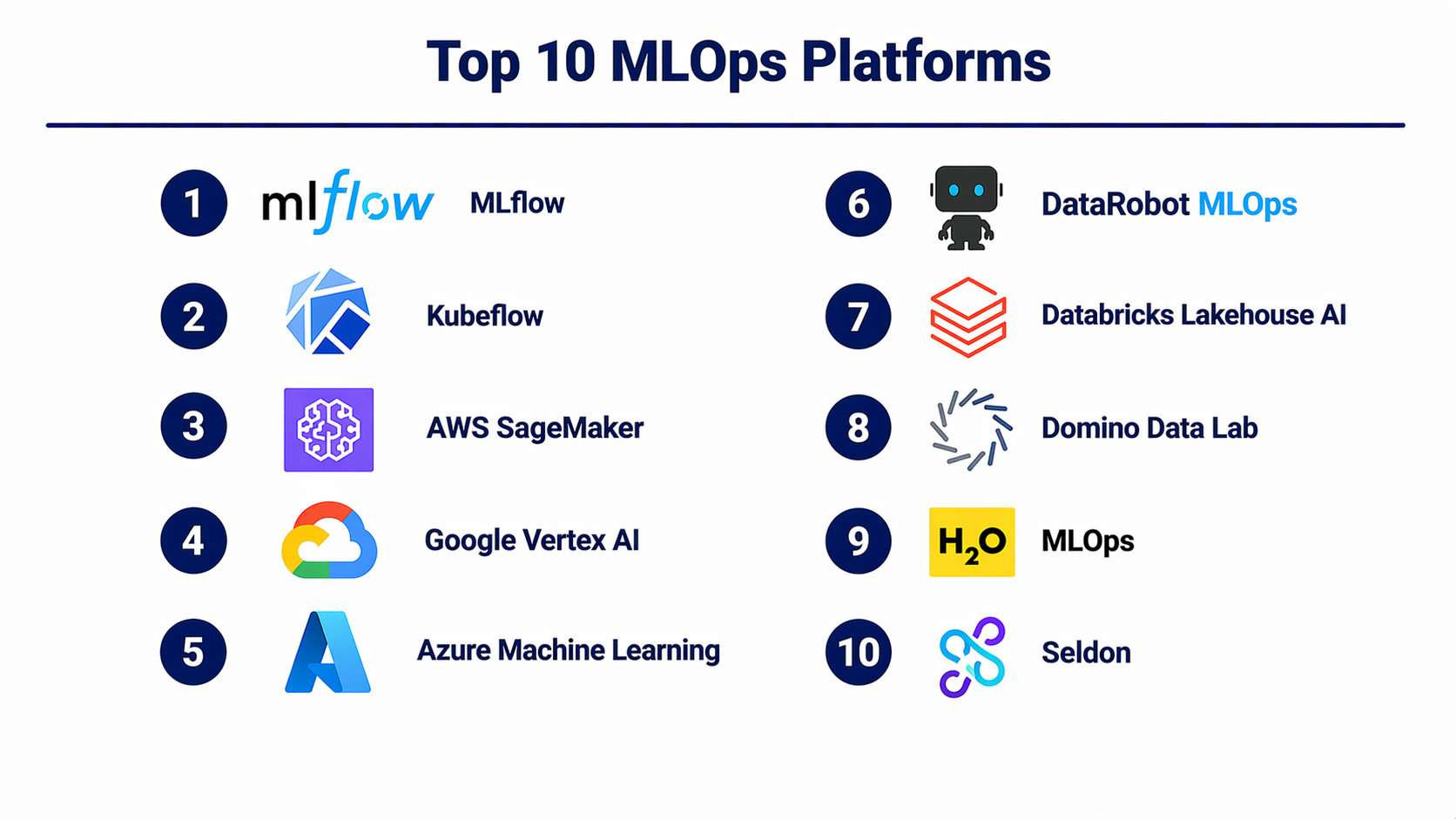
Top 10 MLOps Platforms
#1 — MLflow
Short description: Open-source MLOps platform focused on experiment tracking, model management, and reproducibility.
Key Features
- Experiment tracking and logging
- Model registry
- Deployment tools
- Multi-language support
- Integration with popular ML frameworks
- Open-source flexibility
Pros
- Free and open-source
- Highly flexible
Cons
- Requires setup and maintenance
- Limited UI compared to enterprise tools
Platforms / Deployment
Cloud / Self-hosted
Security & Compliance
Varies / Not publicly stated
Integrations & Ecosystem
MLflow integrates with multiple ML frameworks and cloud environments
- TensorFlow
- PyTorch
- Databricks
- REST APIs
Support & Community
Strong open-source community and documentation
#2 — Kubeflow
Short description: Kubernetes-native MLOps platform for managing ML workflows at scale.
Key Features
- Pipeline orchestration
- Kubernetes integration
- Model serving
- Experiment tracking
- Scalable infrastructure
Pros
- Highly scalable
- Cloud-native design
Cons
- Complex setup
- Requires Kubernetes expertise
Platforms / Deployment
Self-hosted / Cloud
Security & Compliance
Depends on Kubernetes configuration
Integrations & Ecosystem
- Kubernetes
- TensorFlow
- APIs
Support & Community
Active open-source community
#3 — AWS SageMaker
Short description: End-to-end MLOps platform with training, deployment, and monitoring capabilities.
Key Features
- Model training and deployment
- Auto-scaling endpoints
- Pipeline automation
- Monitoring tools
- Integration with AWS services
Pros
- Fully managed service
- Scalable infrastructure
Cons
- Vendor lock-in
- Cost management required
Platforms / Deployment
Cloud
Security & Compliance
IAM, encryption, audit logs supported
Integrations & Ecosystem
- S3
- Lambda
- Redshift
Support & Community
Strong enterprise support
#4 — Google Vertex AI
Short description: Unified MLOps platform for building, deploying, and managing ML models.
Key Features
- Pipeline orchestration
- AutoML integration
- Model monitoring
- Feature store
- Generative AI tools
Pros
- End-to-end platform
- Strong performance
Cons
- Learning curve
- Pricing complexity
Platforms / Deployment
Cloud
Security & Compliance
IAM, encryption, audit logs
Integrations & Ecosystem
- BigQuery
- Dataflow
- APIs
Support & Community
Enterprise-level support
#5 — Azure Machine Learning
Short description: Microsoft’s MLOps platform with strong enterprise integration and governance.
Key Features
- Automated pipelines
- Model deployment
- Monitoring and alerts
- Responsible AI tools
- Integration with Azure ecosystem
Pros
- Enterprise-ready
- Strong compliance
Cons
- Complex UI
- Requires Azure familiarity
Platforms / Deployment
Cloud
Security & Compliance
RBAC, encryption, compliance certifications (varies)
Integrations & Ecosystem
- Power BI
- Azure Data Factory
- Synapse
Support & Community
Strong enterprise support
#6 — DataRobot MLOps
Short description: Enterprise MLOps platform focused on governance, monitoring, and deployment.
Key Features
- Model monitoring
- Deployment automation
- Governance tools
- Explainability features
- Lifecycle management
Pros
- Strong governance
- Easy deployment
Cons
- Expensive
- Limited flexibility
Platforms / Deployment
Cloud / Hybrid
Security & Compliance
Enterprise-grade (details vary)
Integrations & Ecosystem
- APIs
- Data platforms
- BI tools
Support & Community
Premium enterprise support
#7 — Databricks Lakehouse AI
Short description: Unified analytics and MLOps platform combining data engineering and ML workflows.
Key Features
- MLflow integration
- Data lakehouse architecture
- Feature engineering tools
- Pipeline orchestration
- Collaboration features
Pros
- Unified platform
- Strong scalability
Cons
- Cost considerations
- Requires expertise
Platforms / Deployment
Cloud
Security & Compliance
Varies / Not publicly stated
Integrations & Ecosystem
- Spark
- Delta Lake
- APIs
Support & Community
Strong community and enterprise support
#8 — Domino Data Lab
Short description: Enterprise MLOps platform designed for collaborative data science and model governance.
Key Features
- Experiment tracking
- Model deployment
- Governance and compliance
- Collaboration tools
- Reproducibility
Pros
- Strong governance
- Collaboration-focused
Cons
- Expensive
- Complex setup
Platforms / Deployment
Cloud / Hybrid
Security & Compliance
Enterprise-grade features (details vary)
Integrations & Ecosystem
- APIs
- Data tools
- ML frameworks
Support & Community
Enterprise support
#9 — H2O MLOps
Short description: MLOps solution from H2O.ai for managing models at scale.
Key Features
- Model deployment
- Monitoring and alerting
- Explainability tools
- Integration with H2O AutoML
- Scalable architecture
Pros
- Strong performance
- Flexible deployment
Cons
- Requires technical expertise
- UI improvements needed
Platforms / Deployment
Cloud / Self-hosted
Security & Compliance
Varies / Not publicly stated
Integrations & Ecosystem
- Python
- R
- APIs
Support & Community
Active community
#10 — Seldon
Short description: Open-source platform for deploying and managing ML models on Kubernetes.
Key Features
- Model deployment on Kubernetes
- A/B testing
- Monitoring and metrics
- Scalable inference
- Integration with CI/CD
Pros
- Open-source flexibility
- Strong Kubernetes integration
Cons
- Complex setup
- Requires DevOps expertise
Platforms / Deployment
Self-hosted / Cloud
Security & Compliance
Depends on configuration
Integrations & Ecosystem
- Kubernetes
- Prometheus
- APIs
Support & Community
Strong open-source support
Comparison Table (Top 10)
| Tool Name | Best For | Platform(s) Supported | Deployment | Standout Feature | Public Rating |
|---|---|---|---|---|---|
| MLflow | Developers | Multi | Hybrid | Experiment tracking | N/A |
| Kubeflow | DevOps teams | Kubernetes | Hybrid | Pipeline orchestration | N/A |
| SageMaker | AWS users | Cloud | Cloud | Managed MLOps | N/A |
| Vertex AI | Enterprise AI | Cloud | Cloud | Unified platform | N/A |
| Azure ML | Enterprises | Cloud | Cloud | Governance tools | N/A |
| DataRobot | Large orgs | Cloud | Hybrid | Model monitoring | N/A |
| Databricks | Data teams | Cloud | Cloud | Lakehouse integration | N/A |
| Domino Data Lab | Enterprises | Multi | Hybrid | Collaboration | N/A |
| H2O MLOps | Developers | Multi | Hybrid | Performance | N/A |
| Seldon | Kubernetes users | Kubernetes | Hybrid | Model deployment | N/A |
Evaluation & Scoring of MLOps Platforms
| Tool Name | Core | Ease | Integrations | Security | Performance | Support | Value | Weighted Total |
|---|---|---|---|---|---|---|---|---|
| MLflow | 8 | 7 | 8 | 6 | 8 | 7 | 9 | 7.9 |
| Kubeflow | 9 | 5 | 9 | 7 | 9 | 7 | 8 | 8.0 |
| SageMaker | 9 | 7 | 9 | 9 | 9 | 8 | 7 | 8.4 |
| Vertex AI | 9 | 7 | 9 | 9 | 9 | 8 | 7 | 8.4 |
| Azure ML | 9 | 7 | 9 | 9 | 9 | 8 | 7 | 8.4 |
| DataRobot | 9 | 8 | 8 | 9 | 9 | 9 | 6 | 8.3 |
| Databricks | 9 | 7 | 9 | 8 | 9 | 8 | 7 | 8.3 |
| Domino | 8 | 7 | 8 | 9 | 8 | 8 | 6 | 7.9 |
| H2O | 8 | 6 | 8 | 7 | 8 | 7 | 8 | 7.8 |
| Seldon | 8 | 5 | 8 | 7 | 8 | 7 | 8 | 7.7 |
How to interpret scores:
- Scores compare tools relative to each other
- Enterprise tools excel in security and performance
- Open-source tools score high in value
- Choose based on your priorities (cost vs scalability)
- Weighted score reflects balanced evaluation
Which MLOps Platforms for You?
Solo / Freelancer
MLflow or H2O MLOps for flexibility and cost control.
SMB
Databricks or Azure ML for balanced capabilities.
Mid-Market
DataRobot or Vertex AI for scalability and governance.
Enterprise
SageMaker, Vertex AI, and Azure ML are strong choices.
Budget vs Premium
- Budget: MLflow, Seldon
- Premium: DataRobot, Domino
Feature Depth vs Ease of Use
- Easy: DataRobot, Azure ML
- Advanced: Kubeflow, Seldon
Integrations & Scalability
- Best: AWS, Azure, Google ecosystems
Security & Compliance Needs
- Best: Azure ML, DataRobot, Domino
Frequently Asked Questions (FAQs)
What is MLOps?
MLOps combines machine learning with DevOps practices to manage models in production.
Why is MLOps important?
It ensures reliable deployment, monitoring, and scaling of ML models.
Is MLOps only for large companies?
No, even small teams benefit from automation and monitoring.
How much does MLOps cost?
Costs vary based on platform and usage.
Can I use open-source MLOps tools?
Yes, tools like MLflow and Kubeflow are widely used.
What skills are needed for MLOps?
Basic ML, DevOps, and cloud knowledge.
How long does implementation take?
From days to months depending on complexity.
Is MLOps secure?
Most platforms offer enterprise-grade security features.
Can I switch MLOps platforms later?
Yes, but migration can require effort.
What are alternatives to MLOps?
Manual ML workflows or basic deployment pipelines.
Conclusion
MLOps platforms are essential for organizations that want to move beyond experimentation and bring machine learning into real-world production. They help teams manage complexity, improve reliability, and scale AI systems efficiently. There is no one-size-fits-all solution. Open-source tools offer flexibility and cost advantages, while enterprise platforms provide governance, scalability, and support. Your choice should depend on your team size, technical expertise, infrastructure, and long-term AI strategy.
