Introduction
Data Observability Tools help teams monitor, understand, and troubleshoot data pipelines and systems in real time. In simple terms, they answer questions like: Is my data correct? Is it complete? Where did it break? These tools focus on data health, reliability, and trust, similar to how application observability tools monitor systems and infrastructure.
In today’s modern data stack, where data flows across pipelines, warehouses, APIs, and machine learning systems, observability has become critical. As organizations increasingly rely on analytics and AI, bad data can directly impact business decisions, making observability a top priority in 2026 and beyond.
Common real-world use cases include:
- Detecting broken ETL/ELT pipelines before dashboards fail
- Monitoring data freshness and completeness
- Identifying schema changes and anomalies
- Ensuring data quality for AI/ML models
- Debugging data issues across distributed systems
What buyers should evaluate:
- Data freshness and anomaly detection
- Schema change monitoring
- Data lineage visibility
- Alerting and incident management
- Integration with data tools (dbt, Snowflake, etc.)
- Automation and AI-driven insights
- Scalability and performance
- Ease of setup and usability
- Cost and pricing model
Best for: Data engineers, analytics teams, data platform teams, and organizations with complex pipelines or critical reporting systems.
Not ideal for: Small teams with simple datasets or businesses that rely on manual data validation without complex pipelines.
Key Trends in Data Observability Tools
- AI-powered anomaly detection replacing manual monitoring
- Shift-left observability integrated into development workflows
- Real-time pipeline monitoring for streaming data systems
- Data quality automation embedded within observability platforms
- Integration with data transformation tools like dbt
- Unified observability platforms combining logs, metrics, and data
- Data reliability engineering (DRE) emerging as a discipline
- Usage-based pricing models aligned with data volume
- Data lineage + observability convergence
- Cross-cloud and multi-cloud observability support
How We Selected These Tools (Methodology)
- Evaluated market adoption and industry recognition
- Assessed feature completeness for observability use cases
- Considered performance and scalability in production environments
- Reviewed security and compliance readiness
- Analyzed integration ecosystem with modern data stack
- Checked ease of onboarding and usability
- Included both commercial and open-source tools
- Ensured coverage across enterprise and SMB needs
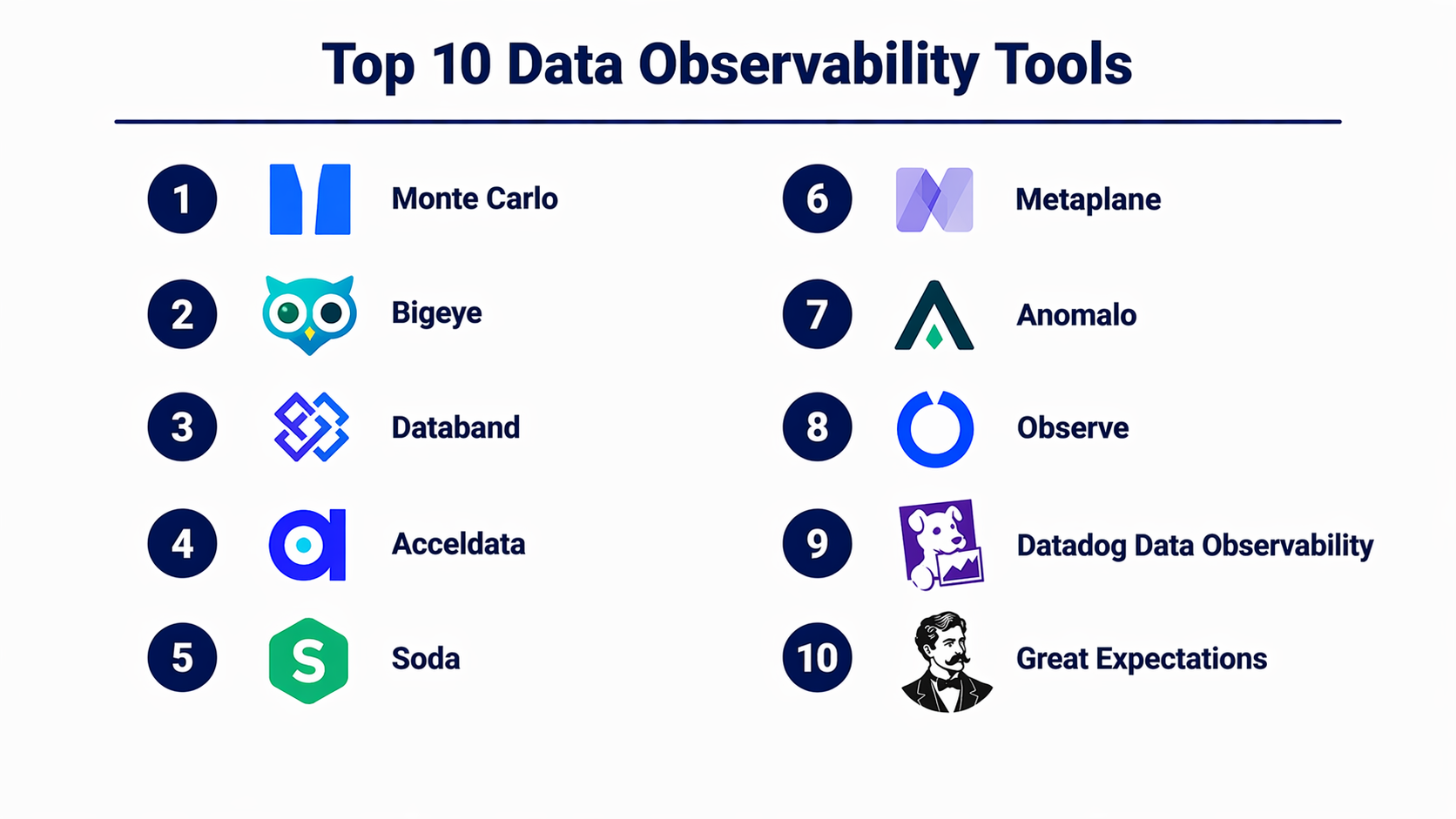
Top 10 Data Observability Tools
#1 — Monte Carlo
Short description: A leading data observability platform designed for enterprises to monitor data reliability across pipelines and warehouses.
Key Features
- Automated anomaly detection
- Data freshness monitoring
- Data lineage tracking
- Incident alerting
- Schema change detection
- Root cause analysis
Pros
- Strong enterprise adoption
- Advanced anomaly detection
Cons
- Premium pricing
- Requires setup effort
Platforms / Deployment
Cloud
Security & Compliance
SSO/SAML, RBAC; other details not publicly stated
Integrations & Ecosystem
Monte Carlo integrates with modern data stacks and cloud warehouses.
- Snowflake, BigQuery, Redshift
- dbt integration
- APIs for extensibility
Support & Community
Enterprise-grade support and onboarding
#2 — Bigeye
Short description: Data observability tool focused on data quality monitoring and pipeline reliability.
Key Features
- Data anomaly detection
- Metrics-based monitoring
- Data freshness tracking
- Alerting system
- Data profiling
Pros
- Easy to implement
- Strong monitoring features
Cons
- Limited advanced governance features
- Pricing varies
Platforms / Deployment
Cloud
Security & Compliance
Not publicly stated
Integrations & Ecosystem
- Integrates with warehouses and pipelines
- API-based integrations
Support & Community
Good support with growing community
#3 — Databand
Short description: Observability platform focused on monitoring data pipelines and workflows.
Key Features
- Pipeline monitoring
- Data lineage
- Incident management
- Alerting
- Workflow observability
Pros
- Strong pipeline visibility
- Enterprise-ready
Cons
- Learning curve
- Integration complexity
Platforms / Deployment
Cloud / Hybrid
Security & Compliance
Varies / Not publicly stated
Integrations & Ecosystem
- Airflow, Spark, dbt
- APIs and connectors
Support & Community
Enterprise support available
#4 — Acceldata
Short description: Comprehensive data observability platform covering performance, quality, and cost monitoring.
Key Features
- Data performance monitoring
- Data quality insights
- Cost optimization
- Data pipeline monitoring
- AI-driven analytics
Pros
- Broad observability coverage
- Enterprise scalability
Cons
- Complex setup
- Higher cost
Platforms / Deployment
Cloud / Hybrid
Security & Compliance
Not publicly stated
Integrations & Ecosystem
- Integrates with big data and cloud platforms
- API support
Support & Community
Enterprise-grade support
#5 — Soda
Short description: Open-source and commercial data observability tool focused on data quality checks.
Key Features
- Data quality testing
- Observability dashboards
- Data monitoring
- Schema validation
- Integration with CI/CD
Pros
- Open-source flexibility
- Developer-friendly
Cons
- Limited enterprise features
- Requires setup
Platforms / Deployment
Cloud / Self-hosted
Security & Compliance
Varies / Not publicly stated
Integrations & Ecosystem
- dbt, Airflow
- APIs and connectors
Support & Community
Active open-source community
#6 — Metaplane
Short description: Data observability platform emphasizing automated monitoring and anomaly detection.
Key Features
- Automated anomaly detection
- Data lineage
- Data quality monitoring
- Alerting
- Schema tracking
Pros
- Easy setup
- Strong automation
Cons
- Limited customization
- Pricing varies
Platforms / Deployment
Cloud
Security & Compliance
Not publicly stated
Integrations & Ecosystem
- Cloud warehouses
- APIs
Support & Community
Growing support ecosystem
#7 — Anomalo
Short description: AI-driven data quality and observability platform for enterprises.
Key Features
- AI-based anomaly detection
- Data quality monitoring
- Root cause analysis
- Alerts and reporting
- Data profiling
Pros
- Strong AI capabilities
- Enterprise-ready
Cons
- Cost considerations
- Setup complexity
Platforms / Deployment
Cloud
Security & Compliance
Not publicly stated
Integrations & Ecosystem
- Integration with data warehouses
- APIs
Support & Community
Enterprise support
#8 — Observe (Observe Inc.)
Short description: Observability platform combining data observability with log and metrics monitoring.
Key Features
- Unified observability
- Data monitoring
- Log analytics
- Metrics tracking
- Pipeline insights
Pros
- Unified platform approach
- Scalable
Cons
- Less specialized for pure data observability
- Learning curve
Platforms / Deployment
Cloud
Security & Compliance
Not publicly stated
Integrations & Ecosystem
- Logs, metrics, data tools
- APIs
Support & Community
Enterprise support
#9 — Datadog Data Observability
Short description: Extension of Datadog platform for monitoring data pipelines and quality.
Key Features
- Pipeline monitoring
- Data metrics tracking
- Alerts
- Integration with logs and metrics
- Dashboards
Pros
- Strong ecosystem
- Easy integration
Cons
- Cost scaling
- Not fully specialized
Platforms / Deployment
Cloud
Security & Compliance
SSO, RBAC; others not publicly stated
Integrations & Ecosystem
- Datadog ecosystem
- Cloud platforms
Support & Community
Strong global community
#10 — Great Expectations
Short description: Open-source framework for validating and testing data quality.
Key Features
- Data validation rules
- Data profiling
- Test automation
- Integration with pipelines
- Reporting
Pros
- Open-source
- Highly customizable
Cons
- Not a full observability platform
- Requires engineering effort
Platforms / Deployment
Self-hosted
Security & Compliance
Varies / Not publicly stated
Integrations & Ecosystem
- Python ecosystem
- Data pipelines
Support & Community
Large open-source community
Comparison Table (Top 10)
| Tool Name | Best For | Platform(s) Supported | Deployment | Standout Feature | Public Rating |
|---|---|---|---|---|---|
| Monte Carlo | Enterprise observability | Web | Cloud | Automated anomaly detection | N/A |
| Bigeye | Data monitoring | Web | Cloud | Metrics-based monitoring | N/A |
| Databand | Pipeline observability | Web | Cloud/Hybrid | Workflow monitoring | N/A |
| Acceldata | Performance monitoring | Web | Cloud/Hybrid | Cost + performance insights | N/A |
| Soda | Open-source observability | Web | Cloud/Self-hosted | Data quality checks | N/A |
| Metaplane | Automated monitoring | Web | Cloud | Easy anomaly detection | N/A |
| Anomalo | AI data observability | Web | Cloud | AI-based detection | N/A |
| Observe | Unified observability | Web | Cloud | Logs + data integration | N/A |
| Datadog | Monitoring ecosystem | Web | Cloud | Integrated observability | N/A |
| Great Expectations | Data validation | Web | Self-hosted | Rule-based testing | N/A |
Evaluation & Scoring of Data Observability Tools
| Tool Name | Core (25%) | Ease (15%) | Integrations (15%) | Security (10%) | Performance (10%) | Support (10%) | Value (15%) | Weighted Total |
|---|---|---|---|---|---|---|---|---|
| Monte Carlo | 9 | 7 | 9 | 8 | 9 | 9 | 6 | 8.2 |
| Bigeye | 8 | 8 | 8 | 7 | 8 | 8 | 7 | 7.8 |
| Databand | 8 | 7 | 9 | 7 | 8 | 8 | 7 | 7.9 |
| Acceldata | 9 | 6 | 8 | 7 | 9 | 8 | 6 | 7.9 |
| Soda | 7 | 7 | 8 | 6 | 7 | 7 | 9 | 7.4 |
| Metaplane | 8 | 8 | 7 | 7 | 8 | 7 | 7 | 7.7 |
| Anomalo | 9 | 7 | 8 | 7 | 8 | 8 | 6 | 7.9 |
| Observe | 8 | 7 | 8 | 7 | 8 | 7 | 7 | 7.6 |
| Datadog | 8 | 8 | 9 | 8 | 9 | 9 | 6 | 8.2 |
| Great Expectations | 7 | 6 | 8 | 6 | 7 | 7 | 9 | 7.3 |
How to interpret scores:
- Scores are comparative across listed tools
- Higher score ≠ best for every use case
- Enterprise tools score higher in features
- Open-source tools score higher in value
- Always validate with real-world testing
Which Data Observability Toolss Right for You?
Solo / Freelancer
- Great Expectations
- Soda
SMB
- Metaplane
- Bigeye
Mid-Market
- Databand
- Anomalo
Enterprise
- Monte Carlo
- Acceldata
- Datadog
Budget vs Premium
- Budget: Great Expectations, Soda
- Premium: Monte Carlo, Acceldata
Feature Depth vs Ease of Use
- Deep features: Acceldata, Monte Carlo
- Easy to use: Metaplane, Bigeye
Integrations & Scalability
- Strong integrations: Datadog, Databand
- Scalable: Monte Carlo, Acceldata
Security & Compliance Needs
- Enterprise-grade: Monte Carlo, Datadog
- Moderate: Soda, Metaplane
Frequently Asked Questions (FAQs)
What is data observability?
It monitors and ensures data quality, reliability, and availability across systems.
How is it different from data monitoring?
Observability provides deeper insights including root cause analysis.
Are these tools expensive?
Enterprise tools can be costly; open-source options are available.
Do they support real-time data?
Yes, many support real-time monitoring.
Can small teams use them?
Yes, but simpler tools may be better.
What integrations are important?
Data warehouses, ETL tools, and BI platforms.
How long does setup take?
From days to weeks depending on complexity.
Do they support AI use cases?
Yes, especially for anomaly detection.
What are common mistakes?
Ignoring alerts and overcomplicating setups.
Can you switch tools easily?
Switching requires planning and migration effort.
Conclusion
Data observability tools are becoming essential for organizations that rely heavily on data for decision-making, analytics, and AI-driven workflows. As data pipelines grow more complex, ensuring reliability, accuracy, and timeliness becomes a continuous challenge. Tools like Monte Carlo and Acceldata provide deep enterprise-grade capabilities, while options like Soda and Great Expectations offer flexibility for teams with technical expertise.
