Introduction
KYC (Know Your Customer) and AML (Anti-Money Laundering) compliance tools help businesses verify customer identities, detect suspicious activities, and meet regulatory requirements. These platforms are widely used in industries like banking, fintech, insurance, crypto, and e-commerce to prevent fraud and financial crime.
As regulations become stricter and digital transactions grow rapidly, organizations need automated and scalable compliance solutions. Manual verification is no longer practical. Modern KYC/AML tools use AI, machine learning, and global data sources to provide real-time identity verification, risk scoring, and transaction monitoring.
Common use cases include:
- Customer onboarding and identity verification
- Fraud detection and prevention
- Sanctions and watchlist screening
- Transaction monitoring and reporting
- Regulatory compliance audits
What buyers should evaluate:
- Accuracy of identity verification
- Global coverage (documents, regions)
- Real-time fraud detection capabilities
- Integration flexibility (APIs, SDKs)
- Compliance standards support
- Scalability and performance
- Cost structure and pricing transparency
- User experience and onboarding speed
Best for: Fintech startups, banks, crypto platforms, payment gateways, and enterprises handling financial transactions.
Not ideal for: Small businesses with minimal regulatory exposure or companies not dealing with financial transactions, where simpler identity checks may be enough.
Key Trends in KYC/AML Compliance Tools
- AI-driven verification: Automated document verification and facial recognition are improving accuracy and speed.
- Real-time risk scoring: Continuous monitoring instead of one-time checks is becoming standard.
- Global compliance coverage: Tools now support multiple jurisdictions and regulatory frameworks.
- API-first platforms: Developer-friendly APIs allow seamless integration into apps and workflows.
- Behavioral analytics: Monitoring user behavior patterns to detect anomalies and fraud.
- Cloud-native deployment: Most tools are SaaS-based for scalability and faster updates.
- Regulatory automation: Automated reporting and audit trails reduce compliance overhead.
- Biometric authentication: Facial recognition and liveness detection are widely adopted.
- Data privacy focus: GDPR and data protection compliance are now essential.
How We Selected These Tools (Methodology)
- Strong market adoption across fintech, banking, and enterprise sectors
- Comprehensive KYC and AML feature sets
- Proven reliability and performance at scale
- Security posture and compliance readiness
- Integration capabilities with modern tech stacks
- Suitability for different business sizes (startup to enterprise)
- Customer support and onboarding experience
- Innovation in AI and automation features
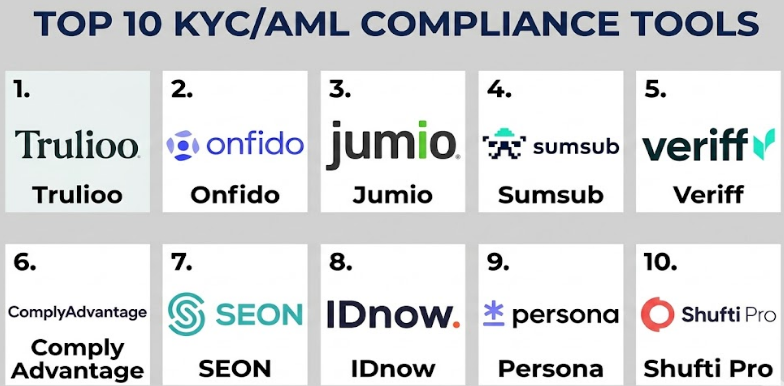
Top 10 KYC/AML Compliance Tools
#1 — Trulioo
Short description: A global identity verification platform designed for enterprises needing fast and accurate KYC checks across multiple regions.
Key Features
- Global identity verification across 190+ countries
- Document and non-document verification
- Real-time AML screening
- API-based integration
- Risk scoring and analytics
- Workflow automation
Pros
- Strong global coverage
- Flexible API integrations
Cons
- Pricing can be complex
- Setup may require technical effort
Platforms / Deployment
Web, Cloud
Security & Compliance
GDPR support, encryption, audit logs (others not publicly stated)
Integrations & Ecosystem
Supports REST APIs and integrates with fintech platforms
- CRM systems
- Payment platforms
- Banking systems
Support & Community
Enterprise-level support; documentation is strong.
#2 — Onfido
Short description: AI-powered identity verification platform focusing on document verification and biometric authentication.
Key Features
- AI document verification
- Facial recognition and liveness detection
- Fraud detection models
- SDKs for mobile apps
- Workflow automation
Pros
- Strong biometric capabilities
- User-friendly integration
Cons
- Limited AML depth compared to others
- Pricing varies
Platforms / Deployment
Web, Mobile SDKs, Cloud
Security & Compliance
GDPR compliance, encryption (others not publicly stated)
Integrations & Ecosystem
API-driven integrations
- Mobile apps
- Fintech platforms
- CRM tools
Support & Community
Good enterprise support; strong onboarding.
#3 — Jumio
Short description: End-to-end identity verification platform with AI-based KYC and AML capabilities.
Key Features
- Document verification
- Biometric authentication
- AML screening
- Risk scoring
- Real-time verification
Pros
- Comprehensive solution
- Strong fraud detection
Cons
- Higher cost for small teams
- Implementation complexity
Platforms / Deployment
Web, Mobile SDKs, Cloud
Security & Compliance
GDPR, encryption (others not publicly stated)
Integrations & Ecosystem
Flexible APIs
- Banking systems
- Fraud detection tools
- CRM platforms
Support & Community
Enterprise-grade support available.
#4 — Sumsub
Short description: All-in-one verification platform offering KYC, AML, and fraud prevention.
Key Features
- Identity verification
- AML screening
- Transaction monitoring
- KYB (business verification)
- Risk scoring
Pros
- Unified platform
- Competitive pricing
Cons
- UI can be complex
- Customization may require effort
Platforms / Deployment
Web, Cloud
Security & Compliance
GDPR support (others not publicly stated)
Integrations & Ecosystem
Wide API support
- Payment gateways
- Crypto platforms
- CRM systems
Support & Community
Responsive support; documentation is solid.
#5 — Veriff
Short description: Identity verification platform focused on user onboarding and fraud prevention.
Key Features
- Document verification
- Biometric authentication
- Fraud detection
- Global coverage
- AI-based decisioning
Pros
- Fast onboarding
- High verification accuracy
Cons
- Limited AML features
- Pricing varies
Platforms / Deployment
Web, Mobile SDKs, Cloud
Security & Compliance
GDPR, encryption (others not publicly stated)
Integrations & Ecosystem
API integrations
- Fintech platforms
- Mobile apps
- CRM tools
Support & Community
Strong onboarding support.
#6 — ComplyAdvantage
Short description: AML-focused platform providing risk detection and transaction monitoring.
Key Features
- AML screening
- Transaction monitoring
- Risk scoring
- Real-time alerts
- Data intelligence
Pros
- Strong AML capabilities
- Real-time monitoring
Cons
- Limited KYC features
- Enterprise-focused
Platforms / Deployment
Web, Cloud
Security & Compliance
Not publicly stated
Integrations & Ecosystem
API-first integrations
- Banking platforms
- Payment systems
- Risk tools
Support & Community
Enterprise support available.
#7 — SEON
Short description: Fraud prevention and AML platform focusing on digital businesses.
Key Features
- Fraud detection
- AML checks
- Device fingerprinting
- Email and phone validation
- Risk scoring
Pros
- Strong fraud detection
- Easy integration
Cons
- Limited enterprise features
- AML depth varies
Platforms / Deployment
Web, Cloud
Security & Compliance
Not publicly stated
Integrations & Ecosystem
Integrates with payment systems and APIs
- E-commerce platforms
- Fintech tools
Support & Community
Good support for SMBs.
#8 — IDnow
Short description: Identity verification platform with strong compliance support in regulated industries.
Key Features
- Video verification
- Document verification
- AML checks
- eID solutions
- Risk scoring
Pros
- Strong compliance focus
- Flexible verification methods
Cons
- Slower onboarding in some cases
- Regional focus
Platforms / Deployment
Web, Cloud
Security & Compliance
GDPR support
Integrations & Ecosystem
API integrations
- Banking systems
- Identity providers
Support & Community
Enterprise support available.
#9 — Persona
Short description: Flexible identity platform offering customizable KYC workflows.
Key Features
- Identity verification
- Custom workflows
- Risk scoring
- Document verification
- API integrations
Pros
- Highly customizable
- Developer-friendly
Cons
- Requires setup effort
- Pricing varies
Platforms / Deployment
Web, Cloud
Security & Compliance
Not publicly stated
Integrations & Ecosystem
Strong API ecosystem
- CRM
- Fintech platforms
- Internal systems
Support & Community
Good documentation and support.
#10 — Shufti Pro
Short description: KYC and AML platform providing real-time identity verification services.
Key Features
- Document verification
- Facial recognition
- AML screening
- Risk scoring
- Real-time verification
Pros
- Fast verification
- Global coverage
Cons
- UI improvements needed
- Customization limitations
Platforms / Deployment
Web, Cloud
Security & Compliance
Not publicly stated
Integrations & Ecosystem
API integrations
- Fintech platforms
- Payment systems
Support & Community
Support quality varies.
Comparison Table (Top 10)
| Tool Name | Best For | Platform(s) Supported | Deployment | Standout Feature | Public Rating |
|---|---|---|---|---|---|
| Trulioo | Global enterprises | Web | Cloud | Global verification coverage | N/A |
| Onfido | Mobile-first apps | Web, Mobile | Cloud | Biometric verification | N/A |
| Jumio | Enterprise KYC | Web, Mobile | Cloud | AI-driven verification | N/A |
| Sumsub | All-in-one solution | Web | Cloud | Unified KYC + AML | N/A |
| Veriff | Fast onboarding | Web, Mobile | Cloud | High accuracy verification | N/A |
| ComplyAdvantage | AML monitoring | Web | Cloud | Real-time AML alerts | N/A |
| SEON | Fraud detection | Web | Cloud | Device fingerprinting | N/A |
| IDnow | Regulated industries | Web | Cloud | Video verification | N/A |
| Persona | Custom workflows | Web | Cloud | Flexible workflows | N/A |
| Shufti Pro | Real-time verification | Web | Cloud | Fast identity checks | N/A |
Evaluation & Scoring of KYC/AML Compliance Tools
| Tool Name | Core (25%) | Ease (15%) | Integrations (15%) | Security (10%) | Performance (10%) | Support (10%) | Value (15%) | Weighted Total |
|---|---|---|---|---|---|---|---|---|
| Trulioo | 9 | 7 | 9 | 8 | 8 | 8 | 7 | 8.2 |
| Onfido | 8 | 8 | 8 | 8 | 8 | 8 | 7 | 8.0 |
| Jumio | 9 | 7 | 8 | 8 | 8 | 8 | 6 | 7.9 |
| Sumsub | 8 | 7 | 8 | 7 | 8 | 7 | 8 | 7.8 |
| Veriff | 8 | 8 | 7 | 7 | 8 | 7 | 7 | 7.7 |
| ComplyAdvantage | 8 | 7 | 8 | 7 | 8 | 7 | 6 | 7.5 |
| SEON | 7 | 8 | 7 | 6 | 7 | 7 | 8 | 7.4 |
| IDnow | 7 | 7 | 7 | 8 | 7 | 7 | 6 | 7.2 |
| Persona | 8 | 7 | 9 | 7 | 7 | 7 | 7 | 7.6 |
| Shufti Pro | 7 | 7 | 7 | 6 | 7 | 6 | 7 | 7.0 |
How to interpret scores:
- Scores are comparative across tools in this list
- Higher score = better overall balance
- Choose based on use case, not just score
- Enterprise tools may score lower on value but higher on features
Which KYC/AML Compliance Tools Is Right for You?
Solo / Freelancer
Lightweight tools or APIs like SEON or Persona are enough.
SMB
Sumsub or Shufti Pro offer balanced pricing and features.
Mid-Market
Onfido and Veriff provide scalability with strong onboarding tools.
Enterprise
Trulioo, Jumio, and ComplyAdvantage offer full-scale compliance.
Budget vs Premium
- Budget: SEON, Shufti Pro
- Premium: Trulioo, Jumio
Feature Depth vs Ease of Use
- Easy: Veriff, Onfido
- Advanced: ComplyAdvantage, Trulioo
Integrations & Scalability
- API-first tools like Persona and Trulioo are best
Security & Compliance Needs
- Highly regulated industries should prioritize Jumio or IDnow
Frequently Asked Questions (FAQs)
What is a KYC/AML tool?
It helps verify identities and detect financial crimes.
How much do these tools cost?
Pricing varies based on usage and features.
Are these tools required by law?
Yes, for regulated industries like banking and fintech.
Can small businesses use them?
Yes, but simpler solutions may be enough.
How long does implementation take?
From a few days to several weeks depending on complexity.
Do they support global users?
Most tools support multiple countries.
Are APIs available?
Yes, most tools are API-first.
How secure are these tools?
They use encryption and compliance frameworks.
Can I switch tools later?
Yes, but migration requires planning.
What are alternatives?
Manual verification or basic identity tools.
Conclusion
KYC/AML compliance tools are no longer optional for businesses handling financial transactions. As regulations tighten and fraud becomes more sophisticated, companies need reliable, scalable, and intelligent solutions to stay compliant and secure. There is no single “best” tool for everyone. Enterprise organizations may prioritize global coverage and advanced analytics, while startups might focus on ease of integration and cost efficiency. Tools like Trulioo and Jumio excel in large-scale deployments, whereas Sumsub and SEON provide flexibility for growing businesses.
