Introduction
Identity Verification (IDV) tools help businesses confirm that a user is who they claim to be. These platforms typically use document verification, biometrics (like facial recognition), and AI-driven fraud detection to reduce identity-related risks during onboarding and transactions.
In today’s digital-first world, IDV has become critical. With remote onboarding, digital banking, and global transactions growing rapidly, organizations must verify users quickly while maintaining strong security and compliance. Regulatory pressure across regions is also increasing, making IDV a foundational part of modern digital infrastructure.
Common use cases include:
- Customer onboarding in fintech and banking
- KYC (Know Your Customer) compliance
- Fraud prevention in e-commerce and marketplaces
- Employee identity verification in remote hiring
- Age verification for restricted services
What buyers should evaluate:
- Accuracy of identity verification (AI + biometrics)
- Global document coverage
- Compliance readiness (KYC, AML, GDPR, etc.)
- API and developer experience
- Speed of verification
- Fraud detection capabilities
- Pricing model and scalability
- Integration with existing systems
- User experience (drop-off rates)
- Support and onboarding assistance
Best for: fintech companies, banks, marketplaces, SaaS platforms, gig platforms, and any business handling sensitive user identity data.
Not ideal for: very small businesses with minimal risk exposure or those operating entirely offline where identity verification is manual and local.
Key Trends in Identity Verification (IDV) Tools
- AI-driven fraud detection using behavioral biometrics
- Increasing adoption of passive liveness detection (no user action required)
- Global identity verification support across 200+ countries
- Real-time verification with instant decisioning
- Integration with AML screening and risk scoring
- API-first and developer-friendly platforms
- Growing use of decentralized identity (DID) concepts
- Privacy-first verification models (data minimization)
- Rise of reusable digital identities
- Shift toward no-code onboarding flows
How We Selected These Tools (Methodology)
- Strong market presence and adoption across industries
- Feature completeness (document verification, biometrics, AML checks)
- Reliability and uptime performance
- Security posture and compliance readiness
- Developer experience and API capabilities
- Integration ecosystem and extensibility
- Scalability across geographies
- Suitability for different business sizes
- Customer support quality and onboarding experience
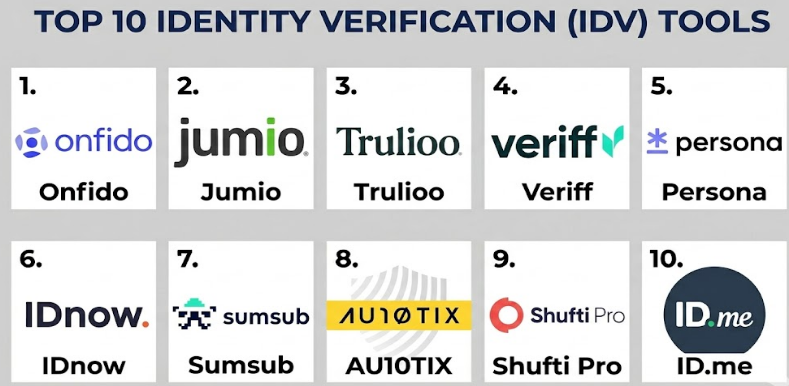
Top 10 Identity Verification (IDV) Tools
#1 — Onfido
Short description: A widely used identity verification platform focused on document verification and AI-powered facial biometrics, ideal for fintech and digital-first businesses.
Key Features
- AI-based document verification
- Facial biometric matching
- Passive liveness detection
- Global document coverage
- Fraud detection signals
- SDKs for mobile/web integration
Pros
- Strong AI accuracy
- Good global coverage
Cons
- Pricing may be high for small businesses
- Limited customization in some workflows
Platforms / Deployment
Cloud
Security & Compliance
SOC 2, GDPR (publicly known)
Integrations & Ecosystem
Offers APIs and SDKs for integration with onboarding systems.
- REST APIs
- Mobile SDKs
- CRM integrations
Support & Community
Well-documented APIs and enterprise-grade support.
#2 — Jumio
Short description: Enterprise-grade identity verification and AML platform known for high compliance and strong fraud detection.
Key Features
- Document verification
- Biometric authentication
- AML screening
- Risk scoring
- AI fraud detection
- Identity proofing
Pros
- Strong compliance capabilities
- Enterprise-ready
Cons
- Complex setup
- Higher cost
Platforms / Deployment
Cloud
Security & Compliance
SOC 2, ISO 27001 (publicly known)
Integrations & Ecosystem
- APIs
- KYC/AML systems
- Banking platforms
Support & Community
Strong enterprise support; documentation is comprehensive.
#3 — Trulioo
Short description: Global identity verification platform offering extensive data coverage for KYC and compliance checks.
Key Features
- Global identity verification
- Data-based identity checks
- AML screening
- Document verification
- API-first platform
Pros
- Wide global reach
- Strong compliance focus
Cons
- Less focus on biometrics compared to competitors
- Can be complex to configure
Platforms / Deployment
Cloud
Security & Compliance
Not publicly stated
Integrations & Ecosystem
- APIs
- Fintech integrations
- Risk platforms
Support & Community
Enterprise-level support; onboarding assistance available.
#4 — Veriff
Short description: AI-powered identity verification platform focused on high accuracy and fraud prevention.
Key Features
- Document verification
- Facial recognition
- Liveness detection
- Video-based verification
- Fraud analytics
Pros
- High accuracy rates
- Good fraud detection
Cons
- Limited pricing transparency
- Requires integration effort
Platforms / Deployment
Cloud
Security & Compliance
Not publicly stated
Integrations & Ecosystem
- APIs
- Mobile SDKs
- Risk tools
Support & Community
Good documentation and onboarding support.
#5 — Persona
Short description: Developer-friendly identity platform that allows flexible identity verification workflows.
Key Features
- Customizable workflows
- Document and biometric checks
- Risk scoring
- API-first design
- Modular verification steps
Pros
- Highly customizable
- Great developer experience
Cons
- Requires technical setup
- Not ideal for non-technical teams
Platforms / Deployment
Cloud
Security & Compliance
Not publicly stated
Integrations & Ecosystem
- APIs
- Workflow automation tools
- SaaS integrations
Support & Community
Strong documentation and developer resources.
#6 — IDnow
Short description: European-focused IDV provider with strong compliance and video verification capabilities.
Key Features
- Video identification
- Document verification
- eID integration
- AML compliance
- Fraud detection
Pros
- Strong EU compliance
- Video-based verification
Cons
- Limited global reach
- Slower verification compared to AI-only tools
Platforms / Deployment
Cloud
Security & Compliance
Not publicly stated
Integrations & Ecosystem
- APIs
- Banking integrations
Support & Community
Enterprise-focused support model.
#7 — Sumsub (Sum & Substance)
Short description: All-in-one identity verification and compliance platform combining KYC, AML, and fraud prevention.
Key Features
- Document verification
- AML screening
- Risk scoring
- Continuous monitoring
- Fraud analytics
Pros
- All-in-one solution
- Strong compliance coverage
Cons
- Pricing complexity
- UI can be complex
Platforms / Deployment
Cloud
Security & Compliance
Not publicly stated
Integrations & Ecosystem
- APIs
- Fintech integrations
- CRM tools
Support & Community
Good documentation and onboarding.
#8 — AU10TIX
Short description: Identity verification platform focused on automation and high-speed document processing.
Key Features
- Automated document verification
- Biometric checks
- OCR technology
- Fraud detection
- Real-time processing
Pros
- Fast processing
- High automation
Cons
- Less known brand
- Limited public information
Platforms / Deployment
Cloud
Security & Compliance
Not publicly stated
Integrations & Ecosystem
- APIs
- SaaS integrations
Support & Community
Varies / Not publicly stated
#9 — Shufti Pro
Short description: Identity verification platform offering global coverage and multiple verification methods.
Key Features
- Document verification
- Facial recognition
- AML screening
- Address verification
- Video KYC
Pros
- Wide verification options
- Global coverage
Cons
- Accuracy may vary by region
- UI improvements needed
Platforms / Deployment
Cloud
Security & Compliance
Not publicly stated
Integrations & Ecosystem
- APIs
- Mobile SDKs
Support & Community
Standard support; documentation available.
#10 — ID.me
Short description: Identity verification platform widely used for government and secure identity use cases.
Key Features
- Identity proofing
- Multi-factor authentication
- Biometric verification
- Credential management
- Secure login
Pros
- Trusted for government use
- Strong security
Cons
- Limited flexibility for businesses
- Not developer-first
Platforms / Deployment
Cloud
Security & Compliance
Not publicly stated
Integrations & Ecosystem
- Government systems
- Authentication tools
Support & Community
Enterprise and government-level support.
Comparison Table (Top 10)
| Tool Name | Best For | Platform(s) Supported | Deployment | Standout Feature | Public Rating |
|---|---|---|---|---|---|
| Onfido | Fintech | Web, Mobile | Cloud | AI biometrics | N/A |
| Jumio | Enterprise | Web, Mobile | Cloud | AML + IDV | N/A |
| Trulioo | Global KYC | Web | Cloud | Global data coverage | N/A |
| Veriff | Fraud prevention | Web, Mobile | Cloud | AI accuracy | N/A |
| Persona | Developers | Web | Cloud | Custom workflows | N/A |
| IDnow | EU compliance | Web | Cloud | Video verification | N/A |
| Sumsub | All-in-one compliance | Web | Cloud | Continuous monitoring | N/A |
| AU10TIX | Automation | Web | Cloud | Fast OCR processing | N/A |
| Shufti Pro | Global coverage | Web, Mobile | Cloud | Multi-method verification | N/A |
| ID.me | Government | Web | Cloud | Identity proofing | N/A |
Evaluation & Scoring of Identity Verification (IDV) Tools
| Tool Name | Core (25%) | Ease (15%) | Integrations (15%) | Security (10%) | Performance (10%) | Support (10%) | Value (15%) | Weighted Total |
|---|---|---|---|---|---|---|---|---|
| Onfido | 9 | 8 | 8 | 9 | 9 | 8 | 7 | 8.4 |
| Jumio | 9 | 7 | 8 | 9 | 8 | 8 | 7 | 8.2 |
| Trulioo | 8 | 7 | 8 | 8 | 8 | 7 | 7 | 7.8 |
| Veriff | 9 | 8 | 7 | 8 | 9 | 8 | 7 | 8.2 |
| Persona | 8 | 9 | 9 | 7 | 8 | 8 | 8 | 8.3 |
| IDnow | 8 | 6 | 7 | 8 | 7 | 7 | 7 | 7.4 |
| Sumsub | 9 | 7 | 8 | 8 | 8 | 8 | 7 | 8.0 |
| AU10TIX | 8 | 7 | 7 | 7 | 9 | 7 | 7 | 7.7 |
| Shufti Pro | 8 | 7 | 7 | 7 | 7 | 7 | 8 | 7.5 |
| ID.me | 8 | 7 | 6 | 9 | 8 | 8 | 6 | 7.7 |
How to interpret scores:
- Scores are relative comparisons across tools
- Higher score means better balance of features and usability
- Enterprise tools may score high on security but lower on ease
- Developer-first tools score high on integrations
- Always validate based on your specific use case
Which Identity Verification (IDV) Tools Is Right for You?
Solo / Freelancer
Simple tools with minimal setup like Shufti Pro are suitable.
SMB
Look for balance between cost and features—Persona or Veriff are good choices.
Mid-Market
Choose scalable tools like Onfido or Sumsub.
Enterprise
Jumio or Trulioo offer compliance and scalability.
Budget vs Premium
- Budget: Shufti Pro
- Premium: Jumio, Onfido
Feature Depth vs Ease of Use
- Deep features: Jumio, Sumsub
- Easy to use: Persona
Integrations & Scalability
- Strong APIs: Persona, Onfido
Security & Compliance Needs
- High compliance: Jumio, Trulioo
Frequently Asked Questions (FAQs)
What is an IDV tool?
It verifies user identity using documents and biometrics.
How much do IDV tools cost?
Varies / N/A depending on usage and region.
Are IDV tools secure?
Yes, most follow strong security practices.
Can IDV tools prevent fraud?
They reduce risk but do not eliminate it entirely.
Do they support global users?
Most modern tools support global verification.
Are APIs available?
Yes, most tools are API-first.
Is onboarding complex?
Depends on the tool; developer tools require setup.
Can I switch providers easily?
Switching is possible but may require re-integration.
Do they support AML checks?
Many tools include AML screening.
What industries use IDV?
Fintech, healthcare, e-commerce, and more.
Conclusion
Identity Verification tools have become essential infrastructure for modern digital businesses. Whether you are onboarding customers, preventing fraud, or meeting compliance requirements, the right IDV platform can significantly impact user trust and operational efficiency. However, there is no single “best” solution for everyone. If you are a startup or SMB, focus on ease of integration and cost efficiency. For mid-market companies, scalability and fraud detection capabilities should be your priority. Enterprises, on the other hand, must evaluate compliance coverage, global reach, and performance at scale.
