Introduction
Threat Intelligence Platforms (TIPs) are cybersecurity solutions that collect, analyze, and operationalize threat data from multiple sources to help organizations detect, prevent, and respond to cyber threats more effectively. In simple terms, a TIP acts as a central hub where security teams can gather intelligence about malicious actors, vulnerabilities, and attack patterns, and use that information to strengthen defenses.
With the increasing sophistication of cyberattacks, organizations are overwhelmed by fragmented threat data. TIPs solve this by automating data aggregation, correlation, and enrichment, enabling faster and more accurate decision-making. As security operations evolve, these platforms are becoming essential for proactive defense strategies.
Common Use Cases
- Aggregating and analyzing threat feeds
- Enriching security alerts with contextual intelligence
- Identifying and tracking threat actors
- Automating incident response workflows
- Supporting vulnerability management and risk assessment
What Buyers Should Evaluate
- Threat data ingestion and normalization capabilities
- Intelligence analysis and enrichment features
- Integration with SIEM, SOAR, EDR, and firewalls
- Automation and workflow orchestration
- Scalability and performance
- User interface and usability
- Threat intelligence sources and coverage
- Security and compliance features
- Reporting and visualization tools
- API and customization capabilities
Best for: SOC teams, cybersecurity analysts, threat intelligence teams, enterprises, MSSPs, and organizations managing complex threat landscapes.
Not ideal for: Small businesses with minimal security infrastructure, teams without dedicated security analysts, or organizations that rely solely on basic endpoint protection tools.
Key Trends in Customer IAM (CIAM)
- AI-driven threat intelligence: Machine learning models for predictive threat detection
- Automated threat enrichment: Real-time contextualization of alerts
- Integration with SOAR platforms: Seamless automation workflows
- Cloud-native intelligence platforms: Faster deployment and scalability
- Open-source intelligence (OSINT) expansion: Increased reliance on public threat data
- Threat sharing ecosystems: Collaboration between organizations
- Zero Trust security integration: Intelligence-driven access control
- Dark web monitoring capabilities: Tracking leaked credentials and data
- Real-time intelligence feeds: Continuous updates and alerts
- Cost optimization through automation: Reducing manual analysis workload
How We Selected These Tools (Methodology)
- Considered market adoption and brand credibility
- Evaluated depth of threat intelligence capabilities
- Assessed integration ecosystem and compatibility
- Reviewed automation and enrichment features
- Analyzed deployment flexibility and scalability
- Considered security and compliance posture
- Evaluated ease of use and onboarding experience
- Reviewed vendor support and documentation quality
- Ensured representation across enterprise and mid-market tools
- Focused on modern, AI-enabled platforms
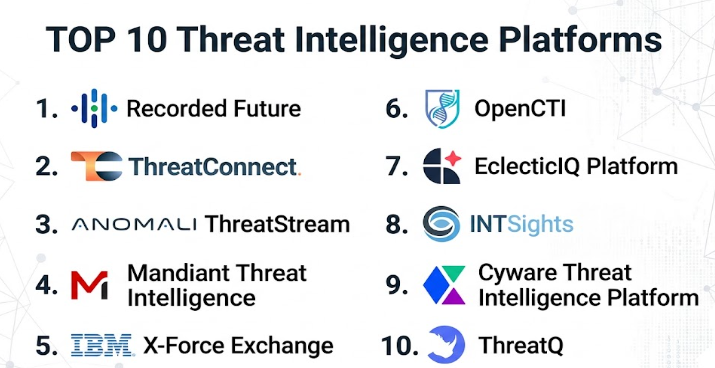
Top Threat Intelligence Platforms
#1 — Recorded Future
Short description: A leading threat intelligence platform that provides real-time intelligence using AI and machine learning, ideal for enterprises.
Key Features
- Real-time threat intelligence feeds
- AI-driven analytics
- Risk scoring and prioritization
- Dark web monitoring
- Threat actor profiling
- Integration with security tools
Pros
- Strong intelligence accuracy
- Extensive data sources
Cons
- Expensive
- Complex for beginners
Platforms / Deployment
Cloud
Security & Compliance
SSO, RBAC, encryption; others Not publicly stated
Integrations & Ecosystem
Strong ecosystem with security tools
- SIEM platforms
- SOAR tools
- Endpoint security
- APIs
Support & Community
Enterprise-level support; strong documentation
#2 — ThreatConnect
Short description: A robust TIP offering intelligence management and automation for security teams.
Key Features
- Threat intelligence lifecycle management
- Automation workflows
- Threat data enrichment
- Collaboration tools
- Intelligence scoring
Pros
- Flexible platform
- Strong automation
Cons
- UI complexity
- Learning curve
Platforms / Deployment
Cloud / Self-hosted
Security & Compliance
SSO, RBAC; others Not publicly stated
Integrations & Ecosystem
- SIEM tools
- SOAR platforms
- APIs
- Threat feeds
Support & Community
Good support; active user base
#3 — Anomali ThreatStream
Short description: Enterprise-grade TIP for threat intelligence aggregation and analysis.
Key Features
- Threat feed aggregation
- Intelligence enrichment
- Threat detection
- Integration capabilities
- Analytics dashboards
Pros
- Large data coverage
- Strong analytics
Cons
- High cost
- Complex setup
Platforms / Deployment
Cloud
Security & Compliance
Encryption, RBAC; others Not publicly stated
Integrations & Ecosystem
- SIEM
- EDR tools
- APIs
Support & Community
Enterprise support; documentation available
#4 — Mandiant Threat Intelligence
Short description: Advanced intelligence platform backed by deep threat research and expertise.
Key Features
- Threat intelligence reports
- Incident insights
- Threat actor tracking
- Vulnerability intelligence
- Integration support
Pros
- High-quality intelligence
- Strong research backing
Cons
- Premium pricing
- Limited automation
Platforms / Deployment
Cloud
Security & Compliance
Not publicly stated
Integrations & Ecosystem
- Security tools
- APIs
- Threat feeds
Support & Community
Strong enterprise support
#5 — IBM X-Force Exchange
Short description: Threat intelligence platform providing insights into vulnerabilities and threats.
Key Features
- Threat intelligence feeds
- Vulnerability insights
- Analytics dashboards
- Threat sharing
- Integration support
Pros
- Trusted brand
- Strong research data
Cons
- Limited automation
- UI could improve
Platforms / Deployment
Cloud
Security & Compliance
Not publicly stated
Integrations & Ecosystem
- IBM tools
- SIEM
- APIs
Support & Community
Enterprise support available
#6 — OpenCTI
Short description: Open-source threat intelligence platform focused on data structuring and sharing.
Key Features
- Open-source framework
- Data modeling
- Threat intelligence sharing
- Custom integrations
- API-first design
Pros
- Highly customizable
- Free/open-source
Cons
- Requires technical expertise
- Limited enterprise support
Platforms / Deployment
Self-hosted
Security & Compliance
Varies / N/A
Integrations & Ecosystem
- APIs
- Threat feeds
- Custom integrations
Support & Community
Strong open-source community
#7 — EclecticIQ Platform
Short description: Intelligence platform designed for large enterprises and government use cases.
Key Features
- Intelligence management
- Threat analysis
- Data visualization
- Integration capabilities
- Workflow automation
Pros
- Enterprise-ready
- Strong analytics
Cons
- Expensive
- Complex deployment
Platforms / Deployment
Cloud / Self-hosted
Security & Compliance
Not publicly stated
Integrations & Ecosystem
- SIEM
- APIs
- Threat feeds
Support & Community
Enterprise support
#8 — IntSights (Rapid7)
Short description: Threat intelligence platform focusing on external threat monitoring.
Key Features
- External threat monitoring
- Risk prioritization
- Dark web intelligence
- Automation workflows
- Integration support
Pros
- Easy to use
- Strong external intelligence
Cons
- Limited customization
- Smaller ecosystem
Platforms / Deployment
Cloud
Security & Compliance
Not publicly stated
Integrations & Ecosystem
- Rapid7 tools
- SIEM
- APIs
Support & Community
Good support
#9 — Cyware Threat Intelligence Platform
Short description: TIP integrated with automation and orchestration capabilities.
Key Features
- Threat intelligence aggregation
- Automation workflows
- Threat sharing
- Integration capabilities
- Analytics
Pros
- Strong automation
- Good integration
Cons
- UI improvements needed
- Moderate complexity
Platforms / Deployment
Cloud / Self-hosted
Security & Compliance
Not publicly stated
Integrations & Ecosystem
- SIEM
- SOAR
- APIs
Support & Community
Growing support ecosystem
#10 — ThreatQ
Short description: Intelligence-driven platform designed for threat data correlation and prioritization.
Key Features
- Intelligence aggregation
- Risk prioritization
- Data correlation
- Integration capabilities
- Analytics
Pros
- Flexible platform
- Strong data correlation
Cons
- Complex setup
- Pricing transparency limited
Platforms / Deployment
Cloud / Self-hosted
Security & Compliance
Not publicly stated
Integrations & Ecosystem
- SIEM
- APIs
- Threat feeds
Support & Community
Enterprise support
Comparison Table (Top 10)
| Tool Name | Best For | Platform(s) Supported | Deployment | Standout Feature | Public Rating |
|---|---|---|---|---|---|
| Recorded Future | Enterprises | Web | Cloud | AI-driven intelligence | N/A |
| ThreatConnect | SOC teams | Web | Hybrid | Automation workflows | N/A |
| Anomali ThreatStream | Enterprises | Web | Cloud | Data aggregation | N/A |
| Mandiant | Threat research | Web | Cloud | High-quality intelligence | N/A |
| IBM X-Force | Enterprises | Web | Cloud | Vulnerability insights | N/A |
| OpenCTI | Developers | Web | Self-hosted | Open-source flexibility | N/A |
| EclecticIQ | Government/Enterprise | Web | Hybrid | Analytics | N/A |
| IntSights | SMB/Mid-market | Web | Cloud | External monitoring | N/A |
| Cyware | Automation-focused | Web | Hybrid | Integrated SOAR | N/A |
| ThreatQ | Data correlation | Web | Hybrid | Intelligence prioritization | N/A |
Threat Intelligence Platforms Scoring
| Tool Name | Core (25%) | Ease (15%) | Integrations (15%) | Security (10%) | Performance (10%) | Support (10%) | Value (15%) | Weighted Total |
|---|---|---|---|---|---|---|---|---|
| Recorded Future | 9 | 7 | 9 | 8 | 9 | 9 | 7 | 8.4 |
| ThreatConnect | 8 | 7 | 8 | 7 | 8 | 8 | 7 | 7.8 |
| Anomali | 9 | 6 | 8 | 8 | 8 | 8 | 6 | 7.9 |
| Mandiant | 9 | 7 | 7 | 8 | 9 | 9 | 6 | 8.0 |
| IBM X-Force | 8 | 7 | 7 | 8 | 8 | 8 | 7 | 7.7 |
| OpenCTI | 7 | 6 | 8 | 6 | 7 | 6 | 9 | 7.1 |
| EclecticIQ | 8 | 6 | 7 | 7 | 8 | 7 | 6 | 7.2 |
| IntSights | 7 | 8 | 7 | 7 | 7 | 7 | 8 | 7.4 |
| Cyware | 8 | 7 | 8 | 7 | 8 | 7 | 7 | 7.6 |
| ThreatQ | 8 | 6 | 8 | 7 | 8 | 7 | 6 | 7.4 |
How to interpret scores:
These scores are comparative benchmarks based on feature depth, usability, and ecosystem strength. A higher score indicates stronger overall capabilities within this category. However, the best tool depends on your organization’s needs, integrations, and budget.
Which Service Mesh Platforms Is Right for You?
Solo / Freelancer
- TIPs are generally unnecessary
- Consider basic security monitoring tools
SMB
- Best choices: IntSights, Cyware
- Focus on ease of use and affordability
Mid-Market
- Best choices: ThreatConnect, Anomali
- Balance automation and intelligence
Enterprise
- Best choices: Recorded Future, Mandiant, IBM X-Force
- Focus on scale, accuracy, and integrations
Budget vs Premium
- Budget: OpenCTI
- Premium: Recorded Future, Mandiant
Feature Depth vs Ease of Use
- Feature-heavy: Anomali, Recorded Future
- Easy-to-use: IntSights
Integrations & Scalability
- High integration: ThreatConnect, Cyware
- Moderate: OpenCTI
Security & Compliance Needs
- High compliance: IBM X-Force, Mandiant
- Moderate: Cyware, IntSights
Threat Intelligence Platforms FAQs
What is a Threat Intelligence Platform?
A TIP collects, analyzes, and manages threat data to help organizations detect and respond to cyber threats effectively.
How much do TIPs cost?
Pricing varies widely depending on features and scale; typically enterprise pricing applies.
Are TIPs only for large organizations?
They are most useful for organizations with complex security environments but can benefit mid-sized businesses too.
How long does deployment take?
Deployment can range from a few weeks to several months depending on integrations.
Can TIPs integrate with SIEM tools?
Yes, integration with SIEM, SOAR, and EDR is a core capability.
What are common mistakes when using TIPs?
Overloading with irrelevant data and poor integration planning are common issues.
Are TIPs cloud-based?
Many modern TIPs are cloud-native, though some offer hybrid or self-hosted options.
Do TIPs support automation?
Yes, many platforms include automation for threat enrichment and response.
Can TIPs improve compliance?
Yes, they help with reporting, auditing, and risk assessment.
Is it easy to switch TIP vendors?
Switching can be complex due to integrations and data dependencies.
Conclusion
Threat Intelligence Platforms play a critical role in modern cybersecurity by transforming raw threat data into actionable insights. From enterprise-grade solutions like Recorded Future and Mandiant to flexible platforms like OpenCTI and Cyware, organizations have a wide range of options depending on their needs. The right choice depends on factors such as integration requirements, automation capabilities, and team expertise. Instead of focusing solely on features, prioritize how well the platform fits into your existing security ecosystem. Shortlist a few tools, test them in real-world scenarios, and evaluate their impact on your security operations before making a final decision.
