Introduction
Unit Testing Frameworks are tools that help developers write and execute tests for individual components (or “units”) of code—such as functions, classes, or modules. In simple terms, they ensure that each part of your application works correctly in isolation before being integrated into a larger system.
As modern software development emphasizes speed, quality, and reliability, unit testing has become a core practice in Agile and DevOps workflows. These frameworks enable developers to catch bugs early, improve code quality, and confidently refactor code without breaking functionality.
Common use cases include:
- Testing individual functions and modules
- Automating regression testing
- Supporting test-driven development (TDD)
- Validating API logic and business rules
- Ensuring code stability during refactoring
Key evaluation criteria:
- Language compatibility and ecosystem support
- Ease of writing and maintaining tests
- Assertion libraries and test utilities
- Integration with CI/CD pipelines
- Speed and execution performance
- Mocking and dependency handling
- Reporting and debugging capabilities
- Community and documentation support
- Extensibility and plugin ecosystem
Best for: Developers, QA engineers, and DevOps teams building reliable, maintainable applications across different programming languages.
Not ideal for: Non-development teams or projects without structured coding practices, where testing frameworks may add unnecessary complexity.
Key Trends in Unit Testing Frameworks
- AI-assisted test generation: Tools suggesting or auto-generating test cases
- Shift-left testing adoption: Developers writing tests earlier in the development cycle
- Integration with CI/CD pipelines: Automated testing in every build
- Faster execution engines: Optimized frameworks for parallel testing
- Improved mocking and stubbing tools: Better isolation of dependencies
- Cross-platform testing support: Unified testing across environments
- Minimalist frameworks: Lightweight tools focused on simplicity
- Better developer experience: Cleaner syntax and improved debugging
- Cloud-based test execution: Running tests at scale in cloud environments
- Enhanced reporting: More actionable insights and visual reports
How We Selected These Tools (Methodology)
We evaluated Unit Testing Frameworks based on:
- Popularity and adoption within developer communities
- Language ecosystem relevance
- Feature completeness (assertions, mocking, reporting)
- Ease of use and learning curve
- Integration with modern development workflows
- Performance and execution speed
- Community support and documentation quality
- Flexibility and extensibility
- Suitability for both small and large projects
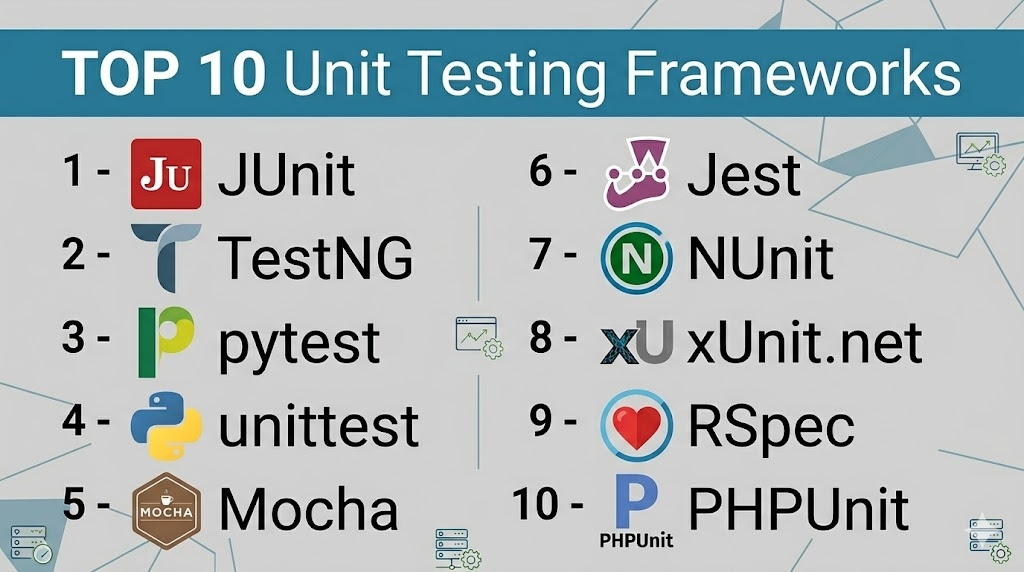
Top 10 Unit Testing Frameworks
#1 — JUnit
Short description: A widely used unit testing framework for Java applications, forming the foundation of Java testing ecosystems.
Key Features
- Annotation-based test definitions
- Assertions and test runners
- Integration with build tools
- Extensive plugin ecosystem
- Parameterized tests
- Support for test lifecycle management
Pros
- Industry standard for Java
- Strong ecosystem and tooling
Cons
- Java-only
- Requires setup for advanced features
Platforms / Deployment
Java / Cross-platform
Security & Compliance
Not publicly stated
Integrations & Ecosystem
JUnit integrates deeply with Java development tools and CI/CD pipelines.
- Maven
- Gradle
- Jenkins
- IDEs (Eclipse, IntelliJ)
Support & Community
Very large and mature community.
#2 — TestNG
Short description: A powerful testing framework inspired by JUnit, offering more advanced testing features.
Key Features
- Flexible test configuration
- Parallel test execution
- Data-driven testing
- Dependency management
- Rich annotations
Pros
- More flexible than JUnit
- Strong parallel execution support
Cons
- Slightly more complex
- Smaller ecosystem than JUnit
Platforms / Deployment
Java / Cross-platform
Security & Compliance
Not publicly stated
Integrations & Ecosystem
Works well with Java testing tools.
- Selenium
- Maven
- Jenkins
Support & Community
Active community.
#3 — pytest
Short description: A popular Python testing framework known for simplicity and powerful features.
Key Features
- Simple syntax
- Fixtures for setup/teardown
- Plugin ecosystem
- Parameterized testing
- Detailed failure reporting
Pros
- Easy to learn
- Highly extensible
Cons
- Python-only
- Plugin dependency for advanced use cases
Platforms / Deployment
Python / Cross-platform
Security & Compliance
Not publicly stated
Integrations & Ecosystem
Strong Python ecosystem support.
- Django
- Flask
- CI/CD tools
Support & Community
Large and active community.
#4 — unittest (Python)
Short description: The built-in Python testing framework based on xUnit architecture.
Key Features
- Built-in module
- Test case classes
- Assertions
- Test discovery
- Setup/teardown support
Pros
- No external installation
- Stable and reliable
Cons
- Verbose syntax
- Less modern than pytest
Platforms / Deployment
Python
Security & Compliance
Not publicly stated
Integrations & Ecosystem
Works with standard Python tools.
- CI/CD pipelines
- Python ecosystem
Support & Community
Well-documented and stable.
#5 — Mocha
Short description: A flexible JavaScript testing framework for Node.js applications.
Key Features
- Asynchronous testing support
- Flexible configuration
- Multiple assertion libraries
- Test runners
- Hooks for setup/teardown
Pros
- Highly customizable
- Strong Node.js support
Cons
- Requires additional libraries
- Setup complexity
Platforms / Deployment
JavaScript / Node.js
Security & Compliance
Not publicly stated
Integrations & Ecosystem
Works with JavaScript ecosystem.
- Chai
- Sinon
- CI/CD tools
Support & Community
Large community.
#6 — Jest
Short description: A modern JavaScript testing framework developed for simplicity and speed.
Key Features
- Zero-config setup
- Snapshot testing
- Built-in mocking
- Parallel test execution
- Rich reporting
Pros
- Easy to use
- Fast and efficient
Cons
- Primarily for JavaScript
- Less flexible than Mocha
Platforms / Deployment
JavaScript / Cross-platform
Security & Compliance
Not publicly stated
Integrations & Ecosystem
Strong frontend ecosystem support.
- React
- Node.js
- CI/CD tools
Support & Community
Very active community.
#7 — NUnit
Short description: A popular unit testing framework for .NET applications.
Key Features
- Attribute-based testing
- Rich assertions
- Test runners
- Parameterized tests
- Parallel execution
Pros
- Strong .NET support
- Mature framework
Cons
- Limited outside .NET
- Requires configuration
Platforms / Deployment
Windows / .NET
Security & Compliance
Not publicly stated
Integrations & Ecosystem
Works with Microsoft ecosystem.
- Visual Studio
- Azure DevOps
Support & Community
Strong community.
#8 — xUnit.net
Short description: A modern testing framework for .NET, designed as a successor to NUnit.
Key Features
- Simplified syntax
- Dependency injection support
- Parallel test execution
- Extensibility
- Modern architecture
Pros
- Lightweight and modern
- Good performance
Cons
- Learning curve
- .NET-focused
Platforms / Deployment
Windows / .NET
Security & Compliance
Not publicly stated
Integrations & Ecosystem
Works with .NET ecosystem.
- Visual Studio
- CI/CD tools
Support & Community
Active community.
#9 — RSpec
Short description: A behavior-driven development (BDD) framework for Ruby applications.
Key Features
- Human-readable syntax
- BDD approach
- Rich matchers
- Flexible configuration
- Test organization
Pros
- Readable tests
- Strong Ruby support
Cons
- Ruby-only
- Learning curve for beginners
Platforms / Deployment
Ruby
Security & Compliance
Not publicly stated
Integrations & Ecosystem
Ruby ecosystem integration.
- Rails
- CI/CD tools
Support & Community
Active Ruby community.
#10 — PHPUnit
Short description: A widely used unit testing framework for PHP applications.
Key Features
- xUnit architecture
- Assertions and test runners
- Test doubles (mocking)
- Code coverage reporting
- Integration with PHP tools
Pros
- Standard for PHP
- Strong ecosystem
Cons
- PHP-only
- Configuration complexity
Platforms / Deployment
PHP
Security & Compliance
Not publicly stated
Integrations & Ecosystem
Works with PHP ecosystem.
- Laravel
- Symfony
- CI/CD tools
Support & Community
Large and active community.
Comparison Table (Top 10)
| Tool Name | Best For | Platform(s) Supported | Deployment | Standout Feature | Public Rating |
|---|---|---|---|---|---|
| JUnit | Java developers | Java | Local | Industry standard | N/A |
| TestNG | Advanced Java testing | Java | Local | Parallel execution | N/A |
| pytest | Python developers | Python | Local | Simplicity | N/A |
| unittest | Python built-in | Python | Local | Native module | N/A |
| Mocha | Node.js apps | JS | Local | Flexibility | N/A |
| Jest | Frontend testing | JS | Local | Zero-config | N/A |
| NUnit | .NET apps | .NET | Local | Mature ecosystem | N/A |
| xUnit | Modern .NET | .NET | Local | Lightweight | N/A |
| RSpec | Ruby apps | Ruby | Local | BDD style | N/A |
| PHPUnit | PHP apps | PHP | Local | Standard framework | N/A |
Unit Testing Frameworks Scoring
| Tool Name | Core (25%) | Ease (15%) | Integrations (15%) | Security (10%) | Performance (10%) | Support (10%) | Value (15%) | Weighted Total |
|---|---|---|---|---|---|---|---|---|
| JUnit | 9 | 7 | 9 | 7 | 8 | 9 | 9 | 8.4 |
| TestNG | 8 | 7 | 8 | 7 | 8 | 8 | 9 | 7.9 |
| pytest | 9 | 9 | 8 | 7 | 8 | 9 | 9 | 8.6 |
| unittest | 7 | 6 | 7 | 7 | 7 | 8 | 10 | 7.5 |
| Mocha | 8 | 7 | 9 | 7 | 8 | 9 | 9 | 8.2 |
| Jest | 9 | 9 | 9 | 7 | 9 | 9 | 9 | 8.8 |
| NUnit | 8 | 7 | 8 | 7 | 8 | 8 | 9 | 8.0 |
| xUnit | 8 | 8 | 8 | 7 | 9 | 8 | 9 | 8.2 |
| RSpec | 7 | 7 | 7 | 7 | 7 | 8 | 9 | 7.5 |
| PHPUnit | 8 | 7 | 8 | 7 | 8 | 9 | 9 | 8.1 |
How to interpret scores:
- Scores are relative and depend on language ecosystems
- Higher scores indicate better balance across features
- Simpler frameworks score higher in ease of use
- Language compatibility is a key deciding factor
- Always choose based on your development stack
Which Unit Testing Frameworks Is Right for You?
Solo / Freelancer
- Use pytest or Jest for simplicity and speed
- Lightweight tools are sufficient
SMB
- Choose JUnit, pytest, or Jest depending on language
- Focus on ease and integration
Mid-Market
- Use TestNG, Mocha, or xUnit for scalability
- Ensure CI/CD integration
Enterprise
- Use JUnit, NUnit, or Jest for robust testing
- Focus on performance and reporting
Budget vs Premium
- Most frameworks are open-source
- Value depends on ecosystem support
Feature Depth vs Ease of Use
- TestNG/Mocha = flexible
- pytest/Jest = simple
Integrations & Scalability
- Choose tools with CI/CD compatibility
- Ensure support for automation frameworks
Security & Compliance Needs
- Focus on integration with secure pipelines
- Most frameworks rely on external security tools
Frequently Asked Questions (FAQs)
What is a unit testing framework?
It is a tool used to test individual components of code in isolation.
Why is unit testing important?
It improves code quality and reduces bugs early.
Are unit testing frameworks free?
Most are open-source and free to use.
Which framework is best for beginners?
pytest and Jest are beginner-friendly.
Do I need coding skills?
Yes, unit testing requires programming knowledge.
Can unit tests be automated?
Yes, they are typically automated in CI/CD pipelines.
What is TDD?
Test-driven development where tests are written before code.
Can I use multiple frameworks?
Yes, depending on project needs.
How fast are unit tests?
They are typically very fast since they test small units.
Can unit tests replace integration tests?
No, both serve different purposes.
Conclusion
Unit Testing Frameworks are essential for building reliable, maintainable, and scalable software. They help teams catch issues early, improve code quality, and support modern development practices like CI/CD and TDD.
