Introduction
Secrets Management Tools are solutions designed to securely store, manage, and control access to sensitive information such as API keys, passwords, tokens, certificates, and encryption keys. In simple terms, they act as a secure vault that protects critical credentials and ensures they are accessed only by authorized users and systems.
With the rise of cloud-native applications, microservices, and DevOps practices, secrets are increasingly distributed across environments—making manual handling risky and inefficient. Secrets management tools help prevent data breaches, enforce security policies, and automate credential rotation.
Common use cases include:
- Storing API keys and credentials securely
- Managing secrets across cloud and on-prem environments
- Automating secret rotation and expiration
- Securing CI/CD pipelines and DevOps workflows
- Managing encryption keys and certificates
Key evaluation criteria:
- Encryption standards and key management
- Access control (RBAC, least privilege)
- Secret rotation and lifecycle management
- Integration with cloud platforms and DevOps tools
- Audit logging and compliance features
- Ease of use and deployment
- Scalability and performance
- Multi-cloud and hybrid support
- API and automation capabilities
- Pricing and licensing
Best for: DevOps engineers, security teams, developers, and organizations handling sensitive credentials across distributed systems.
Not ideal for: Small projects with minimal security requirements or teams that do not manage sensitive credentials at scale.
Key Trends in Secrets Management Tools
- Zero Trust security models: Enforcing strict identity-based access
- Dynamic secrets: Generating short-lived credentials on demand
- Automated secret rotation: Reducing human intervention and risk
- Cloud-native integration: Seamless support for multi-cloud environments
- Infrastructure as Code (IaC) integration: Managing secrets programmatically
- AI-driven anomaly detection: Identifying unusual access patterns
- Centralized secret governance: Unified visibility across environments
- Compliance-driven features: Meeting regulatory requirements
- Secrets scanning: Detecting exposed secrets in code repositories
- Developer-first workflows: Simplifying secure access for developers
How We Selected These Tools (Methodology)
We evaluated Secrets Management Tools based on:
- Market adoption and reputation
- Security capabilities (encryption, access control, auditing)
- Feature completeness (rotation, dynamic secrets, APIs)
- Ease of use and deployment
- Integration with DevOps and cloud ecosystems
- Scalability for enterprise environments
- Compliance and governance capabilities
- Performance and reliability
- Community and vendor support
- Overall value for cost
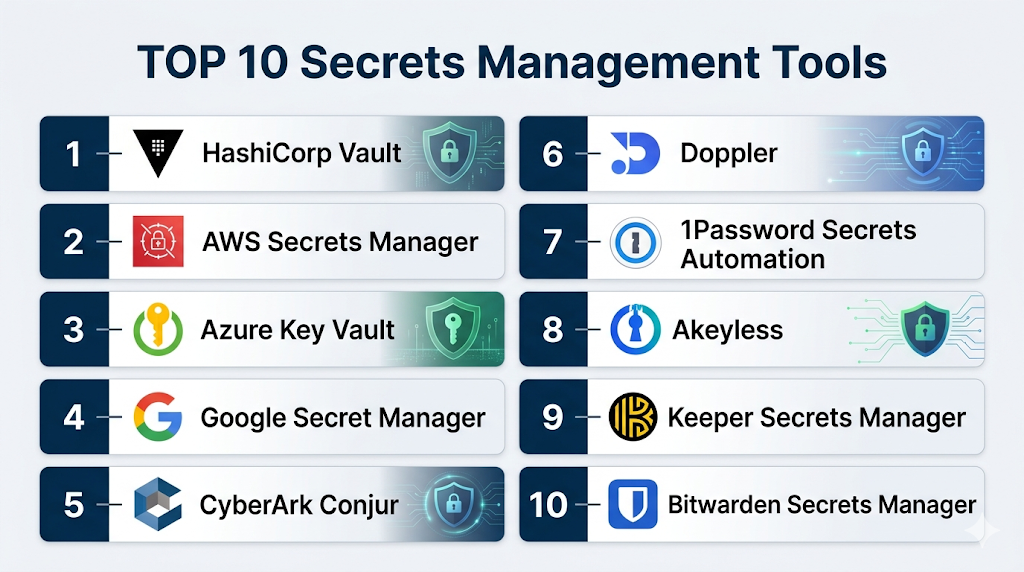
Top 10 Secrets Management Tools
#1 — HashiCorp Vault
Short description: A widely used secrets management platform offering secure storage, dynamic secrets, and encryption services.
Key Features
- Dynamic secret generation
- Encryption as a service
- Fine-grained access control
- Secret rotation and revocation
- API-driven automation
- Multi-cloud support
Pros
- Highly secure and scalable
- Flexible deployment options
Cons
- Complex setup and management
- Steep learning curve
Platforms / Deployment
Cloud / Self-hosted
Security & Compliance
RBAC, encryption, audit logs, SSO
Integrations & Ecosystem
Vault integrates deeply with modern infrastructure and DevOps tools, enabling secure automation across environments.
- Kubernetes
- AWS, Azure, GCP
- CI/CD pipelines
- Infrastructure tools
Support & Community
Large community and strong enterprise support.
#2 — AWS Secrets Manager
Short description: A fully managed service for storing and retrieving secrets securely within AWS environments.
Key Features
- Automatic secret rotation
- Secure storage with encryption
- Integration with AWS services
- Access control via IAM
- Monitoring and logging
Pros
- Fully managed service
- Deep AWS integration
Cons
- Limited outside AWS ecosystem
- Pricing can increase with usage
Platforms / Deployment
Cloud
Security & Compliance
IAM, encryption, audit logs
Integrations & Ecosystem
Seamless integration with AWS ecosystem.
- AWS services
- Lambda
- CI/CD tools
Support & Community
Enterprise support via AWS.
#3 — Azure Key Vault
Short description: A cloud-based service for securely storing secrets, keys, and certificates within Azure environments.
Key Features
- Secret and key management
- Certificate management
- Integration with Azure services
- Access control policies
- Monitoring and logging
Pros
- Strong Microsoft integration
- Easy to use
Cons
- Limited outside Azure
- Requires Azure ecosystem
Platforms / Deployment
Cloud
Security & Compliance
RBAC, encryption, audit logs
Integrations & Ecosystem
Works within Microsoft ecosystem.
- Azure services
- DevOps pipelines
Support & Community
Strong enterprise support.
#4 — Google Secret Manager
Short description: A secure and scalable secrets management service within Google Cloud.
Key Features
- Secure secret storage
- Versioning of secrets
- Access control
- Integration with GCP services
- Audit logging
Pros
- Easy integration with GCP
- Scalable and reliable
Cons
- Limited outside GCP
- Fewer advanced features
Platforms / Deployment
Cloud
Security & Compliance
IAM, encryption, audit logs
Integrations & Ecosystem
Deep integration with Google Cloud services.
- GCP services
- CI/CD tools
Support & Community
Enterprise support.
#5 — CyberArk Conjur
Short description: A secrets management solution focused on securing DevOps environments and applications.
Key Features
- Secrets storage
- Access control
- Integration with containers
- Policy-based security
- Audit logging
Pros
- Strong enterprise security
- Good for DevOps use cases
Cons
- Complex setup
- Requires expertise
Platforms / Deployment
Cloud / Self-hosted
Security & Compliance
RBAC, encryption, audit logs
Integrations & Ecosystem
Integrates with enterprise and DevOps environments.
- Kubernetes
- CI/CD tools
Support & Community
Enterprise support.
#6 — Doppler
Short description: A developer-friendly secrets management tool designed for simplicity and team collaboration.
Key Features
- Centralized secret management
- Environment-based configuration
- Access control
- Audit logs
- CLI and API support
Pros
- Easy to use
- Developer-focused
Cons
- Limited enterprise features
- Smaller ecosystem
Platforms / Deployment
Cloud
Security & Compliance
RBAC, encryption
Integrations & Ecosystem
Doppler integrates with modern development workflows.
- Git platforms
- CI/CD tools
Support & Community
Growing community.
#7 — 1Password Secrets Automation
Short description: A secrets management solution built on top of 1Password, focused on secure credential sharing.
Key Features
- Secure vaults
- Access control
- CLI and API
- Secret sharing
- Audit logs
Pros
- User-friendly
- Strong security foundation
Cons
- Limited advanced automation
- Pricing considerations
Platforms / Deployment
Cloud
Security & Compliance
Encryption, RBAC
Integrations & Ecosystem
Works with developer tools and workflows.
- CI/CD tools
- Development environments
Support & Community
Good vendor support.
#8 — Akeyless
Short description: A SaaS-based secrets management platform with zero-knowledge architecture.
Key Features
- Dynamic secrets
- Encryption services
- Access control
- Centralized management
- Multi-cloud support
Pros
- Strong security model
- Easy deployment
Cons
- Smaller ecosystem
- Less widely adopted
Platforms / Deployment
Cloud
Security & Compliance
RBAC, encryption, audit logs
Integrations & Ecosystem
Integrates with DevOps and cloud platforms.
- Kubernetes
- CI/CD tools
Support & Community
Growing support.
#9 — Keeper Secrets Manager
Short description: A secrets management solution focused on secure credential storage and enterprise security.
Key Features
- Secure vault storage
- Access control
- Audit logs
- API access
- Secret sharing
Pros
- Strong security features
- Easy to use
Cons
- Limited advanced automation
- Smaller developer ecosystem
Platforms / Deployment
Cloud
Security & Compliance
RBAC, encryption, audit logs
Integrations & Ecosystem
Works with enterprise workflows.
- DevOps tools
- APIs
Support & Community
Enterprise support.
#10 — Bitwarden Secrets Manager
Short description: A secrets management solution built on Bitwarden’s secure password management platform.
Key Features
- Secure secret storage
- Access control
- API and CLI
- Open-source foundation
- Encryption
Pros
- Cost-effective
- Open-source option
Cons
- Limited advanced features
- Smaller ecosystem
Platforms / Deployment
Cloud / Self-hosted
Security & Compliance
Encryption, RBAC
Integrations & Ecosystem
Supports development workflows.
- CI/CD tools
- APIs
Support & Community
Active open-source community.
Comparison Table (Top 10)
| Tool Name | Best For | Platform(s) Supported | Deployment | Standout Feature | Public Rating |
|---|---|---|---|---|---|
| HashiCorp Vault | Enterprise | Cross-platform | Hybrid | Dynamic secrets | N/A |
| AWS Secrets Manager | AWS users | Web | Cloud | Managed service | N/A |
| Azure Key Vault | Azure users | Web | Cloud | Key management | N/A |
| Google Secret Manager | GCP users | Web | Cloud | Simplicity | N/A |
| CyberArk Conjur | DevOps security | Cross-platform | Hybrid | Policy control | N/A |
| Doppler | Developers | Web | Cloud | Ease of use | N/A |
| 1Password Secrets | Teams | Web | Cloud | User-friendly | N/A |
| Akeyless | Multi-cloud | Web | Cloud | Zero-knowledge | N/A |
| Keeper | Enterprises | Web | Cloud | Vault security | N/A |
| Bitwarden | Budget users | Web | Hybrid | Open-source | N/A |
Secrets Management Tools Scoring
| Tool Name | Core (25%) | Ease (15%) | Integrations (15%) | Security (10%) | Performance (10%) | Support (10%) | Value (15%) | Weighted Total |
|---|---|---|---|---|---|---|---|---|
| HashiCorp Vault | 10 | 7 | 10 | 10 | 9 | 9 | 8 | 9.3 |
| AWS Secrets Manager | 9 | 8 | 9 | 10 | 9 | 9 | 7 | 8.8 |
| Azure Key Vault | 9 | 8 | 9 | 10 | 9 | 9 | 7 | 8.8 |
| Google Secret Manager | 8 | 9 | 8 | 9 | 9 | 9 | 8 | 8.6 |
| CyberArk Conjur | 9 | 7 | 9 | 10 | 9 | 9 | 7 | 8.7 |
| Doppler | 8 | 9 | 8 | 8 | 8 | 8 | 9 | 8.4 |
| 1Password Secrets | 8 | 9 | 7 | 9 | 8 | 8 | 8 | 8.2 |
| Akeyless | 9 | 8 | 8 | 9 | 9 | 8 | 8 | 8.5 |
| Keeper | 8 | 8 | 7 | 9 | 8 | 8 | 8 | 8.1 |
| Bitwarden | 8 | 8 | 7 | 8 | 8 | 8 | 10 | 8.2 |
How to interpret scores:
- Scores are relative and comparative
- Enterprise tools score higher in security and features
- Developer-friendly tools score higher in ease of use
- Open-source tools provide strong value
- Choose based on security needs and ecosystem
Which Secrets Management Tools Is Right for You?
Solo / Freelancer
- Use Bitwarden or Doppler
- Focus on simplicity and affordability
SMB
- Doppler or 1Password Secrets Automation
- Balance usability and features
Mid-Market
- Akeyless or Google Secret Manager
- Focus on scalability and integrations
Enterprise
- HashiCorp Vault or CyberArk Conjur
- Focus on security and compliance
Budget vs Premium
- Open-source tools provide strong value
- Enterprise tools offer advanced security features
Feature Depth vs Ease of Use
- Vault = powerful
- Doppler = simple
Integrations & Scalability
- Choose tools with strong cloud and CI/CD integrations
- Ensure multi-cloud support
Security & Compliance Needs
- Enterprises should prioritize encryption, RBAC, and audit logs
- Smaller teams can focus on ease of use
Frequently Asked Questions (FAQs)
What is a secrets management tool?
It securely stores and manages sensitive credentials like API keys and passwords.
Why is secrets management important?
It prevents data breaches and unauthorized access.
Are these tools free?
Some offer free tiers; enterprise features are paid.
What are dynamic secrets?
Short-lived credentials generated on demand.
Can secrets be rotated automatically?
Yes, many tools support automated rotation.
Do these tools integrate with CI/CD?
Yes, most support DevOps integrations.
Are secrets encrypted?
Yes, encryption is a core feature.
Can I use these tools in multi-cloud environments?
Yes, many tools support multi-cloud setups.
How long does implementation take?
From hours to days depending on complexity.
Can I switch tools later?
Yes, but migration requires planning.
Conclusion
Secrets Management Tools are essential for securing modern applications and protecting sensitive credentials across distributed systems. They help enforce security policies, automate credential management, and reduce the risk of breaches.
