Introduction
Distributed Tracing Tools are solutions that help teams track and visualize requests as they travel across multiple services in a distributed system. In simple terms, they show how a single user request moves through microservices, APIs, databases, and infrastructure—helping identify where delays or failures occur.
As modern applications rely heavily on microservices, containers, and cloud-native architectures, debugging performance issues has become significantly more complex. Distributed tracing tools provide end-to-end visibility, enabling teams to diagnose latency, detect bottlenecks, and improve overall system performance.
Common use cases include:
- Debugging latency issues across microservices
- Understanding service dependencies and request flows
- Root cause analysis of production issues
- Monitoring API performance
- Improving system reliability and performance
Key evaluation criteria:
- Distributed tracing depth and accuracy
- Integration with observability tools (logs, metrics)
- Support for OpenTelemetry and standards
- Visualization and trace analysis
- Scalability and performance
- Ease of setup and instrumentation
- Real-time monitoring and alerting
- Integration with cloud-native environments
- Security and compliance features
- Pricing and flexibility
Best for: DevOps engineers, SREs, developers, and organizations running microservices or distributed systems.
Not ideal for: Monolithic applications or small systems where tracing across services is not required.
Key Trends in Distributed Tracing Tools
- OpenTelemetry adoption: Standardizing instrumentation across tools
- Full observability platforms: Combining traces, logs, and metrics
- AI-driven root cause analysis: Faster issue identification
- Cloud-native tracing: Deep Kubernetes and serverless integration
- High-cardinality data handling: Managing large volumes of trace data
- Real-time trace analytics: Immediate insights into performance
- Sampling optimization: Reducing storage costs while maintaining visibility
- Security observability integration: Linking performance and security signals
- Visualization improvements: Better trace maps and dependency graphs
- Shift-left observability: Tracing integrated into development workflows
How We Selected These Tools (Methodology)
We evaluated Distributed Tracing Tools based on:
- Market adoption and ecosystem presence
- Feature completeness (tracing, visualization, analytics)
- Ease of use and instrumentation
- Integration with observability and DevOps tools
- Scalability and performance under load
- Security and compliance capabilities
- Support for open standards like OpenTelemetry
- Flexibility and deployment options
- Community and vendor support
- Overall value for cost
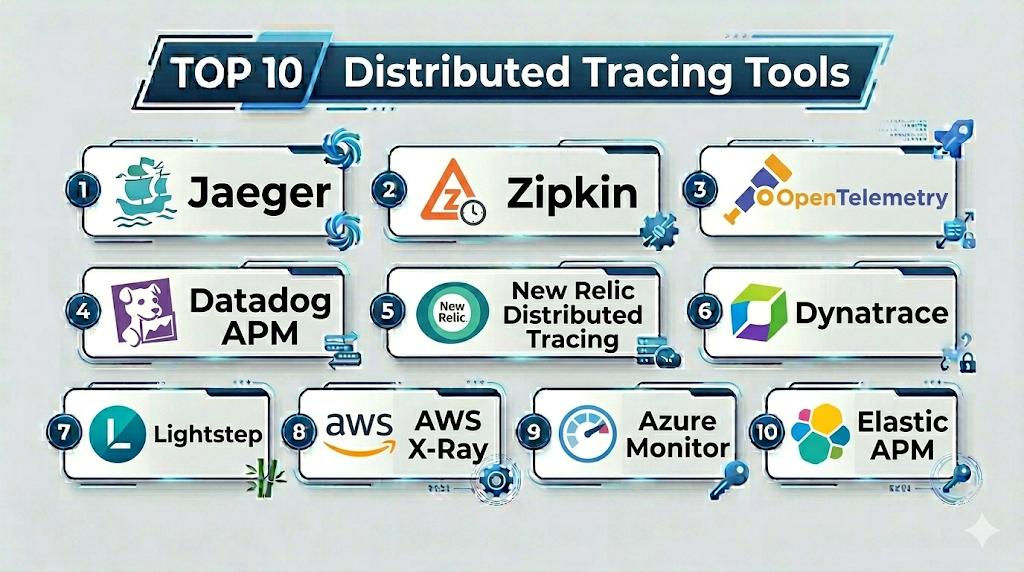
Top 10 Distributed Tracing Tools
#1 — Jaeger
Short description: An open-source distributed tracing platform originally developed for monitoring microservices-based systems.
Key Features
- End-to-end distributed tracing
- Service dependency visualization
- Adaptive sampling
- OpenTelemetry support
- Scalable architecture
Pros
- Free and open-source
- Strong community support
Cons
- Requires setup and maintenance
- Limited advanced analytics
Platforms / Deployment
Self-hosted
Security & Compliance
Not publicly stated
Integrations & Ecosystem
Jaeger integrates with cloud-native environments and observability tools.
- Kubernetes
- OpenTelemetry
- Prometheus
Support & Community
Large open-source community.
#2 — Zipkin
Short description: A lightweight open-source tracing system used for collecting and analyzing timing data.
Key Features
- Distributed tracing
- Simple UI
- Dependency graph visualization
- Sampling support
- OpenTelemetry compatibility
Pros
- Easy to deploy
- Lightweight
Cons
- Limited enterprise features
- Basic UI
Platforms / Deployment
Self-hosted
Security & Compliance
Not publicly stated
Integrations & Ecosystem
Works with various frameworks and tools.
- Spring Cloud
- OpenTelemetry
Support & Community
Active open-source community.
#3 — OpenTelemetry
Short description: An open-source observability framework for collecting traces, metrics, and logs.
Key Features
- Vendor-neutral instrumentation
- Distributed tracing
- Metrics and logs support
- Extensible architecture
- Wide language support
Pros
- Industry standard
- Highly flexible
Cons
- Requires backend tools
- Setup complexity
Platforms / Deployment
Self-hosted
Security & Compliance
Not publicly stated
Integrations & Ecosystem
OpenTelemetry integrates with most observability platforms.
- APM tools
- Cloud providers
Support & Community
Strong community support.
#4 — Datadog APM
Short description: A cloud-based observability platform offering distributed tracing and performance monitoring.
Key Features
- Distributed tracing
- Real-time analytics
- Service maps
- Integration with logs and metrics
- AI-powered alerts
Pros
- Rich feature set
- Highly scalable
Cons
- Expensive
- Complex pricing
Platforms / Deployment
Cloud
Security & Compliance
RBAC, encryption, audit logs
Integrations & Ecosystem
Datadog integrates with a wide range of cloud and DevOps tools.
- AWS, Azure, GCP
- Kubernetes
- CI/CD tools
Support & Community
Strong vendor support.
#5 — New Relic Distributed Tracing
Short description: A full-stack observability solution with advanced tracing capabilities.
Key Features
- Distributed tracing
- Real-time monitoring
- Service maps
- Error tracking
- Integration with logs
Pros
- All-in-one platform
- Strong visualization
Cons
- Learning curve
- Pricing complexity
Platforms / Deployment
Cloud
Security & Compliance
SSO, RBAC, encryption
Integrations & Ecosystem
New Relic integrates with modern cloud and DevOps tools.
- Kubernetes
- Cloud providers
- CI/CD tools
Support & Community
Strong support.
#6 — Dynatrace
Short description: An AI-powered observability platform with automated tracing and root cause analysis.
Key Features
- Automatic distributed tracing
- AI-driven insights
- Dependency mapping
- Real-time monitoring
- Kubernetes support
Pros
- Advanced automation
- Deep insights
Cons
- Premium pricing
- Complex setup
Platforms / Deployment
Cloud / Self-hosted
Security & Compliance
RBAC, encryption, audit logs
Integrations & Ecosystem
Dynatrace integrates with enterprise and cloud environments.
- AWS, Azure, GCP
- Kubernetes
Support & Community
Enterprise support.
#7 — Lightstep
Short description: A cloud-native observability platform focused on distributed tracing and performance insights.
Key Features
- Distributed tracing
- Real-time analytics
- Service maps
- OpenTelemetry support
- Alerting
Pros
- Strong OpenTelemetry integration
- Real-time insights
Cons
- Smaller ecosystem
- Pricing considerations
Platforms / Deployment
Cloud
Security & Compliance
RBAC, encryption
Integrations & Ecosystem
Lightstep integrates with cloud-native tools and environments.
- Kubernetes
- CI/CD tools
Support & Community
Vendor support available.
#8 — AWS X-Ray
Short description: A distributed tracing service designed for applications running on AWS.
Key Features
- Request tracing
- Service maps
- Integration with AWS services
- Performance analysis
- Error detection
Pros
- Seamless AWS integration
- Easy to use
Cons
- Limited outside AWS
- Feature limitations
Platforms / Deployment
Cloud
Security & Compliance
IAM, encryption
Integrations & Ecosystem
Deep integration with AWS ecosystem.
- Lambda
- EC2
- API Gateway
Support & Community
Enterprise support.
#9 — Azure Monitor (Application Insights)
Short description: A monitoring and tracing solution integrated into Azure for application performance insights.
Key Features
- Distributed tracing
- Performance monitoring
- Dependency tracking
- Integration with Azure services
- Analytics
Pros
- Strong Microsoft integration
- Easy setup
Cons
- Limited outside Azure
- Ecosystem dependency
Platforms / Deployment
Cloud
Security & Compliance
RBAC, encryption
Integrations & Ecosystem
Works within Azure ecosystem.
- Azure services
- DevOps tools
Support & Community
Enterprise support.
#10 — Elastic APM
Short description: A distributed tracing solution built on the Elastic Stack.
Key Features
- Distributed tracing
- Log correlation
- Custom dashboards
- Open-source support
- Integration with Elasticsearch
Pros
- Flexible and customizable
- Open-source option
Cons
- Requires setup
- Learning curve
Platforms / Deployment
Cloud / Self-hosted
Security & Compliance
RBAC, encryption
Integrations & Ecosystem
Elastic APM integrates with Elastic Stack and DevOps tools.
- Elasticsearch
- Kibana
- Beats
Support & Community
Strong community support.
Comparison Table (Top 10)
| Tool Name | Best For | Platform(s) Supported | Deployment | Standout Feature | Public Rating |
|---|---|---|---|---|---|
| Jaeger | Open-source | Cross-platform | Self-hosted | Scalability | N/A |
| Zipkin | Lightweight | Cross-platform | Self-hosted | Simplicity | N/A |
| OpenTelemetry | Standardization | Cross-platform | Self-hosted | Vendor-neutral | N/A |
| Datadog | Cloud apps | Web | Cloud | Real-time tracing | N/A |
| New Relic | Full-stack | Web | Cloud | Visualization | N/A |
| Dynatrace | Enterprise | Cross-platform | Hybrid | AI insights | N/A |
| Lightstep | Cloud-native | Web | Cloud | OpenTelemetry | N/A |
| AWS X-Ray | AWS users | Web | Cloud | AWS integration | N/A |
| Azure Monitor | Azure users | Web | Cloud | Microsoft integration | N/A |
| Elastic APM | Custom setups | Cross-platform | Hybrid | Flexibility | N/A |
Distributed Tracing Tools Scoring
| Tool Name | Core (25%) | Ease (15%) | Integrations (15%) | Security (10%) | Performance (10%) | Support (10%) | Value (15%) | Weighted Total |
|---|---|---|---|---|---|---|---|---|
| Jaeger | 8 | 7 | 8 | 7 | 9 | 9 | 10 | 8.3 |
| Zipkin | 7 | 8 | 7 | 7 | 8 | 8 | 10 | 8.0 |
| OpenTelemetry | 9 | 6 | 10 | 7 | 9 | 9 | 10 | 8.8 |
| Datadog | 9 | 8 | 10 | 9 | 9 | 9 | 7 | 8.9 |
| New Relic | 9 | 8 | 10 | 9 | 9 | 9 | 8 | 9.0 |
| Dynatrace | 10 | 7 | 9 | 10 | 10 | 9 | 7 | 9.2 |
| Lightstep | 8 | 8 | 9 | 8 | 9 | 8 | 7 | 8.4 |
| AWS X-Ray | 8 | 9 | 8 | 9 | 9 | 9 | 8 | 8.6 |
| Azure Monitor | 8 | 9 | 8 | 9 | 9 | 9 | 8 | 8.6 |
| Elastic APM | 8 | 7 | 8 | 8 | 8 | 8 | 9 | 8.2 |
How to interpret scores:
- Scores are relative comparisons across tools
- Enterprise tools score higher in automation and AI insights
- Open-source tools provide strong value
- Cloud tools offer ease of use and scalability
- Choose based on infrastructure and observability needs
Which Distributed Tracing Tools Is Right for You?
Solo / Freelancer
- Use Jaeger or Zipkin
- Focus on simplicity and cost
SMB
- Elastic APM or AWS X-Ray
- Balance usability and features
Mid-Market
- Datadog or New Relic
- Focus on scalability and integrations
Enterprise
- Dynatrace or OpenTelemetry (with backend)
- Focus on automation and deep observability
Budget vs Premium
- Open-source tools offer cost efficiency
- Premium tools provide advanced insights
Feature Depth vs Ease of Use
- OpenTelemetry = flexible
- Datadog = easy
Integrations & Scalability
- Choose tools with strong cloud and DevOps integrations
- Ensure support for microservices
Security & Compliance Needs
- Enterprises should prioritize RBAC and audit logs
- Smaller teams can focus on core tracing features
Frequently Asked Questions (FAQs)
What is distributed tracing?
It tracks requests across multiple services in a system.
Why is distributed tracing important?
It helps identify performance bottlenecks and failures.
Are tracing tools free?
Some are open-source; others are paid.
What is OpenTelemetry?
An open standard for observability data collection.
Can tracing tools integrate with APM?
Yes, many are part of APM platforms.
Do I need tracing for monolithic apps?
Not usually, unless complexity increases.
Are these tools cloud-based?
Many support cloud and on-prem deployments.
How long does setup take?
From hours to days depending on complexity.
Can I switch tools later?
Yes, but instrumentation may need updates.
Do tracing tools affect performance?
Minimal overhead when configured properly.
Conclusion
Distributed Tracing Tools are essential for understanding and optimizing performance in modern, distributed applications. They provide deep visibility into request flows, helping teams identify issues quickly and improve system reliability.
