Introduction
Container Orchestration tools, particularly those built around Kubernetes, are designed to automate the deployment, scaling, networking, and management of containerized applications. Kubernetes has become the de facto standard for orchestrating containers, enabling organizations to run complex, distributed systems efficiently.
As businesses adopt microservices and cloud-native architectures, Kubernetes-based orchestration tools provide the backbone for managing workloads across clusters, clouds, and environments. These platforms simplify operations, improve resilience, and enhance scalability.
Real-world use cases include:
- Managing microservices-based applications
- Automating deployment pipelines (CI/CD)
- Running multi-cloud and hybrid cloud workloads
- Scaling applications dynamically based on demand
- Ensuring high availability and fault tolerance
Key evaluation criteria buyers should consider:
- Kubernetes compatibility and compliance
- Ease of cluster deployment and management
- Multi-cluster and multi-cloud support
- Security features (RBAC, network policies, secrets management)
- Monitoring and observability
- Automation and scaling capabilities
- Integration with DevOps and CI/CD tools
- Developer experience and UI/UX
- Cost and licensing model
Best for: DevOps teams, platform engineers, enterprises, and organizations building scalable, cloud-native applications.
Not ideal for: Small teams without DevOps expertise or applications that do not require distributed scalability.
Key Trends in Container Orchestration (Kubernetes)
- Managed Kubernetes growth: Cloud providers simplifying cluster management
- Multi-cluster orchestration: Managing clusters across regions and clouds
- GitOps adoption: Declarative infrastructure managed via Git
- Platform engineering: Internal developer platforms built on Kubernetes
- Security-first orchestration: Policy enforcement and runtime protection
- AI-assisted operations: Predictive scaling and anomaly detection
- Edge Kubernetes: Running clusters closer to users/devices
- Service mesh adoption: Advanced traffic management (e.g., Istio)
- Observability stacks: Integrated logging, metrics, and tracing
- Cost optimization: Better resource scheduling and autoscaling
How We Selected These Tools (Methodology)
We selected the top Kubernetes orchestration tools based on:
- Market adoption and ecosystem strength
- Kubernetes compliance and feature completeness
- Ease of deployment and management
- Multi-cloud and hybrid support
- Security and compliance capabilities
- Integration ecosystem (CI/CD, monitoring, DevOps)
- Scalability and performance
- Developer experience and usability
- Vendor support and community strength
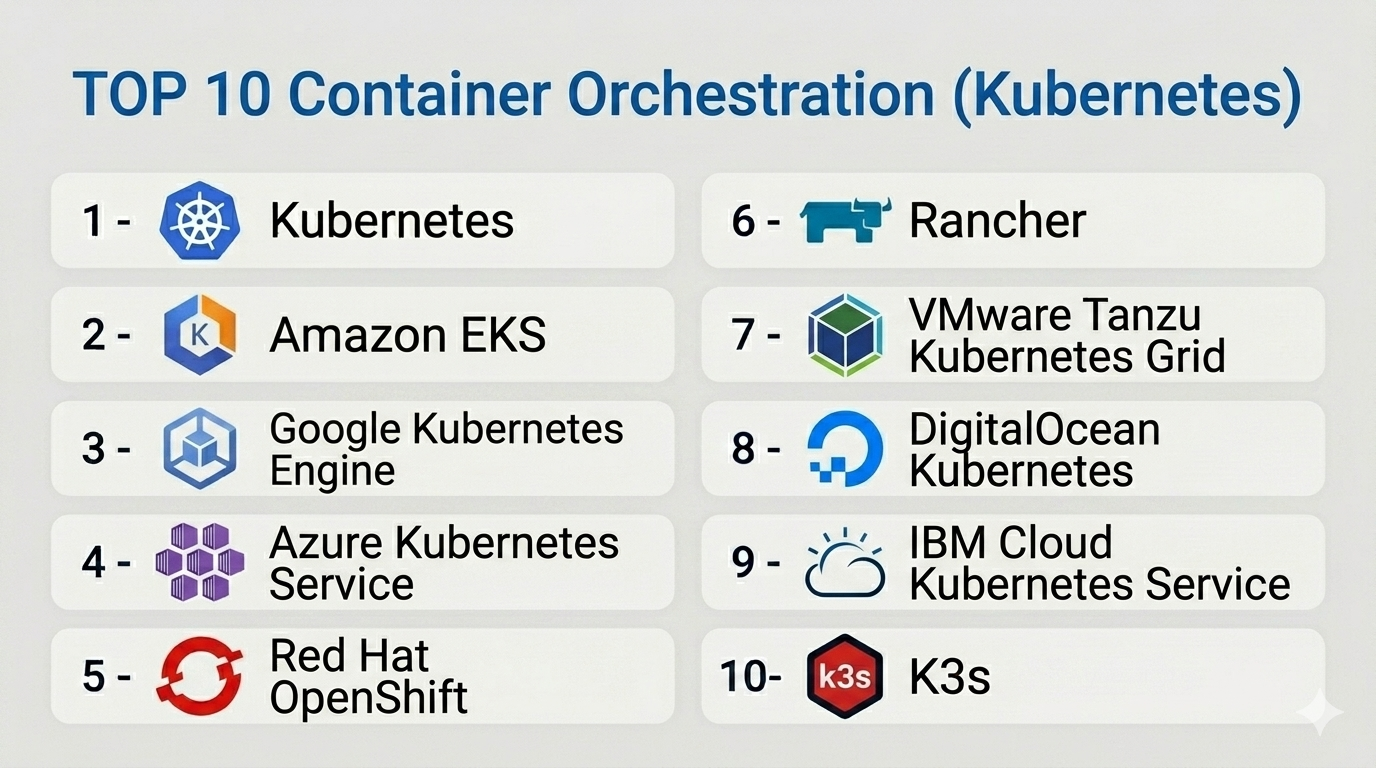
Top 10 Container Orchestration (Kubernetes) Tools
#1 — Kubernetes (Upstream)
Short description: The open-source foundation for all modern container orchestration platforms.
Key Features
- Automated deployment and scaling
- Self-healing workloads
- Service discovery and load balancing
- Rolling updates and rollbacks
- Storage orchestration
- Extensible API
- Multi-cloud support
Pros
- Highly flexible and powerful
- Massive ecosystem
Cons
- Complex to manage directly
- Requires expertise
Platforms / Deployment
Linux
Cloud / On-premise / Hybrid
Security & Compliance
RBAC, network policies, encryption
Compliance certifications: Not publicly stated
Integrations & Ecosystem
- CI/CD tools
- Monitoring tools
- Cloud providers
- APIs
Support & Community
Very large open-source community.
#2 — Amazon EKS
Short description: A fully managed Kubernetes service on AWS.
Key Features
- Managed control plane
- Auto-scaling
- Integration with AWS services
- High availability
- Security controls
- Monitoring tools
- Managed updates
Pros
- Reduces operational overhead
- Highly scalable
Cons
- AWS dependency
- Cost complexity
Platforms / Deployment
Cloud
Security & Compliance
IAM, RBAC, encryption
Compliance certifications: Not publicly stated
Integrations & Ecosystem
- AWS ecosystem
- DevOps tools
- APIs
Support & Community
Strong cloud support.
#3 — Google Kubernetes Engine (GKE)
Short description: A managed Kubernetes platform with advanced automation and performance.
Key Features
- Managed Kubernetes clusters
- Auto-scaling and auto-upgrades
- Integrated monitoring
- Security features
- High availability
- Developer tools
- Policy management
Pros
- Easy to manage
- Strong performance
Cons
- Google Cloud dependency
- Pricing complexity
Platforms / Deployment
Cloud
Security & Compliance
RBAC, encryption
Compliance certifications: Not publicly stated
Integrations & Ecosystem
- Google Cloud services
- APIs
- DevOps tools
Support & Community
Strong support.
#4 — Azure Kubernetes Service (AKS)
Short description: A managed Kubernetes service integrated with Microsoft Azure.
Key Features
- Managed clusters
- Auto-scaling
- Azure integration
- Security features
- Monitoring tools
- CI/CD integration
- High availability
Pros
- Easy integration with Microsoft ecosystem
- Simplified deployment
Cons
- Azure dependency
- Learning curve
Platforms / Deployment
Cloud
Security & Compliance
RBAC, encryption, IAM
Compliance certifications: Not publicly stated
Integrations & Ecosystem
- Azure ecosystem
- DevOps tools
- APIs
Support & Community
Enterprise-level support.
#5 — Red Hat OpenShift
Short description: An enterprise Kubernetes platform with enhanced security and developer tools.
Key Features
- Kubernetes orchestration
- Built-in CI/CD
- Security policies
- Multi-cloud support
- Monitoring and logging
- Developer tools
- Automation
Pros
- Enterprise-ready
- Strong security
Cons
- Expensive
- Requires expertise
Platforms / Deployment
Linux
Cloud / On-premise / Hybrid
Security & Compliance
RBAC, encryption, policy enforcement
Compliance certifications: Not publicly stated
Integrations & Ecosystem
- Red Hat ecosystem
- DevOps tools
- APIs
Support & Community
Strong enterprise support.
#6 — Rancher
Short description: A platform for managing multiple Kubernetes clusters across environments.
Key Features
- Multi-cluster management
- Centralized dashboard
- Role-based access control
- Monitoring tools
- Multi-cloud support
- Automation
- Kubernetes distribution
Pros
- Simplifies Kubernetes management
- Multi-cloud flexibility
Cons
- Requires Kubernetes knowledge
- UI complexity
Platforms / Deployment
Linux
Cloud / On-premise / Hybrid
Security & Compliance
RBAC, encryption
Compliance certifications: Not publicly stated
Integrations & Ecosystem
- Kubernetes ecosystem
- APIs
- DevOps tools
Support & Community
Strong open-source community.
#7 — VMware Tanzu Kubernetes Grid
Short description: A Kubernetes platform integrated with VMware environments.
Key Features
- Kubernetes cluster management
- Integration with VMware tools
- Multi-cloud support
- Automation
- Security features
- Monitoring tools
- Lifecycle management
Pros
- Strong VMware integration
- Enterprise-ready
Cons
- Requires VMware ecosystem
- Licensing cost
Platforms / Deployment
Cloud / On-premise / Hybrid
Security & Compliance
RBAC, encryption
Compliance certifications: Not publicly stated
Integrations & Ecosystem
- VMware ecosystem
- APIs
- DevOps tools
Support & Community
Enterprise support.
#8 — DigitalOcean Kubernetes (DOKS)
Short description: A simplified managed Kubernetes service for developers and SMBs.
Key Features
- Managed Kubernetes clusters
- Auto-scaling
- Simple UI
- Monitoring tools
- High availability
- API access
- Integration with cloud services
Pros
- Easy to use
- Developer-friendly
Cons
- Limited advanced features
- Smaller ecosystem
Platforms / Deployment
Cloud
Security & Compliance
RBAC, encryption
Compliance certifications: Not publicly stated
Integrations & Ecosystem
- Cloud tools
- APIs
- DevOps tools
Support & Community
Good support for SMBs.
#9 — IBM Cloud Kubernetes Service
Short description: A managed Kubernetes service focused on enterprise workloads and compliance.
Key Features
- Managed clusters
- Security and compliance tools
- Auto-scaling
- Monitoring and logging
- Integration with IBM Cloud
- High availability
- Automation
Pros
- Strong enterprise features
- Compliance-focused
Cons
- Smaller ecosystem
- IBM Cloud dependency
Platforms / Deployment
Cloud
Security & Compliance
RBAC, encryption
Compliance certifications: Not publicly stated
Integrations & Ecosystem
- IBM Cloud tools
- APIs
Support & Community
Enterprise support.
#10 — K3s
Short description: A lightweight Kubernetes distribution designed for edge and resource-constrained environments.
Key Features
- Lightweight Kubernetes
- Easy installation
- Low resource usage
- Edge computing support
- Simplified management
- High availability
- Open-source
Pros
- Minimal resource requirements
- Easy to deploy
Cons
- Limited enterprise features
- Smaller ecosystem
Platforms / Deployment
Linux
Cloud / On-premise / Edge
Security & Compliance
RBAC, encryption
Compliance certifications: Not publicly stated
Integrations & Ecosystem
- Kubernetes ecosystem
- APIs
Support & Community
Active open-source community.
Comparison Table (Top 10)
| Tool Name | Best For | Platform(s) Supported | Deployment | Standout Feature | Public Rating |
|---|---|---|---|---|---|
| Kubernetes | Advanced users | Linux | Hybrid | Full control | N/A |
| Amazon EKS | AWS users | Cloud | Cloud | Managed service | N/A |
| GKE | Performance | Cloud | Cloud | Automation | N/A |
| AKS | Microsoft users | Cloud | Cloud | Azure integration | N/A |
| OpenShift | Enterprises | Linux | Hybrid | Security | N/A |
| Rancher | Multi-cloud | Linux | Hybrid | Multi-cluster mgmt | N/A |
| Tanzu | VMware users | Hybrid | Hybrid | VMware integration | N/A |
| DOKS | SMBs | Cloud | Cloud | Simplicity | N/A |
| IBM K8s | Enterprises | Cloud | Cloud | Compliance | N/A |
| K3s | Edge | Linux | Hybrid | Lightweight | N/A |
Container Orchestration (Kubernetes) Tools Scoring
| Tool Name | Core (25%) | Ease (15%) | Integrations (15%) | Security (10%) | Performance (10%) | Support (10%) | Value (15%) | Weighted Total |
|---|---|---|---|---|---|---|---|---|
| Kubernetes | 10 | 6 | 10 | 9 | 10 | 9 | 9 | 9.2 |
| Amazon EKS | 9 | 8 | 10 | 9 | 9 | 9 | 7 | 8.8 |
| GKE | 9 | 9 | 10 | 9 | 9 | 9 | 7 | 9.0 |
| AKS | 9 | 8 | 9 | 9 | 9 | 9 | 8 | 8.8 |
| OpenShift | 9 | 7 | 9 | 9 | 9 | 9 | 7 | 8.6 |
| Rancher | 8 | 7 | 9 | 8 | 8 | 8 | 9 | 8.3 |
| Tanzu | 9 | 7 | 8 | 9 | 9 | 8 | 7 | 8.3 |
| DOKS | 7 | 9 | 7 | 8 | 8 | 7 | 9 | 7.9 |
| IBM K8s | 8 | 7 | 8 | 9 | 8 | 8 | 7 | 8.0 |
| K3s | 7 | 9 | 7 | 8 | 7 | 7 | 9 | 7.8 |
How to interpret:
- Managed services score higher in ease of use
- Open-source Kubernetes offers maximum flexibility
- Enterprise tools excel in security and integrations
- Lightweight distributions prioritize simplicity and efficiency
- Choose based on team expertise and scale
Which Container Orchestration Tool Is Right for You?
Solo / Freelancer
Use lightweight tools like K3s or managed services for simplicity.
SMB
DigitalOcean Kubernetes or managed services like AKS.
Mid-Market
EKS, GKE, or Rancher for scalability.
Enterprise
OpenShift, Tanzu, or upstream Kubernetes for full control.
Budget vs Premium
- Budget: K3s, Kubernetes
- Premium: OpenShift, managed services
Feature Depth vs Ease of Use
- Easy: Managed Kubernetes
- Advanced: Upstream Kubernetes
Integrations & Scalability
Choose cloud-managed Kubernetes for best integrations.
Security & Compliance Needs
Enterprise platforms with policy enforcement are preferred.
Frequently Asked Questions (FAQs)
What is Kubernetes?
An orchestration system for managing containers.
Do I need Kubernetes?
Only if you need scalability and automation.
Is it hard to learn?
Yes, it has a learning curve.
What is managed Kubernetes?
A cloud provider manages the infrastructure.
Is it secure?
Yes, with proper configuration.
Can it scale automatically?
Yes, using auto-scaling features.
Does it support multi-cloud?
Yes, many tools support it.
What is K3s?
A lightweight Kubernetes version.
Can I run it on-premise?
Yes, Kubernetes supports on-premise deployments.
How do I choose?
Based on scale, expertise, and infrastructure.
Conclusion
Container orchestration tools built on Kubernetes are essential for managing modern, scalable applications. Whether you choose a fully managed service or a self-managed platform, Kubernetes provides the flexibility and power needed for cloud-native development.
