Introduction
Predictive Maintenance Platforms are software tools that help companies predict equipment failures before they happen. In simple words, these platforms collect data from machines, sensors, IoT devices, maintenance records, vibration systems, temperature readings, pressure readings, energy usage, and production systems to identify early warning signs of failure.
Traditional maintenance is often reactive. A machine breaks, production stops, and the maintenance team rushes to fix it. Preventive maintenance is better, but it still depends on fixed schedules, which may lead to unnecessary servicing or missed failures. Predictive maintenance uses real machine condition data to help teams take action at the right time.
These platforms are used in manufacturing, energy, utilities, transportation, oil and gas, mining, logistics, aviation, automotive, food processing, pharmaceuticals, and facilities management. Common use cases include machine health monitoring, failure prediction, vibration analysis, anomaly detection, asset performance management, spare parts planning, maintenance scheduling, and downtime reduction.
Buyers should evaluate:
- Sensor and machine data connectivity
- AI and machine learning accuracy
- Asset health monitoring capability
- Failure prediction and anomaly detection
- Integration with CMMS, EAM, ERP, SCADA, MES, and IoT platforms
- Ease of use for maintenance and reliability teams
- Alerting and workflow automation
- Root cause analysis support
- Reporting and dashboards
- Edge and cloud deployment options
- Security, access control, and audit logs
- Total cost of ownership and implementation effort
Best for: Maintenance teams, reliability engineers, plant managers, operations leaders, asset managers, manufacturing companies, utilities, energy companies, transportation operators, and enterprises with critical equipment where downtime is costly.
Not ideal for: Very small operations with few assets, low downtime cost, limited sensor data, or simple maintenance needs. In those cases, a basic CMMS, spreadsheet, or preventive maintenance schedule may be enough.
Key Predictive Maintenance Platform Trends
- AI-based anomaly detection is becoming more practical. Modern platforms can identify unusual machine behavior before failure becomes visible to operators.
- Edge analytics is growing fast. Many plants process machine data locally to reduce latency, improve reliability, and keep operations running even when cloud connectivity is limited.
- Integration with CMMS and EAM is now essential. Predictive alerts must turn into real maintenance work orders, otherwise insights may not lead to action.
- Vibration analysis remains a major use case. Rotating equipment such as motors, pumps, compressors, turbines, and fans often show early failure signs through vibration patterns.
- Digital twins are becoming more common. Some platforms create digital models of assets to compare expected performance with real operating behavior.
- No-code analytics is improving adoption. Maintenance teams increasingly need tools they can use without depending fully on data scientists.
- Cloud-based asset monitoring is expanding. Multi-site companies want centralized visibility across plants, fleets, and facilities.
- Cybersecurity is becoming more important. Predictive maintenance platforms often connect with industrial control systems and machine data, so secure integration matters.
- Prescriptive maintenance is gaining attention. Buyers now want platforms that not only predict a problem but also suggest what action to take.
- Sustainability and energy efficiency are influencing decisions. Better maintenance can reduce energy waste, extend asset life, and lower unnecessary parts replacement.
How We Selected These Tools
The tools below were selected using practical maintenance, industrial IoT, and asset performance criteria.
- Recognition in predictive maintenance, asset performance management, industrial IoT, or reliability engineering
- Ability to monitor machine health and detect early failure signals
- Support for AI, machine learning, anomaly detection, or condition-based monitoring
- Integration potential with CMMS, EAM, ERP, SCADA, MES, IoT, and historian systems
- Fit for manufacturing, energy, utilities, transportation, facilities, and heavy industry
- Scalability across multiple sites, plants, assets, and equipment classes
- Ease of use for maintenance teams, reliability engineers, and operations users
- Dashboarding, alerting, and reporting capabilities
- Security and enterprise deployment readiness
- Practical value for SMB, mid-market, and enterprise buyers
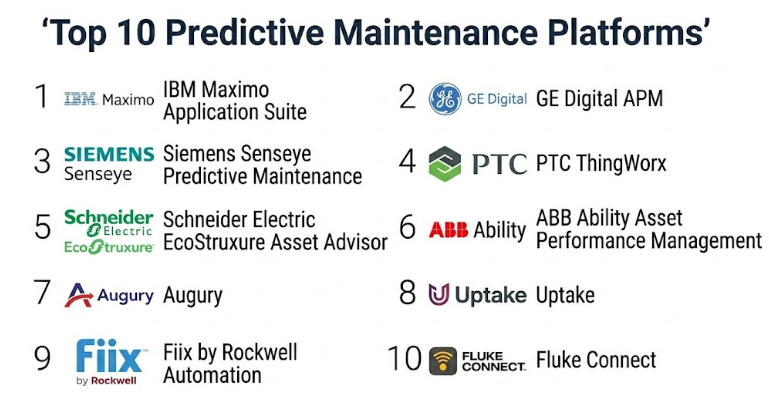
Top 10 Predictive Maintenance Platforms
#1 — IBM Maximo Application Suite
Short description :
IBM Maximo Application Suite is a major enterprise asset management and asset performance platform used by large organizations to manage maintenance, reliability, inspections, asset health, and operational performance. It supports predictive maintenance through asset data, AI-assisted insights, condition monitoring, work management, and reliability workflows. The platform is useful for asset-heavy industries such as utilities, transportation, energy, manufacturing, facilities, and infrastructure. Maximo is especially strong when predictive maintenance needs to connect with formal maintenance execution and enterprise asset management. It is best suited for organizations with complex assets, many users, and mature maintenance operations.
Key Features
- Enterprise asset management
- Asset health monitoring
- Predictive maintenance workflows
- AI-assisted reliability insights
- Work order and maintenance management
- Inspection and mobile maintenance support
- Integration with enterprise and industrial systems
Pros
- Strong enterprise asset management depth
- Good fit for large asset-heavy organizations
- Connects predictive insights with maintenance execution
Cons
- May be complex for smaller teams
- Implementation can require planning and expert support
- Total cost may be high for simple maintenance needs
Platforms / Deployment
Web / Mobile / Enterprise environment.
Cloud / Hybrid / Self-hosted: Varies / N/A.
Security & Compliance
Enterprise security controls may be available depending on deployment.
SSO/SAML, MFA, encryption, audit logs, RBAC: Not publicly stated in detail here.
SOC 2, ISO 27001, GDPR, HIPAA: Not publicly stated in this context.
Integrations & Ecosystem
IBM Maximo can fit into large enterprise environments where maintenance, operations, finance, procurement, and reliability data need to work together.
- ERP and procurement systems
- IoT and sensor data platforms
- SCADA and historian systems
- Work order and maintenance workflows
- Reporting and analytics tools
Support & Community
Support is enterprise-focused, with documentation, implementation partners, training, and professional services. Community strength is strong among enterprise asset management and reliability teams.
#2 — GE Digital APM
Short description :
GE Digital APM is an Asset Performance Management platform designed to help companies improve asset reliability, reduce downtime, and manage risk across critical equipment. It supports predictive maintenance through equipment health monitoring, analytics, reliability strategy, risk assessment, and performance insights. The platform is useful for power generation, oil and gas, manufacturing, utilities, aviation, and other asset-heavy industries. GE Digital APM is especially valuable where equipment failure can create high safety, production, or financial impact. It is a strong choice for organizations that need reliability strategy and asset performance improvement together.
Key Features
- Asset performance management
- Equipment health monitoring
- Predictive maintenance analytics
- Reliability strategy management
- Risk-based maintenance workflows
- Failure mode and root cause analysis support
- Enterprise reporting and dashboards
Pros
- Strong fit for critical industrial assets
- Useful for reliability-centered maintenance
- Good for risk and performance-based asset strategies
Cons
- May be more advanced than small teams need
- Implementation can require reliability engineering maturity
- Pricing and deployment details vary by organization
Platforms / Deployment
Web / Enterprise environment.
Cloud / Hybrid / Self-hosted: Varies / N/A.
Security & Compliance
Enterprise security controls may be available depending on deployment.
SSO/SAML, MFA, encryption, audit logs, RBAC: Not publicly stated in detail here.
SOC 2, ISO 27001, GDPR, HIPAA: Not publicly stated in this context.
Integrations & Ecosystem
GE Digital APM fits into industrial environments where asset data, maintenance workflows, reliability strategy, and operational systems must connect.
- EAM and CMMS systems
- Historian and sensor data
- SCADA and operational systems
- Reliability engineering workflows
- Enterprise analytics and reporting
Support & Community
Support is vendor-led and enterprise-focused. Documentation, implementation services, training, and customer support may vary by deployment and contract scope.
#3 — Siemens Senseye Predictive Maintenance
Short description :
Siemens Senseye Predictive Maintenance is a predictive maintenance platform designed to help manufacturers and industrial companies monitor equipment health, detect failure risks, and reduce unplanned downtime. It uses machine data and analytics to identify abnormal behavior and support maintenance decisions. The platform is useful for factories and industrial operations that need scalable predictive maintenance across many machines and production lines. Senseye is especially relevant for companies that want predictive maintenance without building a custom data science system. It is a good fit for industrial teams seeking machine health visibility and maintenance prioritization.
Key Features
- Predictive maintenance analytics
- Machine health monitoring
- Anomaly detection
- Asset risk prioritization
- Maintenance alert workflows
- Scalable multi-asset monitoring
- Industrial data connectivity support
Pros
- Strong focus on predictive maintenance
- Useful for manufacturing and industrial environments
- Helps prioritize maintenance based on asset health
Cons
- Requires reliable machine data for best results
- Integration effort may vary by factory systems
- Advanced outcomes depend on asset data quality
Platforms / Deployment
Web-based platform.
Cloud / Hybrid / Edge: Varies / N/A.
Security & Compliance
SSO/SAML, MFA, encryption, audit logs, RBAC: Not publicly stated in detail here.
SOC 2, ISO 27001, GDPR, HIPAA: Not publicly stated in this context.
Integrations & Ecosystem
Siemens Senseye can fit into industrial environments where predictive maintenance must connect with production data, asset systems, and maintenance execution.
- Industrial machine data
- IoT and sensor platforms
- CMMS and EAM workflows
- Manufacturing systems
- Dashboards and maintenance alerts
Support & Community
Support is vendor-led with enterprise assistance, onboarding, and documentation. Community strength is connected to Siemens industrial and manufacturing ecosystem.
#4 — PTC ThingWorx
Short description :
PTC ThingWorx is an industrial IoT platform used to connect machines, collect asset data, build industrial applications, and support predictive maintenance use cases. It helps teams monitor equipment, visualize performance, create alerts, and develop custom operational dashboards. ThingWorx is useful when companies need a flexible IoT foundation for predictive maintenance rather than only a fixed maintenance product. It is commonly used in manufacturing, industrial equipment, connected products, and service operations. ThingWorx is best for teams that want to build connected asset monitoring and predictive maintenance applications on top of industrial IoT data.
Key Features
- Industrial IoT connectivity
- Machine and asset monitoring
- Custom dashboard development
- Predictive maintenance application support
- Alerts and operational workflows
- Remote asset visibility
- Integration with industrial systems
Pros
- Flexible platform for industrial IoT use cases
- Good for custom predictive maintenance applications
- Useful for connected products and equipment monitoring
Cons
- May require development and solution design
- Not always a ready-made predictive maintenance tool by itself
- Implementation depends on IoT architecture and data quality
Platforms / Deployment
Web / Industrial IoT platform.
Cloud / On-premise / Hybrid: Varies / N/A.
Security & Compliance
Enterprise access controls may be available depending on deployment.
SSO/SAML, MFA, encryption, audit logs, RBAC: Not publicly stated in detail here.
SOC 2, ISO 27001, GDPR, HIPAA: Not publicly stated in this context.
Integrations & Ecosystem
ThingWorx can connect with industrial assets, enterprise systems, analytics tools, and maintenance platforms.
- Industrial IoT devices and sensors
- SCADA and historian systems
- CMMS and EAM systems
- ERP and enterprise workflows
- Custom industrial applications
Support & Community
Support is enterprise-focused, with documentation, training, partner ecosystem, and professional services. Community strength is strong among industrial IoT and connected product users.
#5 — Schneider Electric EcoStruxure Asset Advisor
Short description :
Schneider Electric EcoStruxure Asset Advisor is an asset monitoring and advisory platform designed to improve reliability and performance of electrical and industrial assets. It helps teams monitor asset condition, receive alerts, and use expert guidance to reduce downtime risk. The platform is useful for facilities, data centers, energy systems, utilities, manufacturing plants, and infrastructure environments. It is especially relevant where electrical distribution, power systems, and critical infrastructure assets need continuous monitoring. EcoStruxure Asset Advisor is a strong fit for organizations already using Schneider Electric equipment or energy management systems.
Key Features
- Asset condition monitoring
- Predictive maintenance alerts
- Electrical asset performance visibility
- Remote monitoring and advisory support
- Energy and infrastructure asset insights
- Expert service support
- Reliability and risk reduction workflows
Pros
- Strong fit for electrical and energy assets
- Useful for facilities and infrastructure reliability
- Works well in Schneider Electric ecosystem
Cons
- Best fit may be Schneider-centered environments
- May not cover every mechanical asset class equally
- Scope depends on equipment and service configuration
Platforms / Deployment
Web / Mobile / Enterprise environment: Varies / N/A.
Cloud / Hybrid: Varies / N/A.
Security & Compliance
SSO/SAML, MFA, encryption, audit logs, RBAC: Not publicly stated in detail here.
SOC 2, ISO 27001, GDPR, HIPAA: Not publicly stated in this context.
Integrations & Ecosystem
EcoStruxure Asset Advisor fits into connected electrical infrastructure and energy management environments.
- Schneider Electric equipment and systems
- Energy management platforms
- Facility monitoring systems
- Maintenance workflows
- Remote advisory services
Support & Community
Support is vendor-led with documentation, service teams, and expert advisory support. Support quality may depend on contract, region, and equipment scope.
#6 — ABB Ability Asset Performance Management
Short description :
ABB Ability Asset Performance Management helps industrial companies monitor asset health, improve reliability, and optimize maintenance decisions. It supports predictive maintenance through equipment condition monitoring, operational analytics, reliability insights, and asset performance visibility. The platform is useful for industries such as mining, energy, process manufacturing, marine, utilities, and heavy industry. ABB Ability is especially relevant where ABB equipment, automation systems, drives, motors, or control systems are already part of operations. It is a strong choice for industrial teams that need asset reliability connected with automation and operational technology.
Key Features
- Asset health monitoring
- Predictive maintenance insights
- Equipment condition monitoring
- Reliability and performance analytics
- Industrial automation integration
- Maintenance prioritization
- Operational dashboards
Pros
- Strong fit for ABB industrial environments
- Useful for heavy industry and process operations
- Helps connect automation data with maintenance decisions
Cons
- Best value may come in ABB-centered ecosystems
- Implementation may need OT and maintenance collaboration
- Scope may vary by industry and asset class
Platforms / Deployment
Web / Enterprise industrial environment.
Cloud / Hybrid / On-premise: Varies / N/A.
Security & Compliance
Enterprise security controls may be available depending on deployment.
SSO/SAML, MFA, encryption, audit logs, RBAC: Not publicly stated in detail here.
SOC 2, ISO 27001, GDPR, HIPAA: Not publicly stated in this context.
Integrations & Ecosystem
ABB Ability fits into industrial environments with automation systems, equipment data, and reliability workflows.
- ABB automation and equipment systems
- Industrial IoT data sources
- CMMS and EAM systems
- Operational dashboards
- Asset performance workflows
Support & Community
Support is vendor-led and enterprise-focused. Documentation, service support, and implementation assistance may vary by region, industry, and asset type.
#7 — Augury
Short description :
Augury is a predictive maintenance and machine health platform focused on helping manufacturers monitor equipment condition and identify machine failure risks. It uses sensor data, AI, and machine health analytics to support maintenance decisions. Augury is especially useful for rotating equipment such as pumps, motors, compressors, fans, and production machinery. It helps maintenance and reliability teams detect early signs of failure, prioritize repairs, and reduce unplanned downtime. Augury is a strong option for manufacturers that want practical machine health monitoring with AI-supported diagnostics.
Key Features
- Machine health monitoring
- AI-based fault detection
- Sensor-based condition monitoring
- Failure risk alerts
- Maintenance prioritization
- Rotating equipment diagnostics
- Reliability dashboards
Pros
- Strong focus on machine health
- Useful for rotating equipment monitoring
- Helps maintenance teams prioritize action
Cons
- Best value depends on sensor coverage
- May be less broad than full EAM platforms
- Integration with existing maintenance systems should be validated
Platforms / Deployment
Web / Mobile / Sensor-connected environment.
Cloud / Edge: Varies / N/A.
Security & Compliance
SSO/SAML, MFA, encryption, audit logs, RBAC: Not publicly stated in detail here.
SOC 2, ISO 27001, GDPR, HIPAA: Not publicly stated in this context.
Integrations & Ecosystem
Augury fits into maintenance environments where sensor data and machine health insights need to connect with reliability workflows.
- Wireless machine sensors
- Maintenance workflows
- CMMS and EAM systems
- Alerting and reporting
- Reliability analytics
Support & Community
Support is vendor-led and usually includes onboarding, monitoring assistance, and customer success support. Community strength is strongest among manufacturing reliability teams.
#8 — Uptake
Short description :
Uptake is an industrial AI and predictive analytics platform focused on asset performance, equipment reliability, and operational intelligence. It helps organizations use machine data to identify failure risks, improve maintenance planning, and optimize asset performance. Uptake is relevant for transportation, energy, mining, industrial equipment, and asset-heavy operations. The platform is useful where companies need predictive insights across fleets, machinery, and complex operational environments. Uptake is a good fit for organizations that want AI-driven maintenance and asset analytics at scale.
Key Features
- Industrial AI analytics
- Predictive maintenance insights
- Asset performance monitoring
- Failure risk detection
- Fleet and equipment analytics
- Maintenance prioritization
- Operational intelligence dashboards
Pros
- Strong industrial AI orientation
- Useful for asset-heavy and fleet-based operations
- Helps turn machine data into maintenance insights
Cons
- May require strong data integration work
- Best value depends on available asset data
- May be more advanced than simple maintenance teams need
Platforms / Deployment
Web / Enterprise analytics environment.
Cloud / Hybrid: Varies / N/A.
Security & Compliance
Enterprise security controls may be available depending on deployment.
SSO/SAML, MFA, encryption, audit logs, RBAC: Not publicly stated in detail here.
SOC 2, ISO 27001, GDPR, HIPAA: Not publicly stated in this context.
Integrations & Ecosystem
Uptake fits into industrial environments where data from machines, fleets, operations, and maintenance systems needs to support predictive decisions.
- Equipment and telematics data
- CMMS and EAM systems
- Fleet management systems
- Industrial IoT data
- Operational analytics dashboards
Support & Community
Support is vendor-led and enterprise-focused. Documentation, onboarding, and implementation services may vary by industry and deployment scope.
#9 — Fiix by Rockwell Automation
Short description :
Fiix is a cloud-based CMMS platform by Rockwell Automation that helps teams manage maintenance work orders, assets, preventive maintenance, parts, and maintenance performance. While Fiix is primarily a CMMS, it can support predictive maintenance when connected with machine data, condition monitoring, and automation workflows. It is useful for maintenance teams that want an easier way to turn asset insights into actual work orders. Fiix is especially suitable for SMB and mid-market organizations that need practical maintenance execution without a heavy enterprise EAM system. It is a strong option when maintenance workflow adoption is the main priority.
Key Features
- Cloud-based CMMS
- Work order management
- Asset and equipment records
- Preventive maintenance scheduling
- Maintenance reporting
- Parts and inventory tracking
- Integration with condition monitoring and automation systems
Pros
- Easy to adopt compared with large EAM systems
- Good fit for SMB and mid-market maintenance teams
- Connects maintenance planning with work execution
Cons
- Not a pure predictive maintenance platform by itself
- Advanced prediction depends on external data and integrations
- May be less suitable for very complex enterprise asset strategies
Platforms / Deployment
Web / Mobile.
Cloud deployment.
Security & Compliance
Enterprise security controls may be available depending on plan and setup.
SSO/SAML, MFA, encryption, audit logs, RBAC: Not publicly stated in detail here.
SOC 2, ISO 27001, GDPR, HIPAA: Not publicly stated in this context.
Integrations & Ecosystem
Fiix fits into maintenance environments where work order execution, asset records, and condition-based alerts need to work together.
- CMMS workflows
- Rockwell Automation ecosystem
- IoT and sensor data connections
- Maintenance dashboards
- Inventory and parts management
Support & Community
Support includes documentation, onboarding resources, customer support, and Rockwell ecosystem support. Community strength is practical among maintenance and operations teams.
#10 — Fluke Connect
Short description :
Fluke Connect is a maintenance and reliability platform connected with Fluke tools, measurement devices, sensors, and condition monitoring workflows. It helps teams capture measurements, monitor equipment condition, track asset data, and support maintenance decisions. The platform is useful for technicians and reliability teams that already use Fluke instruments for electrical, thermal, vibration, and mechanical checks. It supports predictive maintenance by making measurement data easier to collect, compare, and act on. Fluke Connect is a strong choice for teams that want practical condition monitoring tied to field maintenance tools.
Key Features
- Condition monitoring support
- Measurement data capture
- Equipment health tracking
- Integration with Fluke instruments
- Vibration, thermal, and electrical inspection workflows
- Asset records and maintenance insights
- Mobile-friendly technician workflows
Pros
- Strong fit for field maintenance teams
- Works well with Fluke measurement ecosystem
- Useful for practical condition-based maintenance
Cons
- Best value depends on Fluke tool usage
- May not replace enterprise APM platforms
- Advanced predictive analytics may be limited compared with larger systems
Platforms / Deployment
Web / Mobile / Connected device environment.
Cloud / Edge: Varies / N/A.
Security & Compliance
SSO/SAML, MFA, encryption, audit logs, RBAC: Not publicly stated in detail here.
SOC 2, ISO 27001, GDPR, HIPAA: Not publicly stated in this context.
Integrations & Ecosystem
Fluke Connect fits into maintenance workflows where technicians use measurement tools and need better asset condition visibility.
- Fluke instruments and sensors
- Mobile inspection workflows
- Condition monitoring data
- Maintenance reporting
- Asset health records
Support & Community
Support is vendor-led with documentation, product support, and practical maintenance resources. Community strength is strong among field technicians, electrical teams, and reliability professionals.
Comparison Table
| Tool Name | Best For | Platform(s) Supported | Deployment | Standout Feature | Public Rating |
|---|---|---|---|---|---|
| IBM Maximo Application Suite | Enterprise asset management and predictive maintenance | Web / Mobile / Enterprise | Cloud / Hybrid / Self-hosted: Varies | Full asset lifecycle and maintenance execution | N/A |
| GE Digital APM | Critical industrial asset performance | Web / Enterprise | Cloud / Hybrid / Self-hosted: Varies | Reliability and risk-based maintenance strategy | N/A |
| Siemens Senseye Predictive Maintenance | Industrial machine health monitoring | Web | Cloud / Hybrid / Edge: Varies | Scalable predictive maintenance analytics | N/A |
| PTC ThingWorx | Industrial IoT predictive maintenance applications | Web / Industrial IoT | Cloud / On-premise / Hybrid: Varies | Flexible IoT application platform | N/A |
| Schneider Electric EcoStruxure Asset Advisor | Electrical and energy asset monitoring | Web / Mobile / Enterprise: Varies | Cloud / Hybrid: Varies | Remote advisory for critical electrical assets | N/A |
| ABB Ability Asset Performance Management | Industrial automation and asset reliability | Web / Enterprise | Cloud / Hybrid / On-premise: Varies | Automation-connected asset performance | N/A |
| Augury | Machine health and rotating equipment monitoring | Web / Mobile | Cloud / Edge: Varies | AI-based machine health diagnostics | N/A |
| Uptake | Industrial AI for asset-heavy operations | Web / Enterprise | Cloud / Hybrid: Varies | Predictive analytics for equipment and fleets | N/A |
| Fiix by Rockwell Automation | Maintenance execution and work order management | Web / Mobile | Cloud | Easy CMMS connected to maintenance workflows | N/A |
| Fluke Connect | Field condition monitoring and technician workflows | Web / Mobile / Connected devices | Cloud / Edge: Varies | Measurement-driven condition monitoring | N/A |
Evaluation & Predictive Maintenance Platforms
The scoring below is comparative and based on practical predictive maintenance needs such as core capabilities, ease of use, integrations, security signals, performance, support, and value. These scores should not be treated as final purchasing advice. The best platform depends on asset type, industry, downtime cost, data availability, integration needs, and maintenance maturity.
| Tool Name | Core (25%) | Ease (15%) | Integrations (15%) | Security (10%) | Performance (10%) | Support (10%) | Value (15%) | Weighted Total (0–10) |
|---|---|---|---|---|---|---|---|---|
| IBM Maximo Application Suite | 9 | 7 | 9 | 8 | 9 | 9 | 7 | 8.30 |
| GE Digital APM | 9 | 7 | 8 | 8 | 9 | 8 | 7 | 8.10 |
| Siemens Senseye Predictive Maintenance | 9 | 8 | 8 | 7 | 8 | 8 | 8 | 8.15 |
| PTC ThingWorx | 8 | 7 | 9 | 8 | 8 | 8 | 7 | 7.90 |
| Schneider Electric EcoStruxure Asset Advisor | 8 | 8 | 8 | 7 | 8 | 8 | 8 | 7.85 |
| ABB Ability Asset Performance Management | 8 | 7 | 8 | 7 | 8 | 8 | 7 | 7.55 |
| Augury | 8 | 9 | 7 | 7 | 8 | 8 | 8 | 7.95 |
| Uptake | 8 | 7 | 8 | 7 | 8 | 8 | 7 | 7.55 |
| Fiix by Rockwell Automation | 7 | 9 | 8 | 7 | 8 | 8 | 9 | 7.95 |
| Fluke Connect | 7 | 8 | 7 | 6 | 8 | 8 | 8 | 7.40 |
A higher score usually means broader fit across predictive maintenance requirements. However, a lower-scoring tool may still be the best choice for a specific scenario. For example, Fiix may be excellent for a team that needs maintenance execution first, while Augury may be stronger for rotating equipment monitoring. IBM Maximo and GE Digital APM may fit large enterprises, while Fluke Connect may suit field technicians using measurement tools.
Which Predictive Maintenance Platform Should You Choose?
Solo / Freelancer
Solo consultants, reliability advisors, and independent maintenance experts usually do not need a large enterprise platform for personal use. They may need tools that help analyze machine data, inspect asset condition, or support client improvement projects.
Good options:
- Fluke Connect for technician-driven measurement workflows
- Fiix for simple maintenance planning and work order structure
- Augury for machine health use cases when sensor monitoring is needed
- General analytics tools for small consulting projects
The main goal should be practical condition monitoring and clear reporting rather than heavy enterprise architecture.
SMB
Small and mid-sized companies usually need a platform that is easy to adopt, affordable, and practical for maintenance teams. They should avoid starting with overly complex systems unless their downtime cost is very high.
Good options:
- Fiix by Rockwell Automation for CMMS and maintenance execution
- Augury for machine health monitoring
- Fluke Connect for condition monitoring with technician tools
- Siemens Senseye for scalable predictive maintenance in industrial settings
SMBs should begin with critical assets, not every machine. Start with the equipment that causes the most downtime, repair cost, or production risk.
Mid-Market
Mid-market organizations often need better asset visibility, more structured maintenance workflows, and integration between machine data and work orders. They may operate multiple lines, plants, or facilities.
Good options:
- Siemens Senseye for predictive maintenance analytics
- PTC ThingWorx for industrial IoT-based monitoring
- Augury for rotating equipment health
- Schneider Electric EcoStruxure Asset Advisor for electrical assets
- Fiix for maintenance execution
Mid-market buyers should focus on integrations with CMMS, EAM, ERP, SCADA, and production systems.
Enterprise
Large enterprises need scalable, secure, and integrated platforms that support many sites, asset classes, teams, and reliability programs. They often require governance, role-based access, enterprise reporting, and advanced analytics.
Good options:
- IBM Maximo Application Suite for enterprise asset management and predictive maintenance
- GE Digital APM for asset performance and reliability strategy
- PTC ThingWorx for industrial IoT and custom applications
- ABB Ability Asset Performance Management for ABB-heavy industrial operations
- Schneider Electric EcoStruxure Asset Advisor for electrical infrastructure
- Uptake for industrial AI and fleet or equipment analytics
Enterprise buyers should involve maintenance, reliability, operations, IT, security, finance, and plant teams before selecting a platform.
Budget vs Premium
Budget-focused buyers should start with the most critical maintenance pain point. If the issue is poor work order tracking, a CMMS may be the best first step. If the issue is unexpected motor failure, machine health monitoring may be better.
Premium platforms make sense when the company needs:
- Multi-site asset visibility
- Advanced predictive analytics
- Enterprise asset management
- Risk-based maintenance strategy
- Integration with industrial systems
- Strong security and governance
- Reliability-centered maintenance programs
- Large-scale reporting
The best investment depends on downtime cost, asset criticality, and maintenance maturity.
Feature Depth vs Ease of Use
A powerful platform is not useful if maintenance teams do not use it. The best system should balance analytics depth with daily usability.
Choose feature depth when:
- Assets are expensive and critical
- Downtime has high financial impact
- Many sites need standardization
- Reliability engineering maturity is high
- Industrial data is already available
- Enterprise integrations are required
Choose ease of use when:
- Maintenance teams are new to digital tools
- Work order discipline is still developing
- Sensor coverage is limited
- The team needs fast adoption
- The first goal is reducing reactive maintenance
The right platform should help people take action, not only create dashboards.
Integrations & Scalability
Predictive maintenance platforms need strong integration because machine health insights must become maintenance actions.
Important integration areas include:
- CMMS systems
- EAM platforms
- ERP systems
- SCADA systems
- MES platforms
- Data historians
- IoT platforms
- PLC and sensor systems
- Vibration monitoring tools
- Energy monitoring systems
- Spare parts and inventory systems
- BI and reporting platforms
Scalability matters when the company wants to monitor many assets, plants, production lines, or fleets from one system.
Security & Compliance Needs
Predictive maintenance platforms may connect with industrial networks, equipment data, production systems, and enterprise maintenance records. Security should be evaluated before deployment.
Buyers should ask about:
- Role-based access control
- SSO and MFA
- Encryption
- Audit logs
- Secure device connectivity
- Network segmentation support
- Data retention
- Backup and recovery
- Remote access policies
- Vendor security documentation
- Internal security review support
Never assume a platform has a specific security certification unless the vendor clearly confirms it.
Frequently Asked Questions
1. What is a Predictive Maintenance Platform?
A Predictive Maintenance Platform is software that uses equipment data, sensors, AI, and analytics to identify early signs of machine failure. It helps maintenance teams fix problems before they cause unplanned downtime.
2. How is predictive maintenance different from preventive maintenance?
Preventive maintenance follows a fixed schedule, such as servicing equipment every month. Predictive maintenance uses real asset condition data to decide when maintenance is actually needed.
3. What industries use predictive maintenance?
Predictive maintenance is used in manufacturing, energy, utilities, oil and gas, mining, transportation, aviation, logistics, food processing, pharmaceuticals, facilities, and infrastructure operations.
4. What type of data is needed for predictive maintenance?
Useful data includes vibration, temperature, pressure, current, voltage, oil analysis, acoustic signals, operating hours, maintenance history, equipment alarms, production data, and failure records.
5. Can predictive maintenance reduce downtime?
Yes, predictive maintenance can reduce downtime by identifying early failure signs and helping teams plan maintenance before breakdowns happen. Results depend on data quality, asset criticality, and response discipline.
6. Is AI required for predictive maintenance?
AI is useful but not always required. Some condition monitoring programs use thresholds, vibration rules, inspections, and trend analysis. AI becomes more valuable when patterns are complex or large volumes of data are involved.
7. What is the biggest mistake when adopting predictive maintenance?
The biggest mistake is starting with too many assets at once. Teams should begin with critical machines where failure is costly, data is available, and maintenance action can clearly reduce risk.
8. Can predictive maintenance platforms integrate with CMMS?
Yes, many platforms can integrate with CMMS or EAM systems so alerts can become work orders. This integration is important because insights must lead to real maintenance action.
9. How long does implementation take?
Implementation depends on asset count, sensor availability, data quality, integrations, user training, and maintenance maturity. A focused pilot may be faster, while an enterprise rollout can require phased implementation.
10. What assets are best for predictive maintenance?
Predictive maintenance works well for critical rotating equipment, pumps, motors, compressors, turbines, fans, conveyors, gearboxes, electrical systems, HVAC systems, fleets, and production machinery.
Conclusion
Predictive Maintenance Platforms help organizations move from reactive repairs to smarter, condition-based maintenance. They can reduce unplanned downtime, improve asset reliability, extend equipment life, optimize spare parts planning, and support better maintenance decisions. However, the best platform depends on the company’s asset type, maintenance maturity, data availability, industry, budget, and integration needs. IBM Maximo and GE Digital APM are strong for enterprise asset performance, Siemens Senseye and Augury are valuable for machine health monitoring, PTC ThingWorx is useful for industrial IoT applications, and Fiix is practical for maintenance execution.
