Introduction
Asset Performance Management Industrial Platforms help companies monitor, manage, and improve the performance, reliability, safety, and lifecycle value of critical industrial assets. In simple words, these platforms help organizations understand how well machines, equipment, plants, fleets, and infrastructure assets are performing, when they may fail, what risks they carry, and what maintenance or operational action should be taken.
Industrial assets can be expensive, complex, and business-critical. A pump failure, turbine issue, compressor breakdown, electrical system fault, production line stoppage, or mining equipment failure can create downtime, safety risk, quality problems, and high repair costs. Asset Performance Management platforms help teams move from reactive maintenance to condition-based, predictive, and reliability-centered asset strategies.
These platforms are used in manufacturing, energy, utilities, oil and gas, mining, transportation, chemicals, pharma, water treatment, infrastructure, facilities, and heavy industry. Common use cases include asset health monitoring, predictive maintenance, reliability analysis, risk-based inspection, failure mode analysis, work prioritization, condition monitoring, asset strategy management, and executive asset performance reporting.
Buyers should evaluate:
- Asset health monitoring capability
- Predictive maintenance and anomaly detection
- Reliability-centered maintenance support
- Risk-based inspection and compliance workflows
- Integration with EAM, CMMS, ERP, SCADA, MES, historians, and IoT systems
- Support for multi-site and multi-asset operations
- Dashboards, reporting, and asset performance analytics
- Ease of use for maintenance, reliability, and operations teams
- AI, machine learning, and digital twin capabilities
- Security, access control, audit logs, and deployment options
- Vendor support, implementation ecosystem, and industry fit
- Total cost of ownership and long-term scalability
Best for: Reliability engineers, maintenance leaders, asset managers, plant managers, operations teams, industrial companies, utilities, energy firms, manufacturers, transportation operators, and enterprises that manage high-value or safety-critical assets.
Not ideal for: Very small businesses with a few simple assets, low downtime impact, limited data availability, or basic maintenance needs. In those cases, a standard CMMS, spreadsheet, preventive maintenance schedule, or simple monitoring system may be enough.
Key Asset Performance Management Industrial Platform Trends
- Predictive maintenance is becoming a core APM feature. Industrial teams want platforms that can detect early failure signs using sensor data, maintenance history, and machine behavior.
- AI and machine learning are improving asset insights. AI can help detect anomalies, prioritize asset risks, recommend actions, and identify patterns across large asset fleets.
- Digital twins are gaining importance. Asset models help teams compare expected performance with real operating behavior, especially for turbines, compressors, production lines, power systems, and process equipment.
- Risk-based maintenance is replacing fixed schedules. Companies are moving away from calendar-based servicing toward maintenance plans based on asset condition, risk, criticality, and failure impact.
- Integration with EAM and CMMS is essential. APM insights must connect with work orders, spare parts, maintenance plans, inspections, and technician workflows.
- Industrial IoT and sensor data are expanding APM value. More assets are connected through vibration sensors, temperature sensors, pressure monitors, current sensors, oil analysis, and edge gateways.
- Multi-site visibility is becoming a buyer priority. Large companies want a single view of asset health across plants, regions, facilities, production lines, and fleets.
- Sustainability and energy efficiency are influencing APM decisions. Better asset performance can reduce energy waste, extend asset life, lower emissions, and reduce unnecessary replacement.
- Cybersecurity is now a serious requirement. APM platforms often connect with operational technology systems, so secure data flows, access control, and governance matter.
- Prescriptive maintenance is becoming more valuable. Buyers increasingly want platforms that not only predict problems but also suggest what to do next.
How We Selected These Tools
The tools below were selected using practical industrial asset performance, reliability, and maintenance criteria.
- Recognition in industrial Asset Performance Management, Enterprise Asset Management, reliability engineering, or industrial analytics
- Ability to monitor asset health, detect risks, and support maintenance decisions
- Support for predictive maintenance, condition monitoring, reliability analysis, or risk-based workflows
- Fit for industrial environments such as manufacturing, energy, utilities, oil and gas, mining, transportation, and infrastructure
- Integration potential with EAM, CMMS, ERP, SCADA, MES, historians, IoT platforms, and sensor systems
- Scalability across many assets, locations, users, and asset classes
- Practical usability for reliability engineers, maintenance teams, operations teams, and asset managers
- Reporting, dashboards, alerting, and executive visibility
- Security posture signals and enterprise deployment readiness
- Support ecosystem, documentation, implementation partners, and long-term product maturity
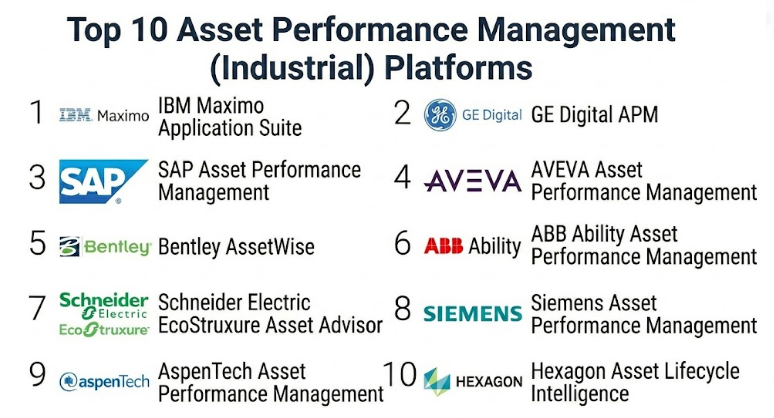
Top 10 Asset Performance Management Industrial Platforms
#1 — IBM Maximo Application Suite
Short description :
IBM Maximo Application Suite is a leading enterprise asset management and asset performance platform used by large industrial organizations to manage asset lifecycle, maintenance, inspections, reliability, and asset health. It supports APM workflows by combining asset data, work management, condition monitoring, analytics, and AI-assisted insights. The platform is suitable for utilities, transportation, energy, manufacturing, infrastructure, facilities, and other asset-heavy industries. Maximo is especially useful when organizations want asset performance insights connected directly with maintenance execution. It is best for enterprises with complex assets, formal maintenance processes, and long-term reliability programs.
Key Features
- Enterprise asset management and asset lifecycle support
- Asset health monitoring
- Predictive maintenance capabilities
- Work order and maintenance execution workflows
- Inspection and mobile maintenance support
- AI-assisted asset insights
- Integration with enterprise and industrial systems
Pros
- Strong fit for large asset-heavy organizations
- Connects APM insights with maintenance execution
- Mature enterprise ecosystem and partner network
Cons
- May be complex for smaller teams
- Implementation can require strong planning and expert support
- Total cost may be high for simple maintenance needs
Platforms / Deployment
Web / Mobile / Enterprise environment.
Cloud / Hybrid / Self-hosted: Varies / N/A.
Security & Compliance
Enterprise security controls may be available depending on deployment.
SSO/SAML, MFA, encryption, audit logs, RBAC: Not publicly stated in detail here.
SOC 2, ISO 27001, GDPR, HIPAA: Not publicly stated in this context.
Integrations & Ecosystem
IBM Maximo fits into complex enterprise environments where asset performance, maintenance, operations, procurement, finance, and reliability data need to work together.
- ERP and procurement systems
- IoT and sensor platforms
- SCADA and historian systems
- CMMS and EAM workflows
- BI and analytics tools
- Mobile maintenance workflows
Support & Community
Support is enterprise-focused, with documentation, training, implementation partners, customer support, and professional services. Community strength is strong among enterprise asset management and reliability professionals.
#2 — GE Digital APM
Short description :
GE Digital APM is an industrial Asset Performance Management platform designed to help organizations improve equipment reliability, reduce operational risk, and optimize asset performance. It supports asset health monitoring, predictive maintenance, risk analysis, reliability strategy, failure mode analysis, and performance dashboards. The platform is useful for power generation, oil and gas, manufacturing, utilities, aviation, and process industries. GE Digital APM is especially relevant where asset failure can create high production, financial, environmental, or safety impact. It is a strong choice for organizations that need reliability engineering and risk-based asset strategy together.
Key Features
- Asset performance management
- Equipment health monitoring
- Predictive maintenance analytics
- Reliability strategy management
- Risk-based maintenance workflows
- Failure mode and root cause analysis support
- Enterprise dashboards and reporting
Pros
- Strong fit for critical industrial assets
- Useful for reliability-centered maintenance programs
- Good for risk-based asset strategy and performance improvement
Cons
- May require reliability engineering maturity
- Implementation can be complex for large organizations
- Pricing and deployment details vary by customer scope
Platforms / Deployment
Web / Enterprise environment.
Cloud / Hybrid / Self-hosted: Varies / N/A.
Security & Compliance
Enterprise security controls may be available depending on deployment.
SSO/SAML, MFA, encryption, audit logs, RBAC: Not publicly stated in detail here.
SOC 2, ISO 27001, GDPR, HIPAA: Not publicly stated in this context.
Integrations & Ecosystem
GE Digital APM fits into industrial environments where asset data, reliability models, maintenance systems, and operational systems must work together.
- EAM and CMMS systems
- SCADA and historian data
- Sensor and IoT systems
- Reliability engineering workflows
- Risk and inspection systems
- Enterprise reporting tools
Support & Community
Support is vendor-led and enterprise-focused. Documentation, implementation services, training, and customer success support may vary by deployment, industry, and contract scope.
#3 — SAP Asset Performance Management
Short description :
SAP Asset Performance Management helps organizations improve asset reliability, performance, and maintenance strategy within the broader SAP ecosystem. It supports asset strategy management, equipment performance visibility, maintenance planning, risk assessment, and reliability workflows. The platform is suitable for companies already using SAP for ERP, maintenance, procurement, finance, and enterprise operations. It is especially useful when asset performance decisions need to connect with business processes, maintenance execution, and enterprise data. SAP Asset Performance Management is a strong option for organizations that want APM aligned closely with SAP-based asset and business operations.
Key Features
- Asset strategy management
- Asset performance monitoring
- Risk and criticality assessment
- Maintenance strategy optimization
- Integration with SAP enterprise systems
- Asset data collaboration
- Reporting and performance visibility
Pros
- Strong fit for SAP-centered enterprises
- Connects asset performance with business operations
- Useful for standardizing asset strategy across teams
Cons
- Best value comes in SAP ecosystem environments
- May require configuration and process alignment
- Smaller teams may find it too enterprise-focused
Platforms / Deployment
Web / Enterprise environment.
Cloud / Hybrid: Varies / N/A.
Security & Compliance
Enterprise security controls may be available depending on SAP environment and deployment.
SSO/SAML, MFA, encryption, audit logs, RBAC: Not publicly stated in detail here.
SOC 2, ISO 27001, GDPR, HIPAA: Not publicly stated in this context.
Integrations & Ecosystem
SAP Asset Performance Management fits naturally into organizations using SAP systems for enterprise asset management, procurement, finance, planning, and maintenance operations.
- SAP ERP and maintenance systems
- Procurement and finance workflows
- Asset master data
- Work management processes
- Enterprise analytics
- Business process integration
Support & Community
Support is enterprise-led through SAP documentation, implementation partners, training resources, and customer support programs. Community strength is strong in SAP enterprise environments.
#4 — AVEVA Asset Performance Management
Short description :
AVEVA Asset Performance Management helps industrial organizations monitor asset health, improve reliability, manage risk, and optimize maintenance decisions. It is especially useful in process industries, energy, utilities, chemicals, mining, and manufacturing environments. The platform can connect operational data, condition monitoring, maintenance history, and asset strategy workflows. AVEVA’s strength is often its alignment with industrial operations, historians, control systems, and plant data environments. It is a strong choice for companies that want asset performance insights connected with operational intelligence.
Key Features
- Asset health monitoring
- Predictive and condition-based maintenance support
- Reliability and risk management workflows
- Operational data integration
- Maintenance strategy optimization
- Industrial analytics and dashboards
- Plant and process asset visibility
Pros
- Strong industrial operations ecosystem
- Good fit for process-heavy industries
- Useful for connecting plant data with asset performance decisions
Cons
- Implementation may require integration with existing plant systems
- Best value depends on data quality and operational maturity
- Smaller teams may need focused deployment scope
Platforms / Deployment
Web / Enterprise industrial environment.
Cloud / Hybrid / On-premise: Varies / N/A.
Security & Compliance
Enterprise security controls may be available depending on deployment.
SSO/SAML, MFA, encryption, audit logs, RBAC: Not publicly stated in detail here.
SOC 2, ISO 27001, GDPR, HIPAA: Not publicly stated in this context.
Integrations & Ecosystem
AVEVA APM fits well in industrial environments where operational data, historian data, asset data, and maintenance workflows need to work together.
- Historian and operations data
- SCADA and control systems
- EAM and CMMS platforms
- Industrial analytics tools
- Plant information systems
- Reliability workflows
Support & Community
Support is vendor-led and enterprise-focused, with documentation, training, technical services, and partner ecosystem support. Community strength is strong in industrial operations and process industries.
#5 — Bentley AssetWise
Short description :
Bentley AssetWise is an asset lifecycle information and performance platform focused on infrastructure, transportation, utilities, plants, and large engineered assets. It helps organizations manage asset information, reliability, inspections, risk, and lifecycle decision-making. The platform is useful for asset-intensive organizations that need strong asset information management along with performance and maintenance insights. Bentley AssetWise is especially relevant for infrastructure owners, rail operators, road networks, utilities, and industrial asset operators. It is a strong choice when asset performance must connect with engineering data, lifecycle records, and infrastructure operations.
Key Features
- Asset lifecycle information management
- Asset performance and reliability support
- Inspection and condition management
- Risk-based asset decision support
- Infrastructure asset visibility
- Engineering information connection
- Maintenance and lifecycle planning support
Pros
- Strong fit for infrastructure and engineered assets
- Useful for lifecycle asset information management
- Good for asset owners managing large physical networks
Cons
- May be less suited for simple machine maintenance programs
- Best value comes when engineering and asset data are mature
- Implementation may require data governance planning
Platforms / Deployment
Web / Enterprise environment.
Cloud / Hybrid / On-premise: Varies / N/A.
Security & Compliance
Enterprise controls may be available depending on deployment.
SSO/SAML, MFA, encryption, audit logs, RBAC: Not publicly stated in detail here.
SOC 2, ISO 27001, GDPR, HIPAA: Not publicly stated in this context.
Integrations & Ecosystem
Bentley AssetWise fits into asset-owner environments where engineering data, asset records, inspection data, and maintenance decisions must connect.
- Engineering information systems
- Inspection and condition records
- Infrastructure asset databases
- Maintenance and reliability workflows
- Asset lifecycle planning
- Enterprise reporting systems
Support & Community
Support is enterprise-focused with documentation, professional services, training, and partner support. Community strength is strongest in infrastructure, engineering, and asset lifecycle management sectors.
#6 — ABB Ability Asset Performance Management
Short description :
ABB Ability Asset Performance Management helps industrial organizations monitor equipment condition, analyze asset health, and improve reliability across critical industrial systems. It is useful for mining, utilities, process industries, marine, energy, and manufacturing environments. The platform can connect equipment data, automation systems, operational signals, and maintenance workflows. ABB Ability is especially valuable where ABB drives, motors, automation systems, control systems, or electrical assets are already in use. It is a strong choice for industrial teams that want APM connected closely with automation and operational technology.
Key Features
- Asset health monitoring
- Predictive maintenance insights
- Equipment condition monitoring
- Reliability and performance analytics
- Industrial automation integration
- Maintenance prioritization
- Operational dashboards
Pros
- Strong fit for ABB-centered industrial environments
- Useful for automation-connected asset performance
- Good for heavy industry and process operations
Cons
- Best value may come in ABB ecosystem environments
- Implementation may need OT and maintenance collaboration
- Scope may vary by industry and asset class
Platforms / Deployment
Web / Enterprise industrial environment.
Cloud / Hybrid / On-premise: Varies / N/A.
Security & Compliance
Enterprise security controls may be available depending on deployment.
SSO/SAML, MFA, encryption, audit logs, RBAC: Not publicly stated in detail here.
SOC 2, ISO 27001, GDPR, HIPAA: Not publicly stated in this context.
Integrations & Ecosystem
ABB Ability fits into industrial environments with automation systems, equipment data, and reliability workflows.
- ABB automation and equipment systems
- Industrial IoT data sources
- CMMS and EAM systems
- Operational dashboards
- Asset performance workflows
- Condition monitoring data
Support & Community
Support is vendor-led and enterprise-focused. Documentation, technical services, and implementation assistance may vary by industry, region, and asset type.
#7 — Schneider Electric EcoStruxure Asset Advisor
Short description :
Schneider Electric EcoStruxure Asset Advisor is an asset monitoring and advisory platform focused on improving reliability and performance of electrical, energy, and infrastructure assets. It helps organizations monitor asset health, receive alerts, identify risk, and use expert support to reduce downtime. The platform is especially useful for facilities, data centers, industrial plants, utilities, and energy-intensive environments. It is a strong fit for organizations using Schneider Electric electrical distribution and energy management systems. EcoStruxure Asset Advisor is best suited for teams that want asset performance visibility around power infrastructure and critical electrical systems.
Key Features
- Asset condition monitoring
- Predictive maintenance alerts
- Electrical asset performance visibility
- Remote monitoring and advisory support
- Energy and infrastructure asset insights
- Risk reduction workflows
- Expert service support
Pros
- Strong fit for electrical and energy assets
- Useful for facilities, infrastructure, and critical power systems
- Works well in Schneider Electric environments
Cons
- Best fit may be Schneider-centered assets
- May not cover every mechanical asset class equally
- Scope depends on equipment and service configuration
Platforms / Deployment
Web / Mobile / Enterprise environment: Varies / N/A.
Cloud / Hybrid: Varies / N/A.
Security & Compliance
SSO/SAML, MFA, encryption, audit logs, RBAC: Not publicly stated in detail here.
SOC 2, ISO 27001, GDPR, HIPAA: Not publicly stated in this context.
Integrations & Ecosystem
EcoStruxure Asset Advisor fits into connected electrical infrastructure, facility operations, and energy management environments.
- Schneider Electric equipment and systems
- Energy management platforms
- Facility monitoring systems
- Maintenance workflows
- Remote advisory services
- Asset health dashboards
Support & Community
Support is vendor-led with documentation, service teams, remote monitoring support, and expert advisory services. Support scope may depend on region, contract, and connected asset type.
#8 — Siemens Asset Performance Management
Short description :
Siemens Asset Performance Management supports industrial organizations in improving asset reliability, maintenance efficiency, and operational performance. It can be relevant for manufacturers and industrial companies that use Siemens automation, production, digital industry, and industrial IoT technologies. The platform helps connect asset data, operational context, predictive insights, and maintenance workflows. Siemens APM is especially useful when asset performance needs to align with manufacturing operations, digital factory initiatives, and industrial data platforms. It is a strong choice for organizations that want APM connected with Siemens industrial ecosystem capabilities.
Key Features
- Asset performance monitoring
- Predictive maintenance support
- Machine and equipment health visibility
- Industrial IoT and automation alignment
- Maintenance prioritization workflows
- Operational dashboards
- Manufacturing performance context
Pros
- Strong fit for Siemens-centered industrial environments
- Useful for manufacturers and digital factory programs
- Connects machine data with asset performance decisions
Cons
- Best value may depend on Siemens ecosystem alignment
- Integration scope varies by factory environment
- Implementation may require OT, IT, and maintenance coordination
Platforms / Deployment
Web / Enterprise industrial environment.
Cloud / Hybrid / Edge: Varies / N/A.
Security & Compliance
SSO/SAML, MFA, encryption, audit logs, RBAC: Not publicly stated in detail here.
SOC 2, ISO 27001, GDPR, HIPAA: Not publicly stated in this context.
Integrations & Ecosystem
Siemens APM can fit into industrial environments where automation systems, industrial IoT, maintenance systems, and production data must work together.
- Siemens automation systems
- Industrial IoT platforms
- Manufacturing systems
- CMMS and EAM workflows
- Sensor and machine data
- Analytics dashboards
Support & Community
Support is vendor-led and enterprise-focused, with documentation, implementation assistance, technical services, and partner ecosystem support. Community strength is connected to Siemens industrial users.
#9 — AspenTech Asset Performance Management
Short description :
AspenTech Asset Performance Management is designed for process industries and asset-intensive operations that need reliability, performance optimization, and operational risk reduction. It is useful for chemicals, energy, oil and gas, refining, utilities, and manufacturing environments. The platform helps teams use industrial data, analytics, and asset models to improve reliability and reduce unplanned downtime. AspenTech is especially relevant where asset performance must connect with process optimization, production reliability, and operational decision-making. It is a strong choice for process-heavy companies looking to connect reliability with operational excellence.
Key Features
- Asset performance analytics
- Predictive maintenance support
- Process industry reliability workflows
- Equipment health monitoring
- Operational risk visibility
- Industrial data and analytics support
- Performance optimization insights
Pros
- Strong fit for process industries
- Useful where reliability and production performance are closely connected
- Good for industrial analytics-driven asset programs
Cons
- May be complex for simple asset maintenance needs
- Best value depends on quality of process and asset data
- Implementation may require domain and data expertise
Platforms / Deployment
Web / Enterprise industrial environment.
Cloud / Hybrid / On-premise: Varies / N/A.
Security & Compliance
Enterprise security controls may be available depending on deployment.
SSO/SAML, MFA, encryption, audit logs, RBAC: Not publicly stated in detail here.
SOC 2, ISO 27001, GDPR, HIPAA: Not publicly stated in this context.
Integrations & Ecosystem
AspenTech APM fits into process industry environments where production data, process models, asset reliability, and operational analytics are connected.
- Process data historians
- Industrial analytics tools
- Maintenance systems
- Production and operations data
- Reliability engineering workflows
- Asset models and performance analytics
Support & Community
Support is enterprise-focused, with documentation, training, professional services, and customer support. Community strength is strongest in process industries and industrial analytics environments.
#10 — Hexagon Asset Lifecycle Intelligence
Short description :
Hexagon Asset Lifecycle Intelligence supports industrial organizations with asset information management, engineering data, operations, maintenance, and lifecycle intelligence. It is useful for asset-heavy industries such as energy, chemicals, mining, manufacturing, infrastructure, and process plants. The platform helps organizations manage complex engineering and asset data so teams can make better lifecycle and performance decisions. While broader than only APM, it is relevant where asset performance depends on accurate asset information, inspection records, maintenance context, and engineering documentation. Hexagon is a strong fit for organizations that need asset intelligence across the full industrial lifecycle.
Key Features
- Asset lifecycle information management
- Engineering data management
- Operations and maintenance support
- Asset information governance
- Inspection and lifecycle workflows
- Industrial plant data visibility
- Performance and decision support
Pros
- Strong fit for complex industrial asset environments
- Useful for connecting engineering and operations data
- Supports asset lifecycle intelligence
Cons
- Broader than dedicated predictive maintenance platforms
- May require strong data governance and implementation planning
- Best value comes in complex asset lifecycle environments
Platforms / Deployment
Web / Enterprise industrial environment.
Cloud / Hybrid / On-premise: Varies / N/A.
Security & Compliance
Enterprise controls may be available depending on deployment.
SSO/SAML, MFA, encryption, audit logs, RBAC: Not publicly stated in detail here.
SOC 2, ISO 27001, GDPR, HIPAA: Not publicly stated in this context.
Integrations & Ecosystem
Hexagon fits into industrial environments where engineering, operations, maintenance, inspection, and asset lifecycle data must be connected.
- Engineering data systems
- Plant information systems
- Maintenance and inspection workflows
- Asset lifecycle records
- Operations data
- Enterprise reporting and analytics
Support & Community
Support is enterprise-led through documentation, implementation services, technical support, training, and partner ecosystem resources. Community strength is strongest among engineering, plant, and lifecycle asset teams.
Comparison Table
| Tool Name | Best For | Platform(s) Supported | Deployment | Standout Feature | Public Rating |
|---|---|---|---|---|---|
| IBM Maximo Application Suite | Enterprise asset lifecycle and maintenance execution | Web / Mobile / Enterprise | Cloud / Hybrid / Self-hosted: Varies | Full asset lifecycle and work management depth | N/A |
| GE Digital APM | Critical industrial reliability and risk management | Web / Enterprise | Cloud / Hybrid / Self-hosted: Varies | Reliability strategy and risk-based asset performance | N/A |
| SAP Asset Performance Management | SAP-centered industrial asset programs | Web / Enterprise | Cloud / Hybrid: Varies | Asset performance connected with SAP business operations | N/A |
| AVEVA Asset Performance Management | Process industries and plant operations | Web / Enterprise | Cloud / Hybrid / On-premise: Varies | Operational data-driven asset performance | N/A |
| Bentley AssetWise | Infrastructure and engineered asset owners | Web / Enterprise | Cloud / Hybrid / On-premise: Varies | Asset lifecycle information and infrastructure performance | N/A |
| ABB Ability Asset Performance Management | ABB-connected industrial operations | Web / Enterprise | Cloud / Hybrid / On-premise: Varies | Automation-connected asset health monitoring | N/A |
| Schneider Electric EcoStruxure Asset Advisor | Electrical and energy asset monitoring | Web / Mobile / Enterprise: Varies | Cloud / Hybrid: Varies | Remote advisory for critical electrical assets | N/A |
| Siemens Asset Performance Management | Siemens-centered industrial manufacturing environments | Web / Enterprise | Cloud / Hybrid / Edge: Varies | Industrial IoT and automation-aligned APM | N/A |
| AspenTech Asset Performance Management | Process industry reliability and optimization | Web / Enterprise | Cloud / Hybrid / On-premise: Varies | Process analytics-driven reliability insights | N/A |
| Hexagon Asset Lifecycle Intelligence | Industrial asset lifecycle and engineering data | Web / Enterprise | Cloud / Hybrid / On-premise: Varies | Engineering-to-operations asset intelligence | N/A |
Evaluation & Asset Performance Management Industrial Platforms
The scoring below is comparative and based on practical industrial APM requirements. It considers core features, ease of use, integrations, security signals, performance, support, and price/value. Scores should not be treated as final purchasing advice because the best fit depends on asset type, industry, data maturity, current systems, and reliability goals.
| Tool Name | Core (25%) | Ease (15%) | Integrations (15%) | Security (10%) | Performance (10%) | Support (10%) | Value (15%) | Weighted Total (0–10) |
|---|---|---|---|---|---|---|---|---|
| IBM Maximo Application Suite | 9 | 7 | 9 | 8 | 9 | 9 | 7 | 8.30 |
| GE Digital APM | 9 | 7 | 8 | 8 | 9 | 8 | 7 | 8.10 |
| SAP Asset Performance Management | 8 | 7 | 9 | 8 | 8 | 8 | 7 | 7.90 |
| AVEVA Asset Performance Management | 8 | 7 | 9 | 8 | 8 | 8 | 7 | 7.90 |
| Bentley AssetWise | 8 | 7 | 8 | 8 | 8 | 8 | 7 | 7.75 |
| ABB Ability Asset Performance Management | 8 | 7 | 8 | 7 | 8 | 8 | 7 | 7.55 |
| Schneider Electric EcoStruxure Asset Advisor | 8 | 8 | 8 | 7 | 8 | 8 | 8 | 7.85 |
| Siemens Asset Performance Management | 8 | 8 | 8 | 7 | 8 | 8 | 8 | 7.85 |
| AspenTech Asset Performance Management | 8 | 7 | 8 | 7 | 8 | 8 | 7 | 7.55 |
| Hexagon Asset Lifecycle Intelligence | 8 | 7 | 8 | 8 | 8 | 8 | 7 | 7.75 |
A higher score usually means stronger overall fit across broad industrial APM needs. However, the best platform depends on your business environment. IBM Maximo may be stronger when asset performance must connect with work execution. GE Digital APM may be stronger for reliability and risk strategy. SAP may be better for SAP-centered enterprises. AVEVA and AspenTech may suit process industries, while Bentley and Hexagon may fit infrastructure and engineering-heavy asset environments.
Which Asset Performance Management Industrial Platform Should You Choose?
Solo / Freelancer
Solo consultants, reliability advisors, and independent asset management experts usually do not need a full enterprise APM platform for personal use. They may need tools for asset assessment, maintenance strategy planning, reliability studies, and client advisory work.
Good approach:
- Use structured asset criticality templates
- Build failure mode and maintenance strategy frameworks
- Recommend enterprise APM only when client complexity justifies it
- Use data analysis tools for small asset studies
- Focus on asset risk, downtime cost, and maintenance maturity
For client projects, the right APM platform should be selected based on existing systems, asset types, and business goals.
SMB
Small and mid-sized industrial companies often need better maintenance discipline before full APM maturity. If work orders, asset lists, spare parts, and maintenance history are not organized, a full APM platform may be too early.
Good options:
- Siemens Asset Performance Management for industrial machine monitoring
- Schneider Electric EcoStruxure Asset Advisor for electrical assets
- ABB Ability Asset Performance Management for ABB-heavy environments
- SAP Asset Performance Management if already using SAP systems
- A CMMS-first approach if maintenance execution is still weak
SMBs should begin with critical assets and high-downtime equipment instead of trying to monitor everything at once.
Mid-Market
Mid-market industrial companies usually need stronger reliability programs, better asset health visibility, and integration between maintenance systems and operational data. They may operate multiple production lines, plants, or facilities.
Good options:
- GE Digital APM for reliability and risk-based maintenance
- AVEVA Asset Performance Management for plant operations and process industries
- Siemens Asset Performance Management for manufacturing and industrial IoT use cases
- Schneider Electric EcoStruxure Asset Advisor for energy and electrical systems
- SAP Asset Performance Management if SAP is already central to operations
Mid-market buyers should evaluate data availability, integration effort, and internal reliability engineering capacity before selecting a platform.
Enterprise
Large enterprises need scalable, secure, and integrated APM platforms that support many sites, users, asset types, and operational requirements. They also need governance, standardized reliability processes, executive reporting, and enterprise integrations.
Good options:
- IBM Maximo Application Suite for enterprise asset lifecycle and maintenance execution
- GE Digital APM for critical asset reliability and risk management
- SAP Asset Performance Management for SAP-led enterprise environments
- AVEVA Asset Performance Management for process-heavy industries
- Bentley AssetWise for infrastructure and engineered assets
- Hexagon Asset Lifecycle Intelligence for engineering-to-operations asset intelligence
- AspenTech Asset Performance Management for process optimization and reliability
Enterprise buyers should involve maintenance, reliability, operations, IT, OT security, procurement, finance, and business leadership before final selection.
Budget vs Premium
Budget-focused teams should first understand whether they need APM, EAM, CMMS, IoT monitoring, or condition monitoring. Buying a premium APM platform too early may create complexity without clear return.
Budget-friendly path:
- Start with asset criticality ranking
- Improve work order discipline
- Add condition monitoring for critical assets
- Use focused dashboards
- Expand only after proving value
Premium APM platforms make sense when the organization needs:
- Multi-site asset performance visibility
- Advanced predictive maintenance
- Risk-based inspection
- Reliability strategy management
- Integration with EAM, ERP, SCADA, and historians
- Executive-level asset performance reporting
- Strong governance and access control
- Long-term asset lifecycle optimization
The right budget depends on downtime cost, asset risk, safety impact, and business value.
Feature Depth vs Ease of Use
Feature depth is important, but daily usability matters just as much. A powerful APM platform will fail if reliability and maintenance teams do not trust it or use it.
Choose feature depth when:
- Assets are complex and critical
- Downtime cost is high
- Safety or environmental risk is serious
- Multiple sites need standard processes
- Data integration is available
- Reliability engineering maturity is strong
- Executive reporting is required
Choose ease of use when:
- Teams are new to digital maintenance
- Asset data is not clean
- Maintenance discipline is still developing
- The first goal is simple asset health visibility
- Users need fast adoption
- Internal IT and reliability resources are limited
The best platform should help teams make better asset decisions, not only create dashboards.
Integrations & Scalability
APM platforms depend heavily on integration because asset performance data comes from many systems. A platform that cannot connect to operational and maintenance data may deliver limited value.
Important integration areas include:
- EAM systems
- CMMS platforms
- ERP systems
- SCADA systems
- MES platforms
- Process historians
- Industrial IoT platforms
- PLC and sensor data
- Vibration monitoring tools
- Inspection systems
- GIS systems for infrastructure
- Spare parts and inventory systems
- BI and reporting platforms
Scalability matters when the organization manages thousands of assets, many locations, different asset classes, and multiple reliability programs.
Security & Compliance Needs
Industrial APM platforms may connect with operational technology, plant networks, asset data, maintenance records, and business systems. Security must be reviewed early.
Buyers should ask vendors about:
- Role-based access control
- SSO and MFA
- Encryption
- Audit logs
- Data retention
- Secure remote access
- Backup and disaster recovery
- Network segmentation support
- User activity tracking
- Secure integration with OT systems
- Vendor security documentation
- Support for internal IT and OT security reviews
Never assume a platform has a certification or compliance feature unless the vendor clearly confirms it.
Frequently Asked Questions
1. What is an Asset Performance Management Industrial Platform?
An Asset Performance Management Industrial Platform helps companies monitor asset health, improve reliability, reduce downtime, manage risk, and optimize maintenance decisions. It connects asset data, operational data, and maintenance workflows to improve asset performance.
2. How is APM different from EAM?
EAM focuses on managing the asset lifecycle, work orders, spare parts, maintenance schedules, and asset records. APM focuses more on asset health, reliability, risk, predictive insights, and performance optimization. Many companies use both together.
3. How is APM different from CMMS?
A CMMS mainly manages maintenance work orders, preventive maintenance, asset lists, and maintenance records. APM provides deeper performance analytics, asset health monitoring, reliability strategy, and predictive maintenance insights.
4. Who uses Industrial APM platforms?
Reliability engineers, maintenance managers, asset managers, plant managers, operations leaders, inspection teams, energy teams, utilities, manufacturers, oil and gas companies, mining firms, transportation operators, and infrastructure owners use APM platforms.
5. What data is needed for APM?
Useful data includes asset master data, maintenance history, work orders, sensor readings, vibration data, temperature, pressure, current, alarms, inspections, failure records, process historian data, production data, and operating conditions.
6. Can APM reduce downtime?
Yes, APM can reduce downtime by identifying asset risks earlier, improving maintenance planning, prioritizing critical work, and helping teams act before failures become major production problems.
7. Is predictive maintenance part of APM?
Yes, predictive maintenance is often a key part of APM. However, APM is broader because it can also include asset strategy, reliability analysis, risk management, inspections, lifecycle planning, and performance optimization.
8. What is asset health monitoring?
Asset health monitoring means tracking the condition and performance of equipment using data such as temperature, vibration, pressure, alarms, inspections, and maintenance history. It helps teams understand whether an asset is healthy, degraded, or at risk.
9. What is risk-based maintenance?
Risk-based maintenance prioritizes maintenance based on the likelihood and impact of failure. It helps teams focus on assets that carry the highest safety, production, financial, or environmental risk.
10. What is the biggest mistake when adopting APM?
The biggest mistake is buying software before cleaning asset data and defining clear reliability goals. APM works best when asset hierarchy, criticality, failure history, and maintenance processes are reasonably structured.
Conclusion
Asset Performance Management Industrial Platforms help organizations improve reliability, reduce downtime, manage risk, and make better decisions across critical assets. These platforms are especially valuable in asset-heavy industries where equipment failure can affect production, safety, cost, compliance, and customer service. However, the best APM platform depends on the organization’s asset types, industry, maintenance maturity, existing systems, data quality, budget, and long-term reliability goals. IBM Maximo is strong for enterprise asset lifecycle and maintenance execution, GE Digital APM is strong for reliability and risk strategy, SAP fits SAP-centered enterprises, AVEVA and AspenTech are valuable for process industries, and Bentley or Hexagon can be strong for infrastructure and engineering-heavy asset environments.
