Introduction
Supply Chain Management, also called SCM, Suites are software platforms that help businesses plan, manage, track, and optimize the movement of goods, materials, orders, suppliers, inventory, warehouses, transportation, demand, and production. In simple words, SCM suites help companies make sure the right products are available at the right place, at the right time, at the right cost.
Modern supply chains are complex. Businesses deal with changing customer demand, supplier delays, transport disruptions, inventory shortages, high logistics costs, global sourcing, warehouse pressure, compliance needs, and customer delivery expectations. A good SCM suite gives teams better visibility, planning control, automation, and decision support across the supply chain.
These tools are used for demand planning, supply planning, inventory optimization, supplier collaboration, procurement coordination, warehouse management, transportation management, order fulfillment, production planning, logistics visibility, and supply chain analytics.
Buyers should evaluate:
- Demand planning and forecasting strength
- Inventory optimization capability
- Supply planning and production planning
- Warehouse and transportation management
- Supplier collaboration features
- Order fulfillment visibility
- AI and scenario planning support
- Integration with ERP, CRM, WMS, TMS, MES, and finance systems
- Real-time dashboards and analytics
- Scalability for multi-location operations
- Security, access control, and audit logs
- Implementation effort and vendor support
Best for: Manufacturers, retailers, distributors, logistics companies, wholesalers, eCommerce businesses, consumer goods companies, automotive firms, pharma companies, food and beverage companies, industrial suppliers, and enterprises with complex supply chain operations.
Not ideal for: Very small businesses with simple ordering, limited suppliers, low inventory complexity, and basic delivery needs. In those cases, a simple inventory system, accounting software, spreadsheet, or lightweight order management tool may be enough.
Key Supply Chain Management SCM Suite Trends
- AI-powered planning is becoming a major requirement. Supply chain teams want better demand forecasting, supply risk alerts, inventory recommendations, and automated scenario planning.
- Real-time visibility is now expected. Companies need to know where inventory, shipments, orders, and supplier commitments stand at any given moment.
- Scenario planning is growing quickly. Businesses want to compare what happens if demand rises, a supplier fails, transport costs increase, or a warehouse capacity issue appears.
- Integrated planning is replacing disconnected spreadsheets. Teams want demand, supply, inventory, finance, procurement, and operations to work from the same planning view.
- Supplier risk management is becoming more important. Delays, shortages, compliance risks, and geopolitical issues have made supplier visibility a key requirement.
- Warehouse and transportation optimization are closely connected. Companies want better coordination between inventory availability, picking, packing, shipping, carrier selection, and delivery promise.
- Cloud SCM suites are widely preferred. Cloud platforms make it easier to support global users, frequent updates, analytics, and multi-site operations.
- Sustainability is becoming part of supply chain planning. Companies are reviewing carbon impact, supplier practices, transportation efficiency, waste reduction, and responsible sourcing.
- Composable supply chain technology is gaining attention. Some businesses want flexible modules instead of one large system that is difficult to change.
- Data quality is still a major challenge. Even the best SCM suite struggles if product master data, supplier data, lead times, inventory records, and demand history are inaccurate.
How We Selected These Tools
The tools below were selected using practical supply chain management and enterprise software evaluation criteria.
- Recognition in supply chain planning, execution, logistics, inventory, procurement, or enterprise operations
- Breadth of SCM capabilities across planning, visibility, fulfillment, warehouse, transportation, and analytics
- Fit for manufacturers, retailers, distributors, logistics providers, and global enterprises
- Ability to support complex demand, supply, and inventory decisions
- Integration potential with ERP, WMS, TMS, MES, CRM, procurement, and finance systems
- Scalability across multiple regions, warehouses, suppliers, channels, and business units
- AI, automation, analytics, and scenario planning capabilities
- Usability for planners, operations teams, supply chain leaders, and executives
- Security, governance, auditability, and enterprise readiness
- Vendor ecosystem, implementation support, documentation, and long-term product maturity
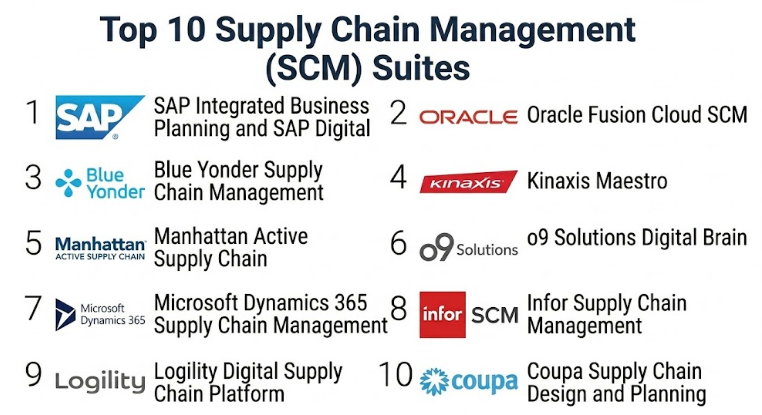
Top 10 Supply Chain Management SCM Suites
#1 — SAP Integrated Business Planning and SAP Digital Supply Chain
Short description :
SAP Integrated Business Planning and SAP Digital Supply Chain tools help organizations manage supply chain planning, demand forecasting, inventory optimization, response planning, logistics, manufacturing coordination, and business alignment. They are especially useful for companies already using SAP ERP or SAP S/4HANA. The platform helps connect supply chain decisions with finance, procurement, production, sales, and enterprise operations. It is suitable for large manufacturers, retailers, consumer goods firms, pharma companies, automotive organizations, and global enterprises. SAP is a strong choice when supply chain planning must connect closely with enterprise business processes.
Key Features
- Demand planning and forecasting
- Supply planning and response management
- Inventory optimization
- Sales and operations planning support
- Scenario planning and what-if analysis
- Integration with SAP ERP and enterprise systems
- Supply chain analytics and dashboards
Pros
- Strong fit for SAP-centered enterprises
- Good for integrated business planning
- Scalable for global supply chain operations
Cons
- Implementation can be complex
- Best value comes when SAP data and processes are mature
- Smaller businesses may find it too enterprise-heavy
Platforms / Deployment
Web / Enterprise environment.
Cloud / Hybrid: Varies / N/A.
Security & Compliance
Enterprise security controls may be available depending on SAP environment and deployment.
SSO/SAML, MFA, encryption, audit logs, RBAC: Not publicly stated in detail here.
SOC 2, ISO 27001, GDPR, HIPAA: Not publicly stated in this context.
Integrations & Ecosystem
SAP SCM capabilities fit naturally into organizations already using SAP systems for ERP, procurement, finance, manufacturing, warehouse operations, and business planning.
- SAP ERP and S/4HANA integration
- Procurement and supplier workflows
- Finance and planning systems
- Manufacturing and logistics data
- Analytics and reporting tools
- Third-party system integration options
Support & Community
SAP has a large enterprise support ecosystem, implementation partner network, documentation, training resources, and customer community. Support experience may vary by contract, region, and implementation partner.
#2 — Oracle Fusion Cloud SCM
Short description :
Oracle Fusion Cloud SCM is a cloud-based supply chain management suite that supports planning, procurement, inventory, manufacturing, maintenance, order management, logistics, and product lifecycle workflows. It is useful for companies that want one connected cloud platform for supply chain and enterprise operations. Oracle SCM is suitable for manufacturers, distributors, retailers, healthcare organizations, industrial companies, and global enterprises. The suite helps teams improve planning, fulfillment, supply visibility, and operational control. It is a strong choice for organizations looking for a broad cloud-native SCM platform.
Key Features
- Supply chain planning
- Inventory and order management
- Procurement and supplier collaboration
- Manufacturing and maintenance support
- Logistics and fulfillment workflows
- Product lifecycle management alignment
- Analytics and AI-assisted insights
Pros
- Broad cloud SCM suite
- Strong fit for enterprise operations
- Useful when supply chain and finance need close alignment
Cons
- Implementation scope can be large
- Requires strong process design and data readiness
- May be more than smaller teams need
Platforms / Deployment
Web / Mobile / Enterprise environment.
Cloud deployment.
Security & Compliance
Enterprise security controls may be available depending on configuration.
SSO/SAML, MFA, encryption, audit logs, RBAC: Not publicly stated in detail here.
SOC 2, ISO 27001, GDPR, HIPAA: Not publicly stated in this context.
Integrations & Ecosystem
Oracle Fusion Cloud SCM fits into Oracle-centered enterprise environments and can also connect with external systems depending on implementation needs.
- Oracle ERP and finance systems
- Procurement and supplier systems
- Manufacturing and inventory systems
- Order management workflows
- Logistics and fulfillment platforms
- Analytics and reporting tools
Support & Community
Oracle provides enterprise documentation, support, training, implementation partners, and cloud support services. Support quality may vary by contract, product scope, and implementation partner.
#3 — Blue Yonder Supply Chain Management
Short description :
Blue Yonder Supply Chain Management is a supply chain planning and execution platform known for demand planning, inventory optimization, warehouse management, transportation management, fulfillment, and retail supply chain use cases. It is useful for retailers, manufacturers, distributors, logistics providers, and consumer goods companies that need advanced planning and execution capabilities. Blue Yonder helps teams improve demand accuracy, inventory placement, order fulfillment, and logistics efficiency. It is especially strong where planning and execution need to work together across complex networks. Blue Yonder is a good fit for organizations with high-volume, multi-channel, or global supply chains.
Key Features
- Demand and supply planning
- Inventory optimization
- Warehouse management
- Transportation management
- Fulfillment and allocation workflows
- AI and machine learning support
- Supply chain control tower capabilities
Pros
- Strong planning and execution coverage
- Good fit for retail, logistics, and distribution-heavy companies
- Useful for complex fulfillment networks
Cons
- Implementation can be detailed and resource-heavy
- May require strong internal supply chain maturity
- Pricing and package details vary widely
Platforms / Deployment
Web / Enterprise environment.
Cloud / Hybrid: Varies / N/A.
Security & Compliance
Enterprise access controls may be available depending on deployment.
SSO/SAML, MFA, encryption, audit logs, RBAC: Not publicly stated in detail here.
SOC 2, ISO 27001, GDPR, HIPAA: Not publicly stated in this context.
Integrations & Ecosystem
Blue Yonder fits into environments where planning, warehouse, transportation, fulfillment, and retail operations need close coordination.
- ERP and finance systems
- WMS and TMS workflows
- Retail and order management systems
- Supplier and logistics networks
- Analytics and control tower tools
- Data integration platforms
Support & Community
Support is enterprise-focused, with documentation, implementation partners, professional services, and customer support. Community strength is strong in supply chain, retail, logistics, and manufacturing sectors.
#4 — Kinaxis Maestro
Short description :
Kinaxis Maestro is a supply chain planning and orchestration platform focused on concurrent planning, scenario modeling, demand planning, supply planning, inventory planning, and response management. It helps supply chain teams understand the impact of changes quickly and make better decisions across demand, supply, inventory, capacity, and operations. The platform is suitable for manufacturers, life sciences companies, automotive firms, electronics companies, aerospace businesses, and complex global supply chains. Kinaxis is especially valuable when teams need fast scenario planning and cross-functional decision-making. It is a strong choice for organizations where supply chain speed and agility matter heavily.
Key Features
- Concurrent supply chain planning
- Demand, supply, and inventory planning
- Scenario planning and simulation
- Response management
- Capacity and constraint visibility
- Collaboration across planning teams
- Analytics and decision support
Pros
- Strong scenario planning capability
- Useful for complex and fast-changing supply chains
- Good fit for planning-heavy organizations
Cons
- Less focused on warehouse execution compared with some suites
- Requires quality planning data for best results
- Implementation may need planning process redesign
Platforms / Deployment
Web / Enterprise environment.
Cloud deployment is commonly expected.
Hybrid: Varies / N/A.
Security & Compliance
Enterprise controls may be available depending on deployment.
SSO/SAML, MFA, encryption, audit logs, RBAC: Not publicly stated in detail here.
SOC 2, ISO 27001, GDPR, HIPAA: Not publicly stated in this context.
Integrations & Ecosystem
Kinaxis fits into supply chain environments where planning data from ERP, demand systems, production systems, and supplier networks must be connected.
- ERP and planning systems
- Demand and sales data
- Manufacturing and capacity data
- Inventory and supplier data
- Analytics and reporting tools
- Scenario planning workflows
Support & Community
Support is vendor-led and enterprise-focused, with implementation assistance, documentation, training, and customer success support. Community strength is strongest among advanced supply chain planning teams.
#5 — Manhattan Active Supply Chain
Short description :
Manhattan Active Supply Chain is a cloud-native suite focused on warehouse management, transportation management, order fulfillment, inventory visibility, labor management, and supply chain execution. It is useful for retailers, distributors, wholesalers, logistics providers, and companies with high-volume fulfillment operations. The platform helps businesses manage warehouse operations, delivery workflows, carrier coordination, and customer order execution. Manhattan is especially strong where warehouse, transportation, and omnichannel fulfillment are major supply chain priorities. It is a strong choice for companies that need execution depth rather than only planning.
Key Features
- Warehouse management
- Transportation management
- Order fulfillment orchestration
- Labor management
- Inventory visibility
- Yard and logistics workflows
- Cloud-native supply chain execution
Pros
- Strong warehouse and fulfillment execution depth
- Good fit for retailers and distributors
- Useful for high-volume logistics operations
Cons
- Less focused on broad enterprise planning than some suites
- Implementation can be operationally intensive
- Best value comes in complex fulfillment environments
Platforms / Deployment
Web / Mobile / Enterprise environment.
Cloud deployment.
Security & Compliance
Enterprise security controls may be available depending on configuration.
SSO/SAML, MFA, encryption, audit logs, RBAC: Not publicly stated in detail here.
SOC 2, ISO 27001, GDPR, HIPAA: Not publicly stated in this context.
Integrations & Ecosystem
Manhattan Active Supply Chain fits into execution-heavy environments where warehouses, transportation, orders, and fulfillment systems must work together.
- ERP and order management systems
- Warehouse automation systems
- Carrier and logistics systems
- Labor and workforce systems
- Inventory and fulfillment workflows
- Reporting and operations dashboards
Support & Community
Support is enterprise-focused with implementation services, documentation, training, and customer support. Community strength is strong in retail, distribution, logistics, and warehouse operations.
#6 — o9 Solutions Digital Brain
Short description :
o9 Solutions Digital Brain is an AI-powered planning and decision-making platform used for supply chain planning, demand planning, integrated business planning, revenue planning, supplier collaboration, and scenario analysis. It helps companies connect data, planning models, business assumptions, and decision workflows in one digital planning environment. The platform is suitable for large manufacturers, retailers, consumer goods companies, industrial firms, and global enterprises. o9 is especially useful when organizations want to improve planning speed, forecast quality, and cross-functional alignment. It is a strong choice for companies seeking AI-driven integrated planning.
Key Features
- Demand and supply planning
- Integrated business planning
- Scenario modeling and simulation
- AI-assisted planning insights
- Supplier and commercial planning support
- Knowledge graph-style decision modeling
- Executive dashboards and analytics
Pros
- Strong integrated planning and analytics focus
- Useful for complex decision-making
- Good fit for planning transformation programs
Cons
- Requires strong data readiness
- Implementation may need process redesign
- Not mainly a warehouse execution platform
Platforms / Deployment
Web / Enterprise environment.
Cloud deployment is commonly expected.
Hybrid: Varies / N/A.
Security & Compliance
Enterprise controls may be available depending on deployment.
SSO/SAML, MFA, encryption, audit logs, RBAC: Not publicly stated in detail here.
SOC 2, ISO 27001, GDPR, HIPAA: Not publicly stated in this context.
Integrations & Ecosystem
o9 fits into planning environments where data from sales, finance, operations, procurement, suppliers, and production must be connected.
- ERP and finance systems
- Demand and sales data
- Supplier and procurement systems
- Manufacturing and inventory data
- Business planning workflows
- Analytics and data platforms
Support & Community
Support is vendor-led and enterprise-focused, with implementation assistance, training, documentation, and customer success support. Community strength is strongest among planning and transformation teams.
#7 — Microsoft Dynamics 365 Supply Chain Management
Short description :
Microsoft Dynamics 365 Supply Chain Management is a cloud-based business application that helps companies manage manufacturing, inventory, procurement, warehouse operations, asset management, and supply chain processes. It is useful for organizations that already use Microsoft business applications, Power Platform, Azure, or Dynamics ERP tools. The platform helps teams connect supply chain operations with finance, sales, production, and analytics. It is suitable for mid-market and enterprise companies that want a flexible SCM platform within the Microsoft ecosystem. Dynamics 365 SCM is a strong option for businesses seeking operational supply chain management with strong integration possibilities.
Key Features
- Inventory and warehouse management
- Procurement and sourcing workflows
- Manufacturing and production control
- Asset management support
- Planning and demand forecasting support
- Integration with Microsoft ecosystem
- Analytics through Microsoft business tools
Pros
- Strong fit for Microsoft-centered businesses
- Good balance of operations and enterprise integration
- Flexible for mid-market and enterprise users
Cons
- Advanced supply chain planning may require additional setup or tools
- Implementation quality depends heavily on partner expertise
- May need customization for complex industries
Platforms / Deployment
Web / Mobile / Enterprise environment.
Cloud deployment.
Hybrid integration options: Varies / N/A.
Security & Compliance
Enterprise security controls may be available depending on Microsoft environment and setup.
SSO/SAML, MFA, encryption, audit logs, RBAC: Not publicly stated in detail here.
SOC 2, ISO 27001, GDPR, HIPAA: Not publicly stated in this context.
Integrations & Ecosystem
Dynamics 365 SCM works well with Microsoft business systems, analytics tools, automation services, and enterprise data platforms.
- Microsoft ERP and CRM tools
- Power Platform workflows
- Azure data and analytics tools
- Warehouse and inventory systems
- Procurement and finance processes
- Third-party system integrations
Support & Community
Microsoft has a large partner ecosystem, documentation, training resources, and customer support. Support quality may vary based on implementation partner and licensing plan.
#8 — Infor Supply Chain Management
Short description :
Infor Supply Chain Management supports planning, procurement, warehouse management, transportation, supplier collaboration, and industry-specific supply chain workflows. It is useful for manufacturing, distribution, healthcare, food and beverage, fashion, industrial, and service-focused companies. Infor is known for industry-focused enterprise software, making it suitable for businesses that need SCM capabilities aligned with specific operational models. The platform can help teams improve visibility, inventory control, logistics coordination, and supplier performance. It is a good fit for organizations that want supply chain management connected with ERP and industry-specific workflows.
Key Features
- Supply chain planning
- Warehouse management
- Transportation management
- Supplier collaboration
- Procurement workflow support
- Inventory visibility
- Industry-specific supply chain capabilities
Pros
- Strong industry-focused approach
- Good fit for manufacturing and distribution
- Useful when SCM needs to connect with Infor ERP
Cons
- Best value may come in Infor ecosystem environments
- Implementation scope can vary widely
- Advanced planning depth may depend on selected modules
Platforms / Deployment
Web / Enterprise environment.
Cloud / Hybrid: Varies / N/A.
Security & Compliance
Enterprise controls may be available depending on deployment.
SSO/SAML, MFA, encryption, audit logs, RBAC: Not publicly stated in detail here.
SOC 2, ISO 27001, GDPR, HIPAA: Not publicly stated in this context.
Integrations & Ecosystem
Infor SCM fits into industry-specific ERP and supply chain environments where planning, logistics, warehouse, and procurement systems must connect.
- Infor ERP systems
- WMS and TMS workflows
- Procurement and supplier systems
- Inventory and distribution processes
- Analytics and reporting tools
- Third-party integration options
Support & Community
Support is vendor-led with documentation, customer support, implementation partners, and industry-focused resources. Community strength is strongest in Infor customer environments.
#9 — Logility Digital Supply Chain Platform
Short description :
Logility Digital Supply Chain Platform helps businesses manage demand planning, inventory optimization, supply planning, product lifecycle planning, supplier management, and supply chain analytics. It is especially useful for consumer goods, retail, apparel, manufacturing, food and beverage, and distribution companies. The platform helps teams improve forecast accuracy, inventory placement, service levels, and planning collaboration. Logility is a strong fit for organizations that need practical supply chain planning capabilities without necessarily adopting a very large ERP-centered suite. It is a good choice for businesses focused on planning improvement and supply chain visibility.
Key Features
- Demand planning and forecasting
- Inventory optimization
- Supply planning
- Supplier management support
- Product lifecycle planning
- Scenario planning and analytics
- Supply chain visibility dashboards
Pros
- Strong planning-focused SCM capabilities
- Good fit for consumer goods, retail, and distribution
- Useful for improving inventory and service levels
Cons
- Less focused on deep warehouse execution than some suites
- Integration quality depends on source systems
- Advanced use cases may require configuration and data cleanup
Platforms / Deployment
Web / Enterprise environment.
Cloud deployment is commonly expected.
Hybrid: Varies / N/A.
Security & Compliance
SSO/SAML, MFA, encryption, audit logs, RBAC: Not publicly stated in detail here.
SOC 2, ISO 27001, GDPR, HIPAA: Not publicly stated in this context.
Integrations & Ecosystem
Logility fits into planning environments where demand, supply, inventory, suppliers, and product data must work together.
- ERP and inventory systems
- Demand and sales data
- Supplier collaboration workflows
- Product lifecycle data
- Analytics and planning dashboards
- Data integration tools
Support & Community
Support is vendor-led and focused on supply chain planning teams. Documentation, onboarding, consulting, and customer support may vary by package and implementation scope.
#10 — Coupa Supply Chain Design and Planning
Short description :
Coupa Supply Chain Design and Planning helps companies model, analyze, optimize, and improve supply chain networks, sourcing decisions, inventory strategies, transportation flows, and planning scenarios. It is useful for organizations that need to design better supply chain networks, evaluate cost-to-serve, improve resilience, and make strategic planning decisions. The platform is especially valuable for companies facing network complexity, supplier changes, transportation cost pressure, or footprint redesign. Coupa is a strong fit when supply chain leaders need decision intelligence, network modeling, and scenario planning. It is best used by teams that want to improve strategic and tactical supply chain design.
Key Features
- Supply chain network design
- Scenario modeling and optimization
- Inventory strategy analysis
- Transportation and logistics modeling
- Cost-to-serve analysis
- Risk and resilience planning
- Decision intelligence workflows
Pros
- Strong supply chain design and scenario planning depth
- Useful for network optimization and resilience planning
- Good for strategic supply chain decisions
Cons
- Not a full daily execution platform by itself
- Requires good data for accurate modeling
- May need specialist users for advanced optimization
Platforms / Deployment
Web / Enterprise environment.
Cloud deployment is commonly expected.
Hybrid: Varies / N/A.
Security & Compliance
Enterprise controls may be available depending on deployment.
SSO/SAML, MFA, encryption, audit logs, RBAC: Not publicly stated in detail here.
SOC 2, ISO 27001, GDPR, HIPAA: Not publicly stated in this context.
Integrations & Ecosystem
Coupa Supply Chain Design and Planning fits into environments where procurement, supplier, cost, transportation, inventory, and network data must support better decisions.
- ERP and procurement data
- Transportation and logistics data
- Supplier and sourcing data
- Inventory and warehouse data
- Financial and cost data
- Scenario planning workflows
Support & Community
Support is vendor-led with documentation, implementation support, consulting, and enterprise customer services. Community strength is connected to procurement, spend management, and supply chain design users.
Comparison Table
| Tool Name | Best For | Platform(s) Supported | Deployment | Standout Feature | Public Rating |
|---|---|---|---|---|---|
| SAP Integrated Business Planning and SAP Digital Supply Chain | SAP-centered global supply chains | Web / Enterprise | Cloud / Hybrid: Varies | Integrated business planning with enterprise alignment | N/A |
| Oracle Fusion Cloud SCM | Broad cloud SCM operations | Web / Mobile / Enterprise | Cloud | End-to-end cloud supply chain suite | N/A |
| Blue Yonder Supply Chain Management | Retail, logistics, and complex fulfillment | Web / Enterprise | Cloud / Hybrid: Varies | Planning and execution depth | N/A |
| Kinaxis Maestro | Concurrent planning and fast scenario analysis | Web / Enterprise | Cloud / Varies | Rapid supply chain scenario planning | N/A |
| Manhattan Active Supply Chain | Warehouse, transportation, and fulfillment execution | Web / Mobile / Enterprise | Cloud | Cloud-native supply chain execution | N/A |
| o9 Solutions Digital Brain | AI-driven integrated planning | Web / Enterprise | Cloud / Varies | Decision intelligence and planning model depth | N/A |
| Microsoft Dynamics 365 Supply Chain Management | Microsoft-centered supply chain operations | Web / Mobile / Enterprise | Cloud | SCM connected with Microsoft ecosystem | N/A |
| Infor Supply Chain Management | Industry-specific SCM workflows | Web / Enterprise | Cloud / Hybrid: Varies | Industry-focused supply chain capabilities | N/A |
| Logility Digital Supply Chain Platform | Demand, inventory, and supply planning | Web / Enterprise | Cloud / Varies | Planning-focused digital supply chain platform | N/A |
| Coupa Supply Chain Design and Planning | Network design and strategic planning | Web / Enterprise | Cloud / Varies | Supply chain network modeling and optimization | N/A |
Evaluation & Supply Chain Management SCM Suites
The scoring below is comparative and based on practical SCM needs such as core features, ease of use, integrations, security signals, performance, support, and value. Scores should not be treated as final purchasing advice because the best fit depends on company size, industry, existing ERP, data maturity, supply chain complexity, and implementation resources.
| Tool Name | Core (25%) | Ease (15%) | Integrations (15%) | Security (10%) | Performance (10%) | Support (10%) | Value (15%) | Weighted Total (0–10) |
|---|---|---|---|---|---|---|---|---|
| SAP Integrated Business Planning and SAP Digital Supply Chain | 9 | 7 | 9 | 8 | 9 | 9 | 7 | 8.30 |
| Oracle Fusion Cloud SCM | 9 | 8 | 9 | 8 | 8 | 8 | 8 | 8.40 |
| Blue Yonder Supply Chain Management | 9 | 7 | 8 | 8 | 9 | 8 | 7 | 8.10 |
| Kinaxis Maestro | 9 | 8 | 8 | 8 | 9 | 8 | 8 | 8.45 |
| Manhattan Active Supply Chain | 9 | 8 | 8 | 8 | 9 | 8 | 8 | 8.45 |
| o9 Solutions Digital Brain | 9 | 7 | 8 | 8 | 8 | 8 | 8 | 8.10 |
| Microsoft Dynamics 365 Supply Chain Management | 8 | 8 | 9 | 8 | 8 | 8 | 8 | 8.15 |
| Infor Supply Chain Management | 8 | 8 | 8 | 7 | 8 | 8 | 8 | 7.85 |
| Logility Digital Supply Chain Platform | 8 | 8 | 7 | 7 | 8 | 8 | 8 | 7.70 |
| Coupa Supply Chain Design and Planning | 8 | 7 | 8 | 8 | 8 | 8 | 8 | 7.90 |
A higher score usually means stronger fit across broad SCM needs. However, a planning-focused platform may score differently than an execution-heavy platform. For example, Kinaxis and o9 are strong for planning and scenario modeling, Manhattan is strong for execution, SAP and Oracle are strong for enterprise-wide supply chain operations, and Coupa is strong for network design and strategic supply chain decisions.
Which Supply Chain Management SCM Suite Should You Choose?
Solo / Freelancer
Solo consultants, supply chain advisors, and independent operations experts usually do not need a full SCM suite for personal use. They may need planning templates, analytics tools, modeling tools, and advisory frameworks to help clients improve processes.
Good approach:
- Use supply chain assessment templates
- Build demand and inventory analysis models
- Review client ERP, warehouse, and planning maturity
- Recommend SCM suites only when complexity justifies the cost
- Focus on process gaps before software selection
For consulting projects, Coupa Supply Chain Design and Planning may be useful for network modeling work, while broader suites should be selected based on client ecosystem and operational scale.
SMB
Small and mid-sized businesses need practical supply chain control without unnecessary complexity. Many SMBs first need better inventory accuracy, purchasing discipline, warehouse control, demand planning, and supplier visibility.
Good options:
- Microsoft Dynamics 365 Supply Chain Management for Microsoft-centered businesses
- Infor Supply Chain Management for industry-specific operations
- Logility for planning-focused improvements
- Oracle Fusion Cloud SCM for growing cloud-first businesses
- Manhattan Active Supply Chain if warehouse and fulfillment are major priorities
SMBs should avoid buying a large platform before cleaning product data, supplier data, inventory records, and order processes.
Mid-Market
Mid-market companies often need stronger planning, fulfillment visibility, supplier coordination, inventory optimization, and multi-location control. They may have multiple warehouses, plants, sales channels, or supplier networks.
Good options:
- Kinaxis Maestro for planning agility and scenario analysis
- Blue Yonder for planning and execution depth
- Microsoft Dynamics 365 SCM for operational flexibility
- Logility for demand and inventory planning
- Manhattan Active Supply Chain for warehouse and fulfillment execution
- Oracle Fusion Cloud SCM for broad cloud SCM capabilities
Mid-market buyers should focus on integration, adoption, reporting, and whether the platform fits their operating model.
Enterprise
Large enterprises need secure, scalable, globally connected SCM suites that can support many business units, regions, channels, suppliers, plants, warehouses, and logistics partners. They also need strong governance, analytics, and process standardization.
Good options:
- SAP Integrated Business Planning and SAP Digital Supply Chain for SAP-centered enterprises
- Oracle Fusion Cloud SCM for broad cloud supply chain management
- Blue Yonder for planning and execution complexity
- Kinaxis Maestro for concurrent planning and response management
- o9 Solutions Digital Brain for AI-driven integrated planning
- Manhattan Active Supply Chain for enterprise fulfillment and logistics execution
- Coupa Supply Chain Design and Planning for network optimization
Enterprise buyers should involve supply chain, finance, procurement, IT, logistics, warehouse, sales, and operations leaders before making a final selection.
Budget vs Premium
Budget-focused teams should first identify whether they need planning, execution, procurement, warehouse, transportation, or network design. Buying a large SCM suite without clear priorities can create cost and complexity.
Budget-friendly path:
- Clean product and inventory data
- Improve demand planning basics
- Standardize supplier and lead time records
- Improve warehouse accuracy
- Add focused planning or execution modules
- Expand after proving value
Premium SCM suites make sense when the organization needs:
- Global supply chain visibility
- Advanced planning and forecasting
- Multi-site inventory optimization
- Complex warehouse and transportation execution
- Supplier collaboration
- AI and scenario planning
- Strong ERP integration
- Executive dashboards
- Multi-region governance
The right budget depends on supply chain complexity, cost of disruption, inventory value, service-level goals, and implementation readiness.
Feature Depth vs Ease of Use
Feature depth is important, but an SCM suite must also be usable by planners, warehouse teams, procurement teams, and business leaders. A powerful platform can fail if users return to spreadsheets.
Choose feature depth when:
- Supply chain complexity is high
- Planning decisions affect many regions
- Inventory value is large
- Fulfillment rules are complex
- Supplier risk is serious
- Advanced scenario planning is required
- Integration with ERP and logistics systems is essential
Choose ease of use when:
- Users are new to advanced planning
- Data maturity is low
- The business needs quick adoption
- The first goal is inventory and order visibility
- Internal IT support is limited
- Processes are still being standardized
The best SCM suite should help teams make better decisions faster, not only add more screens and reports.
Integrations & Scalability
SCM suites depend heavily on integration. Supply chain decisions require data from sales, procurement, production, inventory, logistics, finance, suppliers, customers, and warehouses.
Important integration areas include:
- ERP systems
- CRM platforms
- WMS platforms
- TMS platforms
- MES systems
- Procurement systems
- Supplier portals
- Order management systems
- eCommerce platforms
- Finance systems
- Data warehouses
- BI and analytics tools
- Carrier and logistics networks
Scalability matters when the business has multiple warehouses, countries, product lines, sales channels, supplier networks, or manufacturing sites.
Security & Compliance Needs
SCM suites store sensitive business data, including supplier details, customer orders, pricing, inventory, demand forecasts, production plans, logistics routes, and financial information. Security must be evaluated carefully.
Buyers should ask about:
- Role-based access control
- SSO and MFA
- Encryption
- Audit logs
- Data retention
- User activity tracking
- Secure supplier access
- Backup and recovery
- Regional data handling
- Integration security
- Vendor security documentation
- Support for internal security reviews
Never assume a tool has a specific certification or compliance feature unless the vendor clearly confirms it.
Frequently Asked Questions
1. What is a Supply Chain Management SCM Suite?
A Supply Chain Management SCM Suite is software that helps companies manage planning, inventory, procurement, suppliers, warehouses, transportation, orders, production, and logistics. It gives teams better control and visibility across the full supply chain.
2. How is SCM different from ERP?
ERP manages core business processes such as finance, purchasing, inventory, production, and accounting. SCM focuses more deeply on demand planning, supply planning, supplier collaboration, logistics, warehouse operations, transportation, and fulfillment decisions.
3. Who uses SCM suites?
SCM suites are used by supply chain planners, procurement teams, warehouse managers, logistics teams, manufacturing leaders, operations teams, finance leaders, customer service teams, and executives responsible for service levels and cost control.
4. What is the biggest mistake when choosing an SCM suite?
The biggest mistake is selecting software before fixing poor master data and unclear processes. SCM tools depend on accurate product data, supplier data, lead times, inventory records, demand history, and business rules.
5. Can SCM suites reduce inventory cost?
Yes, SCM suites can reduce inventory cost by improving demand forecasting, safety stock planning, replenishment, inventory placement, and supply visibility. However, results depend on data quality and disciplined planning processes.
6. Can SCM suites improve customer service?
Yes, better supply chain visibility and planning can improve order availability, delivery reliability, fulfillment speed, and response to disruptions. This can help companies meet customer expectations more consistently.
7. What is demand planning in SCM?
Demand planning is the process of forecasting future customer demand using sales history, market signals, seasonality, promotions, customer behavior, and business assumptions. It helps companies plan supply and inventory better.
8. What is supply planning?
Supply planning determines how products, materials, capacity, and suppliers will meet expected demand. It helps companies plan production, purchasing, inventory, and logistics based on business needs and constraints.
9. What is inventory optimization?
Inventory optimization helps companies decide how much stock to keep, where to keep it, and when to replenish it. The goal is to balance service levels, working capital, storage cost, and supply risk.
10. Do SCM suites integrate with warehouse and transportation systems?
Yes, many SCM suites integrate with WMS and TMS platforms. Some suites include warehouse and transportation modules, while others connect with third-party systems depending on company needs.
Conclusion
Supply Chain Management SCM Suites help businesses improve planning, visibility, inventory control, supplier coordination, warehouse operations, transportation, fulfillment, and decision-making. The right platform can reduce manual work, improve service levels, lower inventory waste, strengthen supplier collaboration, and help teams respond faster to disruptions. However, the best SCM suite depends on the organization’s size, industry, current systems, data maturity, supply chain complexity, and business goals. SAP and Oracle are strong for broad enterprise SCM, Kinaxis and o9 are powerful for planning, Blue Yonder and Manhattan are strong in planning and execution, Microsoft and Infor fit ecosystem-based operations, Logility supports planning-focused teams, and Coupa is valuable for network design and scenario modeling.
