Introduction
Drug discovery platforms are software systems that help scientists identify, design, and test new drug candidates faster and more efficiently. Instead of relying only on traditional lab experiments, these platforms use data analysis, simulation, and AI models to predict how molecules will behave before they are tested in real life.
Today, the pressure to reduce drug development timelines and costs is higher than ever. Pharmaceutical and biotech companies are adopting modern drug discovery platforms to accelerate research, improve success rates, and reduce expensive failures. With advances in artificial intelligence, cloud computing, and biological data integration, these tools are becoming central to modern R&D pipelines.
Common Use Cases
- Target identification and validation
- Molecular modeling and simulation
- Virtual screening of compounds
- Lead optimization
- Predictive toxicity and safety analysis
What Buyers Should Evaluate
- AI/ML capabilities for molecule prediction
- Data integration (genomics, proteomics, chemical data)
- Scalability for large datasets
- Simulation and modeling accuracy
- Collaboration features for research teams
- Integration with lab and clinical systems
- Performance and compute efficiency
- Security and data governance
- Deployment flexibility
- Vendor support and ecosystem
Best for: Pharmaceutical companies, biotech startups, research labs, academic institutions, and AI-driven drug discovery teams.
Not ideal for: Small clinics or organizations not involved in drug research; traditional lab tools may be sufficient for them.
Key Trends in Drug Discovery Platforms
- AI-driven molecule generation replacing manual design
- Deep learning models for protein structure prediction
- Cloud-based high-performance computing (HPC) for simulations
- Integration of multi-omics data (genomics, proteomics, metabolomics)
- Automation of virtual screening workflows
- Digital twins for biological systems
- Collaborative cloud research environments
- Real-time analytics and visualization dashboards
- Open science and data-sharing ecosystems
- Subscription-based SaaS models replacing legacy systems
How We Selected These Tools (Methodology)
- Strong adoption in pharma, biotech, and research institutions
- Proven ability to handle large-scale molecular datasets
- Advanced AI/ML capabilities for drug design
- Reliable performance in simulation and modeling
- Integration with scientific and lab systems
- Security and compliance considerations
- Vendor reputation and long-term viability
- Flexibility across different research workflows
- Support for collaboration and team productivity
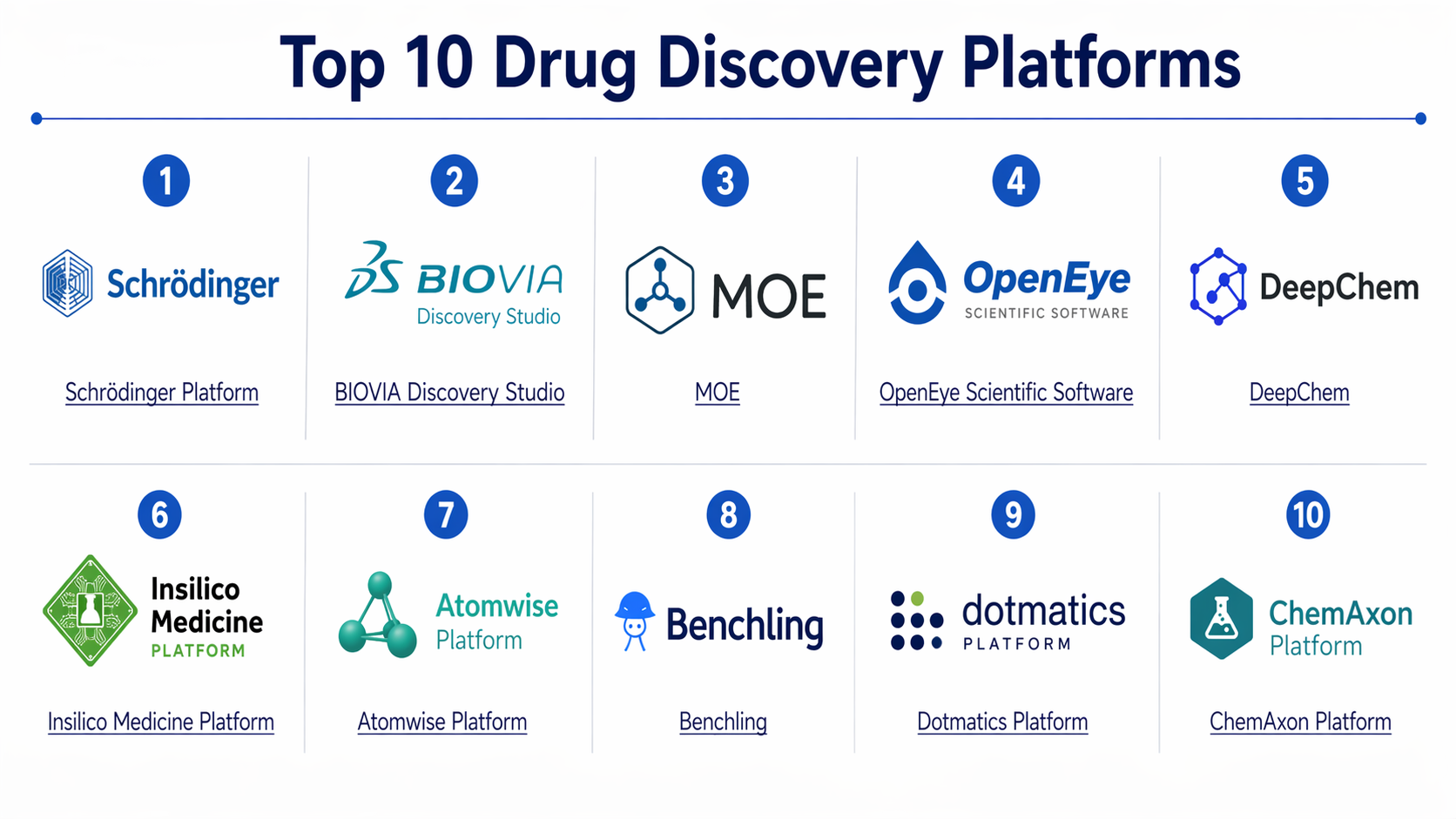
Top 10 Drug Discovery Platforms
#1 — Schrödinger Platform
Short description:
Schrödinger is a leading computational drug discovery platform known for its physics-based modeling and simulation capabilities. It is widely used by pharmaceutical companies for molecular design, docking, and predictive analytics. The platform supports both small molecule and biologics research. It combines advanced simulation with AI tools to improve drug discovery outcomes.
Key Features
- Molecular modeling and docking
- Free energy calculations
- AI-driven drug design tools
- Virtual screening workflows
- Protein structure prediction
- Advanced visualization
Pros
- High accuracy in simulations
- Widely trusted in pharma
Cons
- Expensive licensing
- Requires expertise
Platforms / Deployment
Cloud / Self-hosted
Security & Compliance
Not publicly stated
Integrations & Ecosystem
Integrates with lab systems and scientific tools
- Data platforms
- HPC environments
- APIs
Support & Community
Strong enterprise support and documentation
#2 — BIOVIA Discovery Studio
Short description:
BIOVIA Discovery Studio provides a comprehensive suite for molecular modeling and simulation. It is designed for researchers working in drug discovery and materials science. It offers a range of tools for protein modeling, ligand design, and simulation workflows.
Key Features
- Protein modeling
- Molecular dynamics simulation
- Docking and scoring
- Visualization tools
- Data analysis
Pros
- Comprehensive toolset
- Strong visualization
Cons
- Complex interface
- High cost
Platforms / Deployment
Windows / Cloud
Security & Compliance
Not publicly stated
Integrations & Ecosystem
- Scientific databases
- Lab tools
- APIs
Support & Community
Well-established support ecosystem
#3 — MOE (Molecular Operating Environment)
Short description:
MOE is a versatile drug discovery platform used for modeling, simulation, and visualization. It supports structure-based drug design and cheminformatics workflows.
Key Features
- Molecular modeling
- Docking
- QSAR modeling
- Visualization
- Simulation
Pros
- Flexible workflows
- Broad capabilities
Cons
- Steep learning curve
- UI limitations
Platforms / Deployment
Windows / Linux
Security & Compliance
Not publicly stated
Integrations & Ecosystem
- Scientific tools
- Data systems
Support & Community
Moderate support ecosystem
#4 — OpenEye Scientific Software
Short description:
OpenEye provides computational chemistry tools focused on molecular modeling and cheminformatics. It is widely used in early-stage drug discovery workflows.
Key Features
- Molecular modeling
- Cheminformatics tools
- Virtual screening
- Data analysis
Pros
- Strong algorithms
- High performance
Cons
- Requires technical expertise
- Limited UI features
Platforms / Deployment
Cloud / Linux
Security & Compliance
Not publicly stated
Integrations & Ecosystem
- APIs
- Scientific tools
Support & Community
Good technical support
#5 — DeepChem
Short description:
DeepChem is an open-source platform focused on AI-driven drug discovery. It provides machine learning tools for chemical and biological data analysis.
Key Features
- Deep learning models
- Molecular prediction
- Data pipelines
- Open-source flexibility
Pros
- Free and customizable
- Strong AI capabilities
Cons
- Requires coding skills
- Limited enterprise support
Platforms / Deployment
Linux / Cloud
Security & Compliance
Varies / N/A
Integrations & Ecosystem
- Python ecosystem
- ML frameworks
Support & Community
Active open-source community
#6 — Insilico Medicine Platform
Short description:
Insilico Medicine uses AI to accelerate drug discovery, focusing on generative models for molecule design. It is known for its AI-first approach.
Key Features
- AI molecule generation
- Target discovery
- Predictive modeling
- Automation workflows
Pros
- Cutting-edge AI
- Fast innovation
Cons
- Limited transparency
- Premium pricing
Platforms / Deployment
Cloud
Security & Compliance
Not publicly stated
Integrations & Ecosystem
- AI pipelines
- APIs
Support & Community
Enterprise-level support
#7 — Atomwise Platform
Short description:
Atomwise uses deep learning for structure-based drug discovery. It is particularly known for its virtual screening capabilities.
Key Features
- Deep learning models
- Virtual screening
- Target analysis
- Predictive modeling
Pros
- Strong AI capabilities
- Efficient screening
Cons
- Limited general-purpose features
- Requires specialized knowledge
Platforms / Deployment
Cloud
Security & Compliance
Not publicly stated
Integrations & Ecosystem
- APIs
- Research data systems
Support & Community
Moderate support
#8 — Benchling
Short description:
Benchling is a cloud-based platform for life sciences R&D, offering tools for collaboration, data management, and molecular biology workflows.
Key Features
- Data management
- Collaboration tools
- Molecular design
- Workflow tracking
Pros
- Easy collaboration
- Modern UI
Cons
- Limited deep simulation features
- Pricing concerns
Platforms / Deployment
Cloud
Security & Compliance
Encryption, RBAC; others Not publicly stated
Integrations & Ecosystem
- Lab systems
- APIs
- Data platforms
Support & Community
Strong adoption and support
#9 — Dotmatics Platform
Short description:
Dotmatics provides scientific R&D software focused on data management and analytics. It supports drug discovery workflows through integrated tools.
Key Features
- Data integration
- Analytics
- Visualization
- Workflow management
Pros
- Strong data handling
- Flexible platform
Cons
- Limited simulation capabilities
- Complex setup
Platforms / Deployment
Cloud / Hybrid
Security & Compliance
Not publicly stated
Integrations & Ecosystem
- Scientific tools
- APIs
Support & Community
Enterprise support
#10 — ChemAxon Platform
Short description:
ChemAxon provides cheminformatics tools for drug discovery, focusing on chemical data management and analysis.
Key Features
- Chemical data management
- Structure search
- Prediction tools
- Visualization
Pros
- Strong chemistry tools
- Flexible APIs
Cons
- Limited AI capabilities
- Requires expertise
Platforms / Deployment
Cloud / Self-hosted
Security & Compliance
Not publicly stated
Integrations & Ecosystem
- APIs
- Scientific systems
Support & Community
Good developer support
Comparison Table (Top 10)
| Tool Name | Best For | Platform(s) Supported | Deployment | Standout Feature | Public Rating |
|---|---|---|---|---|---|
| Schrödinger | Enterprise pharma | Web | Hybrid | Simulation accuracy | N/A |
| BIOVIA | Research labs | Windows | Cloud | Visualization | N/A |
| MOE | Modeling workflows | Windows/Linux | Local | Flexibility | N/A |
| OpenEye | Cheminformatics | Linux | Cloud | Algorithms | N/A |
| DeepChem | AI developers | Linux | Cloud | Open-source AI | N/A |
| Insilico | AI-first drug discovery | Web | Cloud | Generative AI | N/A |
| Atomwise | Virtual screening | Web | Cloud | Deep learning | N/A |
| Benchling | Collaboration | Web | Cloud | Data platform | N/A |
| Dotmatics | Data analytics | Web | Hybrid | Integration | N/A |
| ChemAxon | Chemical data | Web | Hybrid | Cheminformatics | N/A |
Evaluation & Drug Discovery Platforms
| Tool Name | Core | Ease | Integrations | Security | Performance | Support | Value | Weighted Total |
|---|---|---|---|---|---|---|---|---|
| Schrödinger | 9 | 6 | 8 | 7 | 9 | 8 | 6 | 7.9 |
| BIOVIA | 8 | 6 | 8 | 7 | 8 | 8 | 6 | 7.5 |
| MOE | 7 | 6 | 7 | 6 | 7 | 7 | 7 | 7.0 |
| OpenEye | 8 | 6 | 7 | 6 | 8 | 7 | 6 | 7.2 |
| DeepChem | 7 | 5 | 8 | 5 | 7 | 6 | 9 | 7.1 |
| Insilico | 8 | 7 | 7 | 6 | 8 | 7 | 6 | 7.3 |
| Atomwise | 7 | 6 | 6 | 6 | 8 | 6 | 6 | 6.9 |
| Benchling | 7 | 9 | 8 | 7 | 7 | 8 | 7 | 7.8 |
| Dotmatics | 7 | 7 | 8 | 7 | 7 | 7 | 7 | 7.3 |
| ChemAxon | 7 | 6 | 8 | 6 | 7 | 7 | 7 | 7.2 |
Interpretation:
These scores compare tools relative to each other. Enterprise tools score higher in core features and performance, while modern platforms like Benchling stand out in usability. Open-source tools like DeepChem score higher in value but require technical expertise.
Which Drug Discovery Platform
Solo / Freelancer
Use DeepChem or ChemAxon for flexibility and cost efficiency.
SMB
Benchling or Dotmatics for collaboration and data management.
Mid-Market
BIOVIA or MOE for balanced capabilities.
Enterprise
Schrödinger or Insilico for advanced modeling and AI.
Budget vs Premium
Budget: DeepChem
Premium: Schrödinger, BIOVIA
Feature Depth vs Ease of Use
Depth: Schrödinger
Ease: Benchling
Integrations & Scalability
Best: Dotmatics, Schrödinger
Security & Compliance Needs
Best: Benchling, BIOVIA
Frequently Asked Questions (FAQs)
1. What is a drug discovery platform?
It is software that helps researchers design and test drug candidates using computational methods.
2. How do these platforms use AI?
They use machine learning to predict molecular behavior and optimize compounds.
3. Are these platforms expensive?
Enterprise tools can be costly, while open-source options are free.
4. Can startups use them?
Yes, especially cloud-based and open-source platforms.
5. Do they replace lab experiments?
No, they complement and reduce the need for extensive lab testing.
6. How long does implementation take?
It varies from days (cloud tools) to months (enterprise systems).
7. What skills are required?
Chemistry, biology, and data science knowledge.
8. Are they secure?
Most platforms include strong security measures, though details vary.
9. Can they integrate with lab systems?
Yes, many tools support integrations.
10. How to choose the right platform?
Based on budget, scale, and research requirements.
Conclusion
Drug discovery platforms have become a critical part of modern pharmaceutical and biotech innovation. They help organizations reduce time, cost, and risk while improving the chances of finding successful drug candidates. Enterprise-grade platforms like Schrödinger and BIOVIA offer deep simulation and modeling capabilities, while newer AI-driven solutions like Insilico and Atomwise are pushing the boundaries of innovation. At the same time, tools like Benchling and Dotmatics provide strong collaboration and data management capabilities, making them suitable for growing teams. Open-source solutions like DeepChem offer flexibility for technically skilled teams. The best choice ultimately depends on your organization’s research complexity, budget, and technical capabilities.
