Introduction
Fraud prevention for e-commerce refers to software tools and platforms designed to detect, prevent, and mitigate fraudulent activities during online transactions. These tools analyze user behavior, payment data, device fingerprints, and transaction patterns to identify suspicious activities in real time. In simple terms, they act as a protective layer between your business and financial or reputational loss.
With the rapid growth of online shopping, fraud tactics have also become more sophisticated. From account takeovers and payment fraud to refund abuse and bot attacks, e-commerce businesses must proactively defend their platforms. Modern fraud prevention tools use AI, machine learning, and behavioral analytics to stay ahead of evolving threats while minimizing false positives.
Common use cases include:
- Preventing payment fraud and chargebacks
- Detecting account takeovers and bot attacks
- Monitoring suspicious login behavior
- Managing refund and return fraud
- Securing digital wallets and payment gateways
What buyers should evaluate:
- Real-time fraud detection capabilities
- Machine learning and AI accuracy
- Integration with payment gateways and platforms
- Custom rule engines and automation
- False positive rate management
- Reporting and analytics depth
- Scalability and performance under high traffic
- Compliance and data security standards
- Global coverage and multi-currency support
Best for: E-commerce platforms, marketplaces, fintech companies, subscription businesses, and digital service providers handling high transaction volumes.
Not ideal for: Small businesses with minimal transaction volume or those using basic payment gateway protections without significant fraud exposure.
Key Trends in Fraud Prevention for E-commerce Tools
- AI-driven fraud detection: Advanced machine learning models for predictive risk scoring
- Behavioral biometrics: Tracking user interactions like typing speed and mouse movement
- Device fingerprinting: Identifying users based on device-level characteristics
- Real-time decision engines: Instant approval or rejection of transactions
- Adaptive authentication: Dynamic security measures based on risk levels
- Global fraud intelligence networks: Shared fraud data across platforms
- Bot detection and mitigation: Protecting against automated attacks
- API-first architecture: Easy integration into modern e-commerce stacks
- Regulatory compliance focus: GDPR and data privacy alignment
- Chargeback management automation: Reducing financial losses and disputes
How We Selected These Tools (Methodology)
- Evaluated market adoption and industry recognition
- Assessed accuracy of fraud detection models
- Reviewed real-time processing capabilities
- Considered security posture and compliance readiness
- Analyzed integration ecosystems with e-commerce and payment systems
- Included tools for SMB, mid-market, and enterprise users
- Focused on AI and automation capabilities
- Considered ease of deployment and scalability
- Evaluated customer support and onboarding experience
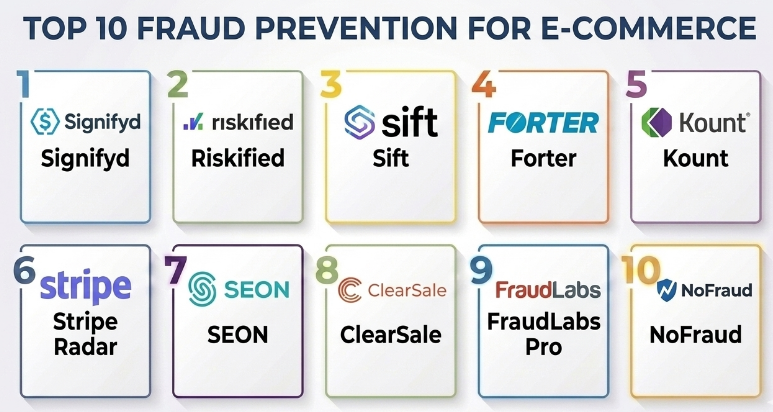
Top 10 Fraud Prevention for E-commerce Tools
#1 — Signifyd
Short description (5-6 lines):
Signifyd is an enterprise-grade fraud protection platform designed for e-commerce merchants. It uses machine learning and global commerce data to assess transaction risk and provides financial guarantees against fraud-related chargebacks.
Key Features
- AI-powered fraud detection
- Chargeback guarantee model
- Real-time transaction scoring
- Global fraud intelligence network
- Automated decision engine
- Order fulfillment protection
Pros
- Financial protection against chargebacks
- High accuracy with AI models
Cons
- Premium pricing
- May require integration effort
Platforms / Deployment
Cloud
Security & Compliance
Encryption, risk scoring; certifications not publicly stated
Integrations & Ecosystem
Integrates with major e-commerce platforms and payment providers.
- Shopify
- Magento
- Payment gateways
- Order management systems
Support & Community
Strong enterprise support and onboarding
#2 — Riskified
Short description (5-6 lines):
Riskified helps online retailers prevent fraud and maximize revenue by approving more legitimate transactions. It combines AI with a global merchant network to improve accuracy.
Key Features
- AI-driven fraud detection
- Chargeback protection
- Revenue optimization
- Behavioral analysis
- Real-time decisions
Pros
- High approval rates
- Strong global data network
Cons
- Enterprise-focused
- Pricing not transparent
Platforms / Deployment
Cloud
Security & Compliance
Not publicly stated
Integrations & Ecosystem
- E-commerce platforms
- Payment systems
- CRM tools
Support & Community
Enterprise-level support
#3 — Sift
Short description (5-6 lines):
Sift is a digital trust platform offering fraud prevention across payments, accounts, and content. It uses machine learning and real-time data analysis.
Key Features
- Machine learning fraud detection
- Account takeover protection
- Payment fraud prevention
- Content abuse detection
- Real-time risk scoring
Pros
- Multi-use case platform
- Strong analytics
Cons
- Complex setup
- Requires technical expertise
Platforms / Deployment
Cloud
Security & Compliance
RBAC, encryption; other details not publicly stated
Integrations & Ecosystem
- APIs
- Payment gateways
- CRM systems
Support & Community
Strong documentation and enterprise support
#4 — Forter
Short description (5-6 lines):
Forter provides fraud prevention using identity-based intelligence. It focuses on reducing friction while improving approval rates.
Key Features
- Identity-based fraud detection
- Real-time decisions
- Chargeback protection
- Bot detection
- Global data network
Pros
- Low false positives
- Seamless customer experience
Cons
- Premium pricing
- Limited SMB focus
Platforms / Deployment
Cloud
Security & Compliance
Not publicly stated
Integrations & Ecosystem
- Payment gateways
- E-commerce platforms
- APIs
Support & Community
Enterprise-grade support
#5 — Kount
Short description (5-6 lines):
Kount offers AI-driven fraud prevention with a strong focus on identity trust and omnichannel protection.
Key Features
- Identity-based fraud scoring
- AI risk analysis
- Omnichannel protection
- Chargeback management
- Device fingerprinting
Pros
- Strong identity intelligence
- Flexible configuration
Cons
- Complex pricing
- Requires setup effort
Platforms / Deployment
Cloud
Security & Compliance
Not publicly stated
Integrations & Ecosystem
- Payment processors
- POS systems
- APIs
Support & Community
Good enterprise support
#6 — Stripe Radar
Short description (5-6 lines):
Stripe Radar is built into the Stripe ecosystem and uses machine learning to detect fraud in payments.
Key Features
- Real-time fraud detection
- Custom rules engine
- AI-based risk scoring
- Integration with Stripe payments
- Dashboard analytics
Pros
- Easy to use
- Seamless Stripe integration
Cons
- Limited outside Stripe ecosystem
- Less customizable for advanced needs
Platforms / Deployment
Cloud
Security & Compliance
Encryption; other details not publicly stated
Integrations & Ecosystem
- Stripe payments
- APIs
- E-commerce tools
Support & Community
Strong documentation and support
#7 — SEON
Short description (5-6 lines):
SEON provides fraud detection using digital footprint analysis and device intelligence.
Key Features
- Device fingerprinting
- Email and phone analysis
- Custom rules engine
- API integration
- Real-time scoring
Pros
- Flexible and customizable
- Transparent pricing
Cons
- Requires tuning
- Limited enterprise features
Platforms / Deployment
Cloud
Security & Compliance
Not publicly stated
Integrations & Ecosystem
- APIs
- Payment systems
- CRM tools
Support & Community
Good support and documentation
#8 — ClearSale
Short description (5-6 lines):
ClearSale combines AI and human analysis to detect fraud and reduce chargebacks.
Key Features
- Hybrid AI + human review
- Chargeback protection
- Fraud scoring
- Real-time decisions
- Reporting
Pros
- Human review adds accuracy
- Strong fraud detection
Cons
- Slower decisions in some cases
- Higher cost
Platforms / Deployment
Cloud
Security & Compliance
Not publicly stated
Integrations & Ecosystem
- E-commerce platforms
- Payment gateways
Support & Community
Strong support services
#9 — FraudLabs Pro
Short description (5-6 lines):
FraudLabs Pro is a cost-effective fraud prevention tool for SMBs, offering real-time screening and validation.
Key Features
- IP geolocation
- Device fingerprinting
- Fraud scoring
- Blacklist database
- API integration
Pros
- Affordable
- Easy to implement
Cons
- Limited advanced features
- Smaller data network
Platforms / Deployment
Cloud
Security & Compliance
Not publicly stated
Integrations & Ecosystem
- APIs
- Payment systems
Support & Community
Basic support
#10 — NoFraud
Short description (5-6 lines):
NoFraud provides automated fraud detection with a focus on reducing false declines and chargebacks.
Key Features
- Real-time transaction analysis
- Fraud detection algorithms
- Chargeback protection
- Reporting tools
Pros
- Easy onboarding
- Good accuracy
Cons
- Limited customization
- Smaller ecosystem
Platforms / Deployment
Cloud
Security & Compliance
Not publicly stated
Integrations & Ecosystem
- E-commerce platforms
- Payment gateways
Support & Community
Good SMB-focused support
Comparison Table (Top 10)
| Tool Name | Best For | Platform(s) Supported | Deployment | Standout Feature | Public Rating |
|---|---|---|---|---|---|
| Signifyd | Enterprise | Web | Cloud | Chargeback guarantee | N/A |
| Riskified | Enterprise | Web | Cloud | Revenue optimization | N/A |
| Sift | Mid-market | Web | Cloud | Multi-use fraud detection | N/A |
| Forter | Enterprise | Web | Cloud | Identity-based intelligence | N/A |
| Kount | Enterprise | Web | Cloud | Identity trust network | N/A |
| Stripe Radar | SMB | Web | Cloud | Native Stripe integration | N/A |
| SEON | SMB | Web | Cloud | Device intelligence | N/A |
| ClearSale | Enterprise | Web | Cloud | AI + human review | N/A |
| FraudLabs Pro | SMB | Web | Cloud | Cost-effective screening | N/A |
| NoFraud | SMB | Web | Cloud | Low false declines | N/A |
Evaluation & Scoring of Fraud Prevention for E-commerce Tools
| Tool Name | Core (25%) | Ease (15%) | Integrations (15%) | Security (10%) | Performance (10%) | Support (10%) | Value (15%) | Weighted Total |
|---|---|---|---|---|---|---|---|---|
| Signifyd | 9 | 7 | 8 | 8 | 9 | 8 | 7 | 8.2 |
| Riskified | 9 | 7 | 8 | 8 | 9 | 8 | 7 | 8.2 |
| Sift | 9 | 6 | 9 | 8 | 8 | 8 | 7 | 8.1 |
| Forter | 9 | 7 | 8 | 8 | 9 | 8 | 7 | 8.2 |
| Kount | 8 | 6 | 8 | 8 | 8 | 7 | 7 | 7.8 |
| Stripe Radar | 7 | 9 | 7 | 7 | 8 | 8 | 8 | 7.9 |
| SEON | 7 | 8 | 7 | 7 | 7 | 7 | 8 | 7.5 |
| ClearSale | 8 | 7 | 7 | 7 | 8 | 8 | 7 | 7.8 |
| FraudLabs Pro | 6 | 9 | 6 | 6 | 7 | 6 | 9 | 7.2 |
| NoFraud | 7 | 8 | 6 | 6 | 7 | 7 | 8 | 7.3 |
How to interpret:
These scores are relative comparisons across tools. A higher score reflects better balance across features, usability, and value—but the “best” choice depends on your business model and fraud risk profile.
Which Fraud Prevention for E-commerce Tools
Solo / Freelancer
Use FraudLabs Pro or SEON for affordability and simplicity.
SMB
Stripe Radar and NoFraud provide good balance between cost and protection.
Mid-Market
Sift and SEON offer flexibility and customization.
Enterprise
Signifyd, Riskified, and Forter are best for scale and advanced fraud detection.
Budget vs Premium
- Budget: FraudLabs Pro, SEON
- Premium: Signifyd, Riskified
Feature Depth vs Ease of Use
- Easy: Stripe Radar
- Advanced: Sift, Forter
Integrations & Scalability
- High scalability: Riskified, Signifyd
- Moderate: Stripe Radar
Security & Compliance Needs
- Enterprise-grade: Forter, Sift
- Basic: FraudLabs Pro
Frequently Asked Questions (FAQs)
1. What is fraud prevention in e-commerce?
It involves tools and strategies to detect and stop fraudulent transactions and activities.
2. How do fraud detection tools work?
They use AI, rules engines, and behavioral analysis to identify suspicious activity.
3. Are these tools expensive?
Pricing varies widely depending on features and transaction volume.
4. Can fraud tools reduce chargebacks?
Yes, many tools provide chargeback protection or reduction strategies.
5. Do they affect customer experience?
Good tools minimize friction while blocking fraud.
6. Can small businesses use these tools?
Yes, many tools offer SMB-friendly pricing and features.
7. Are they compatible with all payment gateways?
Most tools integrate with popular payment providers.
8. How long does setup take?
From a few hours for simple tools to weeks for enterprise platforms.
9. Can I customize fraud rules?
Yes, most platforms allow rule customization.
10. What are common mistakes?
Ignoring false positives and not updating fraud rules regularly.
Conclusion
Fraud prevention for e-commerce is no longer optional—it is a core requirement for protecting revenue, maintaining customer trust, and ensuring long-term business sustainability. As fraud tactics become more advanced, businesses must rely on intelligent, scalable tools that combine AI, behavioral analytics, and real-time decision-making. However, the “best” solution depends entirely on your size, transaction volume, and risk exposure. SMBs may benefit from simple, cost-effective tools, while enterprises require advanced, global intelligence platforms. The smartest approach is to shortlist a few tools, test them with real transaction data, and validate how well they balance fraud detection accuracy with customer experience before making a final decision.
