Introduction
Deception technology tools are cybersecurity solutions designed to detect attackers early by placing fake assets, decoys, credentials, and traps inside IT environments. These tools work on a simple idea: if someone interacts with something that should not exist or be accessed, it is very likely malicious activity.
This approach has become increasingly important as attackers use stealth techniques, credential theft, and lateral movement to bypass traditional defenses like firewalls and antivirus. Deception tools provide high-confidence alerts because legitimate users should never interact with these fake elements.
Common real-world use cases include:
- Detecting lateral movement inside enterprise networks
- Identifying credential misuse and privilege escalation
- Catching ransomware activity in early stages
- Monitoring insider threats and suspicious behavior
- Protecting cloud workloads and identity systems
When evaluating deception tools, buyers should consider:
- Realism and variety of decoys
- Deployment complexity and maintenance effort
- Coverage across endpoint, identity, cloud, and network
- Integration with SIEM, SOAR, and XDR
- Alert accuracy and false-positive rates
- Scalability across large environments
- Automation capabilities
- Cost and licensing model
- Vendor support and documentation
Best for: security teams in mid-sized and large organizations, SOC teams, MSSPs, and industries like finance, healthcare, and SaaS where early threat detection is critical.
Not ideal for: very small businesses, low-risk environments, or teams that only need basic monitoring rather than advanced threat detection.
Key Trends in Deception Technology Tools
- Shift toward identity-based deception targeting Active Directory and IAM attacks
- Increased use of AI-driven decoy generation for realistic environments
- Growth of cloud-native deception using API-based honeytokens
- Integration with XDR, SIEM, and SOAR platforms for automated response
- Focus on high-fidelity alerts to reduce alert fatigue
- Expansion into endpoint-level deception breadcrumbs
- Emergence of GenAI and API-level decoys
- Adoption of agentless deployment models
- Greater emphasis on zero trust architecture alignment
- Flexible pricing models for SMB and enterprise segmentation
How We Selected These Tools (Methodology)
- Included tools with strong market recognition and adoption
- Prioritized platforms with comprehensive deception capabilities
- Evaluated tools based on real-world usability and operational fit
- Considered integration capabilities with modern security stacks
- Looked for balance across enterprise, mid-market, and lightweight solutions
- Focused on tools offering identity, endpoint, and cloud deception
- Avoided niche or outdated products with limited relevance
- Ensured each tool provides practical value beyond basic honeypots
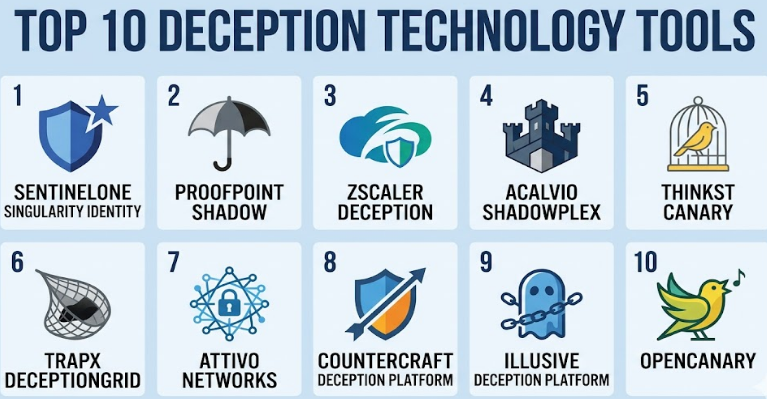
Top 10 Deception Technology Tools
#1 — SentinelOne Singularity Identity
Short description: A modern identity-focused security platform that uses deception techniques to detect credential misuse and identity-based attacks. Best suited for enterprises prioritizing identity security.
Key Features
- Identity-based deception mechanisms
- Detection of credential theft and misuse
- Automated threat response workflows
- Integration with broader endpoint security platform
- Real-time alerting on suspicious identity activity
Pros
- Strong identity-centric security approach
- Integrates well with modern SOC workflows
- Good for detecting lateral movement
Cons
- May be complex for smaller teams
- Best value when used with full platform
- Limited standalone usage visibility
Platforms / Deployment
Cloud / Hybrid
Security & Compliance
Not publicly stated
Integrations & Ecosystem
Designed to work within a broader security platform ecosystem.
- Endpoint security tools
- Identity systems
- SIEM and XDR platforms
Support & Community
Enterprise-grade support with structured onboarding. Community presence is moderate.
#2 — Proofpoint Shadow
Short description: A deception-based identity threat detection tool focused on stopping lateral movement and privilege misuse inside enterprise environments.
Key Features
- Endpoint-based deception paths
- Identity threat detection
- Automated attack detection workflows
- Agentless monitoring capabilities
- Attack path analysis
Pros
- Strong identity threat detection
- Useful for enterprise environments
- Low false positives
Cons
- Requires integration with broader stack
- Less useful as a standalone tool
- Limited public technical detail
Platforms / Deployment
Varies / N/A
Security & Compliance
Not publicly stated
Integrations & Ecosystem
- Identity security platforms
- SIEM tools
- SOAR systems
Support & Community
Primarily enterprise-focused support with limited community resources.
#3 — Zscaler Deception
Short description: A full-featured deception platform integrated into a zero trust ecosystem, covering endpoints, cloud, and network environments.
Key Features
- Endpoint and cloud deception
- AI-based decoy generation
- GenAI and API-level deception
- Identity and network attack detection
- Threat intelligence integration
Pros
- Broad coverage across environments
- Strong integration with zero trust architecture
- Advanced AI capabilities
Cons
- May be complex to deploy
- Premium pricing
- Overkill for smaller environments
Platforms / Deployment
Cloud / Hybrid
Security & Compliance
Not publicly stated
Integrations & Ecosystem
- Zero trust frameworks
- Cloud security platforms
- Endpoint agents
Support & Community
Strong enterprise support with detailed documentation.
#4 — Acalvio ShadowPlex
Short description: A dedicated deception platform offering cloud-native and enterprise-grade threat detection through decoys and honeytokens.
Key Features
- Multi-cloud deception
- Agentless deployment
- Honeytoken support
- Real-time threat intelligence
- Integration with SOC tools
Pros
- Strong cloud capabilities
- Flexible deployment
- Good integration options
Cons
- Less known compared to larger vendors
- Requires SOC maturity
- Limited public compliance detail
Platforms / Deployment
Cloud / Hybrid
Security & Compliance
Not publicly stated
Integrations & Ecosystem
- SIEM
- SOAR
- Cloud platforms
Support & Community
Enterprise support available; community presence is limited.
#5 — Thinkst Canary
Short description: A practical and widely adopted deception solution focused on simple deployment and high-quality alerts using canary devices and tokens.
Key Features
- Canary devices and tokens
- Service emulation
- Cloud management console
- Easy deployment
- Real-time alerting
Pros
- Simple and fast to deploy
- High signal-to-noise ratio
- Strong usability
Cons
- Limited advanced automation
- Not a full platform solution
- Basic compared to enterprise tools
Platforms / Deployment
Hybrid
Security & Compliance
Not publicly stated
Integrations & Ecosystem
- Alerting tools
- Cloud services
- Security monitoring systems
Support & Community
Strong community presence and good documentation.
#6 — TrapX DeceptionGrid
Short description: An enterprise deception platform designed to detect advanced threats and insider attacks using automated decoy systems.
Key Features
- Automated decoy deployment
- Endpoint and network deception
- Threat intelligence integration
- Behavioral analysis
- Attack visualization
Pros
- Enterprise-ready features
- Strong automation
- Good for large networks
Cons
- Complex deployment
- Requires skilled teams
- Limited SMB fit
Platforms / Deployment
Cloud / On-premises
Security & Compliance
Not publicly stated
Integrations & Ecosystem
- SIEM
- Threat intelligence platforms
- SOC tools
Support & Community
Enterprise support with structured onboarding.
#7 — Attivo Networks (SentinelOne Identity Security)
Short description: A deception-driven identity security platform focused on protecting Active Directory and detecting credential-based attacks.
Key Features
- AD protection
- Identity deception
- Threat detection automation
- Privilege monitoring
- Attack path visibility
Pros
- Strong AD security capabilities
- Effective for lateral movement detection
- Enterprise-ready
Cons
- Specialized use case
- Requires integration
- Limited SMB use
Platforms / Deployment
Hybrid
Security & Compliance
Not publicly stated
Integrations & Ecosystem
- Identity systems
- Endpoint security
- SIEM
Support & Community
Enterprise-level support.
#8 — CounterCraft Deception Platform
Short description: A cyber deception platform focused on threat intelligence and attacker engagement using realistic decoy environments.
Key Features
- Threat intelligence collection
- Realistic attacker environments
- Advanced deception campaigns
- Customizable decoys
- Attack tracking
Pros
- Strong intelligence capabilities
- Highly customizable
- Good for advanced use cases
Cons
- Complex setup
- Not beginner-friendly
- Requires expertise
Platforms / Deployment
Cloud / Hybrid
Security & Compliance
Not publicly stated
Integrations & Ecosystem
- Threat intelligence systems
- SIEM
- SOC tools
Support & Community
Specialized support; smaller community.
#9 — Illusive Deception Platform
Short description: A deception platform focused on identity protection and endpoint deception to detect credential abuse.
Key Features
- Endpoint deception
- Identity protection
- Automated deployment
- Attack path mapping
- Credential exposure detection
Pros
- Strong identity protection
- Good automation
- High detection accuracy
Cons
- Less flexible outside identity use cases
- Enterprise-focused
- Limited public info
Platforms / Deployment
Hybrid
Security & Compliance
Not publicly stated
Integrations & Ecosystem
- Identity tools
- SIEM
- Endpoint security
Support & Community
Enterprise-focused support.
#10 — OpenCanary
Short description: An open-source deception tool that provides basic honeypot capabilities for small teams and testing environments.
Key Features
- Open-source honeypot
- Lightweight deployment
- Multiple service emulation
- Simple alerting
- Customizable configuration
Pros
- Free and flexible
- Easy to deploy
- Good for learning and testing
Cons
- Limited enterprise features
- No advanced automation
- Requires manual management
Platforms / Deployment
Linux / Self-hosted
Security & Compliance
Not publicly stated
Integrations & Ecosystem
- Logging systems
- Basic monitoring tools
Support & Community
Community-driven support with open-source contributors.
Comparison Table (Top 10)
| Tool Name | Best For | Platform(s) Supported | Deployment | Standout Feature | Public Rating |
|---|---|---|---|---|---|
| SentinelOne Singularity Identity | Enterprise identity security | Cloud | Hybrid | Identity deception | N/A |
| Proofpoint Shadow | Identity threat detection | N/A | N/A | Endpoint deception paths | N/A |
| Zscaler Deception | Zero trust environments | Cloud | Hybrid | AI-powered decoys | N/A |
| Acalvio ShadowPlex | Cloud deception | Cloud | Hybrid | Honeytokens | N/A |
| Thinkst Canary | SMB & mid-market | Hybrid | Hybrid | Canary tokens | N/A |
| TrapX DeceptionGrid | Large enterprises | Multi-platform | Hybrid | Automated decoys | N/A |
| Attivo Networks | AD security | Hybrid | Hybrid | Identity protection | N/A |
| CounterCraft | Threat intelligence | Cloud | Hybrid | Custom decoys | N/A |
| Illusive | Identity-focused teams | Hybrid | Hybrid | Endpoint deception | N/A |
| OpenCanary | Small teams | Linux | Self-hosted | Open-source honeypot | N/A |
Evaluation & Scoring of Deception Technology Tools
| Tool Name | Core (25%) | Ease (15%) | Integrations (15%) | Security (10%) | Performance (10%) | Support (10%) | Value (15%) | Weighted Total |
|---|---|---|---|---|---|---|---|---|
| SentinelOne | 9 | 7 | 9 | 8 | 9 | 8 | 7 | 8.3 |
| Proofpoint | 8 | 7 | 8 | 8 | 8 | 8 | 7 | 7.9 |
| Zscaler | 9 | 7 | 9 | 9 | 9 | 8 | 7 | 8.5 |
| Acalvio | 8 | 7 | 8 | 8 | 8 | 7 | 7 | 7.8 |
| Thinkst Canary | 7 | 9 | 7 | 7 | 8 | 8 | 9 | 8.0 |
| TrapX | 8 | 6 | 8 | 8 | 8 | 7 | 7 | 7.6 |
| Attivo | 8 | 7 | 8 | 8 | 8 | 7 | 7 | 7.8 |
| CounterCraft | 8 | 6 | 7 | 8 | 7 | 7 | 6 | 7.3 |
| Illusive | 8 | 7 | 8 | 8 | 8 | 7 | 7 | 7.8 |
| OpenCanary | 6 | 8 | 5 | 6 | 6 | 6 | 10 | 6.9 |
How to interpret:
- Scores are comparative, not absolute
- Higher scores indicate stronger overall capability
- Weighting reflects enterprise priorities
- Value score reflects cost vs capability
- Ease score reflects deployment and usability
Which Deception Technology Tool Is Right for You?
Solo / Freelancer
OpenCanary or Thinkst Canary are practical and simple.
SMB
Thinkst Canary or Acalvio provide balance between ease and capability.
Mid-Market
Acalvio, Illusive, and TrapX offer strong features without full enterprise complexity.
Enterprise
Zscaler, SentinelOne, and Proofpoint provide full-scale security integration.
Budget vs Premium
- Budget: OpenCanary
- Mid-range: Thinkst Canary
- Premium: Zscaler, SentinelOne
Feature Depth vs Ease of Use
- Easy: Thinkst Canary
- Balanced: Acalvio
- Advanced: Zscaler
Integrations & Scalability
Enterprise platforms offer best scalability and integration.
Security & Compliance Needs
Larger vendors typically align better with compliance requirements.
Frequently Asked Questions (FAQs)
What is deception technology?
It is a security approach that uses fake assets to detect attackers early.
Is it better than traditional security tools?
It complements them rather than replacing them.
How difficult is deployment?
Varies from simple (OpenCanary) to complex (enterprise platforms).
Does it generate false positives?
Usually low, because interactions with decoys are suspicious by nature.
Is it suitable for cloud environments?
Yes, many tools now support cloud-native deception.
Can it detect insider threats?
Yes, especially when insiders access decoy data.
What are honeytokens?
Fake credentials or data used to detect unauthorized access.
How does it integrate with SIEM?
Most tools send alerts to SIEM platforms.
Is it expensive?
Ranges from free tools to enterprise pricing.
Can small businesses use it?
Yes, but simpler tools are more suitable.
Conclusion
Deception technology has evolved from simple honeypots into a powerful layer of modern cybersecurity. It helps organizations detect threats earlier, reduce alert noise, and gain visibility into attacker behavior. However, the right tool depends on your environment, team maturity, and security goals.
Instead of choosing a single “best” solution, the smarter approach is to shortlist a few tools that match your scale and requirements. Test them in a controlled environment, validate how they integrate with your existing systems, and evaluate the quality of alerts and ease of operation. This hands-on validation will help you choose a solution that delivers real value rather than just adding another layer of complexity.
